

CACHE MEMORY
PRESENTED BY:
2014-UETR-CS-25
WHAT WE NEED?
 What we would prefer in our Computer Memory:
 Fast
 Large
 Cheap
However,
Very Fast memory = Very expensive memory
Since we need large capacity ( today multi-
gigabyte memories) we need to build a system that
is the best compromise to keep the total $$
reasonable.
WHY WE NEED CACHE MEMORY?
Due to increasing the size of main memory day by
day the system’s speed make reduce .
So, Mr. Maurice Wilkes developed a memory
(which is communicating between processor and
main memory) in 1970’s.
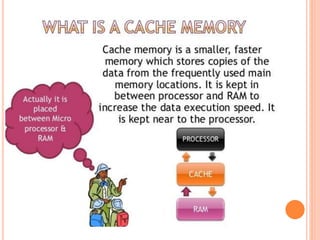
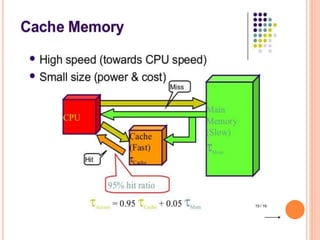
A cache used by (CPU) of a computer to reduce
the average time to access data from the main
memory.
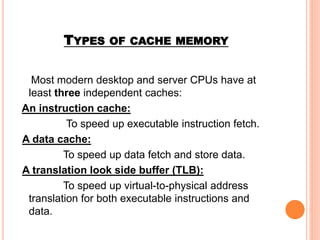
TYPES OF CACHE MEMORY
Most modern desktop and server CPUs have at
least three independent caches:
An instruction cache:
To speed up executable instruction fetch.
A data cache:
To speed up data fetch and store data.
A translation look side buffer (TLB):
To speed up virtual-to-physical address
translation for both executable instructions and
data.
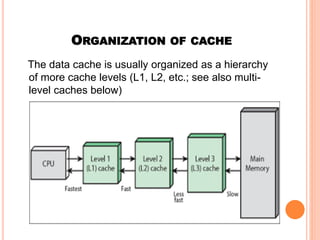
ORGANIZATION OF CACHE
The data cache is usually organized as a hierarchy
of more cache levels (L1, L2, etc.; see also multi-
level caches below)
TRANSFORMATION OF CACHE
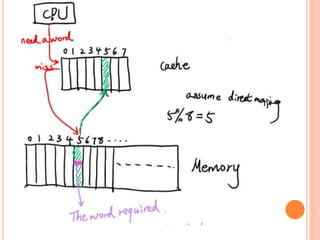
Data is transferred between memory and cache in
blocks of fixed size, called cache lines. When a
cache line is copied from memory into the cache, a
cache entry is created. The cache entry will include
the copied data as well as the requested memory
location (now called a tag).
Note:
Cache memory width is equal to the data bus
width.
Cache memory
Cache memory
Cache memory

Cache memory

  • 1.
  • 3.
    WHAT WE NEED? What we would prefer in our Computer Memory:  Fast  Large  Cheap However, Very Fast memory = Very expensive memory Since we need large capacity ( today multi- gigabyte memories) we need to build a system that is the best compromise to keep the total $$ reasonable.
  • 4.
    WHY WE NEEDCACHE MEMORY? Due to increasing the size of main memory day by day the system’s speed make reduce . So, Mr. Maurice Wilkes developed a memory (which is communicating between processor and main memory) in 1970’s. A cache used by (CPU) of a computer to reduce the average time to access data from the main memory.
  • 6.
    TYPES OF CACHEMEMORY Most modern desktop and server CPUs have at least three independent caches: An instruction cache: To speed up executable instruction fetch. A data cache: To speed up data fetch and store data. A translation look side buffer (TLB): To speed up virtual-to-physical address translation for both executable instructions and data.
  • 7.
    ORGANIZATION OF CACHE Thedata cache is usually organized as a hierarchy of more cache levels (L1, L2, etc.; see also multi- level caches below)
  • 8.
    TRANSFORMATION OF CACHE Datais transferred between memory and cache in blocks of fixed size, called cache lines. When a cache line is copied from memory into the cache, a cache entry is created. The cache entry will include the copied data as well as the requested memory location (now called a tag). Note: Cache memory width is equal to the data bus width.