1
Lecture-2 Recap Lecture-1
Introduction to the course title, Formal and In-
formal languages, Alphabets, Strings, Null
string, Words, Valid and In-valid alphabets,
length of a string, Reverse of a string, Defining
languages, Descriptive definition of languages,
EQUAL, EVEN-EVEN, INTEGER, EVEN, { an
bn
},
{ an
bn
an
}, factorial, FACTORIAL,
DOUBLEFACTORIAL, SQUARE,
DOUBLESQUARE, PRIME, PALINDROME.
2
Task
Q) Prove that there are as many palindromes
of length 2n, defined over Σ = {a,b,c}, as
there are of length 2n-1, n = 1,2,3… .
Determine the number of palindromes of
length 2n defined over the same alphabet as
well.
3
Solution
To calculate the number of palindromes
of length(2n), consider the following
diagram,
4
which shows that there are as many
palindromes of length 2n as there are the strings
of length n i.e. the required number of
palindromes are 3n
(as there are three letters in
the given alphabet, so the number of strings of
length n will be 3n
).
5
To calculate the number of palindromes
of length (2n-1) with a as the middle
letter, consider the following diagram,
6
which shows that there are as many
palindromes of length 2n-1, with a as middle
letter, as there are the strings of length n-1, i.e.
the required number of palindromes are 3n-1
.
Similarly the number of palindromes of length
2n-1, with b or c as middle letter, will be 3n-1
as
well. Hence the total number of palindromes of
length 2n-1 will be 3n-1
+ 3n-1
+ 3n-1
= 3 (3n-1
)= 3n
.
7
Kleene Star Closure
Given Σ, then the Kleene Star Closure of the
alphabet Σ, denoted by Σ*, is the collection of
all strings defined over Σ, including Λ.
It is to be noted that Kleene Star Closure can
be defined over any set of strings.
8
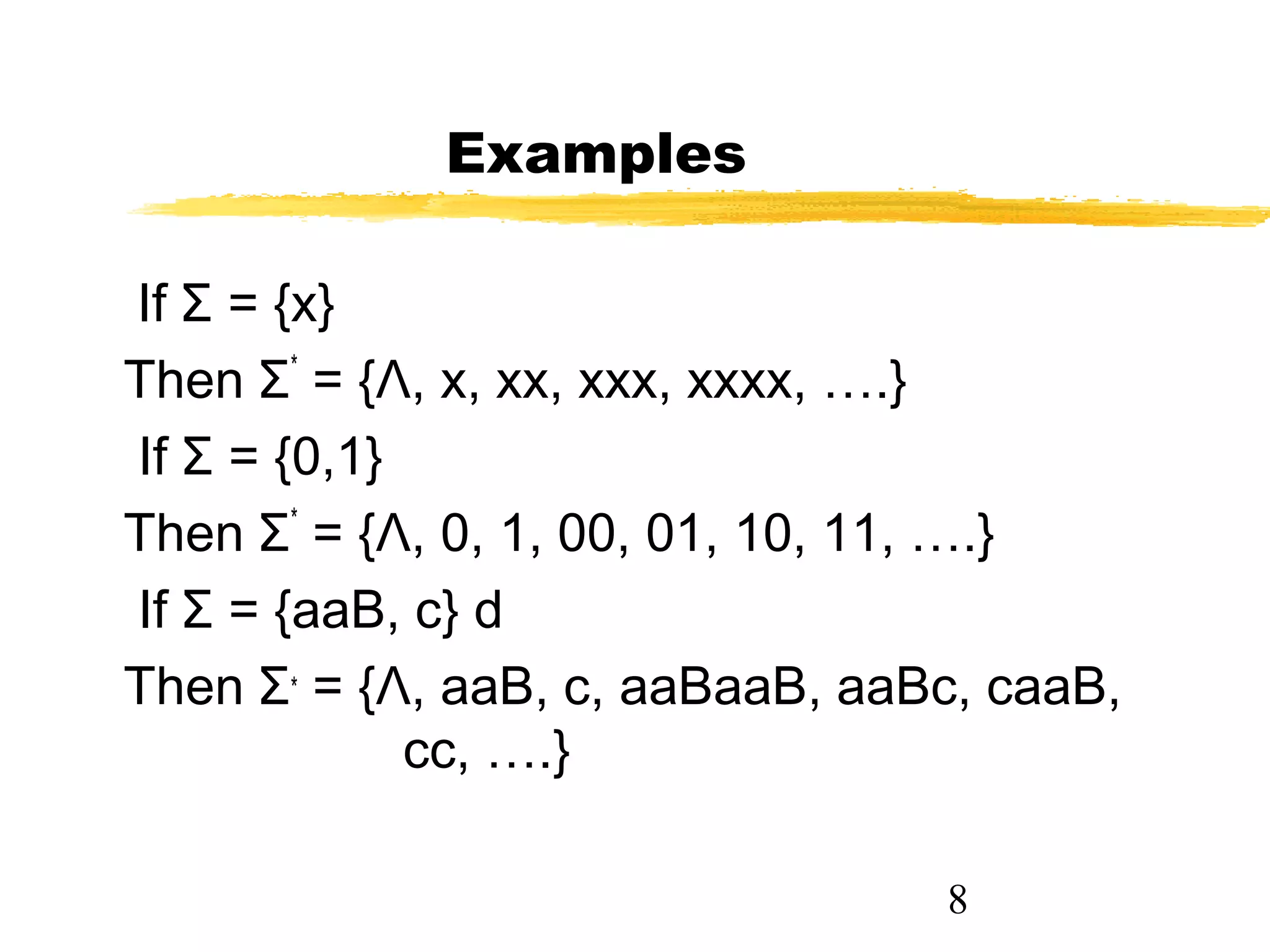
Examples
If Σ = {x}
Then Σ*
= {Λ, x, xx, xxx, xxxx, ….}
If Σ = {0,1}
Then Σ*
= {Λ, 0, 1, 00, 01, 10, 11, ….}
If Σ = {aaB, c} d
Then Σ* = {Λ, aaB, c, aaBaaB, aaBc, caaB,
cc, ….}
9
Note
Languages generated by Kleene Star
Closure of set of strings, are infinite
languages. (By infinite language, it is
supposed that the language contains infinite
many words, each of finite length).
10
Task
Q)
1) Let S={ab, bb} and T={ab, bb, bbbb} Show
that S*
= T*
[Hint S*
 T*
and T*
 S*
]
2) Let S={ab, bb} and T={ab, bb, bbb} Show
that S*
≠ T*
But S*
⊂ T*
3) Let S={a, bb, bab, abaab} be a set of strings.
Are abbabaabab and baabbbabbaabb in S*
?
Does any word in S*
have odd number of
b’s?
11
PLUS Operation (+
)
Plus Operation is same as Kleene Star Closure
except that it does not generate Λ (null string),
automatically.
Example:
If Σ = {0,1}
Then Σ+
= {0, 1, 00, 01, 10, 11, ….}
If Σ = {aab, c}
Then Σ+
= {aab, c, aabaab, aabc, caab, cc, ….}
12
TASK
Q1)Is there any case when S+
contains Λ? If
yes then justify your answer.
Q2) Prove that for any set of strings S
i. (S+
)*
=(S*
)*
ii. (S+
)+
=S+
iii. Is (S*
)+
=(S+
)*
13
Remark
It is to be noted that Kleene Star can also be
operated on any string i.e. a*
can be considered
to be all possible strings defined over {a}, which
shows that a*
generates
Λ, a, aa, aaa, …
It may also be noted that a+
can be considered to
be all possible non empty strings defined over
{a}, which shows that a+
generates
a, aa, aaa, aaaa, …
14
Defining Languages Continued…
Recursive definition of languages
The following three steps are used in recursive
definition
1. Some basic words are specified in the
language.
2. Rules for constructing more words are defined
in the language.
3. No strings except those constructed in above,
are allowed to be in the language.
15
Example
Defining language of INTEGER
Step 1:
1 is in INTEGER.
Step 2:
If x is in INTEGER then x+1 and x-1 are
also in INTEGER.
Step 3:
No strings except those constructed in
above, are allowed to be in INTEGER.
16
Example
Defining language of EVEN
Step 1:
2 is in EVEN.
Step 2:
If x is in EVEN then x+2 and x-2 are also in
EVEN.
Step 3:
No strings except those constructed in above,
are allowed to be in EVEN.
17
Example
Defining the language factorial
Step 1:
As 0!=1, so 1 is in factorial.
Step 2:
n!=n*(n-1)! is in factorial.
Step 3:
No strings except those constructed in above,
are allowed to be in factorial.
18
Defining the language PALINDROME,
defined over Σ = {a,b}
Step 1:
a and b are in PALINDROME
Step 2:
if x is palindrome, then s(x)Rev(s) and xx will
also be palindrome, where s belongs to Σ*
Step 3:
No strings except those constructed in
above, are allowed to be in palindrome
19
Defining the language {an
bn
}, n=1,2,3,… ,
of strings defined over Σ={a,b}
Step 1:
ab is in {an
bn
}
Step 2:
if x is in {an
bn
}, then axb is in {an
bn
}
Step 3:
No strings except those constructed in
above, are allowed to be in {an
bn
}
20
Defining the language L, of strings
ending in a , defined over Σ={a,b}
Step 1:
a is in L
Step 2:
if x is in L then s(x) is also in L, where s belongs
to Σ*
Step 3:
No strings except those constructed in
above, are allowed to be in L
21
Defining the language L, of strings
beginning and ending in same letters ,
defined over Σ={a, b}
Step 1:
a and b are in L
Step 2:
(a)s(a) and (b)s(b) are also in L, where s
belongs to Σ*
Step 3:
No strings except those constructed in
above, are allowed to be in L
22
Defining the language L, of strings
containing aa or bb , defined over
Σ={a, b}
Step 1:
aa and bb are in L
Step 2:
s(aa)s and s(bb)s are also in L, where s
belongs to Σ*
Step 3:
No strings except those constructed in
above, are allowed to be in L
23
Defining the language L, of strings
containing exactly aa, defined over
Σ={a, b}
Step 1:
aa is in L
Step 2:
s(aa)s is also in L, where s belongs to b*
Step 3:
No strings except those constructed in
above, are allowed to be in L
24
Summing Up
Kleene Star Closure, Plus operation, recursive
definition of languages, INTEGER, EVEN,
factorial, PALINDROME, {an
bn
}, languages of
strings (i) ending in a, (ii) beginning and ending
in same letters, (iii) containing aa or bb
(iv)containing exactly aa,

Lesson 02

  • 1.
    1 Lecture-2 Recap Lecture-1 Introductionto the course title, Formal and In- formal languages, Alphabets, Strings, Null string, Words, Valid and In-valid alphabets, length of a string, Reverse of a string, Defining languages, Descriptive definition of languages, EQUAL, EVEN-EVEN, INTEGER, EVEN, { an bn }, { an bn an }, factorial, FACTORIAL, DOUBLEFACTORIAL, SQUARE, DOUBLESQUARE, PRIME, PALINDROME.
  • 2.
    2 Task Q) Prove thatthere are as many palindromes of length 2n, defined over Σ = {a,b,c}, as there are of length 2n-1, n = 1,2,3… . Determine the number of palindromes of length 2n defined over the same alphabet as well.
  • 3.
    3 Solution To calculate thenumber of palindromes of length(2n), consider the following diagram,
  • 4.
    4 which shows thatthere are as many palindromes of length 2n as there are the strings of length n i.e. the required number of palindromes are 3n (as there are three letters in the given alphabet, so the number of strings of length n will be 3n ).
  • 5.
    5 To calculate thenumber of palindromes of length (2n-1) with a as the middle letter, consider the following diagram,
  • 6.
    6 which shows thatthere are as many palindromes of length 2n-1, with a as middle letter, as there are the strings of length n-1, i.e. the required number of palindromes are 3n-1 . Similarly the number of palindromes of length 2n-1, with b or c as middle letter, will be 3n-1 as well. Hence the total number of palindromes of length 2n-1 will be 3n-1 + 3n-1 + 3n-1 = 3 (3n-1 )= 3n .
  • 7.
    7 Kleene Star Closure GivenΣ, then the Kleene Star Closure of the alphabet Σ, denoted by Σ*, is the collection of all strings defined over Σ, including Λ. It is to be noted that Kleene Star Closure can be defined over any set of strings.
  • 8.
    8 Examples If Σ ={x} Then Σ* = {Λ, x, xx, xxx, xxxx, ….} If Σ = {0,1} Then Σ* = {Λ, 0, 1, 00, 01, 10, 11, ….} If Σ = {aaB, c} d Then Σ* = {Λ, aaB, c, aaBaaB, aaBc, caaB, cc, ….}
  • 9.
    9 Note Languages generated byKleene Star Closure of set of strings, are infinite languages. (By infinite language, it is supposed that the language contains infinite many words, each of finite length).
  • 10.
    10 Task Q) 1) Let S={ab,bb} and T={ab, bb, bbbb} Show that S* = T* [Hint S*  T* and T*  S* ] 2) Let S={ab, bb} and T={ab, bb, bbb} Show that S* ≠ T* But S* ⊂ T* 3) Let S={a, bb, bab, abaab} be a set of strings. Are abbabaabab and baabbbabbaabb in S* ? Does any word in S* have odd number of b’s?
  • 11.
    11 PLUS Operation (+ ) PlusOperation is same as Kleene Star Closure except that it does not generate Λ (null string), automatically. Example: If Σ = {0,1} Then Σ+ = {0, 1, 00, 01, 10, 11, ….} If Σ = {aab, c} Then Σ+ = {aab, c, aabaab, aabc, caab, cc, ….}
  • 12.
    12 TASK Q1)Is there anycase when S+ contains Λ? If yes then justify your answer. Q2) Prove that for any set of strings S i. (S+ )* =(S* )* ii. (S+ )+ =S+ iii. Is (S* )+ =(S+ )*
  • 13.
    13 Remark It is tobe noted that Kleene Star can also be operated on any string i.e. a* can be considered to be all possible strings defined over {a}, which shows that a* generates Λ, a, aa, aaa, … It may also be noted that a+ can be considered to be all possible non empty strings defined over {a}, which shows that a+ generates a, aa, aaa, aaaa, …
  • 14.
    14 Defining Languages Continued… Recursivedefinition of languages The following three steps are used in recursive definition 1. Some basic words are specified in the language. 2. Rules for constructing more words are defined in the language. 3. No strings except those constructed in above, are allowed to be in the language.
  • 15.
    15 Example Defining language ofINTEGER Step 1: 1 is in INTEGER. Step 2: If x is in INTEGER then x+1 and x-1 are also in INTEGER. Step 3: No strings except those constructed in above, are allowed to be in INTEGER.
  • 16.
    16 Example Defining language ofEVEN Step 1: 2 is in EVEN. Step 2: If x is in EVEN then x+2 and x-2 are also in EVEN. Step 3: No strings except those constructed in above, are allowed to be in EVEN.
  • 17.
    17 Example Defining the languagefactorial Step 1: As 0!=1, so 1 is in factorial. Step 2: n!=n*(n-1)! is in factorial. Step 3: No strings except those constructed in above, are allowed to be in factorial.
  • 18.
    18 Defining the languagePALINDROME, defined over Σ = {a,b} Step 1: a and b are in PALINDROME Step 2: if x is palindrome, then s(x)Rev(s) and xx will also be palindrome, where s belongs to Σ* Step 3: No strings except those constructed in above, are allowed to be in palindrome
  • 19.
    19 Defining the language{an bn }, n=1,2,3,… , of strings defined over Σ={a,b} Step 1: ab is in {an bn } Step 2: if x is in {an bn }, then axb is in {an bn } Step 3: No strings except those constructed in above, are allowed to be in {an bn }
  • 20.
    20 Defining the languageL, of strings ending in a , defined over Σ={a,b} Step 1: a is in L Step 2: if x is in L then s(x) is also in L, where s belongs to Σ* Step 3: No strings except those constructed in above, are allowed to be in L
  • 21.
    21 Defining the languageL, of strings beginning and ending in same letters , defined over Σ={a, b} Step 1: a and b are in L Step 2: (a)s(a) and (b)s(b) are also in L, where s belongs to Σ* Step 3: No strings except those constructed in above, are allowed to be in L
  • 22.
    22 Defining the languageL, of strings containing aa or bb , defined over Σ={a, b} Step 1: aa and bb are in L Step 2: s(aa)s and s(bb)s are also in L, where s belongs to Σ* Step 3: No strings except those constructed in above, are allowed to be in L
  • 23.
    23 Defining the languageL, of strings containing exactly aa, defined over Σ={a, b} Step 1: aa is in L Step 2: s(aa)s is also in L, where s belongs to b* Step 3: No strings except those constructed in above, are allowed to be in L
  • 24.
    24 Summing Up Kleene StarClosure, Plus operation, recursive definition of languages, INTEGER, EVEN, factorial, PALINDROME, {an bn }, languages of strings (i) ending in a, (ii) beginning and ending in same letters, (iii) containing aa or bb (iv)containing exactly aa,