MEMORYREFERENCE
INSTRUCTIONS
1
Presented by: Rabin BK
BSc.CSIT 3rd Semester
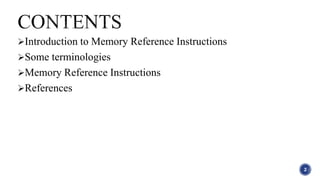
Introduction to Memory Reference Instructions
Some terminologies
Memory Reference Instructions
References
2
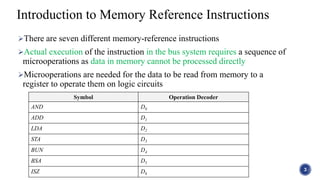
There are seven different memory-reference instructions
Actual execution of the instruction in the bus system requires a sequence of
microoperations as data in memory cannot be processed directly
Microoperations are needed for the data to be read from memory to a
register to operate them on logic circuits
3
Introduction to Memory Reference Instructions
Symbol Operation Decoder
AND D0
ADD D1
LDA D2
STA D3
BUN D4
BSA D5
ISZ D6
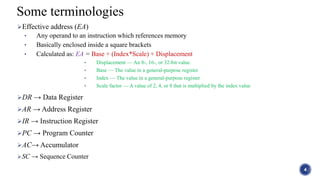
Effective address (EA)
• Any operand to an instruction which references memory
• Basically enclosed inside a square brackets
• Calculated as: EA = Base + (Index*Scale) + Displacement
• Displacement — An 8-, 16-, or 32-bit value.
• Base — The value in a general-purpose register
• Index — The value in a general-purpose register
• Scale factor — A value of 2, 4, or 8 that is multiplied by the index value
DR → Data Register
AR → Address Register
IR → Instruction Register
PC → Program Counter
AC→ Accumulator
SC → Sequence Counter
4
Some terminologies
AND to AC
 Performs the AND logic operations on pairs of bits in AC and the
memory word specified by the effective address
 Two timing signals are needed
• In T4 transfering operand from memory into DR
• In T5 transfering result of AND logic operation between the contents
of DR and AC
• In T5 SC is cleared to 0 and control is transfered to T0 to start a new
instruction cycle
 Example:
• D0T4: DR←M[AR]
• D0T5: AC←AC∧ DR, SC←0
5
Instructions
ADD to AC
 Adds the contents of memory word specified by the effective
address to the value of AC
 Sum is transferred into AC and the output carry Cout is transferred to
the E(extended accumulator) flip flop
 Two timing signals are needed but decoder D1 instead of D0
 Example:
• D1T4: DR←M[AR]
• D1T5: AC←AC+DR, E←Cout SC←0
6
Instructions cont...
LDA:Load to AC
 Tranfers the memory word specified by the effective address to AC
 Necessary to read the memory word into DR first and transfer the
contents of DR into AC
 there is no direct path from bus into AC
 to maintain one clock cycle as well
 Example:
 D2T4: DR←M[AR]
 D2T5: AC←DR SC←0
7
Instructions cont...
STA:Store AC
Stores the content of AC into the memory word specified by the
effective address
 The output of AC is applied to the bus and the data input of
memory is connected to the bus
 Example:
 D3T4: M[AR]←AC, SC←0
8
Instructions cont...
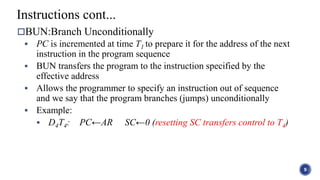
BUN:Branch Unconditionally
 PC is incremented at time T1 to prepare it for the address of the next
instruction in the program sequence
 BUN transfers the program to the instruction specified by the
effective address
 Allows the programmer to specify an instruction out of sequence
and we say that the program branches (jumps) unconditionally
 Example:
 D4T4: PC←AR SC←0 (resetting SC transfers control to T4)
9
Instructions cont...
BSA:Branch and Save Return Address
 Useful for branching to a portion of the program called a subroutine
or procedure
 When executed, it stores the address of the next instruction in
sequence (which is available in PC) into a memory location
specified by the effective address
 (Effective address + 1) is then transferred to PC to serve as the
address of the first instruction in the subroutine
 The return to the original program is accomplished by the BUN
instruction placed at the end of the subroutine
 Example:
 D5T4: M[AR]←PC, AR←AR+1
 D5T5: PC ← AR, SC←0
10
Instructions cont...
ISZ:Increment and Skip if Zero
 Increments the word specified by the effective address
 If the incremented value is equal to 0, PC is incremented by 1
 When a negative number(in 2's compelement) stored in memory word is
repeatedy incremented by 1 it eventually reaches zero
 At this time PC is incremented by one in order to skip the next
instruction in the program
 It is necessary to read the word into DR, increment DR and store the
word back into memory since it is not possible to increment a word
inside the memory
 Example:
 D6T4: DR←M[AR]
 D6T5: DR←DR+1
 D6T6: M[AR] ← DR, if (DR=0) then (PC←PC+1), SC←0
11
Instructions cont...
References
• Dasgupta, S., Computer Architecture: A Modern Synthersis, Vol. 2 New
York: John Wiley, 1989
• M.Morris Mano, Computer System Architecture, Pearson, Third Edition
• https://www.tortall.net/projects/yasm/manual/html/nasm-effaddr.html
• http://faculty.cs.niu.edu/~berezin/463/notes/addrmode.html
• https://everything2.com/title/Effective+address
12
Queries
13

Memory Reference Instructions

  • 1.
  • 2.
    Introduction to MemoryReference Instructions Some terminologies Memory Reference Instructions References 2
  • 3.
    There are sevendifferent memory-reference instructions Actual execution of the instruction in the bus system requires a sequence of microoperations as data in memory cannot be processed directly Microoperations are needed for the data to be read from memory to a register to operate them on logic circuits 3 Introduction to Memory Reference Instructions Symbol Operation Decoder AND D0 ADD D1 LDA D2 STA D3 BUN D4 BSA D5 ISZ D6
  • 4.
    Effective address (EA) •Any operand to an instruction which references memory • Basically enclosed inside a square brackets • Calculated as: EA = Base + (Index*Scale) + Displacement • Displacement — An 8-, 16-, or 32-bit value. • Base — The value in a general-purpose register • Index — The value in a general-purpose register • Scale factor — A value of 2, 4, or 8 that is multiplied by the index value DR → Data Register AR → Address Register IR → Instruction Register PC → Program Counter AC→ Accumulator SC → Sequence Counter 4 Some terminologies
  • 5.
    AND to AC Performs the AND logic operations on pairs of bits in AC and the memory word specified by the effective address  Two timing signals are needed • In T4 transfering operand from memory into DR • In T5 transfering result of AND logic operation between the contents of DR and AC • In T5 SC is cleared to 0 and control is transfered to T0 to start a new instruction cycle  Example: • D0T4: DR←M[AR] • D0T5: AC←AC∧ DR, SC←0 5 Instructions
  • 6.
    ADD to AC Adds the contents of memory word specified by the effective address to the value of AC  Sum is transferred into AC and the output carry Cout is transferred to the E(extended accumulator) flip flop  Two timing signals are needed but decoder D1 instead of D0  Example: • D1T4: DR←M[AR] • D1T5: AC←AC+DR, E←Cout SC←0 6 Instructions cont...
  • 7.
    LDA:Load to AC Tranfers the memory word specified by the effective address to AC  Necessary to read the memory word into DR first and transfer the contents of DR into AC  there is no direct path from bus into AC  to maintain one clock cycle as well  Example:  D2T4: DR←M[AR]  D2T5: AC←DR SC←0 7 Instructions cont...
  • 8.
    STA:Store AC Stores thecontent of AC into the memory word specified by the effective address  The output of AC is applied to the bus and the data input of memory is connected to the bus  Example:  D3T4: M[AR]←AC, SC←0 8 Instructions cont...
  • 9.
    BUN:Branch Unconditionally  PCis incremented at time T1 to prepare it for the address of the next instruction in the program sequence  BUN transfers the program to the instruction specified by the effective address  Allows the programmer to specify an instruction out of sequence and we say that the program branches (jumps) unconditionally  Example:  D4T4: PC←AR SC←0 (resetting SC transfers control to T4) 9 Instructions cont...
  • 10.
    BSA:Branch and SaveReturn Address  Useful for branching to a portion of the program called a subroutine or procedure  When executed, it stores the address of the next instruction in sequence (which is available in PC) into a memory location specified by the effective address  (Effective address + 1) is then transferred to PC to serve as the address of the first instruction in the subroutine  The return to the original program is accomplished by the BUN instruction placed at the end of the subroutine  Example:  D5T4: M[AR]←PC, AR←AR+1  D5T5: PC ← AR, SC←0 10 Instructions cont...
  • 11.
    ISZ:Increment and Skipif Zero  Increments the word specified by the effective address  If the incremented value is equal to 0, PC is incremented by 1  When a negative number(in 2's compelement) stored in memory word is repeatedy incremented by 1 it eventually reaches zero  At this time PC is incremented by one in order to skip the next instruction in the program  It is necessary to read the word into DR, increment DR and store the word back into memory since it is not possible to increment a word inside the memory  Example:  D6T4: DR←M[AR]  D6T5: DR←DR+1  D6T6: M[AR] ← DR, if (DR=0) then (PC←PC+1), SC←0 11 Instructions cont...
  • 12.
    References • Dasgupta, S.,Computer Architecture: A Modern Synthersis, Vol. 2 New York: John Wiley, 1989 • M.Morris Mano, Computer System Architecture, Pearson, Third Edition • https://www.tortall.net/projects/yasm/manual/html/nasm-effaddr.html • http://faculty.cs.niu.edu/~berezin/463/notes/addrmode.html • https://everything2.com/title/Effective+address 12
  • 13.