ROUTING AND ROUTING
ALGORITHMS
Aadil A. Bhat (1502CUKMr001)
Zarak Reeman (1502CUKMr001)
ROUTING
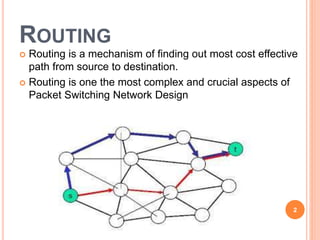
 Routing is a mechanism of finding out most cost effective
path from source to destination.
 Routing is one the most complex and crucial aspects of
Packet Switching Network Design
2
DESIRABLE PROPERTIES
 Correctness and simplicity : Packets should be delivered to
correct destination. Routing algorithm should be simple.
 Robustness: Ability of the network to deliver packets via some
route even in face of failures.
 Stability: The algorithm should converge to equilibrium fast in
the face of changing environment.
 Fairness and optimality: Obvious requirement but conflicting.
 Efficiency: Minimum Overhead.
3
DESIGN PARAMETERS
 Performance Criteria: Number of Hops, Cost Delay,
Throughput.
 Decision Time: Per Packet(Datagram), per secession (Virtual
Circuit).
 Decision place: Each node distributed, Central node
(centralized), originated note (source).
 Network Information Source: None, local, adjacent node,
nodes along route, all nodes. 4
ROUTING STRATEGIES
 Fixed (static) Routing.
 Flooding
 Random Routing
 Flow based Routing
 Adaptive/ Dynamic Routing
5
FIXED ROUTING
 A route is selected for each source-destination pair
of nodes in the network.
 The routes are fixed, they may only change if there
is change in topology of the network.
 How fixed routing may be implemented???
6
FIXED ROUTING- EXAMPLE
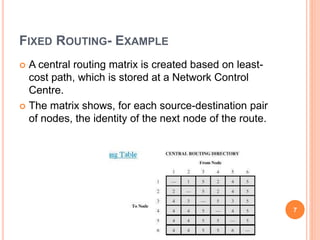
 A central routing matrix is created based on least-
cost path, which is stored at a Network Control
Centre.
 The matrix shows, for each source-destination pair
of nodes, the identity of the next node of the route.
7
FIXED ROUTING- EXAMPLE(CONT.)
8
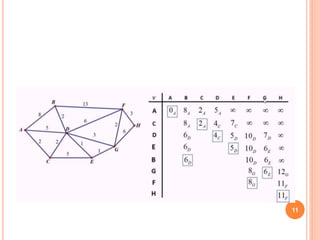
LEAST COST PATH
 A cost is associated with each link.
 The simplest criterion is to choose the minimum-
hop route through the network.
 A generalization is least cost
 For any pair of attached stations, the least cost
route through the network is looked for.
 For either case, several well known algorithms exist
to obtain the optimum path.
i. Dijkstra’s algorithm
ii. Bellman- Ford algorithm
9
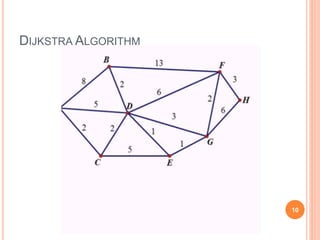
DIJKSTRA ALGORITHM
10
11
FIXED ROUTING
 Advantages
 Simple
 Works well in the reliable network
 Same for virtual circuit and datagram
 Disadvantages
 Lack of flexibility
 Doesn’t react to failures or network congestion.
12
FLOODING
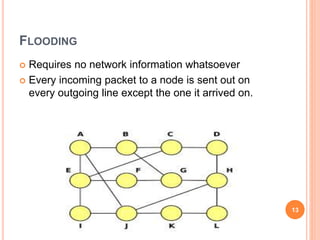
 Requires no network information whatsoever
 Every incoming packet to a node is sent out on
every outgoing line except the one it arrived on.
13
FLOODING CHARACTERISTICS
 All possible routes between source and destination
are tried. A packet will go through if a path exists.
 As all routes are tried, at least one packet will pass
through the shortest route.
 All nodes, directly or indirectly are visited
 Limitations
 Flooding generates vast number of duplicate packets
 Suitable damping mechanism must be used
14
SELECTIVE FLOODING
 A variation which is more practical is selective
flooding.
 The router do not send every incoming packet out on
every line, only those lines that go in approximately in
the direction of destination.
15
UTILITIES OF FLOODING
 Flooding is highly robust and could be used to send
emergency messages.
 May be used to initially set up the route in a virtual
circuit.
 Flooding always chooses the shortest since it
explores every possible path in parallel.
 Can be useful for the dissemination of important
information to all nodes
16

Routing and routing algorithms

  • 1.
    ROUTING AND ROUTING ALGORITHMS AadilA. Bhat (1502CUKMr001) Zarak Reeman (1502CUKMr001)
  • 2.
    ROUTING  Routing isa mechanism of finding out most cost effective path from source to destination.  Routing is one the most complex and crucial aspects of Packet Switching Network Design 2
  • 3.
    DESIRABLE PROPERTIES  Correctnessand simplicity : Packets should be delivered to correct destination. Routing algorithm should be simple.  Robustness: Ability of the network to deliver packets via some route even in face of failures.  Stability: The algorithm should converge to equilibrium fast in the face of changing environment.  Fairness and optimality: Obvious requirement but conflicting.  Efficiency: Minimum Overhead. 3
  • 4.
    DESIGN PARAMETERS  PerformanceCriteria: Number of Hops, Cost Delay, Throughput.  Decision Time: Per Packet(Datagram), per secession (Virtual Circuit).  Decision place: Each node distributed, Central node (centralized), originated note (source).  Network Information Source: None, local, adjacent node, nodes along route, all nodes. 4
  • 5.
    ROUTING STRATEGIES  Fixed(static) Routing.  Flooding  Random Routing  Flow based Routing  Adaptive/ Dynamic Routing 5
  • 6.
    FIXED ROUTING  Aroute is selected for each source-destination pair of nodes in the network.  The routes are fixed, they may only change if there is change in topology of the network.  How fixed routing may be implemented??? 6
  • 7.
    FIXED ROUTING- EXAMPLE A central routing matrix is created based on least- cost path, which is stored at a Network Control Centre.  The matrix shows, for each source-destination pair of nodes, the identity of the next node of the route. 7
  • 8.
  • 9.
    LEAST COST PATH A cost is associated with each link.  The simplest criterion is to choose the minimum- hop route through the network.  A generalization is least cost  For any pair of attached stations, the least cost route through the network is looked for.  For either case, several well known algorithms exist to obtain the optimum path. i. Dijkstra’s algorithm ii. Bellman- Ford algorithm 9
  • 10.
  • 11.
  • 12.
    FIXED ROUTING  Advantages Simple  Works well in the reliable network  Same for virtual circuit and datagram  Disadvantages  Lack of flexibility  Doesn’t react to failures or network congestion. 12
  • 13.
    FLOODING  Requires nonetwork information whatsoever  Every incoming packet to a node is sent out on every outgoing line except the one it arrived on. 13
  • 14.
    FLOODING CHARACTERISTICS  Allpossible routes between source and destination are tried. A packet will go through if a path exists.  As all routes are tried, at least one packet will pass through the shortest route.  All nodes, directly or indirectly are visited  Limitations  Flooding generates vast number of duplicate packets  Suitable damping mechanism must be used 14
  • 15.
    SELECTIVE FLOODING  Avariation which is more practical is selective flooding.  The router do not send every incoming packet out on every line, only those lines that go in approximately in the direction of destination. 15
  • 16.
    UTILITIES OF FLOODING Flooding is highly robust and could be used to send emergency messages.  May be used to initially set up the route in a virtual circuit.  Flooding always chooses the shortest since it explores every possible path in parallel.  Can be useful for the dissemination of important information to all nodes 16