1
Recap Lecture-2
Kleene Star Closure, Plus operation, recursive
definition of languages, INTEGER, EVEN,
factorial, PALINDROME, {an
bn
}, languages of
strings (i) ending in a, (ii) beginning and ending
in same letters, (iii) containing aa or bb
(iv)containing exactly aa,
2
Task
Q)
1) Let S={ab, bb} and T={ab, bb, bbbb} Show
that S*
= T*
[Hint S*
⊆ T*
and T*
⊆ S*
]
2) Let S={ab, bb} and T={ab, bb, bbb} Show that S*
≠
T*
But S*
⊂ T*
Solution: Since S⊂ T , so every string belonging
to S*
, also belongs to T*
but bbb is a string belongs
to T*
but does not belong to S*
.
3
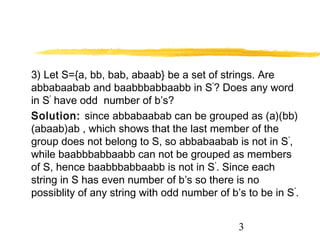
3) Let S={a, bb, bab, abaab} be a set of strings. Are
abbabaabab and baabbbabbaabb in S*
? Does any word
in S*
have odd number of b’s?
Solution: since abbabaabab can be grouped as (a)(bb)
(abaab)ab , which shows that the last member of the
group does not belong to S, so abbabaabab is not in S*
,
while baabbbabbaabb can not be grouped as members
of S, hence baabbbabbaabb is not in S*
. Since each
string in S has even number of b’s so there is no
possiblity of any string with odd number of b’s to be in S*
.
4
Task
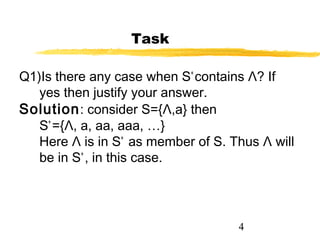
Q1)Is there any case when S+
contains Λ? If
yes then justify your answer.
Solution: consider S={Λ,a} then
S+
={Λ, a, aa, aaa, …}
Here Λ is in S+
as member of S. Thus Λ will
be in S+
, in this case.
5
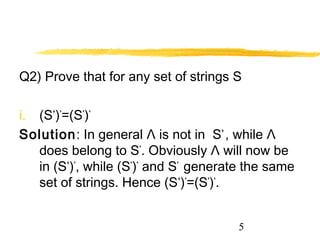
Q2) Prove that for any set of strings S
i. (S+
)*
=(S*
)*
Solution: In general Λ is not in S+
, while Λ
does belong to S*
. Obviously Λ will now be
in (S+
)*
, while (S*
)*
and S*
generate the same
set of strings. Hence (S+
)*
=(S*
)*
.
6
Q2) continued…
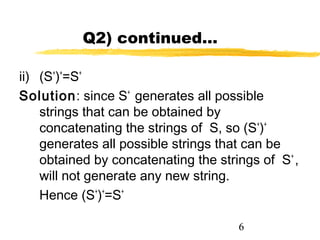
ii) (S+
)+
=S+
Solution: since S+
generates all possible
strings that can be obtained by
concatenating the strings of S, so (S+
)+
generates all possible strings that can be
obtained by concatenating the strings of S+
,
will not generate any new string.
Hence (S+
)+
=S+
7
Q2) continued…
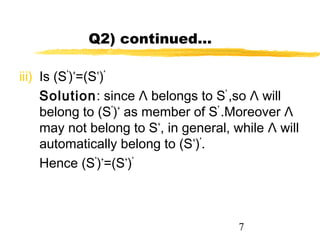
iii) Is (S*
)+
=(S+
)*
Solution: since Λ belongs to S*
,so Λ will
belong to (S*
)+
as member of S*
.Moreover Λ
may not belong to S+
, in general, while Λ will
automatically belong to (S+
)*
.
Hence (S*
)+
=(S+
)*
8
Regular Expression
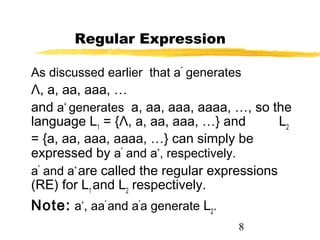
As discussed earlier that a*
generates
Λ, a, aa, aaa, …
and a+
generates a, aa, aaa, aaaa, …, so the
language L1
= {Λ, a, aa, aaa, …} and L2
= {a, aa, aaa, aaaa, …} can simply be
expressed by a*
and a+
, respectively.
a*
and a+
are called the regular expressions
(RE) for L1
and L2
respectively.
Note: a+
, aa*
and a*
a generate L2
.
9
Recursive definition of Regular
Expression(RE)
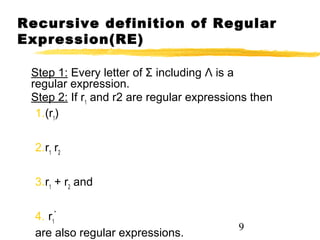
Step 1: Every letter of Σ including Λ is a
regular expression.
Step 2: If r1
and r2 are regular expressions then
1.(r1
)
2.r1
r2
3.r1
+ r2
and
4. r1
*
are also regular expressions.
10
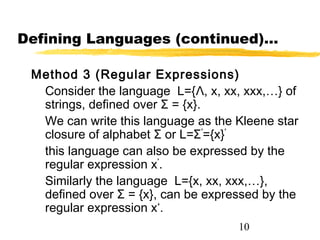
Defining Languages (continued)…
Method 3 (Regular Expressions)
Consider the language L={Λ, x, xx, xxx,…} of
strings, defined over Σ = {x}.
We can write this language as the Kleene star
closure of alphabet Σ or L=Σ*
={x}*
this language can also be expressed by the
regular expression x*
.
Similarly the language L={x, xx, xxx,…},
defined over Σ = {x}, can be expressed by the
regular expression x+
.
11
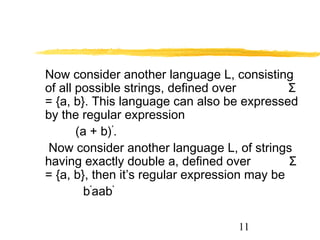
Now consider another language L, consisting
of all possible strings, defined over Σ
= {a, b}. This language can also be expressed
by the regular expression
(a + b)*
.
Now consider another language L, of strings
having exactly double a, defined over Σ
= {a, b}, then it’s regular expression may be
b*
aab*
12
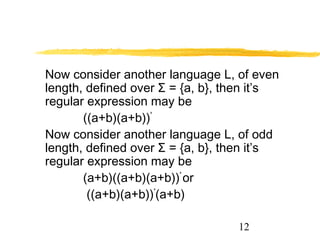
Now consider another language L, of even
length, defined over Σ = {a, b}, then it’s
regular expression may be
((a+b)(a+b))*
Now consider another language L, of odd
length, defined over Σ = {a, b}, then it’s
regular expression may be
(a+b)((a+b)(a+b))*
or
((a+b)(a+b))*
(a+b)
13
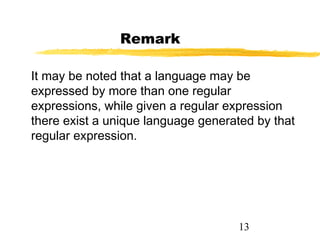
Remark
It may be noted that a language may be
expressed by more than one regular
expressions, while given a regular expression
there exist a unique language generated by that
regular expression.
14
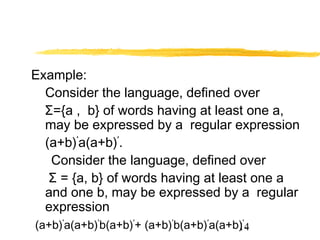
Example:
Consider the language, defined over
Σ={a , b} of words having at least one a,
may be expressed by a regular expression
(a+b)*
a(a+b)*
.
Consider the language, defined over
Σ = {a, b} of words having at least one a
and one b, may be expressed by a regular
expression
(a+b)*
a(a+b)*
b(a+b)*
+ (a+b)*
b(a+b)*
a(a+b)*
.
15
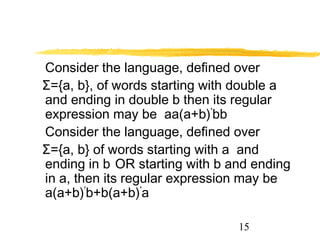
Consider the language, defined over
Σ={a, b}, of words starting with double a
and ending in double b then its regular
expression may be aa(a+b)*
bb
Consider the language, defined over
Σ={a, b} of words starting with a and
ending in b OR starting with b and ending
in a, then its regular expression may be
a(a+b)*
b+b(a+b)*
a
16
TASK
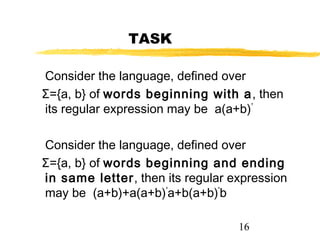
Consider the language, defined over
Σ={a, b} of words beginning with a, then
its regular expression may be a(a+b)*
Consider the language, defined over
Σ={a, b} of words beginning and ending
in same letter, then its regular expression
may be (a+b)+a(a+b)*
a+b(a+b)*
b
17
TASK
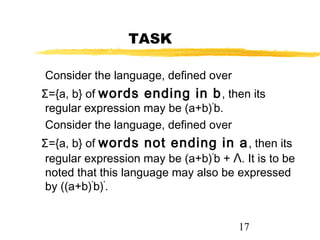
Consider the language, defined over
Σ={a, b} of words ending in b, then its
regular expression may be (a+b)*
b.
Consider the language, defined over
Σ={a, b} of words not ending in a, then its
regular expression may be (a+b)*
b + Λ. It is to be
noted that this language may also be expressed
by ((a+b)*
b)*
.
18
SummingUP Lecture 3
RE, Recursive definition of RE, defining
languages by RE, { x}*
, { x}+
, {a+b}*
, Language of
strings having exactly one aa, Language of
strings of even length, Language of strings of
odd length, RE defines unique language (as
Remark), Language of strings having at least
one a, Language of strings havgin at least
one a and one b, Language of strings
starting with aa and ending in bb,
Language of strings starting with and
ending in different letters.

Lesson 03

  • 1.
    1 Recap Lecture-2 Kleene StarClosure, Plus operation, recursive definition of languages, INTEGER, EVEN, factorial, PALINDROME, {an bn }, languages of strings (i) ending in a, (ii) beginning and ending in same letters, (iii) containing aa or bb (iv)containing exactly aa,
  • 2.
    2 Task Q) 1) Let S={ab,bb} and T={ab, bb, bbbb} Show that S* = T* [Hint S* ⊆ T* and T* ⊆ S* ] 2) Let S={ab, bb} and T={ab, bb, bbb} Show that S* ≠ T* But S* ⊂ T* Solution: Since S⊂ T , so every string belonging to S* , also belongs to T* but bbb is a string belongs to T* but does not belong to S* .
  • 3.
    3 3) Let S={a,bb, bab, abaab} be a set of strings. Are abbabaabab and baabbbabbaabb in S* ? Does any word in S* have odd number of b’s? Solution: since abbabaabab can be grouped as (a)(bb) (abaab)ab , which shows that the last member of the group does not belong to S, so abbabaabab is not in S* , while baabbbabbaabb can not be grouped as members of S, hence baabbbabbaabb is not in S* . Since each string in S has even number of b’s so there is no possiblity of any string with odd number of b’s to be in S* .
  • 4.
    4 Task Q1)Is there anycase when S+ contains Λ? If yes then justify your answer. Solution: consider S={Λ,a} then S+ ={Λ, a, aa, aaa, …} Here Λ is in S+ as member of S. Thus Λ will be in S+ , in this case.
  • 5.
    5 Q2) Prove thatfor any set of strings S i. (S+ )* =(S* )* Solution: In general Λ is not in S+ , while Λ does belong to S* . Obviously Λ will now be in (S+ )* , while (S* )* and S* generate the same set of strings. Hence (S+ )* =(S* )* .
  • 6.
    6 Q2) continued… ii) (S+ )+ =S+ Solution:since S+ generates all possible strings that can be obtained by concatenating the strings of S, so (S+ )+ generates all possible strings that can be obtained by concatenating the strings of S+ , will not generate any new string. Hence (S+ )+ =S+
  • 7.
    7 Q2) continued… iii) Is(S* )+ =(S+ )* Solution: since Λ belongs to S* ,so Λ will belong to (S* )+ as member of S* .Moreover Λ may not belong to S+ , in general, while Λ will automatically belong to (S+ )* . Hence (S* )+ =(S+ )*
  • 8.
    8 Regular Expression As discussedearlier that a* generates Λ, a, aa, aaa, … and a+ generates a, aa, aaa, aaaa, …, so the language L1 = {Λ, a, aa, aaa, …} and L2 = {a, aa, aaa, aaaa, …} can simply be expressed by a* and a+ , respectively. a* and a+ are called the regular expressions (RE) for L1 and L2 respectively. Note: a+ , aa* and a* a generate L2 .
  • 9.
    9 Recursive definition ofRegular Expression(RE) Step 1: Every letter of Σ including Λ is a regular expression. Step 2: If r1 and r2 are regular expressions then 1.(r1 ) 2.r1 r2 3.r1 + r2 and 4. r1 * are also regular expressions.
  • 10.
    10 Defining Languages (continued)… Method3 (Regular Expressions) Consider the language L={Λ, x, xx, xxx,…} of strings, defined over Σ = {x}. We can write this language as the Kleene star closure of alphabet Σ or L=Σ* ={x}* this language can also be expressed by the regular expression x* . Similarly the language L={x, xx, xxx,…}, defined over Σ = {x}, can be expressed by the regular expression x+ .
  • 11.
    11 Now consider anotherlanguage L, consisting of all possible strings, defined over Σ = {a, b}. This language can also be expressed by the regular expression (a + b)* . Now consider another language L, of strings having exactly double a, defined over Σ = {a, b}, then it’s regular expression may be b* aab*
  • 12.
    12 Now consider anotherlanguage L, of even length, defined over Σ = {a, b}, then it’s regular expression may be ((a+b)(a+b))* Now consider another language L, of odd length, defined over Σ = {a, b}, then it’s regular expression may be (a+b)((a+b)(a+b))* or ((a+b)(a+b))* (a+b)
  • 13.
    13 Remark It may benoted that a language may be expressed by more than one regular expressions, while given a regular expression there exist a unique language generated by that regular expression.
  • 14.
    14 Example: Consider the language,defined over Σ={a , b} of words having at least one a, may be expressed by a regular expression (a+b)* a(a+b)* . Consider the language, defined over Σ = {a, b} of words having at least one a and one b, may be expressed by a regular expression (a+b)* a(a+b)* b(a+b)* + (a+b)* b(a+b)* a(a+b)* .
  • 15.
    15 Consider the language,defined over Σ={a, b}, of words starting with double a and ending in double b then its regular expression may be aa(a+b)* bb Consider the language, defined over Σ={a, b} of words starting with a and ending in b OR starting with b and ending in a, then its regular expression may be a(a+b)* b+b(a+b)* a
  • 16.
    16 TASK Consider the language,defined over Σ={a, b} of words beginning with a, then its regular expression may be a(a+b)* Consider the language, defined over Σ={a, b} of words beginning and ending in same letter, then its regular expression may be (a+b)+a(a+b)* a+b(a+b)* b
  • 17.
    17 TASK Consider the language,defined over Σ={a, b} of words ending in b, then its regular expression may be (a+b)* b. Consider the language, defined over Σ={a, b} of words not ending in a, then its regular expression may be (a+b)* b + Λ. It is to be noted that this language may also be expressed by ((a+b)* b)* .
  • 18.
    18 SummingUP Lecture 3 RE,Recursive definition of RE, defining languages by RE, { x}* , { x}+ , {a+b}* , Language of strings having exactly one aa, Language of strings of even length, Language of strings of odd length, RE defines unique language (as Remark), Language of strings having at least one a, Language of strings havgin at least one a and one b, Language of strings starting with aa and ending in bb, Language of strings starting with and ending in different letters.