Nadar Saraswathi college of
arts and science Theni
Department of CS and IT
Presented by:
S.Swetha
I M.sc(IT) Parallel
programming models
Parallel programming models
 It is a collection of program abstraction providing a
programmer a simplified and transparent view of
the computer hardware and software.
 The parallel programming model is a vector
computers.
Types of parallel programming
• Shared memory model
• Message passing model (Or) Distributed memory
model.
• Threads model
• Data parallel model.
Shared Memory Model.
 In this programming model, tasks share a common address space,
which they read and write to asynchronously.
 Various mechanisms such as locks may be used to control access to
the shared memory.
 An advantage is that the notion of data "ownership" is lacking,
 so there is no need to specify explicitly the communication of data
between tasks.
Shared Memory Model.
 An important disadvantage is that it becomes more difficult to
understand and manage data locality.
 Keeping data local to the processor that works on it conserves
memory accesses, cache refreshes and bus traffic that occurs when
multiple processors use the same data.
 Unfortunately, controlling data locality is hard to understand and
beyond the control of the average user.
Implementation
Advantages
and
Disadvantages
Implementations and
advantages & disadvantages:
 Native compilers and/or hardware translate user program variables
into actual memory addresses, which are global.
Advantages:
• Program to development becomes simple.As all
process see and have equal access to shared
memory.
• Data "Ownership" is locking so there is no need to
explicitly specify the communication of data
between process.
Disadvantage
Threads Model
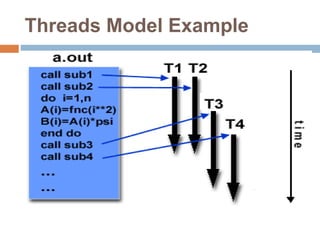
 This is a type of shared memory programming.
 In this model, a single process can have multiple, concurrent execution
paths.
 An analogy that can be used to describe threads is
 the concept of a single program that includes a number of
subroutines:
Threads Model Example
 The main program a.out is scheduled to run by the native operating
system.
 a.out loads and acquires all of the necessary system and user resources
to run.
 a.out performs some serial work, and then creates a number of tasks
(threads) that can be scheduled and run by the operating system
concurrently.
Threads Model Example
 A thread's work may best be described as a subroutine within the
main program.
 Any thread can execute any subroutine at the same time as other
threads.
 Threads communicate with each other through global memory
(updating address locations).
Threads Model Example
 This requires synchronization constructs to ensure that more than one
thread is not updating the same global address at any time.
 Threads can come and go,
 but a.out remains present to provide the necessary shared resources
until the application has completed.
Implementations:
 From a programming perspective, threads implementations commonly
comprise:
 A library of subroutines that are called from within parallel source
code
 A set of compiler directives imbedded in either serial or parallel
source code
Implementations:
 These implementations differed substantially from each other making
it difficult for programmers to develop portable threaded applications.
 Unrelated standardization efforts have resulted in two very different
implementations of threads: POSIX Threads and OpenMP.
POSIX Threads
 Library based; requires parallel coding
 Specified by the IEEE POSIX 1003.1c standard (1995).
 C Language only
 Commonly referred to as Pthreads.
POSIX Threads
 Most hardware vendors now offer Pthreads in addition to their
proprietary threads implementations.
 Very explicit parallelism; requires significant programmer attention to
detail.
OpenMP
 Compiler directive based; can use serial code
 Jointly defined and endorsed by a group of major computer hardware
and software vendors. The OpenMP Fortran API was released October
28, 1997. The C/C++ API was released in late 1998.
OpenMP
 Portable / multi-platform, including Unix and Windows NT platforms
 Available in C/C++ and Fortran implementations
 Can be very easy and simple to use - provides for "incremental
parallelism"
 Microsoft has its own implementation for threads, which is not related
to the UNIX POSIX standard or OpenMP.
Distributed Memory / Message
Passing Model
 This model demonstrates the following characteristics:
 A set of tasks that use their own local memory during computation.
 Multiple tasks can reside on the same physical machine and/or across
an arbitrary number of machines.
Distributed Memory / Message
Passing Model
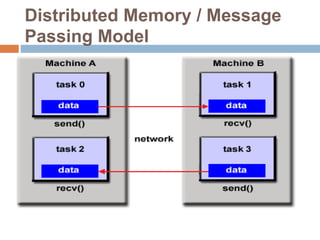
 Tasks exchange data through communications by sending and
receiving messages.
 Data transfer usually requires cooperative operations to be performed
by each process.
 For example, a send operation must have a matching receive
operation.
Distributed Memory / Message
Passing Model
Implementations
 From a programming perspective, message passing implementations
usually comprise a library of subroutines.
 Calls to these subroutines are imbedded in source code.
 The programmer is responsible for determining all parallelism.
Implementations
 Historically, a variety of message passing libraries have been available
since the 1980s.
 These implementations differed substantially from each other making
it difficult for programmers to develop portable applications.
 In 1992, the MPI Forum was formed with the primary goal of
establishing a standard interface for message passing
implementations.
Implementations
 Part 1 of the Message Passing Interface (MPI) was released in 1994.
Part 2 (MPI-2) was released in 1996.
 MPI is now the "de facto" industry standard for message passing,
 replacing virtually all other message passing implementations used for
production work.
Implementations
 MPI implementations exist for virtually all popular parallel computing
platforms.
 Not all implementations include everything in both MPI1 and MPI2.
Data Parallel Model
 The data parallel model demonstrates the following characteristics:
 Most of the parallel work focuses on performing operations on a data
set.
 The data set is typically organized into a common structure, such as an
array or cube.
 A set of tasks work collectively on the same data structure, however,
each task works on a different partition of the same data structure.
Data Parallel Model
 Tasks perform the same operation on their partition of work, for
example, "add 4 to every array element".
 On shared memory architectures, all tasks may have access to the data
structure through global memory.
 On distributed memory architectures the data structure is split up and
resides as "chunks" in the local memory of each task.
Data Parallel Model
Implementations
 Programming with the data parallel model is usually accomplished by
writing a program with data parallel constructs.
 The constructs can be calls to a data parallel subroutine library or,
 compiler directives recognized by a data parallel compiler.

parallel programming models

  • 1.
    Nadar Saraswathi collegeof arts and science Theni Department of CS and IT Presented by: S.Swetha I M.sc(IT) Parallel programming models
  • 2.
    Parallel programming models It is a collection of program abstraction providing a programmer a simplified and transparent view of the computer hardware and software.  The parallel programming model is a vector computers.
  • 3.
    Types of parallelprogramming • Shared memory model • Message passing model (Or) Distributed memory model. • Threads model • Data parallel model.
  • 4.
    Shared Memory Model. In this programming model, tasks share a common address space, which they read and write to asynchronously.  Various mechanisms such as locks may be used to control access to the shared memory.  An advantage is that the notion of data "ownership" is lacking,  so there is no need to specify explicitly the communication of data between tasks.
  • 5.
    Shared Memory Model. An important disadvantage is that it becomes more difficult to understand and manage data locality.  Keeping data local to the processor that works on it conserves memory accesses, cache refreshes and bus traffic that occurs when multiple processors use the same data.  Unfortunately, controlling data locality is hard to understand and beyond the control of the average user.
  • 6.
  • 7.
    Implementations and advantages &disadvantages:  Native compilers and/or hardware translate user program variables into actual memory addresses, which are global. Advantages: • Program to development becomes simple.As all process see and have equal access to shared memory. • Data "Ownership" is locking so there is no need to explicitly specify the communication of data between process.
  • 8.
  • 9.
    Threads Model  Thisis a type of shared memory programming.  In this model, a single process can have multiple, concurrent execution paths.  An analogy that can be used to describe threads is  the concept of a single program that includes a number of subroutines:
  • 10.
  • 11.
    Threads Model Example The main program a.out is scheduled to run by the native operating system.  a.out loads and acquires all of the necessary system and user resources to run.  a.out performs some serial work, and then creates a number of tasks (threads) that can be scheduled and run by the operating system concurrently.
  • 12.
    Threads Model Example A thread's work may best be described as a subroutine within the main program.  Any thread can execute any subroutine at the same time as other threads.  Threads communicate with each other through global memory (updating address locations).
  • 13.
    Threads Model Example This requires synchronization constructs to ensure that more than one thread is not updating the same global address at any time.  Threads can come and go,  but a.out remains present to provide the necessary shared resources until the application has completed.
  • 14.
    Implementations:  From aprogramming perspective, threads implementations commonly comprise:  A library of subroutines that are called from within parallel source code  A set of compiler directives imbedded in either serial or parallel source code
  • 15.
    Implementations:  These implementationsdiffered substantially from each other making it difficult for programmers to develop portable threaded applications.  Unrelated standardization efforts have resulted in two very different implementations of threads: POSIX Threads and OpenMP.
  • 16.
    POSIX Threads  Librarybased; requires parallel coding  Specified by the IEEE POSIX 1003.1c standard (1995).  C Language only  Commonly referred to as Pthreads.
  • 17.
    POSIX Threads  Mosthardware vendors now offer Pthreads in addition to their proprietary threads implementations.  Very explicit parallelism; requires significant programmer attention to detail.
  • 18.
    OpenMP  Compiler directivebased; can use serial code  Jointly defined and endorsed by a group of major computer hardware and software vendors. The OpenMP Fortran API was released October 28, 1997. The C/C++ API was released in late 1998.
  • 19.
    OpenMP  Portable /multi-platform, including Unix and Windows NT platforms  Available in C/C++ and Fortran implementations  Can be very easy and simple to use - provides for "incremental parallelism"  Microsoft has its own implementation for threads, which is not related to the UNIX POSIX standard or OpenMP.
  • 20.
    Distributed Memory /Message Passing Model  This model demonstrates the following characteristics:  A set of tasks that use their own local memory during computation.  Multiple tasks can reside on the same physical machine and/or across an arbitrary number of machines.
  • 21.
    Distributed Memory /Message Passing Model  Tasks exchange data through communications by sending and receiving messages.  Data transfer usually requires cooperative operations to be performed by each process.  For example, a send operation must have a matching receive operation.
  • 22.
    Distributed Memory /Message Passing Model
  • 23.
    Implementations  From aprogramming perspective, message passing implementations usually comprise a library of subroutines.  Calls to these subroutines are imbedded in source code.  The programmer is responsible for determining all parallelism.
  • 24.
    Implementations  Historically, avariety of message passing libraries have been available since the 1980s.  These implementations differed substantially from each other making it difficult for programmers to develop portable applications.  In 1992, the MPI Forum was formed with the primary goal of establishing a standard interface for message passing implementations.
  • 25.
    Implementations  Part 1of the Message Passing Interface (MPI) was released in 1994. Part 2 (MPI-2) was released in 1996.  MPI is now the "de facto" industry standard for message passing,  replacing virtually all other message passing implementations used for production work.
  • 26.
    Implementations  MPI implementationsexist for virtually all popular parallel computing platforms.  Not all implementations include everything in both MPI1 and MPI2.
  • 27.
    Data Parallel Model The data parallel model demonstrates the following characteristics:  Most of the parallel work focuses on performing operations on a data set.  The data set is typically organized into a common structure, such as an array or cube.  A set of tasks work collectively on the same data structure, however, each task works on a different partition of the same data structure.
  • 28.
    Data Parallel Model Tasks perform the same operation on their partition of work, for example, "add 4 to every array element".  On shared memory architectures, all tasks may have access to the data structure through global memory.  On distributed memory architectures the data structure is split up and resides as "chunks" in the local memory of each task.
  • 29.
  • 30.
    Implementations  Programming withthe data parallel model is usually accomplished by writing a program with data parallel constructs.  The constructs can be calls to a data parallel subroutine library or,  compiler directives recognized by a data parallel compiler.