





PRESENTATION BY
Usman
Faraz
Faizan
Ali
Kashif
STRATEGIES FOR
SUCCESSFUL
SPEAKING AND
SUCCESSFUL
LISTENING
STRATEGIES FOR SUCCESSFUL SPEAKING AND
SUCCESSFUL LISTENING
This chapter consist of three Basic
Parts:
1. Strategies for Improving Oral
Presentation
2. Strategies for Reducing Stage
Fright
3. Strategies for improving listening
STRATEGIES FOR IMPROVING
ORAL PRESENTATION
To make our presentation meaningful, we need strategy.
This section takes us through the steps needed to be
effective in oral communication.
1. Steps for Preparing Oral Presentation
2. Kinds of Oral Presentation
3. Ways of Delivering Oral Message
4. Strategies for Using an Effective Oral Delivery
5. Strategies for Effective Non-Verbal Delivery
STEPS FOR AN EFFECTIVE ORAL
PRESENTATION
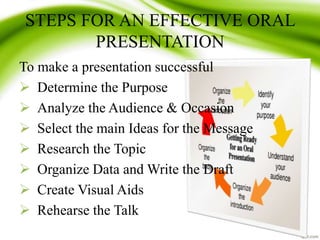
To make a presentation successful
 Determine the Purpose
 Analyze the Audience & Occasion
 Select the main Ideas for the Message
 Research the Topic
 Organize Data and Write the Draft
 Create Visual Aids
 Rehearse the Talk
KINDS OF ORAL PRESENTATION
Presentations are organized for different purposes such as
 Information
 Persuasion
 Entertainment
NOTE: “The longer the presentation the higher the
risk of losing an audience attention”
WAYS OF DELIVERING ORAL
PRESENTATION
 Extemporaneous
 Reading
 Memorization
 Impromptu
STRATEGIES FOR AN EFFECTIVE
ORAL DELIVERY
Your voice is your trade mark that add the human
elements in your words. You can give extra life to your
delivery in five traditional ways.
 Pitch
 Rate
 Volume
 Vocal quality
 Pronunciation
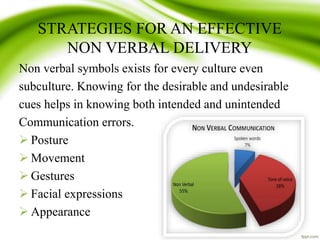
STRATEGIES FOR AN EFFECTIVE
NON VERBAL DELIVERY
Non verbal symbols exists for every culture even
subculture. Knowing for the desirable and undesirable
cues helps in knowing both intended and unintended
Communication errors.
 Posture
 Movement
 Gestures
 Facial expressions
 Appearance
STRATEGIES FOR REDUCING STAGE
FRIGHT
Being at ease or simply giving the impression of being
at ease is difficult for most people.
 Know your subject well
 Rehearse your talk several times
 Recheck equipment you will need (projector, screen)
 Take an object with you (pen, marking pencil)
 Breathe deeply and slowly before speaking
 Move during the speech
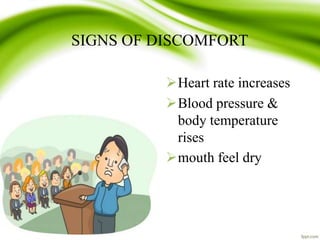
SIGNS OF DISCOMFORT
Heart rate increases
Blood pressure &
body temperature
rises
mouth feel dry
STRATEGIES FOR IMPROVING LISTENING
Listening is neglected in school, college even manager
but it is an significant part of ones communication skills.
 Be prepared (Assignments responsibilities)
 Accent the positive (if you have to do it, do it with a positive attitude)
 Listen to understand, no refute
(try to understand the points he emphasis and why he has such feeling)
 Focus your attention
(construct a mental outline where the speaker is going)
 Concentrate on context
 Take notes (jot down ideas, even incomplete sentences or single words)
 Curb the impulse to interrupt
(listen attentively until the speaker invites questions)
 Summarize and evaluate
STRATEGIES FOR
SUCCESSFUL
INFORMATION AND
PERSUASIVE
SPEAKING
STRATEGIES FOR SUCCESSFUL INFORMATION
AND PERSUASIVE SPEAKING
Oral communication is our most used mode of
Communication.
Purpose of informative and persuasive
speaking
Oral communication has two purposes
1. General / Macro purpose
2. Specific / Micro purpose
Kinds of informative and persuasive
speaking
Informative speaking:-
There are four types of informative situations in
business communication.
 Reports
 Goodwill (for positive company image in the community)
 Briefings (Problem solving session)
 instruction
Kinds of informative and persuasive
speaking
Persuasive speaking:-
Opportunities to persuade are endless it is classified into
four major categories
 Policy (course of action to be taken or not)
 Procedure (steps for implementing policy)
 Value (credibility of speaker)
 Facts (present situation, past performance and future plans)
Audience analysis for informative and
persuasive speaking
Knowing as much about your audience as you can
decrease your chance of making either content to
attitudinal errors.
1. Interest and attitude of audience
2. Occasion
3. Location
Organization for informative and
persuasive speaking
Organize the data in to logical pattern
 Introduction
 Body
 Conclusion
Supports for informative and
persuasive speaking
Good oral communication depend upon three bases
 Ethos (concern your credibility as a speaker)
 Pathos (using emotion to support your idea)
 Logos (emphasis on both written and oral persuasion)
STRATEGIES
FOR
SUCCESSFUL
INTERPERSONAL
COMMUNICATION
STRATEGIES FOR SUCCESSFUL
INTERPERSONAL COMMUNICATION
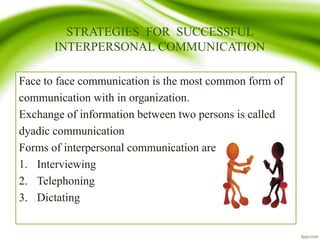
Face to face communication is the most common form of
communication with in organization.
Exchange of information between two persons is called
dyadic communication
Forms of interpersonal communication are
1. Interviewing
2. Telephoning
3. Dictating
Interviewing
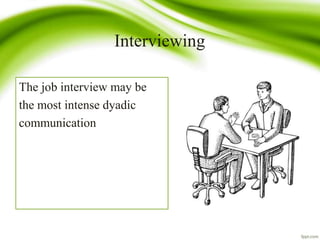
The job interview may be
the most intense dyadic
communication
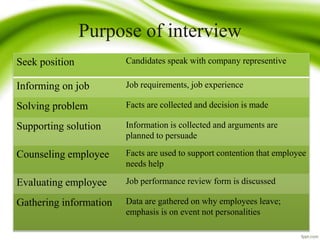
Purpose of interview
Seek position Candidates speak with company representive
Informing on job Job requirements, job experience
Solving problem Facts are collected and decision is made
Supporting solution Information is collected and arguments are
planned to persuade
Counseling employee Facts are used to support contention that employee
needs help
Evaluating employee Job performance review form is discussed
Gathering information Data are gathered on why employees leave;
emphasis is on event not personalities
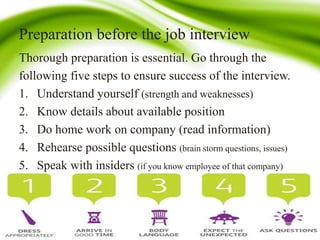
Preparation before the job interview
Thorough preparation is essential. Go through the
following five steps to ensure success of the interview.
1. Understand yourself (strength and weaknesses)
2. Know details about available position
3. Do home work on company (read information)
4. Rehearse possible questions (brain storm questions, issues)
5. Speak with insiders (if you know employee of that company)
Procedure during the job interview
The candidate have to…
 Give positive first impression (offer a warm handshake, show
pleasant smile)
 State your understanding of the interview
 Organize your answers
 Listen carefully (This task is difficult because you may desire to do
most of the talking, avoid confrontation)
 Ask thoughtful questions (About company, Position)
 Offer a conclusion
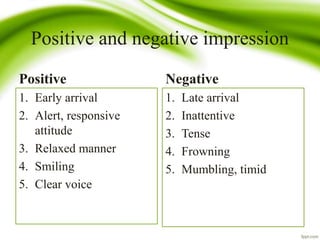
Positive and negative impression
Positive
1. Early arrival
2. Alert, responsive
attitude
3. Relaxed manner
4. Smiling
5. Clear voice
Negative
1. Late arrival
2. Inattentive
3. Tense
4. Frowning
5. Mumbling, timid
TELEPHONING
Telephone is important for business communication and
it is used extensively in international communication
DICTATING
Dyadic communication is direct communication
between two persons.
Dictation is oral communication between two people
but with twist. You speak to someone either directly or
via some electronic device.
Strategies
for successful
business and
group meetings
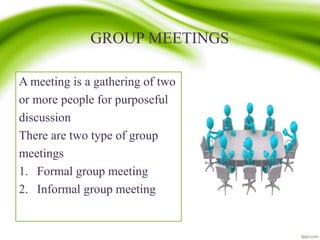
GROUP MEETINGS
A meeting is a gathering of two
or more people for purposeful
discussion
There are two type of group
meetings
1. Formal group meeting
2. Informal group meeting
TYPES OF GROUP MEETING
1. Formal group meeting:
Formal meetings are clear and planned, the purpose
meeting is to change the policy, make decision to
solve the meeting.
2. Informal group meeting:
Informal meetings are common, unplanned, chat over
coffee, meeting after work or get together for purely
social occasion
PURPOSES AND KINS OF MEETING
Meetings have two core purposes, both purposes occur
in all meetings
1. To present information
2. To solve problem
KINDS OF MEETINGS:
There are three kinds of meetings.
1. Informational meeting
2. Suggested solution meeting
3. Problem solving meeting
INFORMATIONAL MEETING
Informational meetings only seek to clarify, to make
something clear to give information.
 Change in reporting procedure
 Company strategic plans
 Announcement of the new mission statement
 Retirement planning
 Cultural difference
 Documents needed for working with other countries
SUGGESTED SOLUTION MEETING
Suggested solution meetings visualize the situation
receive input from staff on issue and review preliminary
recommendations before solving the issue.
PROBLEM SOLVING MEETING
Problem solving meeting required the most careful
planning and supervision by the leader.
problem, solution, benefit and steps for action are
discuss in problem solving meetings.
Business communication

Business communication

  • 2.
  • 3.
  • 4.
    STRATEGIES FOR SUCCESSFULSPEAKING AND SUCCESSFUL LISTENING This chapter consist of three Basic Parts: 1. Strategies for Improving Oral Presentation 2. Strategies for Reducing Stage Fright 3. Strategies for improving listening
  • 5.
    STRATEGIES FOR IMPROVING ORALPRESENTATION To make our presentation meaningful, we need strategy. This section takes us through the steps needed to be effective in oral communication. 1. Steps for Preparing Oral Presentation 2. Kinds of Oral Presentation 3. Ways of Delivering Oral Message 4. Strategies for Using an Effective Oral Delivery 5. Strategies for Effective Non-Verbal Delivery
  • 6.
    STEPS FOR ANEFFECTIVE ORAL PRESENTATION To make a presentation successful  Determine the Purpose  Analyze the Audience & Occasion  Select the main Ideas for the Message  Research the Topic  Organize Data and Write the Draft  Create Visual Aids  Rehearse the Talk
  • 7.
    KINDS OF ORALPRESENTATION Presentations are organized for different purposes such as  Information  Persuasion  Entertainment NOTE: “The longer the presentation the higher the risk of losing an audience attention”
  • 8.
    WAYS OF DELIVERINGORAL PRESENTATION  Extemporaneous  Reading  Memorization  Impromptu
  • 9.
    STRATEGIES FOR ANEFFECTIVE ORAL DELIVERY Your voice is your trade mark that add the human elements in your words. You can give extra life to your delivery in five traditional ways.  Pitch  Rate  Volume  Vocal quality  Pronunciation
  • 10.
    STRATEGIES FOR ANEFFECTIVE NON VERBAL DELIVERY Non verbal symbols exists for every culture even subculture. Knowing for the desirable and undesirable cues helps in knowing both intended and unintended Communication errors.  Posture  Movement  Gestures  Facial expressions  Appearance
  • 11.
    STRATEGIES FOR REDUCINGSTAGE FRIGHT Being at ease or simply giving the impression of being at ease is difficult for most people.  Know your subject well  Rehearse your talk several times  Recheck equipment you will need (projector, screen)  Take an object with you (pen, marking pencil)  Breathe deeply and slowly before speaking  Move during the speech
  • 12.
    SIGNS OF DISCOMFORT Heartrate increases Blood pressure & body temperature rises mouth feel dry
  • 13.
    STRATEGIES FOR IMPROVINGLISTENING Listening is neglected in school, college even manager but it is an significant part of ones communication skills.  Be prepared (Assignments responsibilities)  Accent the positive (if you have to do it, do it with a positive attitude)  Listen to understand, no refute (try to understand the points he emphasis and why he has such feeling)  Focus your attention (construct a mental outline where the speaker is going)  Concentrate on context  Take notes (jot down ideas, even incomplete sentences or single words)  Curb the impulse to interrupt (listen attentively until the speaker invites questions)  Summarize and evaluate
  • 14.
  • 15.
    STRATEGIES FOR SUCCESSFULINFORMATION AND PERSUASIVE SPEAKING Oral communication is our most used mode of Communication.
  • 16.
    Purpose of informativeand persuasive speaking Oral communication has two purposes 1. General / Macro purpose 2. Specific / Micro purpose
  • 17.
    Kinds of informativeand persuasive speaking Informative speaking:- There are four types of informative situations in business communication.  Reports  Goodwill (for positive company image in the community)  Briefings (Problem solving session)  instruction
  • 18.
    Kinds of informativeand persuasive speaking Persuasive speaking:- Opportunities to persuade are endless it is classified into four major categories  Policy (course of action to be taken or not)  Procedure (steps for implementing policy)  Value (credibility of speaker)  Facts (present situation, past performance and future plans)
  • 19.
    Audience analysis forinformative and persuasive speaking Knowing as much about your audience as you can decrease your chance of making either content to attitudinal errors. 1. Interest and attitude of audience 2. Occasion 3. Location
  • 20.
    Organization for informativeand persuasive speaking Organize the data in to logical pattern  Introduction  Body  Conclusion
  • 21.
    Supports for informativeand persuasive speaking Good oral communication depend upon three bases  Ethos (concern your credibility as a speaker)  Pathos (using emotion to support your idea)  Logos (emphasis on both written and oral persuasion)
  • 22.
  • 23.
    STRATEGIES FOR SUCCESSFUL INTERPERSONALCOMMUNICATION Face to face communication is the most common form of communication with in organization. Exchange of information between two persons is called dyadic communication Forms of interpersonal communication are 1. Interviewing 2. Telephoning 3. Dictating
  • 24.
    Interviewing The job interviewmay be the most intense dyadic communication
  • 25.
    Purpose of interview Seekposition Candidates speak with company representive Informing on job Job requirements, job experience Solving problem Facts are collected and decision is made Supporting solution Information is collected and arguments are planned to persuade Counseling employee Facts are used to support contention that employee needs help Evaluating employee Job performance review form is discussed Gathering information Data are gathered on why employees leave; emphasis is on event not personalities
  • 26.
    Preparation before thejob interview Thorough preparation is essential. Go through the following five steps to ensure success of the interview. 1. Understand yourself (strength and weaknesses) 2. Know details about available position 3. Do home work on company (read information) 4. Rehearse possible questions (brain storm questions, issues) 5. Speak with insiders (if you know employee of that company)
  • 27.
    Procedure during thejob interview The candidate have to…  Give positive first impression (offer a warm handshake, show pleasant smile)  State your understanding of the interview  Organize your answers  Listen carefully (This task is difficult because you may desire to do most of the talking, avoid confrontation)  Ask thoughtful questions (About company, Position)  Offer a conclusion
  • 28.
    Positive and negativeimpression Positive 1. Early arrival 2. Alert, responsive attitude 3. Relaxed manner 4. Smiling 5. Clear voice Negative 1. Late arrival 2. Inattentive 3. Tense 4. Frowning 5. Mumbling, timid
  • 29.
    TELEPHONING Telephone is importantfor business communication and it is used extensively in international communication
  • 30.
    DICTATING Dyadic communication isdirect communication between two persons. Dictation is oral communication between two people but with twist. You speak to someone either directly or via some electronic device.
  • 31.
  • 32.
    GROUP MEETINGS A meetingis a gathering of two or more people for purposeful discussion There are two type of group meetings 1. Formal group meeting 2. Informal group meeting
  • 33.
    TYPES OF GROUPMEETING 1. Formal group meeting: Formal meetings are clear and planned, the purpose meeting is to change the policy, make decision to solve the meeting. 2. Informal group meeting: Informal meetings are common, unplanned, chat over coffee, meeting after work or get together for purely social occasion
  • 34.
    PURPOSES AND KINSOF MEETING Meetings have two core purposes, both purposes occur in all meetings 1. To present information 2. To solve problem KINDS OF MEETINGS: There are three kinds of meetings. 1. Informational meeting 2. Suggested solution meeting 3. Problem solving meeting
  • 35.
    INFORMATIONAL MEETING Informational meetingsonly seek to clarify, to make something clear to give information.  Change in reporting procedure  Company strategic plans  Announcement of the new mission statement  Retirement planning  Cultural difference  Documents needed for working with other countries
  • 36.
    SUGGESTED SOLUTION MEETING Suggestedsolution meetings visualize the situation receive input from staff on issue and review preliminary recommendations before solving the issue.
  • 37.
    PROBLEM SOLVING MEETING Problemsolving meeting required the most careful planning and supervision by the leader. problem, solution, benefit and steps for action are discuss in problem solving meetings.