By Keerthana Nair
   Introduction
   Difference between oral and written
    communication
   Conversational skills
   Telephone skills
   Public speaking
   Presentation skills
   Listening skills
   Questioning skills
   Feedback skills
   Group discussion
   Effective communication

   Methods to express thoughts

   Managerial management

   Common function
Written communication               Oral communication

1.nature:
Written communication is            Oral communication is
formal in nature and it is rigid.   informal and is free from all
                                    formalities.

Record keeping:                     Oral communication does
Written communication acts          not act like evidence. Record
like evidence , it is permanent     of oral communication
record e.g. letter and              cannot be maintained.
documents which can be
preserved for years.


Time element:                       Oral communication can be
Written communication is            made quickly, there is no
time-consuming and slow.            wastage of time.
Misunderstanding:                        Oral communication is sometimes
There are less chances of written        misunderstood.
communication to be misunderstood


Accuracy:                                Whereas in oral communication there
Written communication there is more      is less accuracy.it may be casual.
accuracy. while drafting letters more
care can be taken.

Language and possibility of change:      Language used is more subject to
In written communication, language       change.
used is less subject to change.


Utility:                                 a) Is good when a brief message is to
a) Very useful when legal documents         be communicated or an order is to
   are to be prepared                       be placed.
b) Can reach only literate hence it is   b) Can reach illiterate as well as semi
   of limited use.                          illitrate;hence it can be used
                                            effectively.
   Essential
   Development of good conversation skills
   Good conversationalist are good listeners
   Benefits
   Business environment
   Looking at the people who are
    talking.
   Choosing words that are not
    offensive or confusing to
    others.
   Giving other people a chance to
    talk.
   Avoid fidgeting, looking away
    or yawning.
   Taking turns in the
    conversation and saying
    "excuse me "when interruption
    of others occur.
   Crucial managerial skill
    Telephone manner and courtesy
    Control your voice
    Pay attention to:
a)   Pitch-index of your confidence
b)   Volume-should be loud enough
c)   Rate-your message wont get through
d)   Quality-essence of warmth
e)   Articulation - pronounciation must be clear
   4 things to be remembered while greeting:
   Welcome your caller
   Announce the name of your organization
   Introduce yourself
   Let them know you are here to help them.
   Identify yourself
   Offer explanation
   Pause to prepare to listen
   Listen as if you will report
   Eliminate clutter
   Choose your time
   Admit your problem
   Important method
   Preparing and delivery
   Aware of goals
   Knowledge about subject matter
   Speaking from a
    manuscript
   Speaking from
    memory
   Impromptu delivery
   Extemporaneous
    delivery
   TIPS FOR
    SUCCESSFUL
    PUBLIC SPEAKING:
   Know the room.be familiar
    with the place in which you
    will speak.
   Know the audience. Greet
    the audience. Its easier to
    speak to a group of friends
    than to group of strangers.
   Don’t apologize. If you mention your
    nervousness for any problems you think you
    have with your speech, you may be calling
    the audience attention to something they
    hadn’t noticed. Keep silent.
   Concentrate on the message-not the medium.
    Focus your attention away from your own
    anxieties, and outwardly toward your
    message and your audience.
   Turn nervousness into positive energy.
   Dress appropriately
   Project self-confidence
   Make the listeners feel comfortable
   Make eye contact
   Use nonverbal medium as well
   Modulate your voice
   Speak clearly
   Use good grammar
   Choose words Carefully
   Be perceptive
   What is presentation?
   Presentation is a way of
    communicating ideas and
    information to a group.characterstics
    of a good presentation include:
   Content
   Structure
   Packaging
   Human element
   Strategy-purpose, audience, movement, eye-
    contact.
   Delivering-tone, fluency, confidence, context.
   Handling Q/A-plan, listen, answer,
    consistent.
   Designing visual aids- neat, purposeful,
    consistent.
   Preparing your presentation
   Presentation room and visual aids
   Rehearsing
   Appearance and approach
   Discussion
   Evaluation
   Dealing with nerves
   Handling Q/A
   Use large, bold sans-serif fonts between 24 and
    36pt
   Keep your slides simple
   The 6*6 or 3*3 rule
   Choose appropriate medium for visual aids
   Creating visual aids
   Using visual aids
   Underestimate the sensitivity of an audience.
   Use contemporary colloquialisms
   Touch audience members
   Be defensive
   Lose your temper
   Talk to yourself under your breath
   Waste time at the beginning
   Basic listening modes:
   Competitive or combative listening
   Passive or attentive listening
   Active or reflective listening
   Types of listening:
   Discriminative listening
   Comprehensive listening
   Critical listening
   Empathic listening
   A disparity between the speed at
    which we normally speak and the
    speed at which our brain can process
    data.
   A desire to keep control of the
    conversation.
   Difficulty by the listener.
   A desire to demonstrate intelligence
    and skills by trying to give the
    answer before fully hearing the
    question.
   To avoid listening errors
    caused by inattention.
   To avoid listening errors
    caused by self-absorption.
   To reduce listening errors
    caused by misinterpretation.
   To avoid listening errors
    caused by focusing solely on
    facts.
principle              Good listener               Bad listener
1.Look for areas of    Seeks personal              Turns out dry subjects ,
interest               enlighten/ information,     narrowly defines what is
                       entertains new topics as    interesting.
                       potentially interesting.
2.Overlook errors of   Attends to meeting and      Ignores if delivery is poor ,
delivery               content, ignores delivery   misses messages because of
                       errors while being          personal attributes of the
                       sensitive to any message    communicator.
                       in them.
Postpone judgment      Avoid quick judgments,      Quickly evaluates and
                       waits until                 passes judgement,inflexible
                       comprehension of the        regarding contrary
                       core message is             messages.
                       complete.
Listen for idea        Take careful notes and      Listen for facts and ideas.
                       uses a variety of note
                       taking or recording
                       schemes depending on
                       the speaker.
principle       Good listener                     Bad listener

Be actively     Responds frequently               Little energy output
responsive
Challenge       Use difficult material to         Avoids difficult
your mind       stimulate the mind, seeks to      material, does not
speed           enlarge understanding.            seek to broaden
                                                  knowledge base.

Capitalize on   Uses listening time to            Daydreams with slow
mind speed      summer4ises and anticipate        speakers, becomes
                the messages, attends to          preoccupied with
                implicit message.                 other thoughts.

Assist and      Asks for clarifying information   Interrupts, asks
encourage the   or examples, uses reflecting      trivial questions,
speaker         phrases, helps to rephrase the    makes distracting
                idea.                             comments.
Take notes      Take careful notes and uses a     Takes incomplete
                variety of note taking or         note using one
                recording schemes depending       system.
                on the speaker.
   Main types of questions:
   Factual questions
   Interpretive questions
   Evaluative questions
   Direct questions
   Return questions
   General questions
   Hypothetical questions
   Probing questions
   The echo questions
   Leading questions
   Strategic questions
   Powerful questions
   Effective questions
   The ability to give and receive feedback
    is the most important communication
    skill that helps in working through any
    problem.
   Use softeners and tell the person what
    SPECIFIC behavior would be useful for
    them to change and improve.
   Always use softeners like `I wonder
    if…’,`perhaps you could…’.
   Do not use command words like 'you
    should….’,`you need to…’.
   How to give effective feed???
   Clarity
   Emphasize the positive
   Be specific
   Focus on behavior rather than the person
   Own the feedback-use `I’ statements.
   Generalizations
   Be very careful with advice
   Be descriptive
   Avoid using labels
   Don`t exaggerate
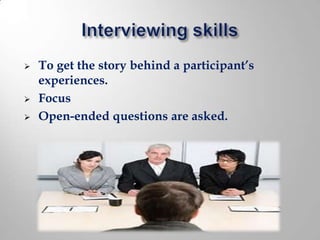
   To get the story behind a participant’s
    experiences.
   Focus
   Open-ended questions are asked.
   Informal, conversational interview-

   General interview guide approach-

   Standardized, open-ended interview-

   Closed, fixed-response interview-
   Behaviors
   Opinion/values
   Feelings
   Knowledge
   Sensory
   Background/demographics
Sequence of questions:


1)   Get the respondents involve in the interview
     as soon as possible.
2)   Before asking about controversial matters,
     first ask about some facts.
3)   Ask questions about the present before
     questions about the past or future.
Wording of questions:

   Wording should be open-ended

   Questions should be as neutral as possible

   Questions should be asked one at time

   Questions should be worded clearly

   Be careful asking “why "questions
    Guidelines for facing the job interview:
1.    Tell me about yourself
2.    Where do you see yourself in five years
3.    Who are your favorite references
4.    Have you ever owned your own business
5.    What is your greatest strength
6.    Are you a risk taker
7.    Are you self starter
8.    How well do you handle change
9.    How do you react to criticism from supervisors that
      you consider to be unjust
10.   How do you resolve disputes with co-workers and
      handle conflict
   Group process or team
    building exercise
   Used in the selection
    process
   Team player
   Reasoning ability
   Leadership
   Flexibility
   Assertiveness
   Initiative
   Creativity
   Inspiring ability
   Listening
   Awareness
   Interpersonal skills
   Persuasive skills
   Conceptualizing skills
   Problem solving skills
   Positive interdependence
   Face-to-face interaction and advocacy
   Individual accountability
   Group processing
   Getting started
    how to reframe disagreements in
    constructive way
   Common mistakes in group
    discussion
   Quality v/s quantity
   Egotism showing off
   Get noticed-but for right reasons
   Managing ones insecurities
Oral communication (2)

Oral communication (2)

  • 1.
  • 2.
    Introduction  Difference between oral and written communication  Conversational skills  Telephone skills  Public speaking  Presentation skills  Listening skills  Questioning skills  Feedback skills  Group discussion
  • 3.
    Effective communication  Methods to express thoughts  Managerial management  Common function
  • 4.
    Written communication Oral communication 1.nature: Written communication is Oral communication is formal in nature and it is rigid. informal and is free from all formalities. Record keeping: Oral communication does Written communication acts not act like evidence. Record like evidence , it is permanent of oral communication record e.g. letter and cannot be maintained. documents which can be preserved for years. Time element: Oral communication can be Written communication is made quickly, there is no time-consuming and slow. wastage of time.
  • 5.
    Misunderstanding: Oral communication is sometimes There are less chances of written misunderstood. communication to be misunderstood Accuracy: Whereas in oral communication there Written communication there is more is less accuracy.it may be casual. accuracy. while drafting letters more care can be taken. Language and possibility of change: Language used is more subject to In written communication, language change. used is less subject to change. Utility: a) Is good when a brief message is to a) Very useful when legal documents be communicated or an order is to are to be prepared be placed. b) Can reach only literate hence it is b) Can reach illiterate as well as semi of limited use. illitrate;hence it can be used effectively.
  • 6.
    Essential  Development of good conversation skills  Good conversationalist are good listeners  Benefits  Business environment
  • 7.
    Looking at the people who are talking.  Choosing words that are not offensive or confusing to others.  Giving other people a chance to talk.  Avoid fidgeting, looking away or yawning.  Taking turns in the conversation and saying "excuse me "when interruption of others occur.
  • 8.
    Crucial managerial skill  Telephone manner and courtesy  Control your voice  Pay attention to: a) Pitch-index of your confidence b) Volume-should be loud enough c) Rate-your message wont get through d) Quality-essence of warmth e) Articulation - pronounciation must be clear
  • 9.
    4 things to be remembered while greeting:  Welcome your caller  Announce the name of your organization  Introduce yourself  Let them know you are here to help them.  Identify yourself  Offer explanation
  • 10.
    Pause to prepare to listen  Listen as if you will report  Eliminate clutter  Choose your time  Admit your problem
  • 11.
    Important method  Preparing and delivery  Aware of goals  Knowledge about subject matter
  • 12.
    Speaking from a manuscript  Speaking from memory  Impromptu delivery  Extemporaneous delivery
  • 13.
    TIPS FOR SUCCESSFUL PUBLIC SPEAKING:  Know the room.be familiar with the place in which you will speak.  Know the audience. Greet the audience. Its easier to speak to a group of friends than to group of strangers.
  • 14.
    Don’t apologize. If you mention your nervousness for any problems you think you have with your speech, you may be calling the audience attention to something they hadn’t noticed. Keep silent.  Concentrate on the message-not the medium. Focus your attention away from your own anxieties, and outwardly toward your message and your audience.  Turn nervousness into positive energy.
  • 15.
    Dress appropriately  Project self-confidence  Make the listeners feel comfortable  Make eye contact  Use nonverbal medium as well  Modulate your voice  Speak clearly  Use good grammar  Choose words Carefully  Be perceptive
  • 16.
    What is presentation?  Presentation is a way of communicating ideas and information to a group.characterstics of a good presentation include:  Content  Structure  Packaging  Human element
  • 17.
    Strategy-purpose, audience, movement, eye- contact.  Delivering-tone, fluency, confidence, context.  Handling Q/A-plan, listen, answer, consistent.  Designing visual aids- neat, purposeful, consistent.
  • 18.
    Preparing your presentation  Presentation room and visual aids  Rehearsing  Appearance and approach  Discussion  Evaluation  Dealing with nerves  Handling Q/A
  • 19.
    Use large, bold sans-serif fonts between 24 and 36pt  Keep your slides simple  The 6*6 or 3*3 rule  Choose appropriate medium for visual aids  Creating visual aids  Using visual aids
  • 20.
    Underestimate the sensitivity of an audience.  Use contemporary colloquialisms  Touch audience members  Be defensive  Lose your temper  Talk to yourself under your breath  Waste time at the beginning
  • 21.
    Basic listening modes:  Competitive or combative listening  Passive or attentive listening  Active or reflective listening
  • 22.
    Types of listening:  Discriminative listening  Comprehensive listening  Critical listening  Empathic listening
  • 23.
    A disparity between the speed at which we normally speak and the speed at which our brain can process data.  A desire to keep control of the conversation.  Difficulty by the listener.  A desire to demonstrate intelligence and skills by trying to give the answer before fully hearing the question.
  • 24.
    To avoid listening errors caused by inattention.  To avoid listening errors caused by self-absorption.  To reduce listening errors caused by misinterpretation.  To avoid listening errors caused by focusing solely on facts.
  • 25.
    principle Good listener Bad listener 1.Look for areas of Seeks personal Turns out dry subjects , interest enlighten/ information, narrowly defines what is entertains new topics as interesting. potentially interesting. 2.Overlook errors of Attends to meeting and Ignores if delivery is poor , delivery content, ignores delivery misses messages because of errors while being personal attributes of the sensitive to any message communicator. in them. Postpone judgment Avoid quick judgments, Quickly evaluates and waits until passes judgement,inflexible comprehension of the regarding contrary core message is messages. complete. Listen for idea Take careful notes and Listen for facts and ideas. uses a variety of note taking or recording schemes depending on the speaker.
  • 26.
    principle Good listener Bad listener Be actively Responds frequently Little energy output responsive Challenge Use difficult material to Avoids difficult your mind stimulate the mind, seeks to material, does not speed enlarge understanding. seek to broaden knowledge base. Capitalize on Uses listening time to Daydreams with slow mind speed summer4ises and anticipate speakers, becomes the messages, attends to preoccupied with implicit message. other thoughts. Assist and Asks for clarifying information Interrupts, asks encourage the or examples, uses reflecting trivial questions, speaker phrases, helps to rephrase the makes distracting idea. comments. Take notes Take careful notes and uses a Takes incomplete variety of note taking or note using one recording schemes depending system. on the speaker.
  • 27.
    Main types of questions:  Factual questions  Interpretive questions  Evaluative questions
  • 28.
    Direct questions  Return questions  General questions  Hypothetical questions  Probing questions  The echo questions  Leading questions  Strategic questions  Powerful questions  Effective questions
  • 29.
    The ability to give and receive feedback is the most important communication skill that helps in working through any problem.  Use softeners and tell the person what SPECIFIC behavior would be useful for them to change and improve.  Always use softeners like `I wonder if…’,`perhaps you could…’.  Do not use command words like 'you should….’,`you need to…’.
  • 30.
    How to give effective feed???  Clarity  Emphasize the positive  Be specific  Focus on behavior rather than the person  Own the feedback-use `I’ statements.  Generalizations  Be very careful with advice
  • 31.
    Be descriptive  Avoid using labels  Don`t exaggerate
  • 32.
    To get the story behind a participant’s experiences.  Focus  Open-ended questions are asked.
  • 33.
    Informal, conversational interview-  General interview guide approach-  Standardized, open-ended interview-  Closed, fixed-response interview-
  • 34.
    Behaviors  Opinion/values  Feelings  Knowledge  Sensory  Background/demographics
  • 35.
    Sequence of questions: 1) Get the respondents involve in the interview as soon as possible. 2) Before asking about controversial matters, first ask about some facts. 3) Ask questions about the present before questions about the past or future.
  • 36.
    Wording of questions:  Wording should be open-ended  Questions should be as neutral as possible  Questions should be asked one at time  Questions should be worded clearly  Be careful asking “why "questions
  • 37.
    Guidelines for facing the job interview: 1. Tell me about yourself 2. Where do you see yourself in five years 3. Who are your favorite references 4. Have you ever owned your own business 5. What is your greatest strength 6. Are you a risk taker 7. Are you self starter 8. How well do you handle change 9. How do you react to criticism from supervisors that you consider to be unjust 10. How do you resolve disputes with co-workers and handle conflict
  • 38.
    Group process or team building exercise  Used in the selection process  Team player  Reasoning ability  Leadership  Flexibility  Assertiveness
  • 39.
    Initiative  Creativity  Inspiring ability  Listening  Awareness  Interpersonal skills  Persuasive skills  Conceptualizing skills  Problem solving skills
  • 40.
    Positive interdependence  Face-to-face interaction and advocacy  Individual accountability  Group processing
  • 41.
    Getting started  how to reframe disagreements in constructive way  Common mistakes in group discussion  Quality v/s quantity  Egotism showing off  Get noticed-but for right reasons  Managing ones insecurities