Building 
Your Career Success 
With Communication 
Skills
COMMUNICATION 
• Communication can be defined as the process by 
which people share ideas, experience, knowledge 
and feelings through the transmission of symbolic 
messages. 
• The means of communication are usually spoken 
or written words, pictures or symbols. 
• But we also give information through body 
language, gestures, and looks, facial expressions 
can show how we feel and what we think about an 
issue or another person
TYPES OF 
COMMUNICATION 
• Communication can be classified into 
following types- 
• 1.FORMAL AND INFORMAL 
• 2.ORAL AND WRITTEN 
• 3.INTERNAL AND EXTERNAL 
• 4.VERBAL AND NON-VERBAL
FORMAL COMMMUNICATION 
• When we consider style and purpose we can divide it into two sub groups, formal 
communication and informal communication. 
• Formal communication includes all forms of formal exchanges of information. 
• Business communication and corporate communication are some of the formal 
communication methods. 
• Formal communication is that which devices support from the organisation 
structure. 
• .It is associated with the particular positions of the communicator and the recipient 
in the structure. 
• Formal communications are mostly of the written type such as company manuals, 
handbooks magazines, bulletins annual reports and are designed to meet the specific 
need s of the organization
INFORMAL COMMUNICATION 
• Informal communication is the opposite of the above. 
• It is a form of casual conversation or exchange of 
communication. 
• This type of co 
• mmunication happens out side of the business or corporate 
community or between freely understanding parties. 
• There are no strong rules or guidelines; the only rule is that 
all the parties should be able to understand each other. This 
kind of communication does not require a certain topic. It is 
just normal conversation between known people
• This kind of communication does not require a certain topic. 
• It is just normal conversation between known people. 
• Informal communication is based on the informal 
relationships that grow up in an organisation and is commonly 
referred to as "the grapevine". 
• It may be conveyed by a nod, a glance, a gesture, a smile, and 
even silence. 
• The two or more parties in concern should understand a 
common language or method of communication.
ORAL COMMUNICATION 
• Oral communication implies communication through mouth. 
• It includes individuals conversing with each other, be it direct 
conversation or telephonic conversation. 
• Speeches, presentations, discussions are all forms of oral 
communication. 
• Oral communication is generally recommended when the 
communication matter is of temporary kind or where a direct interaction 
is required. 
• Face to face communication (meetings, lectures, conferences, interviews, 
etc.) is significant so as to build a rapport and trust. 
• Oral communication is not only time saving, but it also saves upon 
money and efforts. 
• Oral communication is best in case of problem resolution. The conflicts, 
disputes and many issues/differences can be put to an end by talking 
them over.
WRITTEN COMMUNICATION 
• Written communication has great significance in 
today’s business world. 
• It is an innovative activity of the mind. Effective written 
communication is essential for preparing worthy 
promotional materials for business development. 
• Effective writing involves careful choice of words, their 
organization in correct order in sentences formation as 
well as cohesive composition of sentences
INTERNAL COMMUNICATION 
• Communication within an organization is known as 
internal communication,which is usually formal. 
• Internal communication helps in achieving an 
organisation’s goals by informing the members of the 
general and specific objectives of the organization either 
at the macro or at the micro level. 
• It is only through internal communication that this 
information is distributed to various departments and 
employees within the organization. 
• Letters,reports,instructions,seminars,etc.are methods of 
transmitting information.
EXTERNAL 
COMMUNICATION 
• To expand the boundaries of business, a good 
relationship with other external organization is a 
must. 
• This requires a sound communication strategy. 
• All official ,technical or professional 
communication with people outside the 
organization is known as external communication. 
• This mode is equally important, as it helps in 
achieving an organization’s goals by coordinating 
with external agencies.
VERBAL COMMUNICATION 
• . We can categorize verbal communication into two 
parts, oral communication and written communication. 
• Oral communication is when two or more parties 
communicate verbally with words. 
• The other type is written communication. Written 
communication can happen through normal mail, e-mail, 
or any other form of documented writing.
NON-VERBAL 
COMMUNICATION 
• Non-verbal communication is mostly body 
language. It is possible to understand what 
a person is trying to say or how he/she is 
feeling. 
• It is also possible to tell the mood of a 
person by bodily and facial expressions. 
• Facial expressions are very important as 
well. Facial expressions give out what the 
person is feeling.
Cont… 
• The face is the first thing we notice in a 
person and the facial muscles give out 
most of the human expressions. Pictures, 
sign boards and photographs are also a 
part of non-verbal communication.
Communication skills are essential for 
 Job placement 
 Job performance 
 Career advancement 
 Success in the new world of work
Projecting Professionalism 
When You Communicate
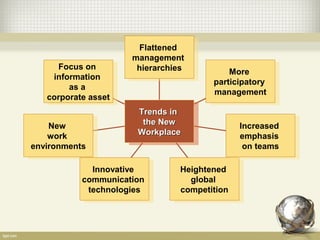
Focus on 
information 
Focus on 
information 
as a 
as a 
corporate asset 
corporate asset 
New 
work 
New 
work 
environments 
environments 
Flattened 
management 
hierarchies 
TTrreennddss iinn 
tthhee NNeeww 
WWoorrkkppllaaccee 
Innovative 
communication 
technologies 
Innovative 
communication 
technologies 
More 
participatory 
management 
participatory 
management 
Heightened 
global 
competition 
Heightened 
global 
competition 
More 
Increased 
emphasis 
on teams 
Increased 
emphasis 
on teams 
Flattened 
management 
hierarchies 
TTrreennddss iinn 
tthhee NNeeww 
WWoorrkkppllaaccee
The Process of Communication
The Process of Communication 
Verbally or nonverbally. 
By speaking, writing, 
gesturing. 
HHooww mmaayy tthhee sseennddeerr 
eennccooddee aa mmeessssaaggee?? 
Letters, e-mail, IM, 
memos, TV, cell phone, 
voice, body. Others? 
WWhhaatt kkiinnddss ooff 
cchhaannnneellss ccaarrrryy 
mmeessssaaggeess??
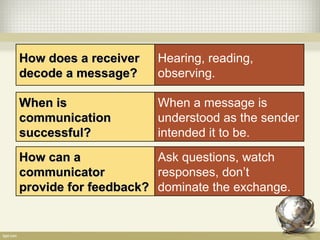
Hearing, reading, 
observing. 
HHooww ddooeess aa rreecceeiivveerr 
ddeeccooddee aa mmeessssaaggee?? 
When a message is 
understood as the sender 
intended it to be. 
WWhheenn iiss 
ccoommmmuunniiccaattiioonn 
ssuucccceessssffuull?? 
Ask questions, watch 
responses, don’t 
dominate the exchange. 
HHooww ccaann aa 
ccoommmmuunniiccaattoorr 
pprroovviiddee ffoorr ffeeeeddbbaacckk??
Barriers to Effective Listening 
• PPhhyyssiiccaall bbaarrrriieerrss 
• Hearing disabilities, noisy surroundings 
• PPssyycchhoollooggiiccaall bbaarrrriieerrss 
• Tuning out ideas that counter our values 
• LLaanngguuaaggee pprroobblleemmss 
• Unfamiliar or charged words 
• NNoonnvveerrbbaall ddiissttrraaccttiioonnss 
• Clothing, mannerisms, appearance
• TThhoouugghhtt ssppeeeedd 
• Our minds process thoughts faster than 
speakers express them 
• FFaakkiinngg aatttteennttiioonn 
• Pretending to listen 
• GGrraannddssttaannddiinngg 
• Talking all the time or listening only for the 
next pause
Tips for Becoming an 
Active Listener 
• Stop talking. 
• Control your surroundings. 
• Establish a receptive mind-set. 
• Listen for main points. 
• Capitalize on lag time. 
• Listen between the lines.
• Judge ideas, not appearances. 
• Hold your fire. 
• Take selective notes. 
• Provide feedback.
Nonverbal Communication 
• Eye contact, facial expression, and 
posture and gestures send silent 
messages.
• Time, space, and territory 
send silent messages. 
– Time (punctuality and 
structure of) 
– Space (arrangement of 
objects in) 
– Territory (privacy zones)
Tips for Improving 
Your Nonverbal Skills 
• Establish and maintain eye contact. 
• Use posture to show interest. 
• Improve your decoding skills. 
• Probe for more information. 
• Avoid assigning nonverbal meanings out of 
context. 
• Associate with people from diverse cultures. 
• Appreciate the power of appearance. 
• Observe yourself on videotape. 
• Enlist friends and family.
Culture and Communication 
• Good communication demands special 
sensitivity and skills when communicators 
are from different cultures.
Improving Communication With 
Multicultural Audiences 
• Oral Messages 
– Use simple 
English. 
– Speak slowly and 
enunciate clearly. 
– Encourage 
accurate 
feedback.
• Oral Messages (continued) 
– Check frequently for comprehension. 
– Observe eye messages. 
– Accept blame. 
– Listen without interrupting. 
– Remember to smile! 
– Follow up in writing.
• Written Messages 
– Adapt to local formats. 
– Consider hiring a translator. 
– Use short sentences and short paragraphs. 
– Avoid ambiguous wording. 
– Strive for clarity. 
– Cite numbers carefully.
Effective Communication With 
Diverse Workplace Audiences 
• Understand the value of differences. 
• Don’t expect total conformity. 
• Create zero tolerance for bias and 
stereotypes. 
• Practice focused, thoughtful, and open-minded 
listening. 
• Invite, use, and give feedback.
• Make fewer workplace assumptions. 
• Learn about your own cultural self. 
• Learn about other 
cultures and 
identity groups. 
• Seek common 
ground.

Communication

  • 1.
    Building Your CareerSuccess With Communication Skills
  • 2.
    COMMUNICATION • Communicationcan be defined as the process by which people share ideas, experience, knowledge and feelings through the transmission of symbolic messages. • The means of communication are usually spoken or written words, pictures or symbols. • But we also give information through body language, gestures, and looks, facial expressions can show how we feel and what we think about an issue or another person
  • 3.
    TYPES OF COMMUNICATION • Communication can be classified into following types- • 1.FORMAL AND INFORMAL • 2.ORAL AND WRITTEN • 3.INTERNAL AND EXTERNAL • 4.VERBAL AND NON-VERBAL
  • 4.
    FORMAL COMMMUNICATION •When we consider style and purpose we can divide it into two sub groups, formal communication and informal communication. • Formal communication includes all forms of formal exchanges of information. • Business communication and corporate communication are some of the formal communication methods. • Formal communication is that which devices support from the organisation structure. • .It is associated with the particular positions of the communicator and the recipient in the structure. • Formal communications are mostly of the written type such as company manuals, handbooks magazines, bulletins annual reports and are designed to meet the specific need s of the organization
  • 5.
    INFORMAL COMMUNICATION •Informal communication is the opposite of the above. • It is a form of casual conversation or exchange of communication. • This type of co • mmunication happens out side of the business or corporate community or between freely understanding parties. • There are no strong rules or guidelines; the only rule is that all the parties should be able to understand each other. This kind of communication does not require a certain topic. It is just normal conversation between known people
  • 6.
    • This kindof communication does not require a certain topic. • It is just normal conversation between known people. • Informal communication is based on the informal relationships that grow up in an organisation and is commonly referred to as "the grapevine". • It may be conveyed by a nod, a glance, a gesture, a smile, and even silence. • The two or more parties in concern should understand a common language or method of communication.
  • 7.
    ORAL COMMUNICATION •Oral communication implies communication through mouth. • It includes individuals conversing with each other, be it direct conversation or telephonic conversation. • Speeches, presentations, discussions are all forms of oral communication. • Oral communication is generally recommended when the communication matter is of temporary kind or where a direct interaction is required. • Face to face communication (meetings, lectures, conferences, interviews, etc.) is significant so as to build a rapport and trust. • Oral communication is not only time saving, but it also saves upon money and efforts. • Oral communication is best in case of problem resolution. The conflicts, disputes and many issues/differences can be put to an end by talking them over.
  • 8.
    WRITTEN COMMUNICATION •Written communication has great significance in today’s business world. • It is an innovative activity of the mind. Effective written communication is essential for preparing worthy promotional materials for business development. • Effective writing involves careful choice of words, their organization in correct order in sentences formation as well as cohesive composition of sentences
  • 9.
    INTERNAL COMMUNICATION •Communication within an organization is known as internal communication,which is usually formal. • Internal communication helps in achieving an organisation’s goals by informing the members of the general and specific objectives of the organization either at the macro or at the micro level. • It is only through internal communication that this information is distributed to various departments and employees within the organization. • Letters,reports,instructions,seminars,etc.are methods of transmitting information.
  • 10.
    EXTERNAL COMMUNICATION •To expand the boundaries of business, a good relationship with other external organization is a must. • This requires a sound communication strategy. • All official ,technical or professional communication with people outside the organization is known as external communication. • This mode is equally important, as it helps in achieving an organization’s goals by coordinating with external agencies.
  • 11.
    VERBAL COMMUNICATION •. We can categorize verbal communication into two parts, oral communication and written communication. • Oral communication is when two or more parties communicate verbally with words. • The other type is written communication. Written communication can happen through normal mail, e-mail, or any other form of documented writing.
  • 12.
    NON-VERBAL COMMUNICATION •Non-verbal communication is mostly body language. It is possible to understand what a person is trying to say or how he/she is feeling. • It is also possible to tell the mood of a person by bodily and facial expressions. • Facial expressions are very important as well. Facial expressions give out what the person is feeling.
  • 13.
    Cont… • Theface is the first thing we notice in a person and the facial muscles give out most of the human expressions. Pictures, sign boards and photographs are also a part of non-verbal communication.
  • 15.
    Communication skills areessential for  Job placement  Job performance  Career advancement  Success in the new world of work
  • 16.
  • 19.
    Focus on information Focus on information as a as a corporate asset corporate asset New work New work environments environments Flattened management hierarchies TTrreennddss iinn tthhee NNeeww WWoorrkkppllaaccee Innovative communication technologies Innovative communication technologies More participatory management participatory management Heightened global competition Heightened global competition More Increased emphasis on teams Increased emphasis on teams Flattened management hierarchies TTrreennddss iinn tthhee NNeeww WWoorrkkppllaaccee
  • 20.
    The Process ofCommunication
  • 21.
    The Process ofCommunication Verbally or nonverbally. By speaking, writing, gesturing. HHooww mmaayy tthhee sseennddeerr eennccooddee aa mmeessssaaggee?? Letters, e-mail, IM, memos, TV, cell phone, voice, body. Others? WWhhaatt kkiinnddss ooff cchhaannnneellss ccaarrrryy mmeessssaaggeess??
  • 22.
    Hearing, reading, observing. HHooww ddooeess aa rreecceeiivveerr ddeeccooddee aa mmeessssaaggee?? When a message is understood as the sender intended it to be. WWhheenn iiss ccoommmmuunniiccaattiioonn ssuucccceessssffuull?? Ask questions, watch responses, don’t dominate the exchange. HHooww ccaann aa ccoommmmuunniiccaattoorr pprroovviiddee ffoorr ffeeeeddbbaacckk??
  • 23.
    Barriers to EffectiveListening • PPhhyyssiiccaall bbaarrrriieerrss • Hearing disabilities, noisy surroundings • PPssyycchhoollooggiiccaall bbaarrrriieerrss • Tuning out ideas that counter our values • LLaanngguuaaggee pprroobblleemmss • Unfamiliar or charged words • NNoonnvveerrbbaall ddiissttrraaccttiioonnss • Clothing, mannerisms, appearance
  • 24.
    • TThhoouugghhtt ssppeeeedd • Our minds process thoughts faster than speakers express them • FFaakkiinngg aatttteennttiioonn • Pretending to listen • GGrraannddssttaannddiinngg • Talking all the time or listening only for the next pause
  • 25.
    Tips for Becomingan Active Listener • Stop talking. • Control your surroundings. • Establish a receptive mind-set. • Listen for main points. • Capitalize on lag time. • Listen between the lines.
  • 26.
    • Judge ideas,not appearances. • Hold your fire. • Take selective notes. • Provide feedback.
  • 27.
    Nonverbal Communication •Eye contact, facial expression, and posture and gestures send silent messages.
  • 28.
    • Time, space,and territory send silent messages. – Time (punctuality and structure of) – Space (arrangement of objects in) – Territory (privacy zones)
  • 29.
    Tips for Improving Your Nonverbal Skills • Establish and maintain eye contact. • Use posture to show interest. • Improve your decoding skills. • Probe for more information. • Avoid assigning nonverbal meanings out of context. • Associate with people from diverse cultures. • Appreciate the power of appearance. • Observe yourself on videotape. • Enlist friends and family.
  • 30.
    Culture and Communication • Good communication demands special sensitivity and skills when communicators are from different cultures.
  • 31.
    Improving Communication With Multicultural Audiences • Oral Messages – Use simple English. – Speak slowly and enunciate clearly. – Encourage accurate feedback.
  • 32.
    • Oral Messages(continued) – Check frequently for comprehension. – Observe eye messages. – Accept blame. – Listen without interrupting. – Remember to smile! – Follow up in writing.
  • 33.
    • Written Messages – Adapt to local formats. – Consider hiring a translator. – Use short sentences and short paragraphs. – Avoid ambiguous wording. – Strive for clarity. – Cite numbers carefully.
  • 34.
    Effective Communication With Diverse Workplace Audiences • Understand the value of differences. • Don’t expect total conformity. • Create zero tolerance for bias and stereotypes. • Practice focused, thoughtful, and open-minded listening. • Invite, use, and give feedback.
  • 35.
    • Make fewerworkplace assumptions. • Learn about your own cultural self. • Learn about other cultures and identity groups. • Seek common ground.