Page 1
UNIVERSITY OF KARACHI
KARACHI UNIVERSITY BUSINESS SCHOOL
MBA Banking & Finance 2014
Semester: II
NEGOTIABLE INSTRUMENT
Act 1881
Page 2
DEDICATED TO
Our teacher whose teaching and enlightenment inspired and
enabled us to write this report
&
Our parents who supported us at every stage of our busy
schedule during the preparation of this report
Page 3
ACKNOWLEDGEMENT
We offer our humblest thank to Allah and Hazrat Muhammad
(PBUH) from the deep of our heart that always provide us
guidance and blessings which are uncountable.
Our sincerest appreciation must be extended to
Who has given his comments, corrections and guided us at every step in
preparing this report
AND Group Members
Page 4
CONTENTS
What is negotiable instrument…………………………………………………………………………….5
Characteristics of negotiable instruments…………………………………………………………………6
Elements of negotiable instruments……………………………………………………………………....7
Types of negotiable instruments………………………………………………………………………….8
Classification of negotiable instruments………………………………………………………………….9
Documents NOT negotiable instruments…………………………………………………………………9
Promissory note………………………………………………………………………………………….10
Bill of exchange……………………………………………………………………………………….…..11
Cheque………………………………………………………………………………………………..…..12
Negotiation………………………………………………………………………………………………..13
Presentment………………………………………………………………………………………………..13
Page 5
What is Negotiable Instrument?
 The term negotiable instruments mean a written documenting
which entitles a person to a sum of money.
 A Negotiable Instrument is transferable by delivery or by
endorsement and delivery
 The transfer entitle a person to the some of money mentioned
therein
 Thus the negotiable instrument is a document which is legally
recognized by custom of
 trade or law, transferable by delivery or by endorsement and
delivery
Page 6
CHRACTERSTICS OF NEGOTIABLE INSTRUMENT
 Freelytransferable:-
The property in a negotiable instrument passes from one person to another by a
simple process, i.e., by mere delivery if it is payable to bearer, and by
endorsement and delivery if it is payable to order
 Holder’s title free from all defects:-
The holder in due course (one who acquires the instrument in good faith and for
consideration) gets it free from all defects
 Recovery:-
One can sue upon the instrument in his own name
 Payable to order or bearer: -
It must be payable either to order or bearer
 Presumption as to Holder:-
Every holder of negotiable instrument is presumed to be holder in due course
 Presumption as to considerations:-
Every negotiable instrument is presumed to have been made, drawn, accepted,
endorsed, negotiated or transferred for consideration
Page 7
ELEMENTS OF NEGOTIABLE INSTRUMENTS
For a negotiable instrument the following essential elements are required:
 Written: Negotiable instrument must be in writing
 Signed:Instrument must be signed by maker
 Unconditional: It must contain unconditional promise or order to pay
 Uncertain sum: Instrument must require payment of a certain sum of money only and
nothing else.
 Certain time: Instrument must be payable at a time which is certain to arrive.
 Certain payee: Drawee of a bill or cheque must with reasonable certainty be named or
desired.
 Mere delivery: Instrument must be transferable by simple delivery like cash.
Page 8
TYPES OF NEGOTIABLE INSTRUMENTS
1. NEGOTIABLE BY STATUTE:
Section 13 of the negotiable instrument Act mention only three kinds of negotiable instruments,
i. Promissory Notes
ii. Bill of Exchange
iii. Cheque
2. NEGOTIABLE BY CUSTOM or USAGE OF TRADE:
The number of instruments which are negotiable either by mercantile usage or customs of trade the
following instruments have acquired such character:
i. Dividend warrant
ii. Port Trust Debentures
iii. Railway Bonds Payable to Bearer
iv. Railway Receipts
v. Bank Note
vi. Share Warrant
vii. Share Certificates With Blank Transfer Deed
Page 9
CLASSIFICATION OF NEGOTIABLE INSTRUMENT
i. Inland Instrument Sec 11
ii. Foreign Instrument sec 12
iii. Time and Demand Instrument Sec 19
iv. Ambiguous Instrument Sec 17
v. Inchoate Instrument sec 20
vi. Forged Instrument Sec 58
vii. Escrow Instrument Sec 46 Para 3
viii. Lost Instrument Sec 58
ix. Stolen Instrument sec 58
x. Instrument Obtain by Fraud or Coercion Sec 58
xi. Instrument without Consideration sec 43
xii. Instrument Obtained for Unlawful Consideration Sec 58
DOCUMENTS “NOT” NEGOTIABLE INSTRUMENTS
i. Money order
ii. Postal order
iii. Deposit receipts
iv. Share certificate
v. Bill of lading
vi. Dock warrant
vii. Carrier receipt
Page
10
PROMISSORY NOTE
A promissory note is an instrument in writing containing an unconditional undertaking signed by
the maker to pay a certain sum of money only to or to the order of a certain person or to the
bearer of the instrument
PARTIES
 MAKER : The person who makes the promissory note and promises to pay is called the
Maker
 PAYEE: The person to whom the payment is to be made is called the Payee
 HOLDER: The holder is either the payee or someone to whom he may have indorsed
(transfer) the note is known as Holder
 ENDORSER: The person who indorses the note to another is called the Endorser
 ENDORSEE: The person to whose favor the note is endorsed is called the Endorsee
ESSTENTIALS OF THE PROMISSORY NOTES
 It must be in writing
 it must contain a promise or undertaking to pay a definite sum of money
 It must be signed by the make of the promise to pay must be unconditional
 The payee must be identified & the sum payable must be certain must be certain.

FORMAT OF PROMISSORY NOTE
Page
11
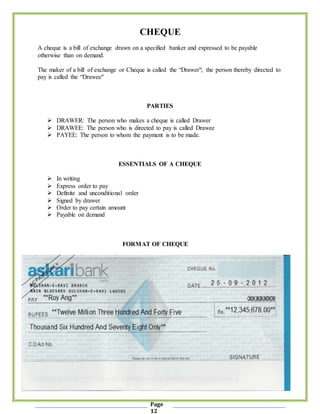
BILL OF EXCHANGE
An instrument in writing containing an unconditional order signed by the maker, directing a
certain person to pay a certain sum of money only to, or to the order of certain person to the
bearer of the instrument.
PARTIES
 DRAWER: The person who makes the bill of exchange is called drawer
 DRAWEE: The person who is directed to pay is called drawee
 PAYEE: The person to whom the payment is to be made is called payee
 ACCEPTOR: When the drawee accepts the bill is called acceptor
CHARACTERSTICS OF BILL OF THE EXCHANGE
 The amount payable must be certain
 The payment must be made in money
 The bill payable may be either on demand or after a specified period
 The bill may be payable either to the bearer or to the order of payee
FORMAT OF BILL OF EXCHANGE
Page
12
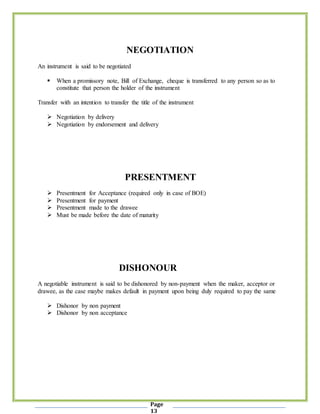
CHEQUE
A cheque is a bill of exchange drawn on a specified banker and expressed to be payable
otherwise than on demand.
The maker of a bill of exchange or Cheque is called the “Drawer"; the person thereby directed to
pay is called the “Drawee"
PARTIES
 DRAWER: The person who makes a cheque is called Drawer
 DRAWEE: The person who is directed to pay is called Drawee
 PAYEE: The person to whom the payment is to be made.
ESSENTIALS OF A CHEQUE
 In writing
 Express order to pay
 Definite and unconditional order
 Signed by drawer
 Order to pay certain amount
 Payable on demand
FORMAT OF CHEQUE
Page
13
NEGOTIATION
An instrument is said to be negotiated
 When a promissory note, Bill of Exchange, cheque is transferred to any person so as to
constitute that person the holder of the instrument
Transfer with an intention to transfer the title of the instrument
 Negotiation by delivery
 Negotiation by endorsement and delivery
PRESENTMENT
 Presentment for Acceptance (required only in case of BOE)
 Presentment for payment
 Presentment made to the drawee
 Must be made before the date of maturity
DISHONOUR
A negotiable instrument is said to be dishonored by non-payment when the maker, acceptor or
drawee, as the case maybe makes default in payment upon being duly required to pay the same
 Dishonor by non payment
 Dishonor by non acceptance

Negotiable instrument

  • 1.
    Page 1 UNIVERSITY OFKARACHI KARACHI UNIVERSITY BUSINESS SCHOOL MBA Banking & Finance 2014 Semester: II NEGOTIABLE INSTRUMENT Act 1881
  • 2.
    Page 2 DEDICATED TO Ourteacher whose teaching and enlightenment inspired and enabled us to write this report & Our parents who supported us at every stage of our busy schedule during the preparation of this report
  • 3.
    Page 3 ACKNOWLEDGEMENT We offerour humblest thank to Allah and Hazrat Muhammad (PBUH) from the deep of our heart that always provide us guidance and blessings which are uncountable. Our sincerest appreciation must be extended to Who has given his comments, corrections and guided us at every step in preparing this report AND Group Members
  • 4.
    Page 4 CONTENTS What isnegotiable instrument…………………………………………………………………………….5 Characteristics of negotiable instruments…………………………………………………………………6 Elements of negotiable instruments……………………………………………………………………....7 Types of negotiable instruments………………………………………………………………………….8 Classification of negotiable instruments………………………………………………………………….9 Documents NOT negotiable instruments…………………………………………………………………9 Promissory note………………………………………………………………………………………….10 Bill of exchange……………………………………………………………………………………….…..11 Cheque………………………………………………………………………………………………..…..12 Negotiation………………………………………………………………………………………………..13 Presentment………………………………………………………………………………………………..13
  • 5.
    Page 5 What isNegotiable Instrument?  The term negotiable instruments mean a written documenting which entitles a person to a sum of money.  A Negotiable Instrument is transferable by delivery or by endorsement and delivery  The transfer entitle a person to the some of money mentioned therein  Thus the negotiable instrument is a document which is legally recognized by custom of  trade or law, transferable by delivery or by endorsement and delivery
  • 6.
    Page 6 CHRACTERSTICS OFNEGOTIABLE INSTRUMENT  Freelytransferable:- The property in a negotiable instrument passes from one person to another by a simple process, i.e., by mere delivery if it is payable to bearer, and by endorsement and delivery if it is payable to order  Holder’s title free from all defects:- The holder in due course (one who acquires the instrument in good faith and for consideration) gets it free from all defects  Recovery:- One can sue upon the instrument in his own name  Payable to order or bearer: - It must be payable either to order or bearer  Presumption as to Holder:- Every holder of negotiable instrument is presumed to be holder in due course  Presumption as to considerations:- Every negotiable instrument is presumed to have been made, drawn, accepted, endorsed, negotiated or transferred for consideration
  • 7.
    Page 7 ELEMENTS OFNEGOTIABLE INSTRUMENTS For a negotiable instrument the following essential elements are required:  Written: Negotiable instrument must be in writing  Signed:Instrument must be signed by maker  Unconditional: It must contain unconditional promise or order to pay  Uncertain sum: Instrument must require payment of a certain sum of money only and nothing else.  Certain time: Instrument must be payable at a time which is certain to arrive.  Certain payee: Drawee of a bill or cheque must with reasonable certainty be named or desired.  Mere delivery: Instrument must be transferable by simple delivery like cash.
  • 8.
    Page 8 TYPES OFNEGOTIABLE INSTRUMENTS 1. NEGOTIABLE BY STATUTE: Section 13 of the negotiable instrument Act mention only three kinds of negotiable instruments, i. Promissory Notes ii. Bill of Exchange iii. Cheque 2. NEGOTIABLE BY CUSTOM or USAGE OF TRADE: The number of instruments which are negotiable either by mercantile usage or customs of trade the following instruments have acquired such character: i. Dividend warrant ii. Port Trust Debentures iii. Railway Bonds Payable to Bearer iv. Railway Receipts v. Bank Note vi. Share Warrant vii. Share Certificates With Blank Transfer Deed
  • 9.
    Page 9 CLASSIFICATION OFNEGOTIABLE INSTRUMENT i. Inland Instrument Sec 11 ii. Foreign Instrument sec 12 iii. Time and Demand Instrument Sec 19 iv. Ambiguous Instrument Sec 17 v. Inchoate Instrument sec 20 vi. Forged Instrument Sec 58 vii. Escrow Instrument Sec 46 Para 3 viii. Lost Instrument Sec 58 ix. Stolen Instrument sec 58 x. Instrument Obtain by Fraud or Coercion Sec 58 xi. Instrument without Consideration sec 43 xii. Instrument Obtained for Unlawful Consideration Sec 58 DOCUMENTS “NOT” NEGOTIABLE INSTRUMENTS i. Money order ii. Postal order iii. Deposit receipts iv. Share certificate v. Bill of lading vi. Dock warrant vii. Carrier receipt
  • 10.
    Page 10 PROMISSORY NOTE A promissorynote is an instrument in writing containing an unconditional undertaking signed by the maker to pay a certain sum of money only to or to the order of a certain person or to the bearer of the instrument PARTIES  MAKER : The person who makes the promissory note and promises to pay is called the Maker  PAYEE: The person to whom the payment is to be made is called the Payee  HOLDER: The holder is either the payee or someone to whom he may have indorsed (transfer) the note is known as Holder  ENDORSER: The person who indorses the note to another is called the Endorser  ENDORSEE: The person to whose favor the note is endorsed is called the Endorsee ESSTENTIALS OF THE PROMISSORY NOTES  It must be in writing  it must contain a promise or undertaking to pay a definite sum of money  It must be signed by the make of the promise to pay must be unconditional  The payee must be identified & the sum payable must be certain must be certain.  FORMAT OF PROMISSORY NOTE
  • 11.
    Page 11 BILL OF EXCHANGE Aninstrument in writing containing an unconditional order signed by the maker, directing a certain person to pay a certain sum of money only to, or to the order of certain person to the bearer of the instrument. PARTIES  DRAWER: The person who makes the bill of exchange is called drawer  DRAWEE: The person who is directed to pay is called drawee  PAYEE: The person to whom the payment is to be made is called payee  ACCEPTOR: When the drawee accepts the bill is called acceptor CHARACTERSTICS OF BILL OF THE EXCHANGE  The amount payable must be certain  The payment must be made in money  The bill payable may be either on demand or after a specified period  The bill may be payable either to the bearer or to the order of payee FORMAT OF BILL OF EXCHANGE
  • 12.
    Page 12 CHEQUE A cheque isa bill of exchange drawn on a specified banker and expressed to be payable otherwise than on demand. The maker of a bill of exchange or Cheque is called the “Drawer"; the person thereby directed to pay is called the “Drawee" PARTIES  DRAWER: The person who makes a cheque is called Drawer  DRAWEE: The person who is directed to pay is called Drawee  PAYEE: The person to whom the payment is to be made. ESSENTIALS OF A CHEQUE  In writing  Express order to pay  Definite and unconditional order  Signed by drawer  Order to pay certain amount  Payable on demand FORMAT OF CHEQUE
  • 13.
    Page 13 NEGOTIATION An instrument issaid to be negotiated  When a promissory note, Bill of Exchange, cheque is transferred to any person so as to constitute that person the holder of the instrument Transfer with an intention to transfer the title of the instrument  Negotiation by delivery  Negotiation by endorsement and delivery PRESENTMENT  Presentment for Acceptance (required only in case of BOE)  Presentment for payment  Presentment made to the drawee  Must be made before the date of maturity DISHONOUR A negotiable instrument is said to be dishonored by non-payment when the maker, acceptor or drawee, as the case maybe makes default in payment upon being duly required to pay the same  Dishonor by non payment  Dishonor by non acceptance