By DAWLE ABHIJEET
Occasions for formal oral Communication
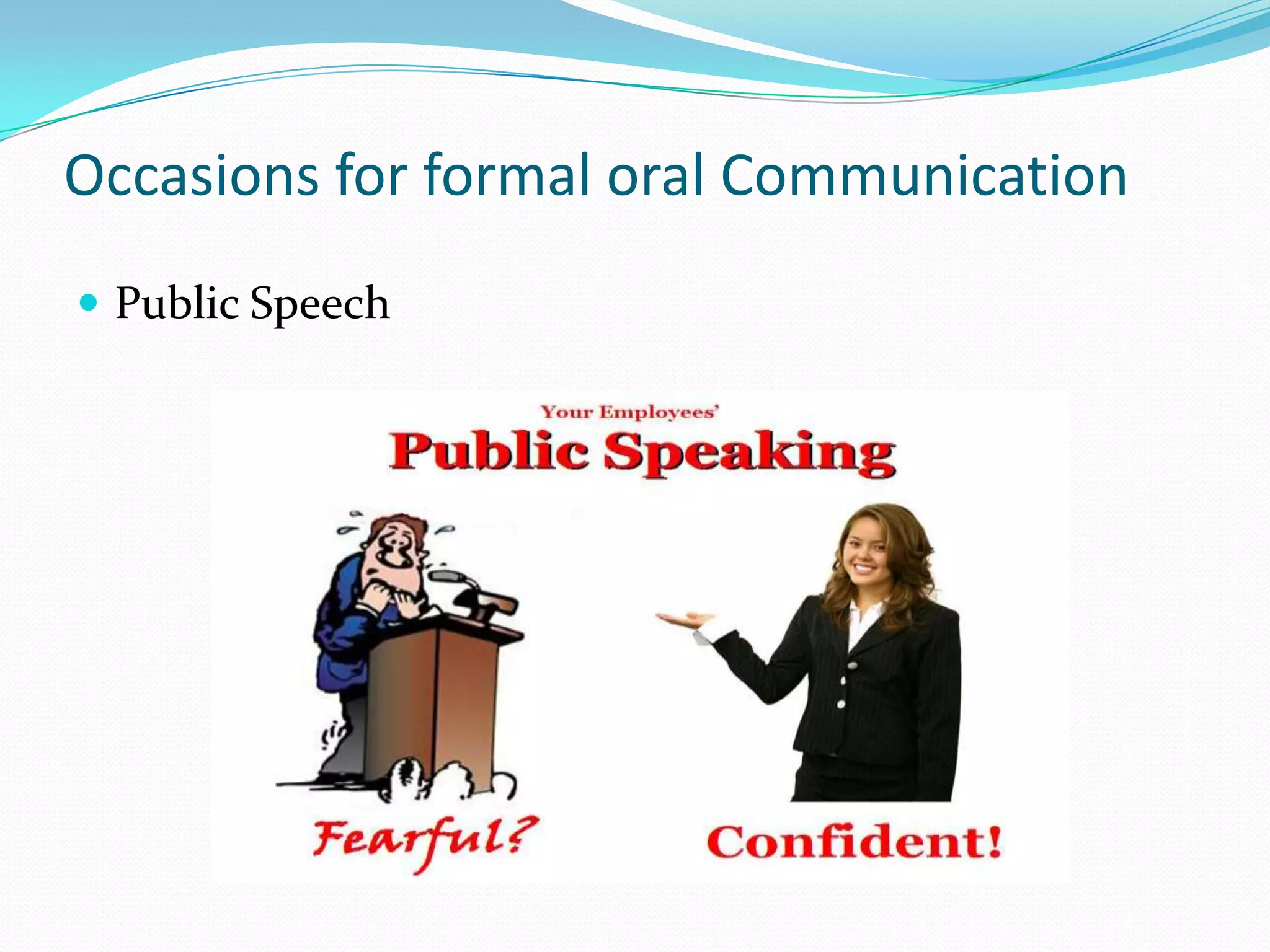
 Public Speech
Occasions for formal oral Communication
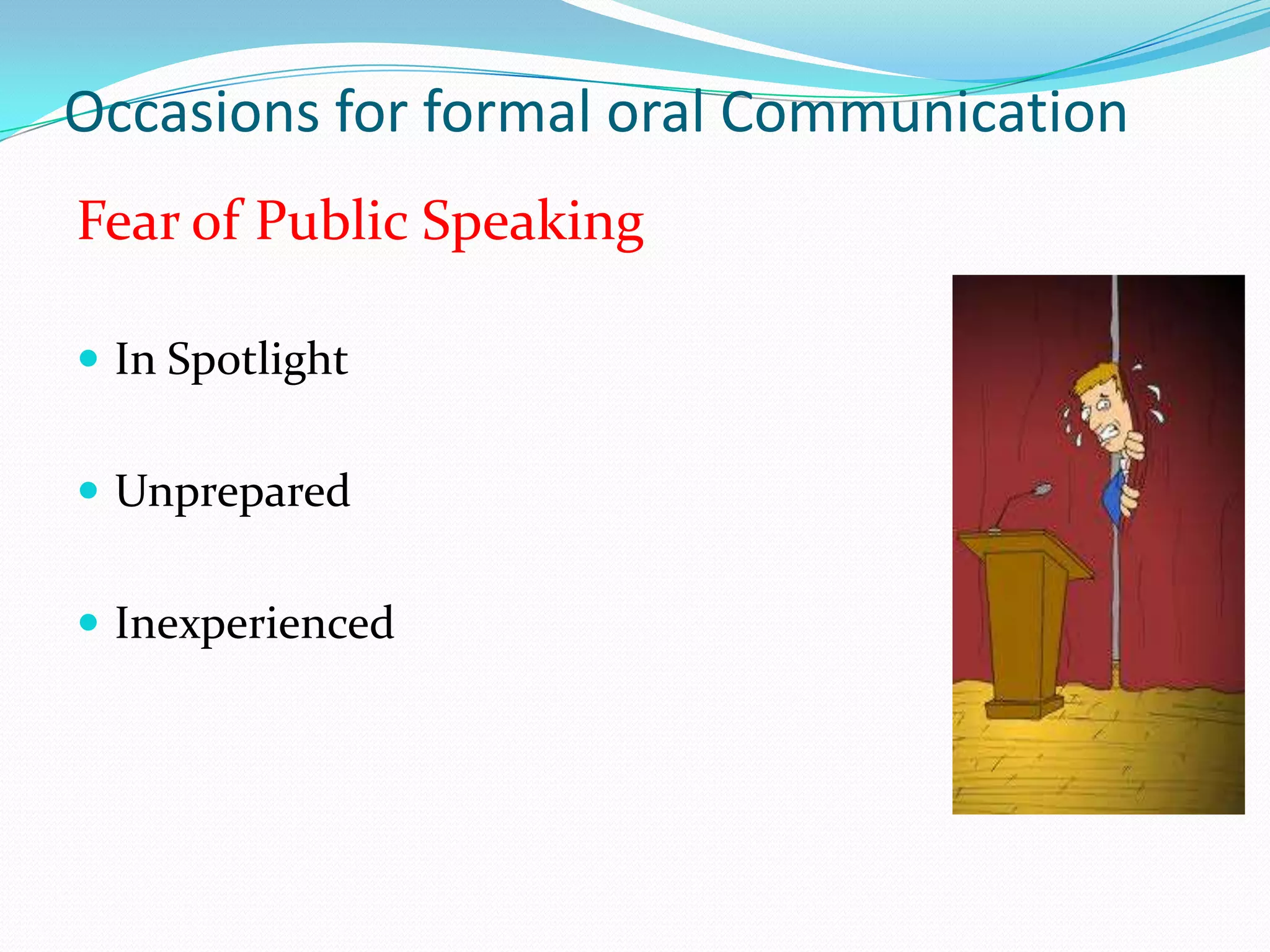
Fear of Public Speaking
 In Spotlight
 Unprepared
 Inexperienced
Occasions for formal oral Communication
What is Public Speech
Public speaking skill may be defined as the art of
appearing in front of an audience, facing the
audience, presenting your speech and making them
understand what you want them to understand within
the limited time and resources given to you.
Occasions for formal oral Communication
Public Speaking Tips
 Do your Homework or research a topic
Occasions for formal oral Communication
Public Speaking Tips
 Organize ideas logically
 Employ quotations, facts and statistics

 Start strong and close stronger
 Incorporate humor
Occasions for formal oral Communication
Public Speaking Tips
 Analyze your audience- deliver the message they want

to hear
Occasions for formal oral Communication
Public Speaking Tips
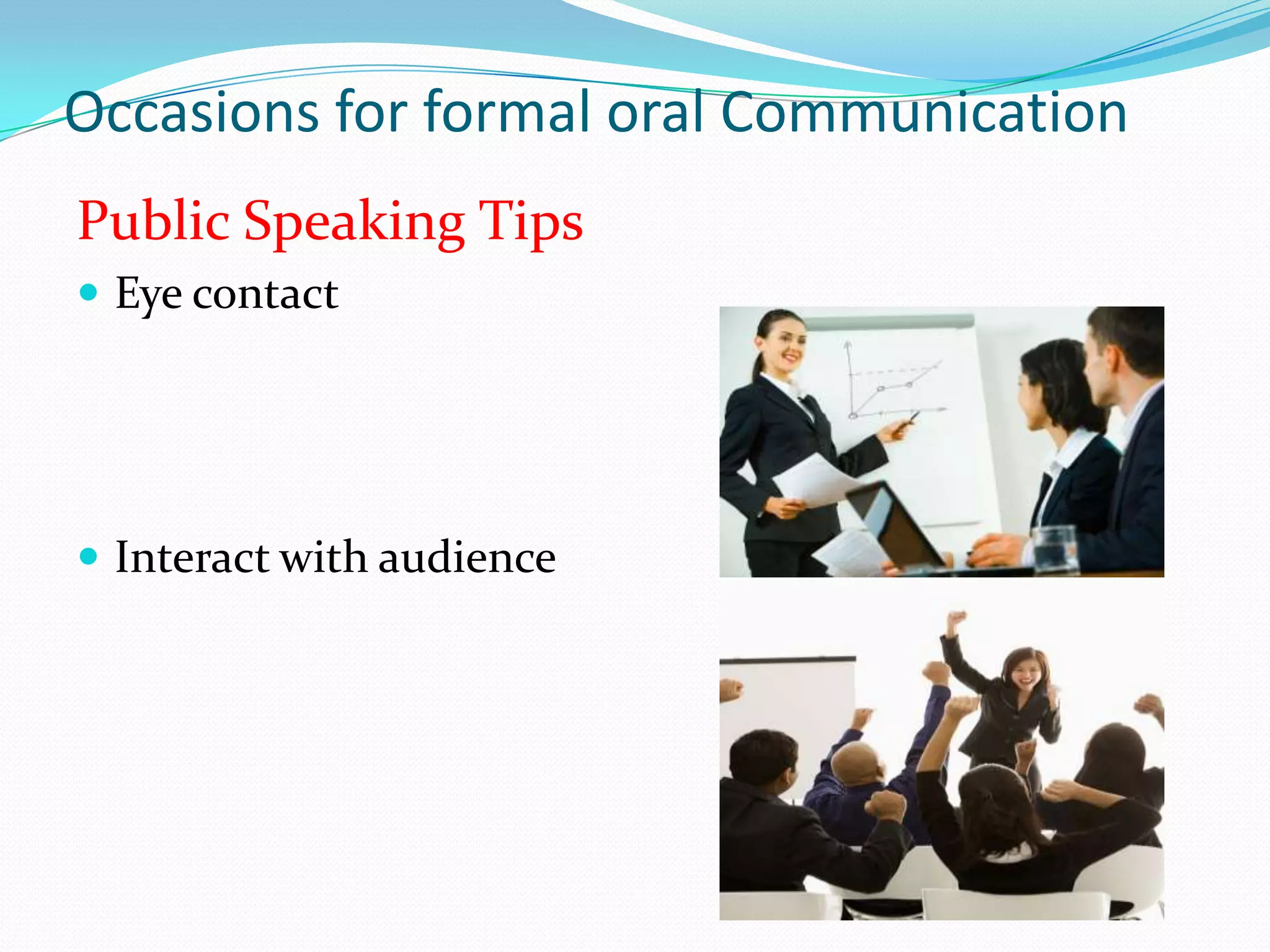
 Eye contact

 Interact with audience
Occasions for formal oral Communication
Public Speaking Tips
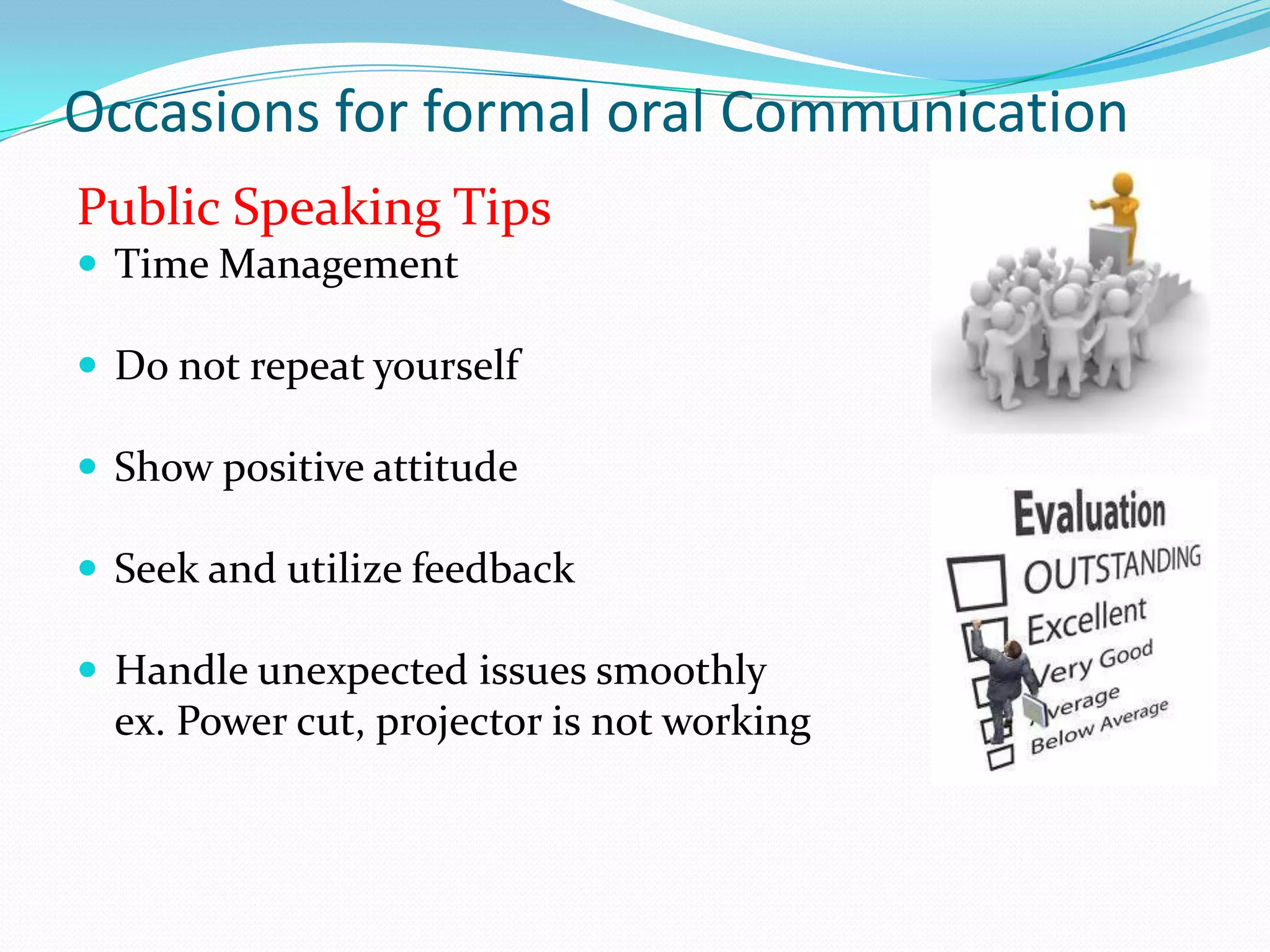
 Time Management
 Do not repeat yourself
 Show positive attitude
 Seek and utilize feedback
 Handle unexpected issues smoothly

ex. Power cut, projector is not working
Occasions for formal oral Communication
Public Speaking (Things you shouldn’t do)
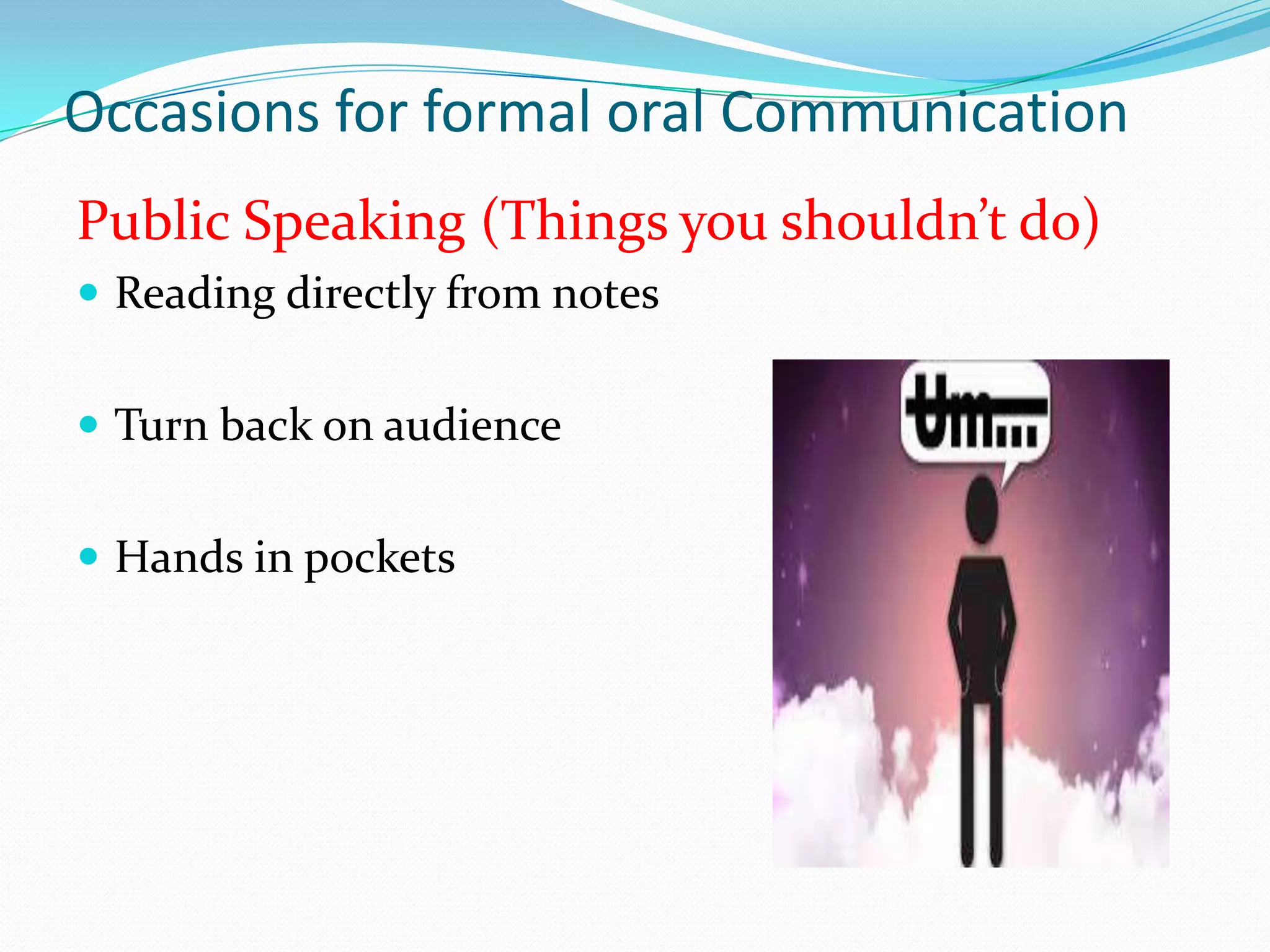
 Reading directly from notes
 Turn back on audience

 Hands in pockets
Occasions for formal oral Communication
Public Speaking (Things you shouldn’t do)
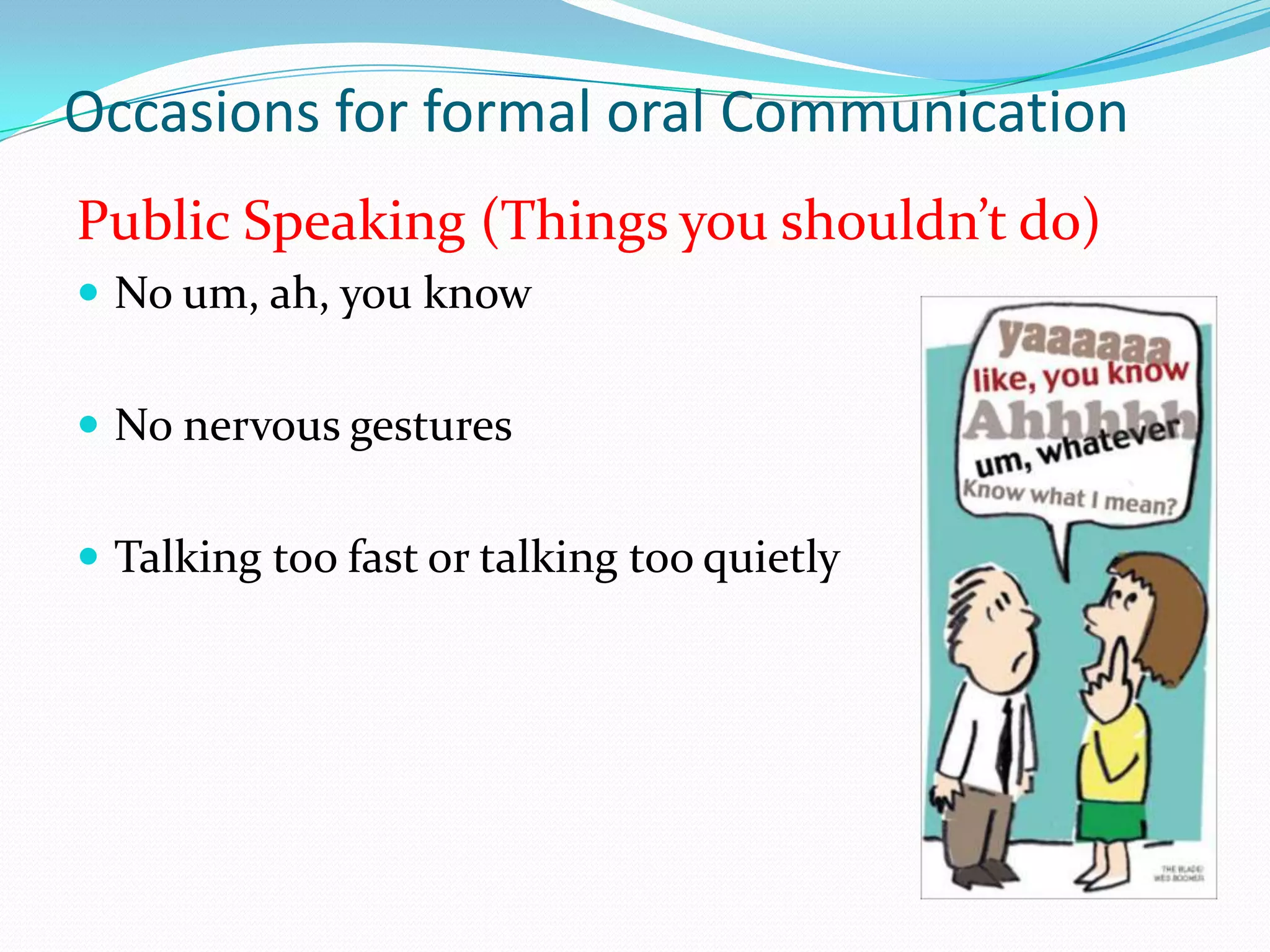
 No um, ah, you know
 No nervous gestures

 Talking too fast or talking too quietly
Occasions for formal oral Communication
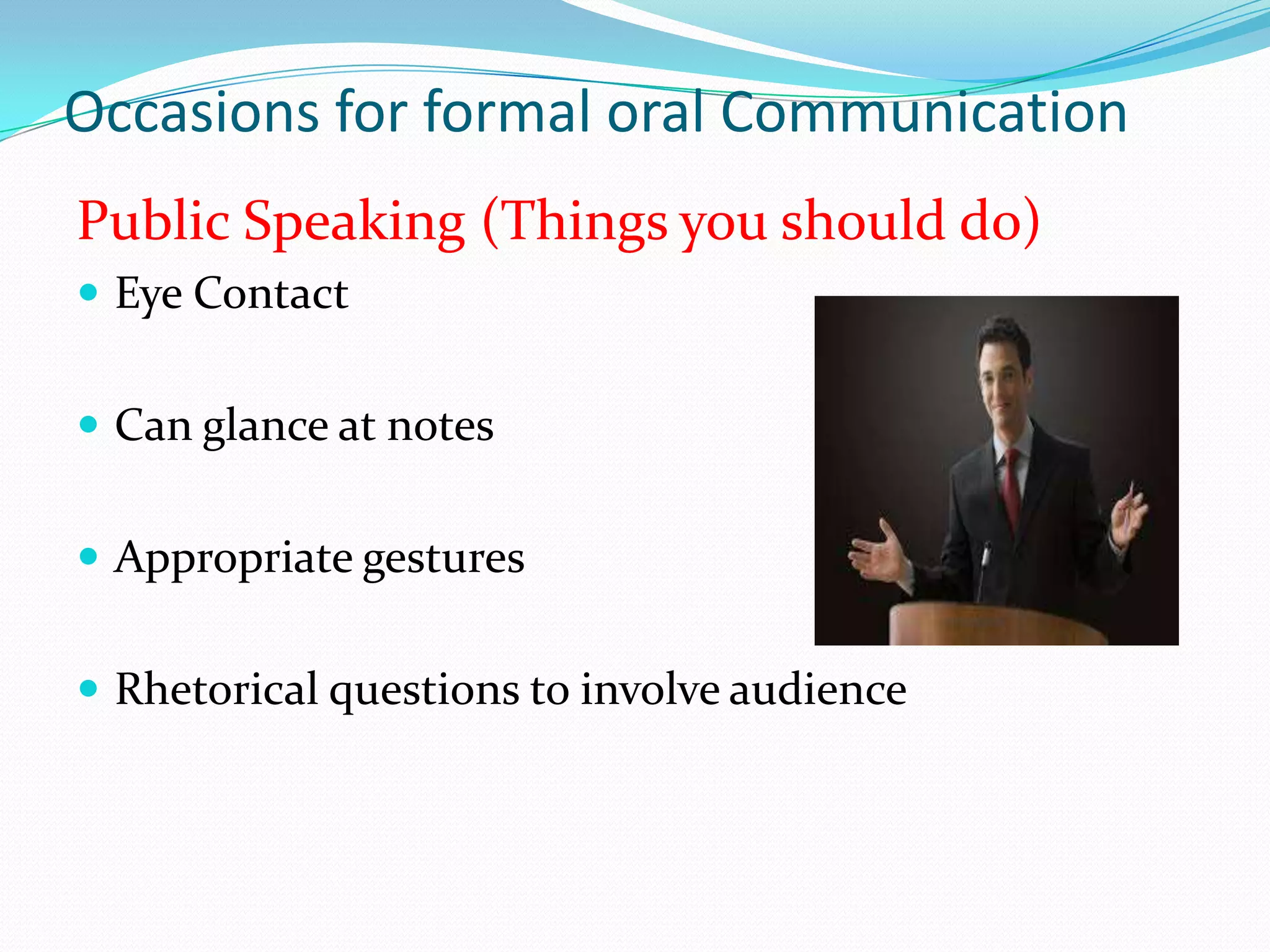
Public Speaking (Things you should do)
 Eye Contact
 Can glance at notes

 Appropriate gestures
 Rhetorical questions to involve audience
Occasions for formal oral Communication
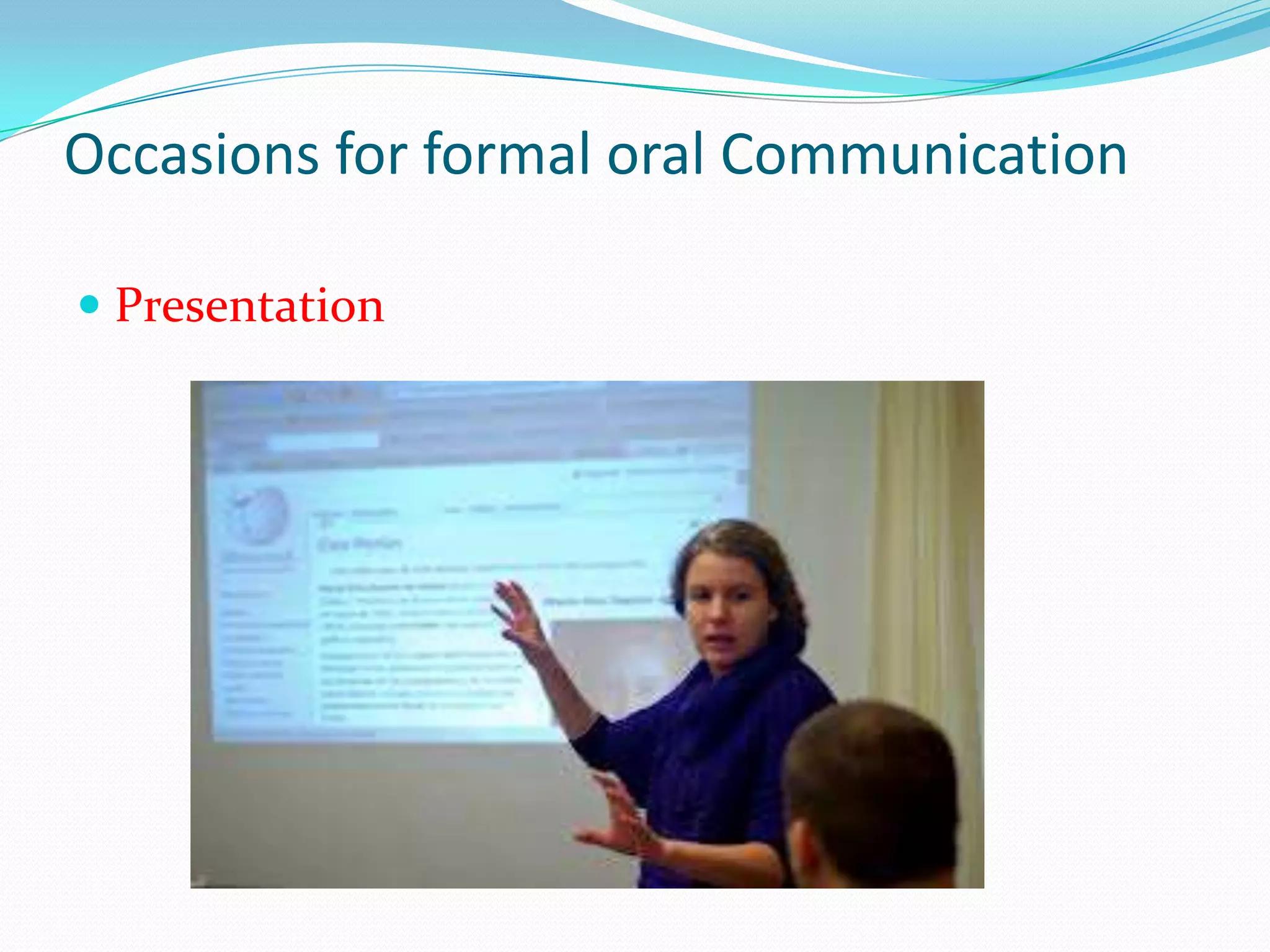
 Presentation
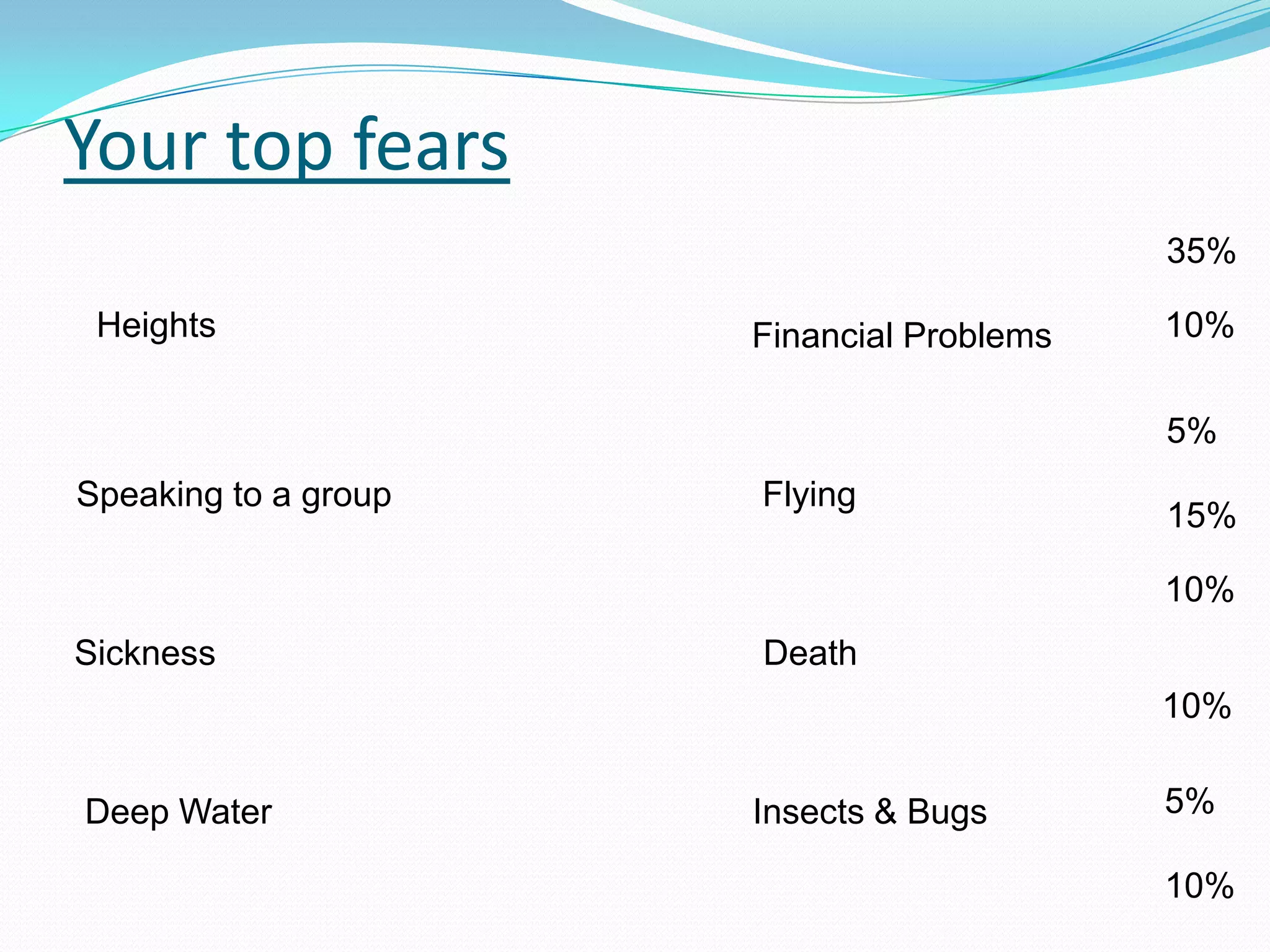
Your top fears
35%

Heights

Financial Problems

10%
5%

Speaking to a group

Flying

15%
10%

Sickness

Death
10%

Deep Water

Insects & Bugs

5%
10%
General pointers to improve speaking skills:
 SPEAK
 Be thoroughly aware of the subject.

 Know the audience; tailor your speech to meet their

needs.
General pointers…contd.
 Rehearse your speech well and time it.
 Practice good articulation:
 Make exaggerated use of articulators.



Pay attention to proper diction, pronunciation & stress.
Use voice modulation.
General pointers…contd
 Show interest and enthusiasm.
 Begin well & end well.

 Understand that stage fright is common and some

what necessary.
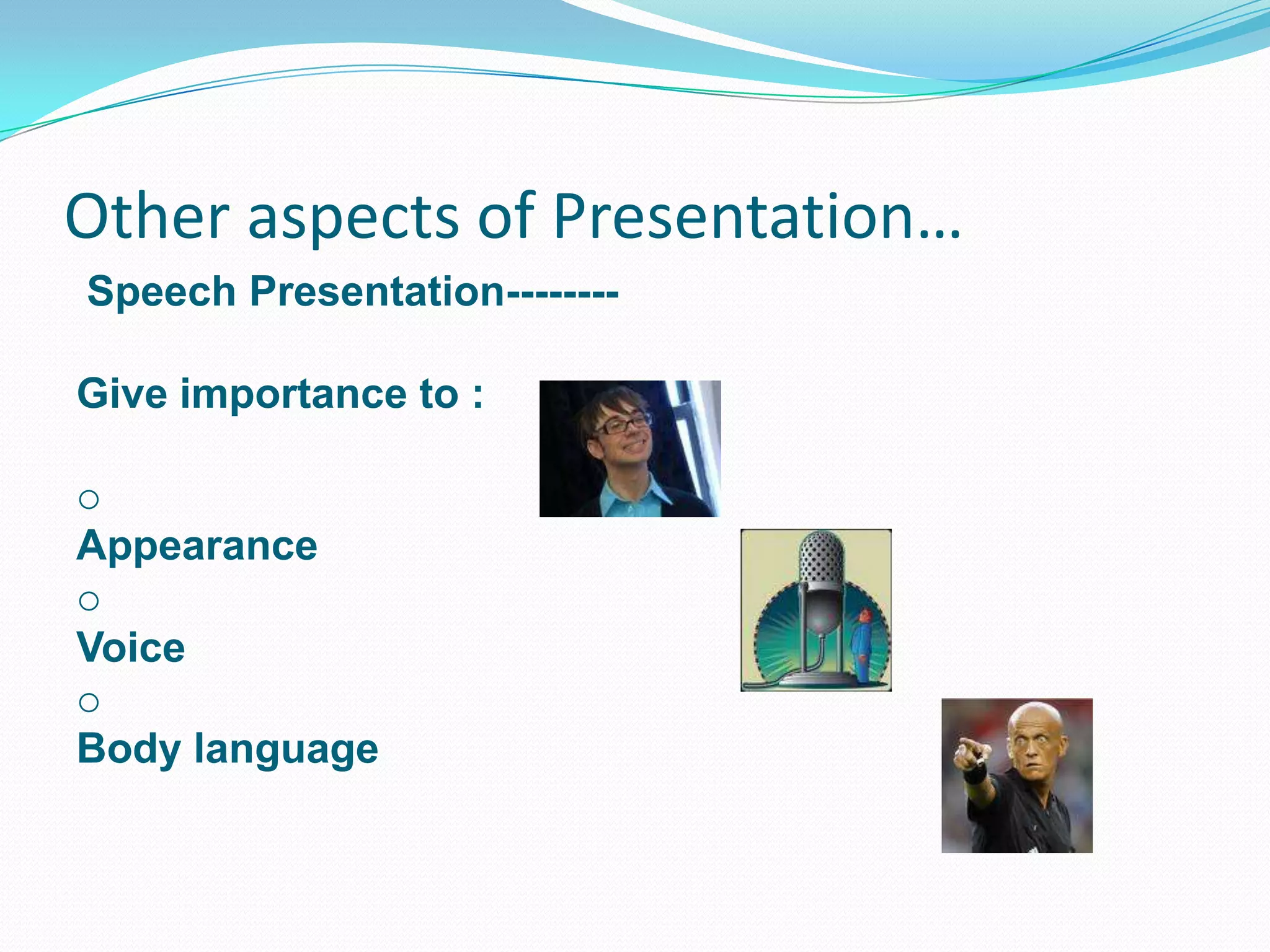
Other aspects of Presentation…
Speech Presentation-------Give importance to :
o
Appearance
o
Voice
o
Body language
…aspects of Presentation
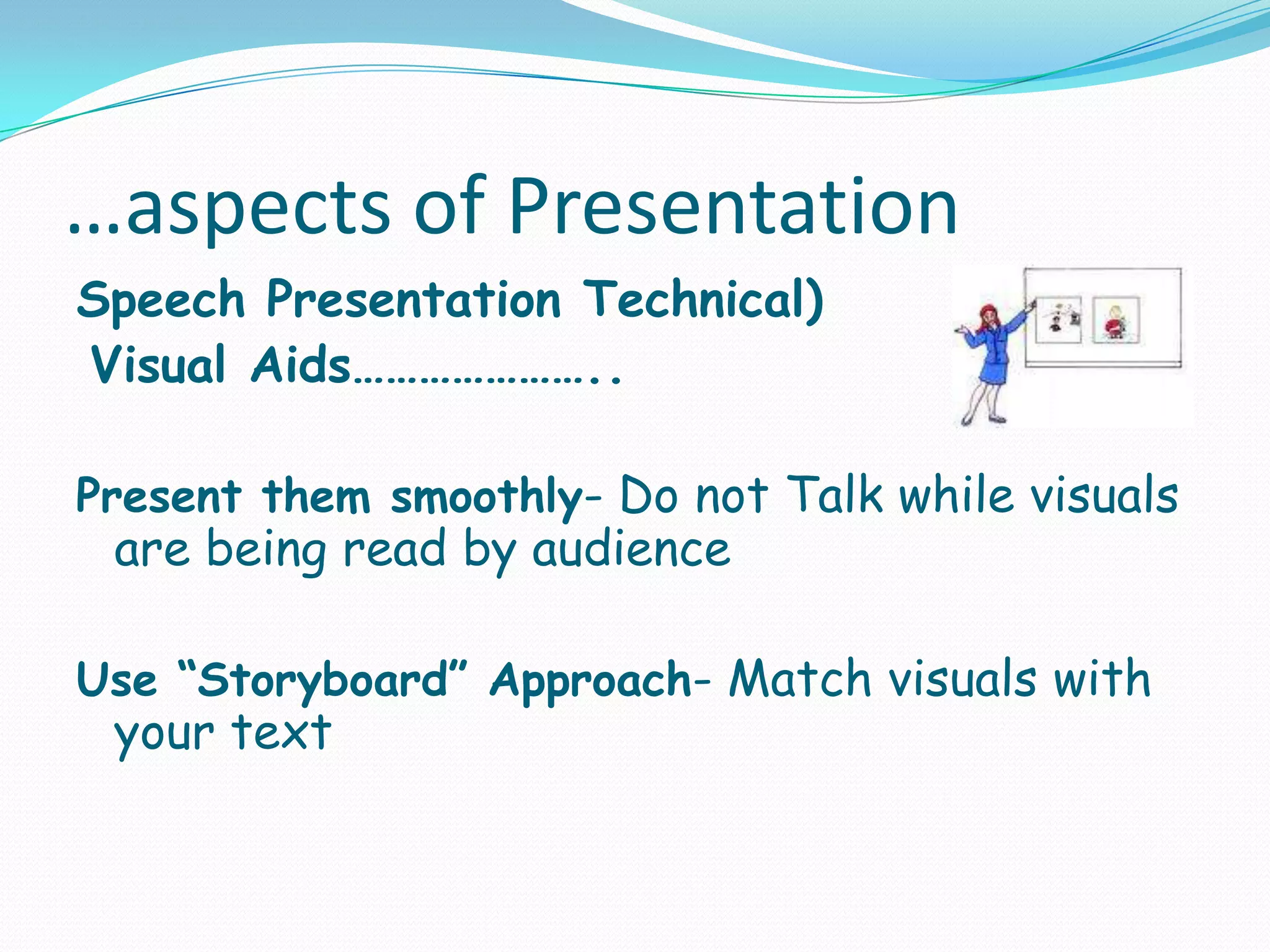
Speech Presentation Technical)
Visual Aids…………………..
Present them smoothly- Do not Talk while visuals

are being read by audience

Use “Storyboard” Approach- Match visuals with

your text
Most common PowerPoint mistakes
1)Many people tend to put every word
they are going to say on their powerPoint
slides. Although this eliminates the need
to memorize your talk , ultimately this
makes your slides crowded , wordy and
boring. You will loose your audience’s
attention before you even reach the
bottom of your……first slide.
Most common powerpoint mistakes
Many people do not run spell cheeck before their
presentation-BIG MISTAK!!!

Nothing makes you look stupid than spelling errors.
Bullet Pointing













Avoid
Excessive
Bullet-Pointing.
Only
Bullet
Key
Points.
Too
many
Bullet-Points
And
Your















Key messages
Will NOT
Stand out.
In fact,
The
Term
“Bullet-point”
Comes
From
People firing
Guns at
Annoying
Presenters.
Bad color schemes
Clashing background and funky colors can lead to:
 Distraction
 Confusion
 Headache
 sickness
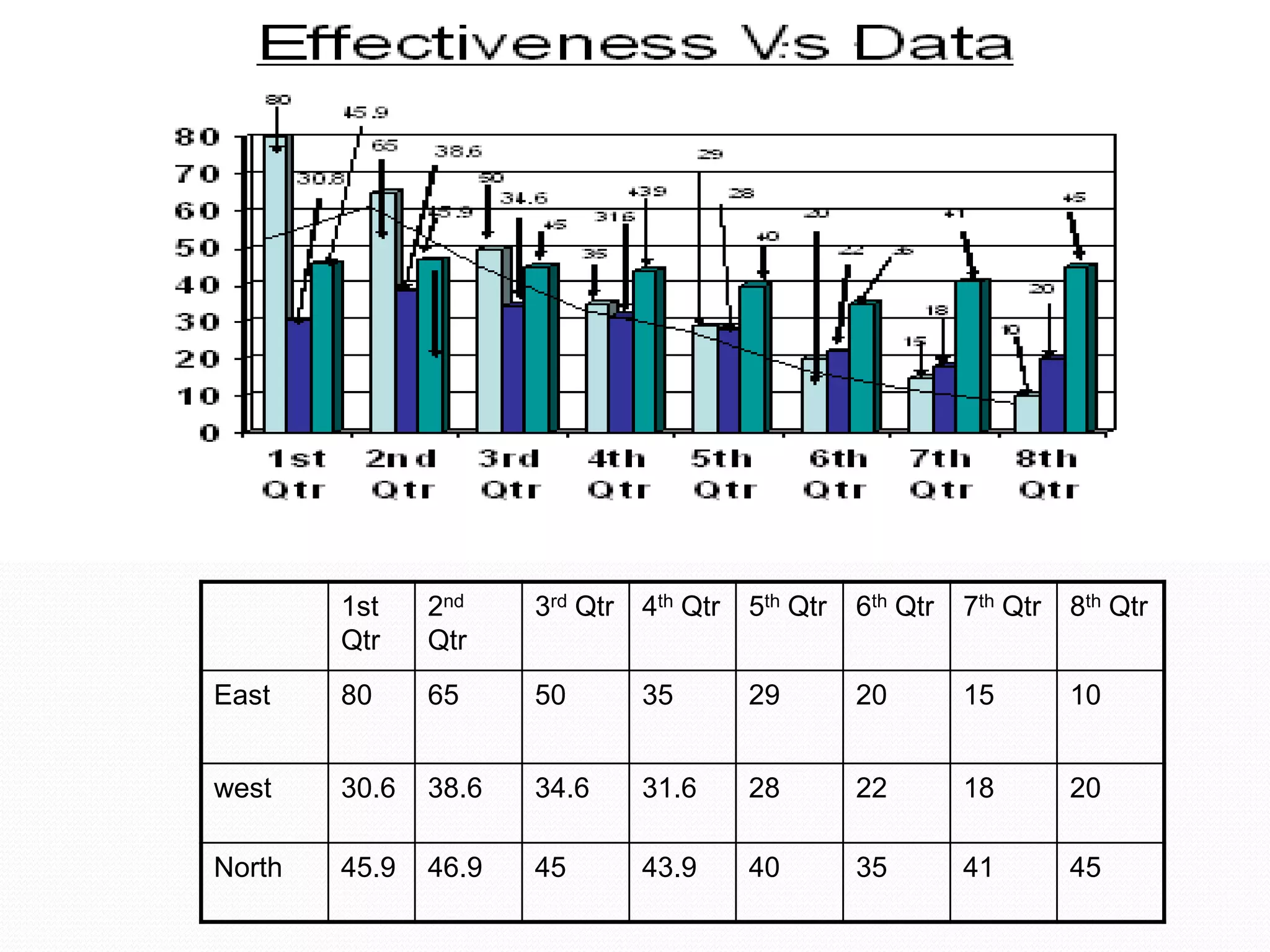
1st
Qtr

2nd
Qtr

3rd Qtr

4th Qtr

5th Qtr

6th Qtr

7th Qtr

8th Qtr

East

80

65

50

35

29

20

15

10

west

30.6

38.6

34.6

31.6

28

22

18

20

North

45.9

46.9

45

43.9

40

35

41

45
Your feeling after a successful
presentation!!!
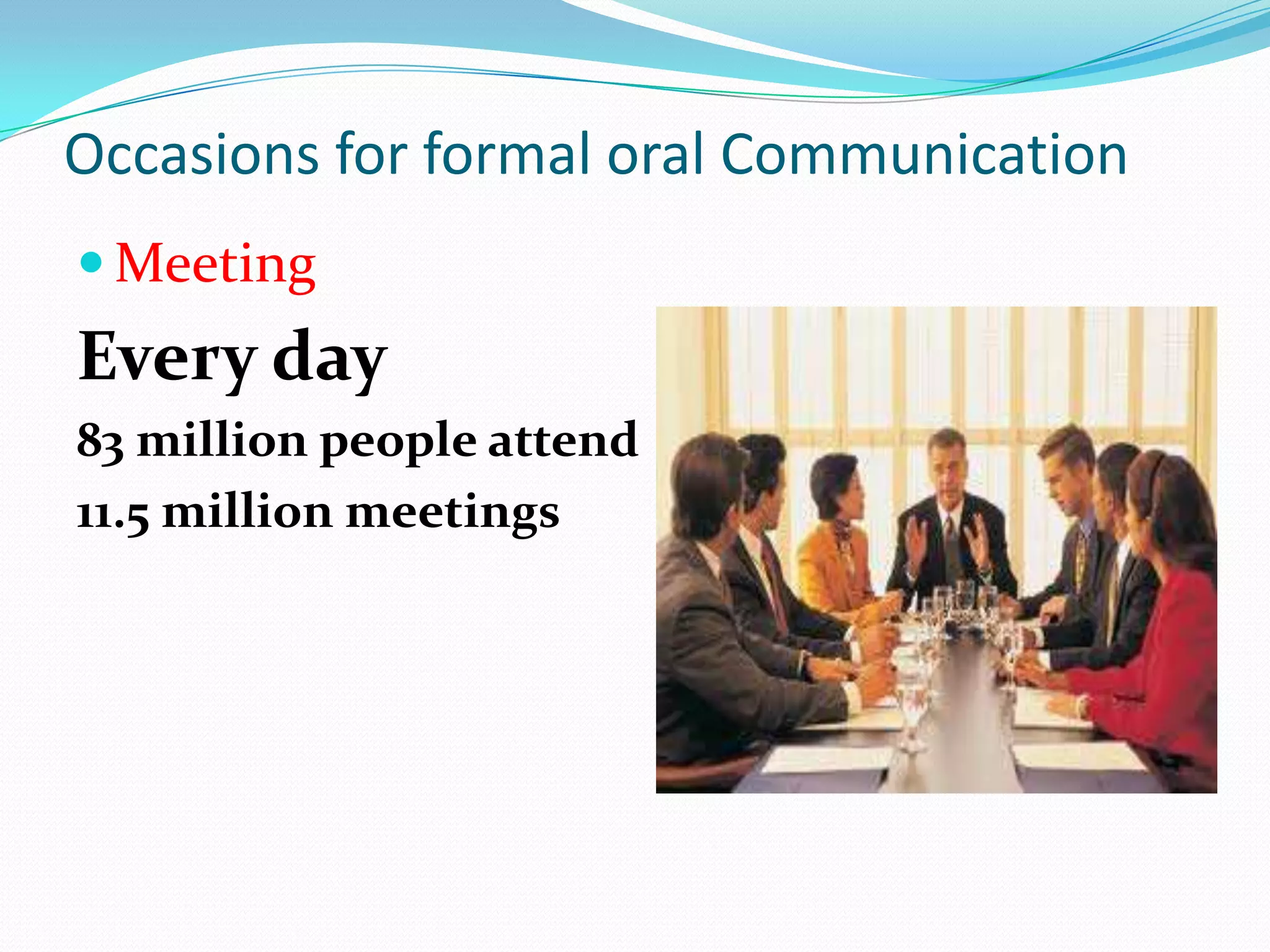
Occasions for formal oral Communication
 Meeting

Every day
83 million people attend
11.5 million meetings
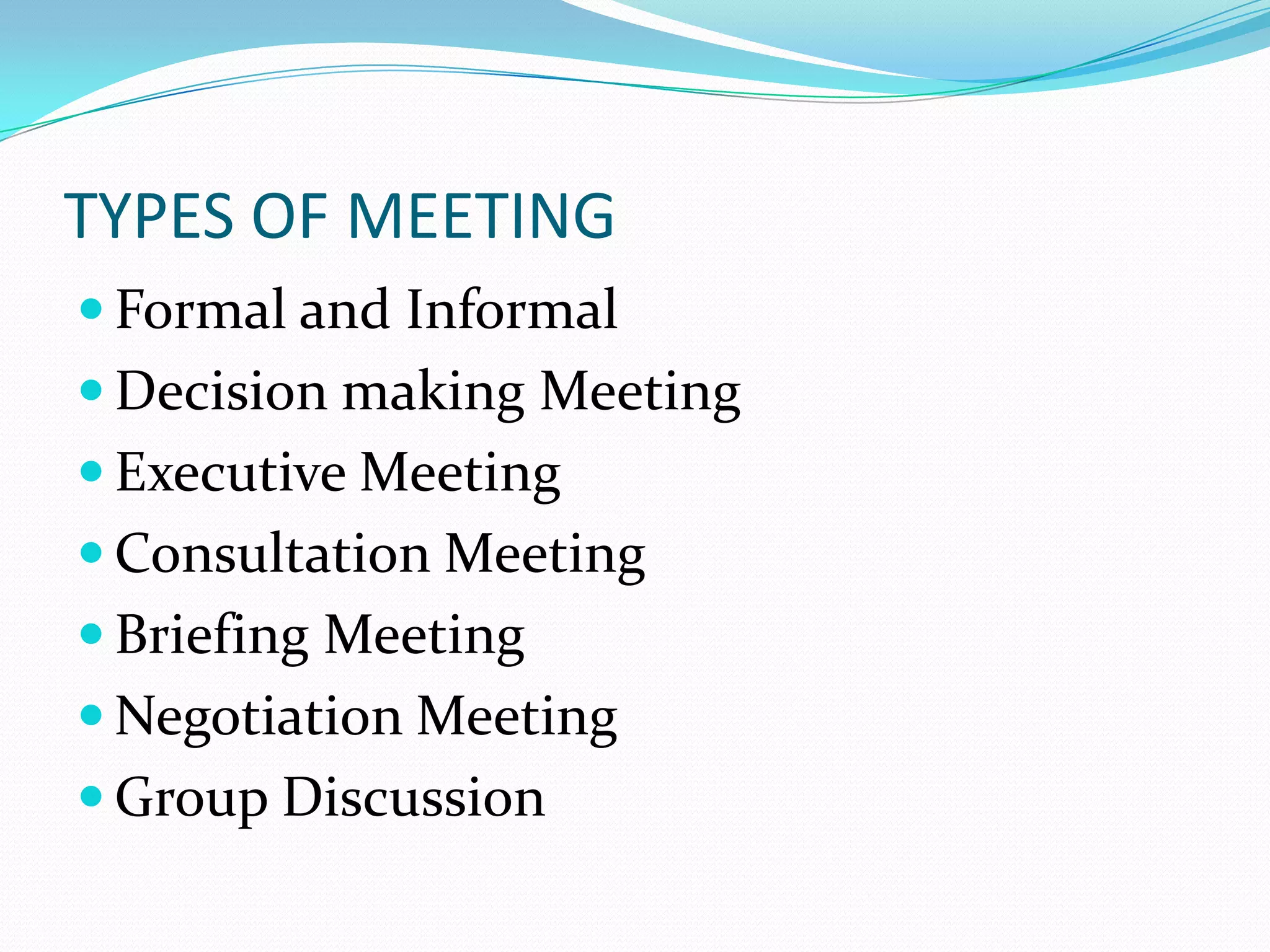
TYPES OF MEETING
 Formal and Informal
 Decision making Meeting
 Executive Meeting

 Consultation Meeting
 Briefing Meeting
 Negotiation Meeting
 Group Discussion
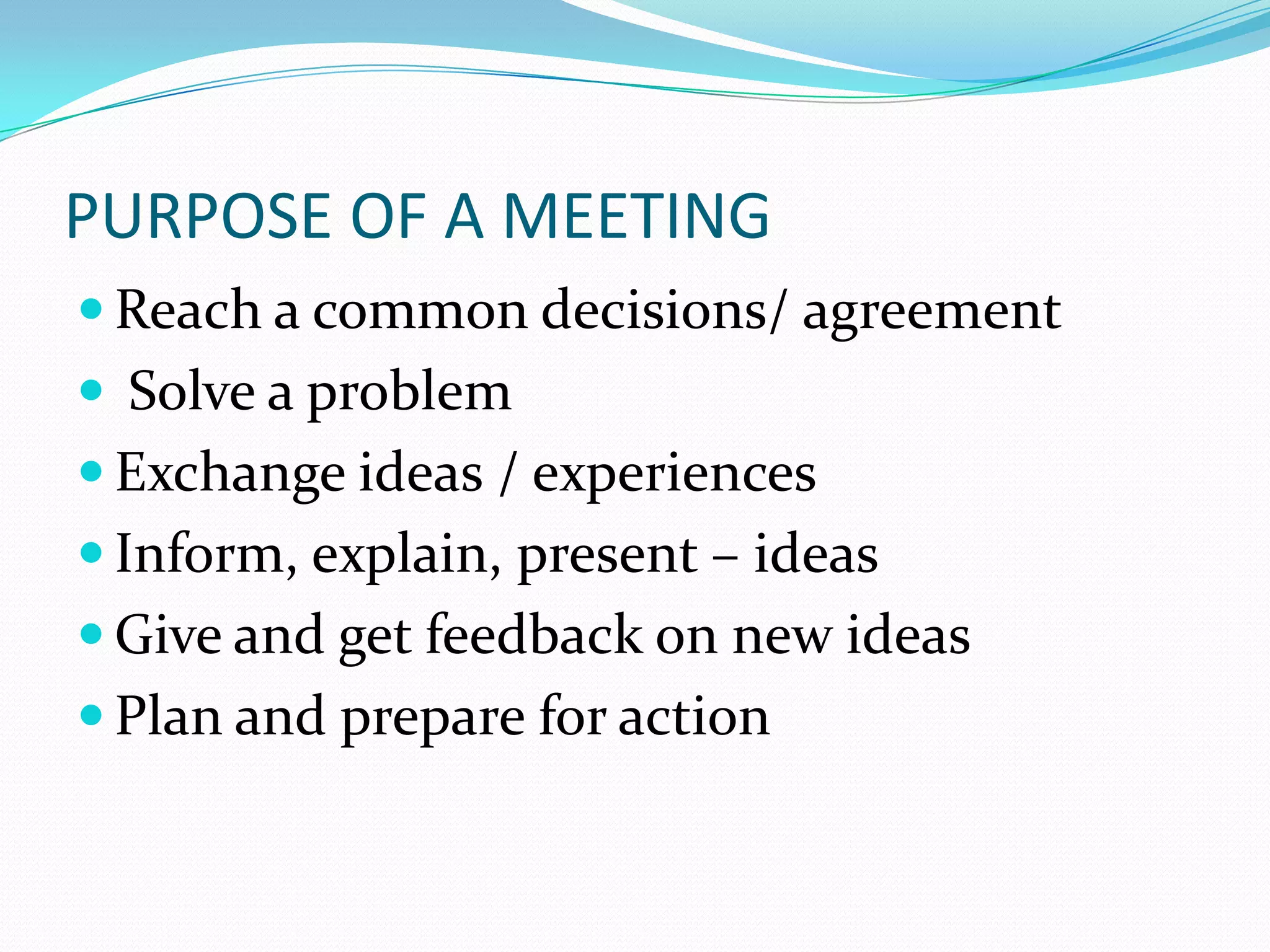
PURPOSE OF A MEETING
 Reach a common decisions/ agreement
 Solve a problem
 Exchange ideas / experiences

 Inform, explain, present – ideas
 Give and get feedback on new ideas
 Plan and prepare for action
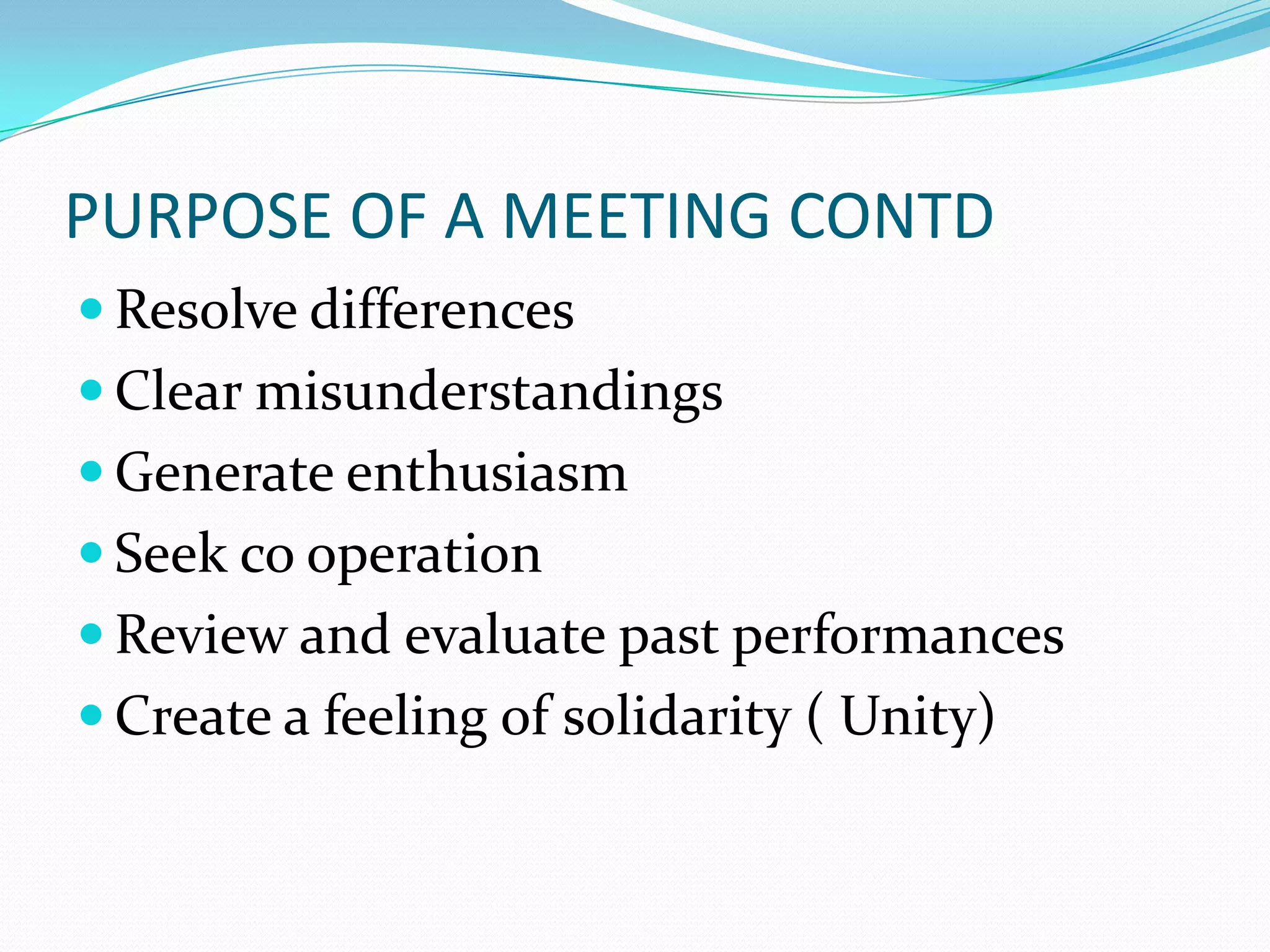
PURPOSE OF A MEETING CONTD
 Resolve differences
 Clear misunderstandings
 Generate enthusiasm

 Seek co operation
 Review and evaluate past performances
 Create a feeling of solidarity ( Unity)
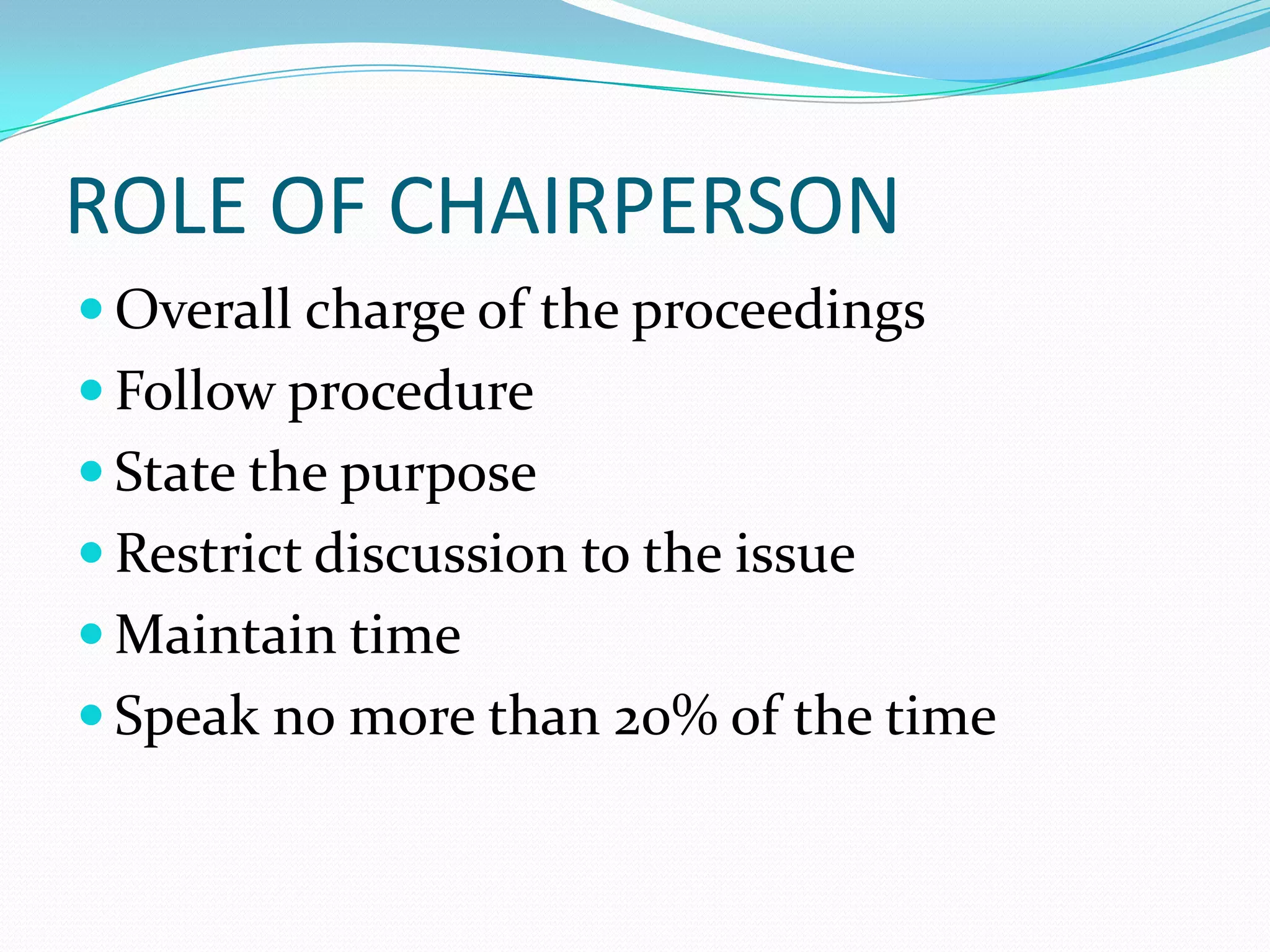
ROLE OF CHAIRPERSON
 Overall charge of the proceedings
 Follow procedure
 State the purpose

 Restrict discussion to the issue
 Maintain time
 Speak no more than 20% of the time
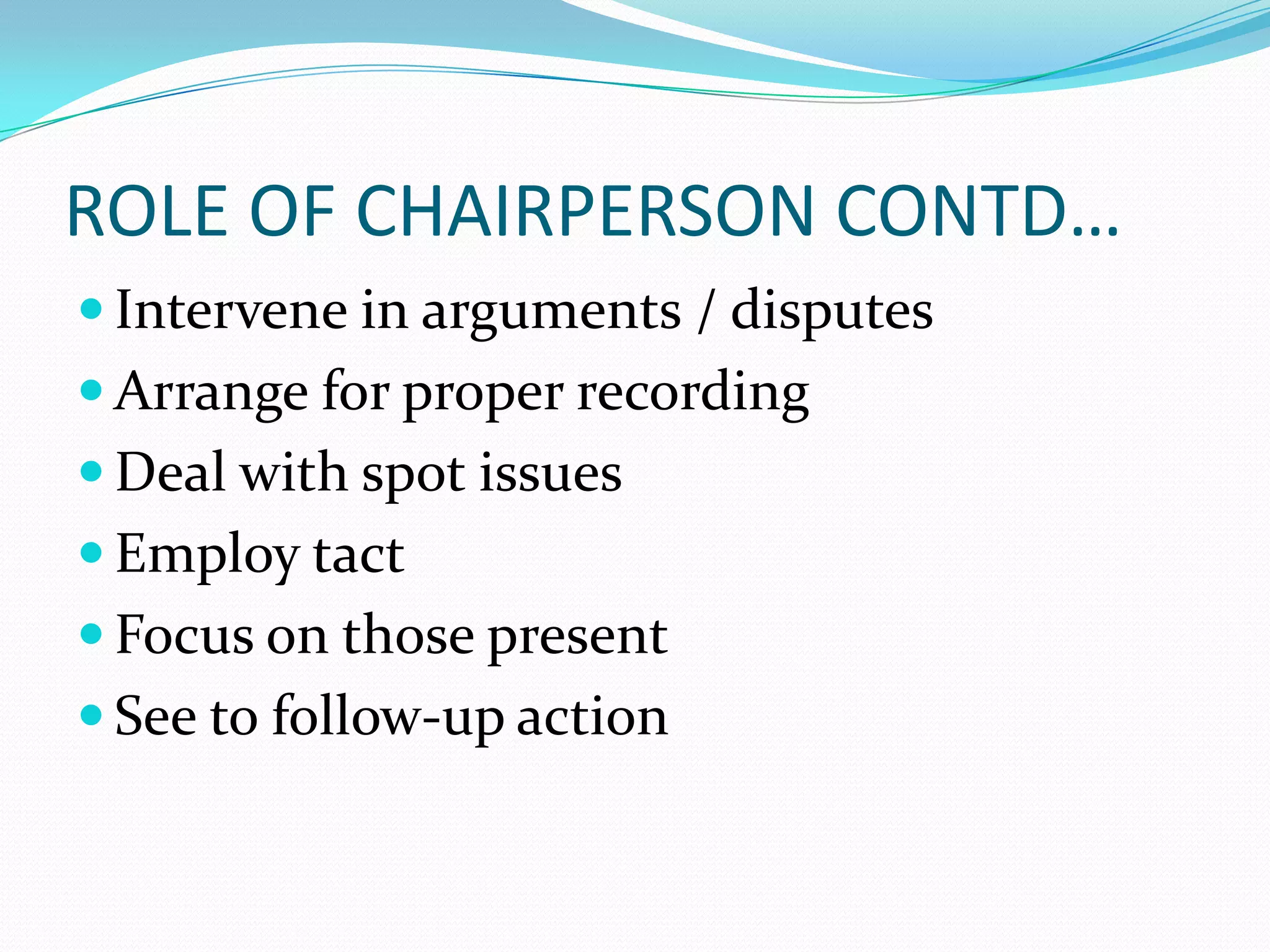
ROLE OF CHAIRPERSON CONTD…
 Intervene in arguments / disputes
 Arrange for proper recording
 Deal with spot issues

 Employ tact
 Focus on those present
 See to follow-up action
ROLE OF SECRETARY
 Send notice on time
 Organize the venue
 Keep handouts etc. ready

 Arrange for stationary
 Test equipments
 Take care of catering
 Write minutes
ROLE OF PARTICIPANTS
 Punctuality
 Stick to the agenda
 Contributing/ evaluating information

 Raising questions
 Listening attentively
 Avoiding side discussions
 Going along with the group
ROLE OF PARTICIPANTS CONTD…
 Not interrupting other speakers
 Co-operating
 Showing courtesy

 Keeping an open mind
 Talking to the point
 Following rules
 Participating actively
ADVANTAGES OF A MEETING
 Saves time
 New information
 Sense of participation

 Democratic functioning
 Bold/quick/joint decision-making
 Prevention of mistakes
 Idea development
DISADVANTAGES OF A MEETING
 Sometimes…

- time consuming
- no decision taken
- lack of seriousness
- wasteful arguments
- Expensive
NOTICE
 Sent under proper authority
 48 hours to 7 days notice
 Name of the body/group to meet

 Day, date, time and venue
 Agenda and purpose
 Sent to all expected to attend
AGENDA
 Confirm the minutes of the previous

meeting
 Items on the agenda
 E.g.,- Appointment of sub-committee to…
- Proposal to open a branch
- Purchase of a generator etc.
MINUTES
 Name of the body/ organization and nature

of meeting
 Day, date, time and place of meeting
 Name of the chairperson, secretary,
members present and absent
 Attendees by invitation
 Decisions/ resolutions
 ( The next meeting)
Occasions for formal oral Communication
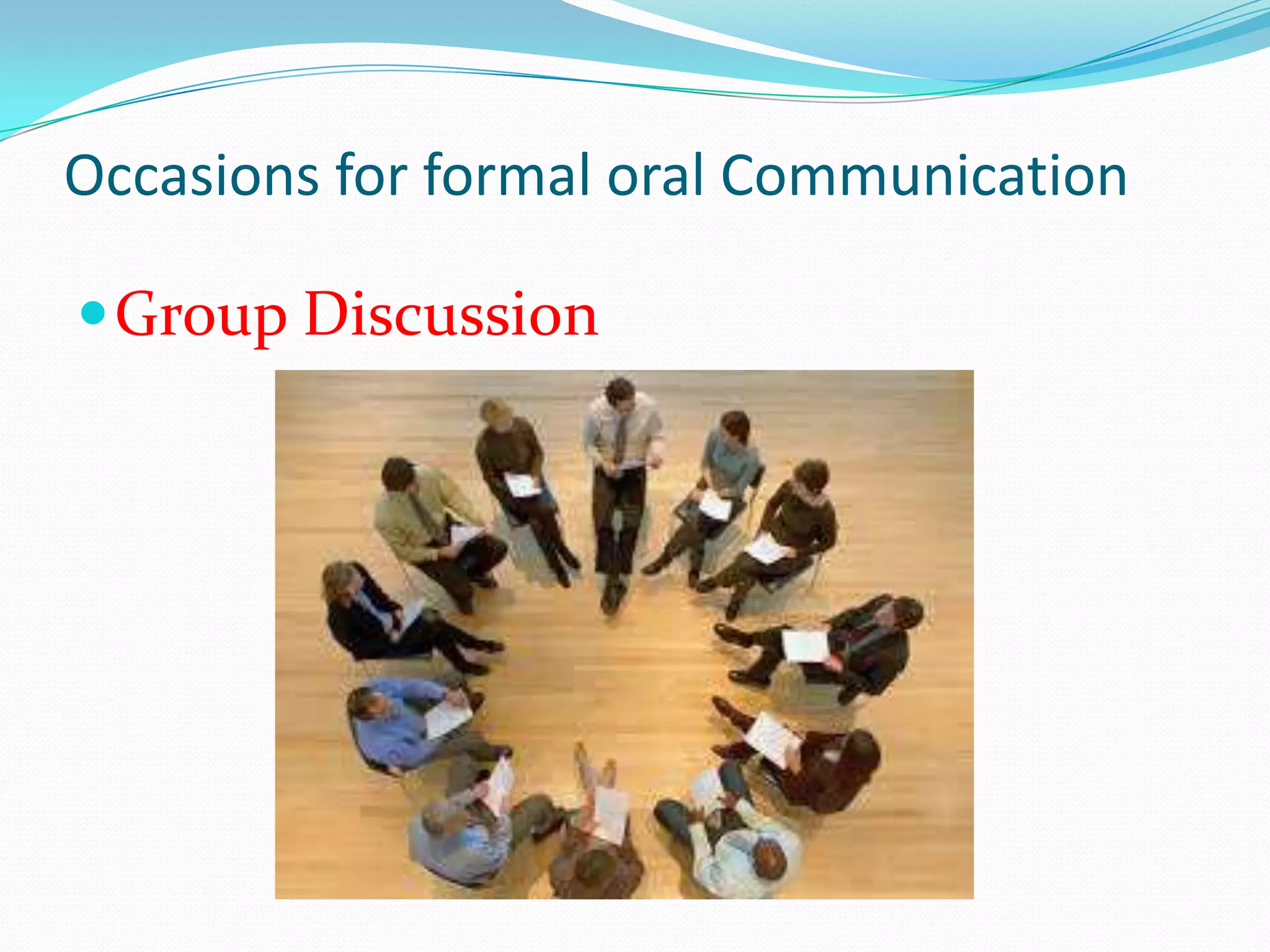
 Group Discussion
Definition of Group Discussion
 Group Discussion is a modern method of assessing
students personality.
 It is both a technique and an art and a
comprehensive tool to judge the worthiness of the
student and his appropriateness for the job.
Group Discussion
The term suggests a discussion among a
group of persons.
 The group will have 8 & 12 members who will
express their views freely, frankly in a
friendly manner, on a topic of current issue.
 Within a time limit of 20 to 30 minutes, the
abilities of the members of the group is
measured.

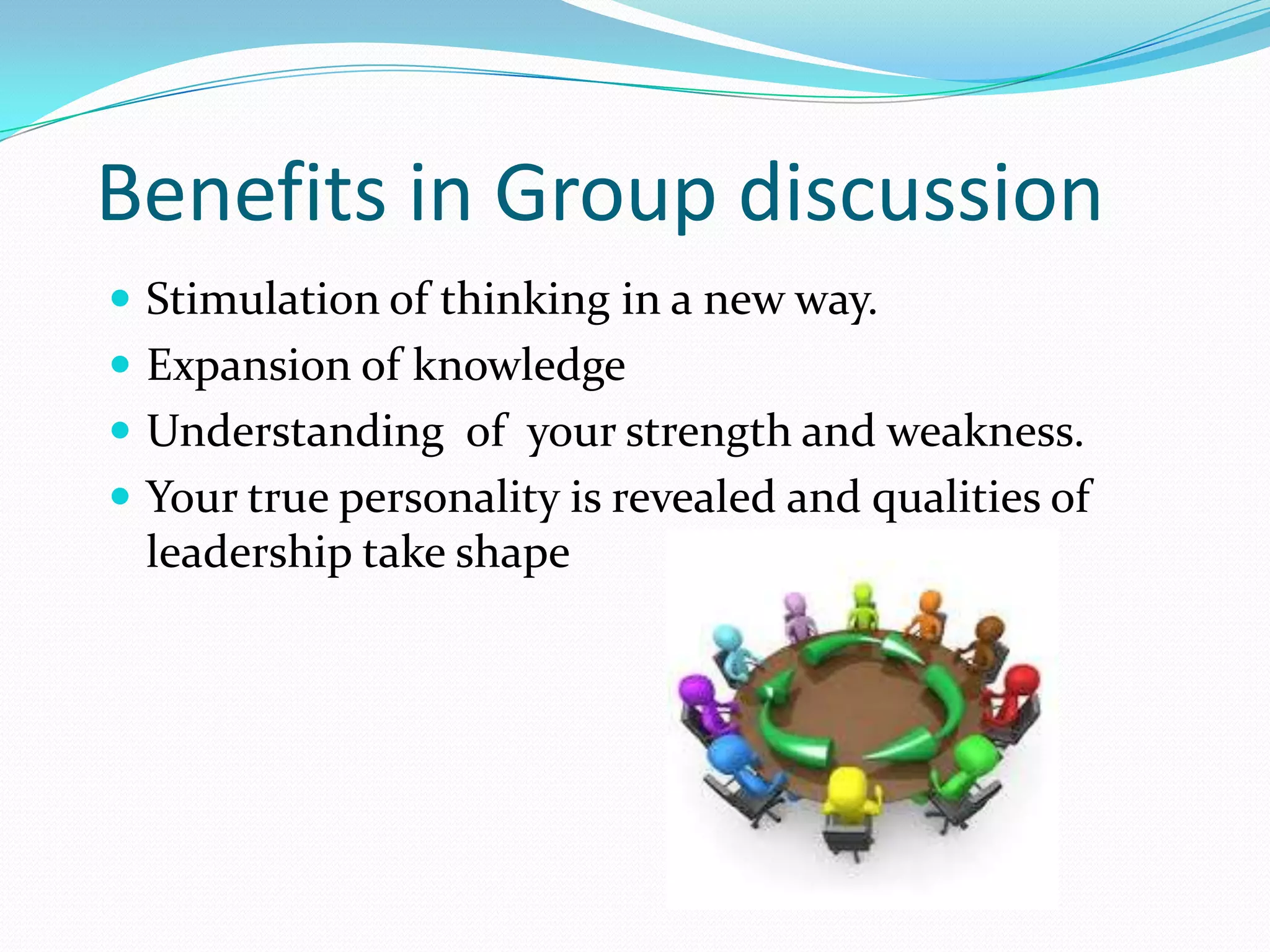
Benefits in Group discussion
 Stimulation of thinking in a new way.
 Expansion of knowledge
 Understanding of your strength and weakness.
 Your true personality is revealed and qualities of

leadership take shape
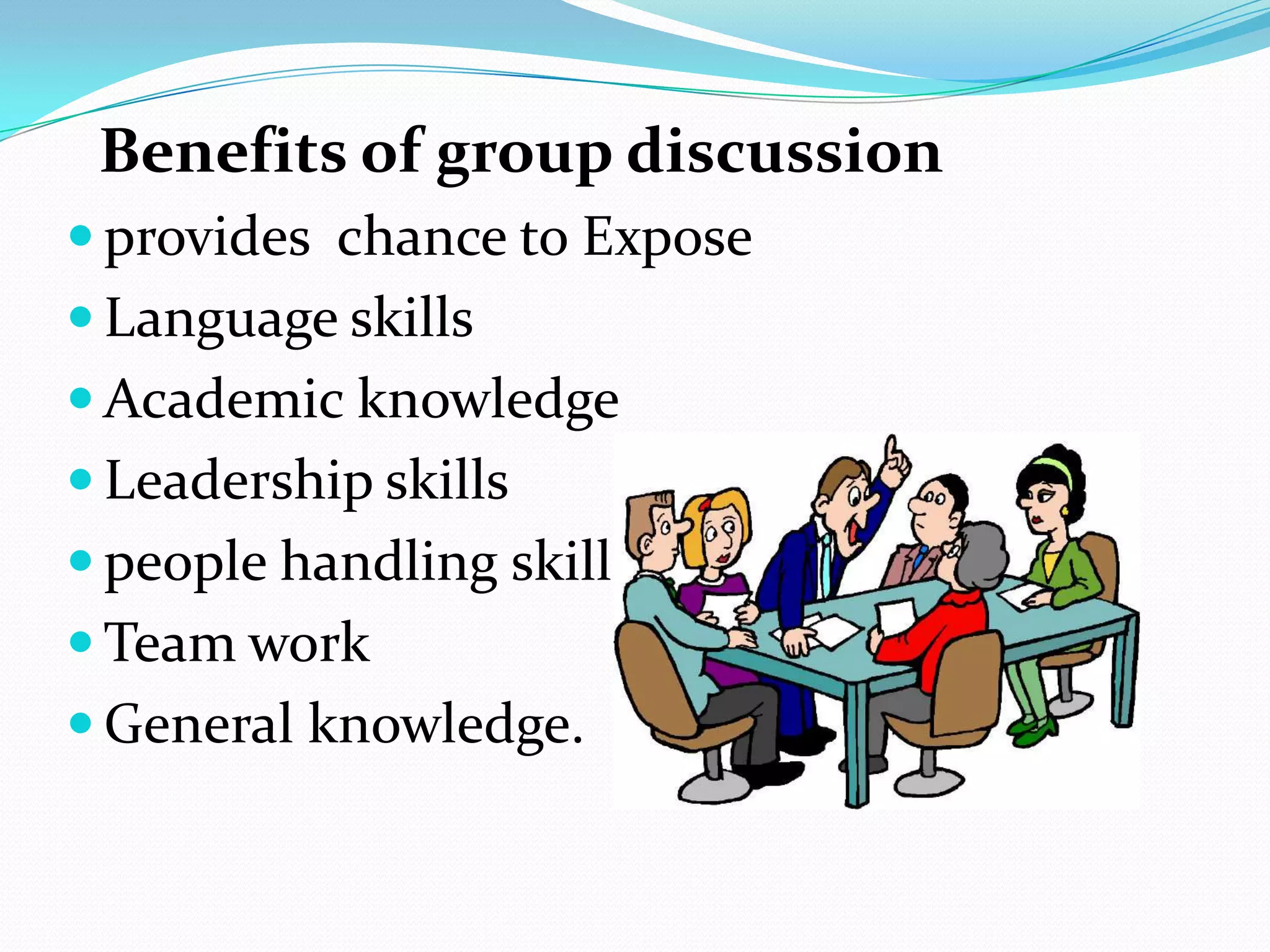
Benefits of group discussion
 provides chance to Expose
 Language skills
 Academic knowledge
 Leadership skills

 people handling skills
 Team work
 General knowledge.
Do`s in group discussion


Appropriate to the issue .

 Make original points & support them by
substantial reasoning .
 Listen to the other participants actively & carefully.
 Whatever you say must be with a logical flow, &
validate it with an example as far as possible.
 Make only accurate statements.
Do`s in group discussion
 Modulate the volume, pitch and tone.
 Be considerate to the feelings of the others.

 Try to get your turn.
 Be an active and dynamic participant by listening.
 Talk with confidence and self-assurance.
Don’ts during group discussion
 Being shy /nervous / keeping isolated from G.D

 Interrupting another participant before his
arguments are over
 Speak in favour ; example:Establish your

position and stand by it stubbornly
 Changed opinions
 Don’t make fun of any participant even if his
arguments are funny.
Don`ts during group discussion
 Don’t engage yourself in sub-group conversation.
 Don’t repeat and use irrelevant materials.
 Addressing yourself to the examiner.
 Worrying about making some grammatical mistakes, for

your interest the matter you put across are important.
Important points in group discussion
 Be assertive: An assertive person is direct , honest
careful about not hurting others ‘self-respect’.

 A patient listener: listening to another person is one
way of showing appreciation.
 Right language : Words can make friends & right

words at the right time make the best results.
 Be analytical and fact-oriented : It is necessary to
make relevant points which can be supported with
facts and analyzed logically.
Accept criticism
 If any member of the group criticizes or

disapproves a point, it is unwise to get
upset or react sharply.

 In case the criticism is flimsy, the same can

be pointed out politely.

 Maximize participation ; one must try to

contribute fully, vigorously & steadily
throughout the discussion.

 Show leadership ability: A group discussion

also evaluates your leadership qualities.
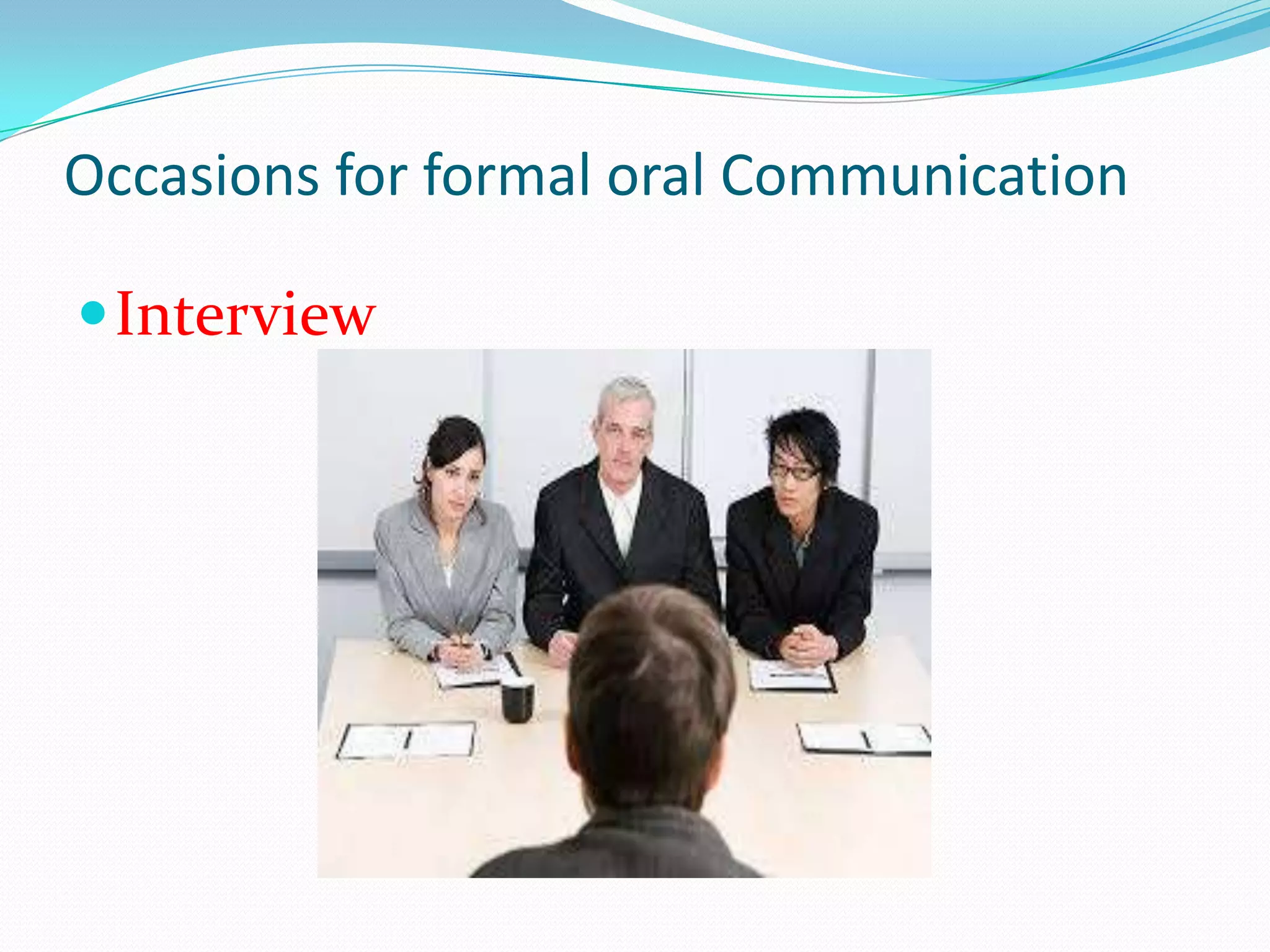
Occasions for formal oral Communication
 Interview
How To Prepare For Job Interviews
 Prepare yourself with effective interview

strategies before you actually go to an
organization and meet with the interviewer.
Increase your chances of success by using these
tips from the experts.
 Preparation is the key to success
How To Prepare For Job Interviews
 FIND DETAILS ABOUT THE INTERVIEW
 GET GOOD DIRECTIONS
 RESEARCH THE ORGANIZATION
 PREPARE YOUR INTERVIEW MATERIALS

 DRESS IN A MANNER THAT SUITS THE JOB
 PAY ATTENTION TO DETAILS IN YOUR

APPEARANCE
 HAVE PLENTY OF TIME TO GET TO THE
INTERVIEW
 GROOMING

 ATTITUDE

 Shower, Hair shampooed

 Be punctual, realistic,

 Clothes –

clean, neat, appropriate for
a job interview
 Shoes are cleaned and

shined

relaxed, courteous,
enthusiastic
 Show initiative
 Smile, pleasant greeting,

firm handshake
Competency-based Interviews





Company identifies key skills required for job
Designs questions to elicit evidence of skills
Emphasis on past behaviour as predictor of success
Teamwork: Describe a team project you worked on. What problems arose?
How did you deal with them?

 Communication Skills: Describe situation when you had to persuade
others to support your view. Give an example of any reports you’ve written which
illustrate your writing skills

 Interpersonal skills: What kinds of people do you find it difficult to work
with? How do you handle those situations?

 Taking Responsibility: Describe a time when you took responsibility to
achieve a challenging goal

 Problem-solving:Tell about a time when you had several tasks to manage at
one time with conflicting deadlines.
Responding to Competency Q
 Q Give me an example of a problem you encountered.
How did you approach it. What was the outcome?
 STAR response
 S: Describe the situation

 T: Explain the task/problem that arose
 A: What action did you take?
 R: What was the result or outcome?
 What did you learn from this experience?
Your Answers
 Listen carefully, seek clarification
 Illustrate answers with real examples and
evidence
 Be positive – constructive criticism
 Keep answers specific
 Take time to respond
 Be alert to interviewer’s body language
 Speak clearly, smile and show enthusiasm
 Know what you want to say, and find the
opportunity
Qualities Employers Seek
 Good all-round intelligence
 Enthusiasm, commitment and motivation
 Good communication skills
 Team work ability
 Ability to solve problems
 Capacity to work hard
 Initiative and self-reliance
 Balanced personality
What creates a bad impression
 Poor personal appearance
 Negative attitude – evasive, using excuses
 Lack of interest and enthusiasm
 Lack of preparation
 Poor knowledge of role
 Failure to give concrete examples of skills
 Over emphasis on money/rewards
 Lack of career plan
Speaking skill

Speaking skill

  • 1.
  • 2.
    Occasions for formaloral Communication  Public Speech
  • 3.
    Occasions for formaloral Communication Fear of Public Speaking  In Spotlight  Unprepared  Inexperienced
  • 4.
    Occasions for formaloral Communication What is Public Speech Public speaking skill may be defined as the art of appearing in front of an audience, facing the audience, presenting your speech and making them understand what you want them to understand within the limited time and resources given to you.
  • 5.
    Occasions for formaloral Communication
  • 6.
    Occasions for formaloral Communication Public Speaking Tips  Do your Homework or research a topic
  • 7.
    Occasions for formaloral Communication Public Speaking Tips  Organize ideas logically  Employ quotations, facts and statistics  Start strong and close stronger  Incorporate humor
  • 8.
    Occasions for formaloral Communication Public Speaking Tips  Analyze your audience- deliver the message they want to hear
  • 9.
    Occasions for formaloral Communication Public Speaking Tips  Eye contact  Interact with audience
  • 10.
    Occasions for formaloral Communication Public Speaking Tips  Time Management  Do not repeat yourself  Show positive attitude  Seek and utilize feedback  Handle unexpected issues smoothly ex. Power cut, projector is not working
  • 11.
    Occasions for formaloral Communication Public Speaking (Things you shouldn’t do)  Reading directly from notes  Turn back on audience  Hands in pockets
  • 12.
    Occasions for formaloral Communication Public Speaking (Things you shouldn’t do)  No um, ah, you know  No nervous gestures  Talking too fast or talking too quietly
  • 13.
    Occasions for formaloral Communication Public Speaking (Things you should do)  Eye Contact  Can glance at notes  Appropriate gestures  Rhetorical questions to involve audience
  • 14.
    Occasions for formaloral Communication  Presentation
  • 15.
    Your top fears 35% Heights FinancialProblems 10% 5% Speaking to a group Flying 15% 10% Sickness Death 10% Deep Water Insects & Bugs 5% 10%
  • 16.
    General pointers toimprove speaking skills:  SPEAK  Be thoroughly aware of the subject.  Know the audience; tailor your speech to meet their needs.
  • 17.
    General pointers…contd.  Rehearseyour speech well and time it.  Practice good articulation:  Make exaggerated use of articulators.   Pay attention to proper diction, pronunciation & stress. Use voice modulation.
  • 18.
    General pointers…contd  Showinterest and enthusiasm.  Begin well & end well.  Understand that stage fright is common and some what necessary.
  • 19.
    Other aspects ofPresentation… Speech Presentation-------Give importance to : o Appearance o Voice o Body language
  • 20.
    …aspects of Presentation SpeechPresentation Technical) Visual Aids………………….. Present them smoothly- Do not Talk while visuals are being read by audience Use “Storyboard” Approach- Match visuals with your text
  • 21.
    Most common PowerPointmistakes 1)Many people tend to put every word they are going to say on their powerPoint slides. Although this eliminates the need to memorize your talk , ultimately this makes your slides crowded , wordy and boring. You will loose your audience’s attention before you even reach the bottom of your……first slide.
  • 22.
    Most common powerpointmistakes Many people do not run spell cheeck before their presentation-BIG MISTAK!!! Nothing makes you look stupid than spelling errors.
  • 23.
  • 24.
    Bad color schemes Clashingbackground and funky colors can lead to:  Distraction  Confusion  Headache  sickness
  • 25.
    1st Qtr 2nd Qtr 3rd Qtr 4th Qtr 5thQtr 6th Qtr 7th Qtr 8th Qtr East 80 65 50 35 29 20 15 10 west 30.6 38.6 34.6 31.6 28 22 18 20 North 45.9 46.9 45 43.9 40 35 41 45
  • 26.
    Your feeling aftera successful presentation!!!
  • 27.
    Occasions for formaloral Communication  Meeting Every day 83 million people attend 11.5 million meetings
  • 28.
    TYPES OF MEETING Formal and Informal  Decision making Meeting  Executive Meeting  Consultation Meeting  Briefing Meeting  Negotiation Meeting  Group Discussion
  • 29.
    PURPOSE OF AMEETING  Reach a common decisions/ agreement  Solve a problem  Exchange ideas / experiences  Inform, explain, present – ideas  Give and get feedback on new ideas  Plan and prepare for action
  • 30.
    PURPOSE OF AMEETING CONTD  Resolve differences  Clear misunderstandings  Generate enthusiasm  Seek co operation  Review and evaluate past performances  Create a feeling of solidarity ( Unity)
  • 31.
    ROLE OF CHAIRPERSON Overall charge of the proceedings  Follow procedure  State the purpose  Restrict discussion to the issue  Maintain time  Speak no more than 20% of the time
  • 32.
    ROLE OF CHAIRPERSONCONTD…  Intervene in arguments / disputes  Arrange for proper recording  Deal with spot issues  Employ tact  Focus on those present  See to follow-up action
  • 33.
    ROLE OF SECRETARY Send notice on time  Organize the venue  Keep handouts etc. ready  Arrange for stationary  Test equipments  Take care of catering  Write minutes
  • 34.
    ROLE OF PARTICIPANTS Punctuality  Stick to the agenda  Contributing/ evaluating information  Raising questions  Listening attentively  Avoiding side discussions  Going along with the group
  • 35.
    ROLE OF PARTICIPANTSCONTD…  Not interrupting other speakers  Co-operating  Showing courtesy  Keeping an open mind  Talking to the point  Following rules  Participating actively
  • 36.
    ADVANTAGES OF AMEETING  Saves time  New information  Sense of participation  Democratic functioning  Bold/quick/joint decision-making  Prevention of mistakes  Idea development
  • 37.
    DISADVANTAGES OF AMEETING  Sometimes… - time consuming - no decision taken - lack of seriousness - wasteful arguments - Expensive
  • 39.
    NOTICE  Sent underproper authority  48 hours to 7 days notice  Name of the body/group to meet  Day, date, time and venue  Agenda and purpose  Sent to all expected to attend
  • 40.
    AGENDA  Confirm theminutes of the previous meeting  Items on the agenda  E.g.,- Appointment of sub-committee to… - Proposal to open a branch - Purchase of a generator etc.
  • 41.
    MINUTES  Name ofthe body/ organization and nature of meeting  Day, date, time and place of meeting  Name of the chairperson, secretary, members present and absent  Attendees by invitation  Decisions/ resolutions  ( The next meeting)
  • 42.
    Occasions for formaloral Communication  Group Discussion
  • 43.
    Definition of GroupDiscussion  Group Discussion is a modern method of assessing students personality.  It is both a technique and an art and a comprehensive tool to judge the worthiness of the student and his appropriateness for the job.
  • 44.
    Group Discussion The termsuggests a discussion among a group of persons.  The group will have 8 & 12 members who will express their views freely, frankly in a friendly manner, on a topic of current issue.  Within a time limit of 20 to 30 minutes, the abilities of the members of the group is measured. 
  • 45.
    Benefits in Groupdiscussion  Stimulation of thinking in a new way.  Expansion of knowledge  Understanding of your strength and weakness.  Your true personality is revealed and qualities of leadership take shape
  • 46.
    Benefits of groupdiscussion  provides chance to Expose  Language skills  Academic knowledge  Leadership skills  people handling skills  Team work  General knowledge.
  • 47.
    Do`s in groupdiscussion  Appropriate to the issue .  Make original points & support them by substantial reasoning .  Listen to the other participants actively & carefully.  Whatever you say must be with a logical flow, & validate it with an example as far as possible.  Make only accurate statements.
  • 48.
    Do`s in groupdiscussion  Modulate the volume, pitch and tone.  Be considerate to the feelings of the others.  Try to get your turn.  Be an active and dynamic participant by listening.  Talk with confidence and self-assurance.
  • 49.
    Don’ts during groupdiscussion  Being shy /nervous / keeping isolated from G.D  Interrupting another participant before his arguments are over  Speak in favour ; example:Establish your position and stand by it stubbornly  Changed opinions  Don’t make fun of any participant even if his arguments are funny.
  • 50.
    Don`ts during groupdiscussion  Don’t engage yourself in sub-group conversation.  Don’t repeat and use irrelevant materials.  Addressing yourself to the examiner.  Worrying about making some grammatical mistakes, for your interest the matter you put across are important.
  • 51.
    Important points ingroup discussion  Be assertive: An assertive person is direct , honest careful about not hurting others ‘self-respect’.  A patient listener: listening to another person is one way of showing appreciation.  Right language : Words can make friends & right words at the right time make the best results.  Be analytical and fact-oriented : It is necessary to make relevant points which can be supported with facts and analyzed logically.
  • 52.
    Accept criticism  Ifany member of the group criticizes or disapproves a point, it is unwise to get upset or react sharply.  In case the criticism is flimsy, the same can be pointed out politely.  Maximize participation ; one must try to contribute fully, vigorously & steadily throughout the discussion.  Show leadership ability: A group discussion also evaluates your leadership qualities.
  • 53.
    Occasions for formaloral Communication  Interview
  • 54.
    How To PrepareFor Job Interviews  Prepare yourself with effective interview strategies before you actually go to an organization and meet with the interviewer. Increase your chances of success by using these tips from the experts.  Preparation is the key to success
  • 55.
    How To PrepareFor Job Interviews  FIND DETAILS ABOUT THE INTERVIEW  GET GOOD DIRECTIONS  RESEARCH THE ORGANIZATION  PREPARE YOUR INTERVIEW MATERIALS  DRESS IN A MANNER THAT SUITS THE JOB  PAY ATTENTION TO DETAILS IN YOUR APPEARANCE  HAVE PLENTY OF TIME TO GET TO THE INTERVIEW
  • 56.
     GROOMING  ATTITUDE Shower, Hair shampooed  Be punctual, realistic,  Clothes – clean, neat, appropriate for a job interview  Shoes are cleaned and shined relaxed, courteous, enthusiastic  Show initiative  Smile, pleasant greeting, firm handshake
  • 57.
    Competency-based Interviews     Company identifieskey skills required for job Designs questions to elicit evidence of skills Emphasis on past behaviour as predictor of success Teamwork: Describe a team project you worked on. What problems arose? How did you deal with them?  Communication Skills: Describe situation when you had to persuade others to support your view. Give an example of any reports you’ve written which illustrate your writing skills  Interpersonal skills: What kinds of people do you find it difficult to work with? How do you handle those situations?  Taking Responsibility: Describe a time when you took responsibility to achieve a challenging goal  Problem-solving:Tell about a time when you had several tasks to manage at one time with conflicting deadlines.
  • 58.
    Responding to CompetencyQ  Q Give me an example of a problem you encountered. How did you approach it. What was the outcome?  STAR response  S: Describe the situation  T: Explain the task/problem that arose  A: What action did you take?  R: What was the result or outcome?  What did you learn from this experience?
  • 59.
    Your Answers  Listencarefully, seek clarification  Illustrate answers with real examples and evidence  Be positive – constructive criticism  Keep answers specific  Take time to respond  Be alert to interviewer’s body language  Speak clearly, smile and show enthusiasm  Know what you want to say, and find the opportunity
  • 60.
    Qualities Employers Seek Good all-round intelligence  Enthusiasm, commitment and motivation  Good communication skills  Team work ability  Ability to solve problems  Capacity to work hard  Initiative and self-reliance  Balanced personality
  • 61.
    What creates abad impression  Poor personal appearance  Negative attitude – evasive, using excuses  Lack of interest and enthusiasm  Lack of preparation  Poor knowledge of role  Failure to give concrete examples of skills  Over emphasis on money/rewards  Lack of career plan