Communication
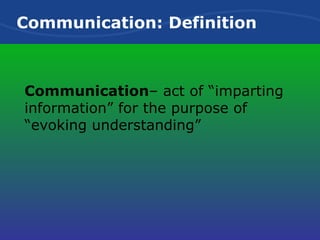
Communication: Definition Communication – act of “imparting information” for the purpose of “evoking understanding”
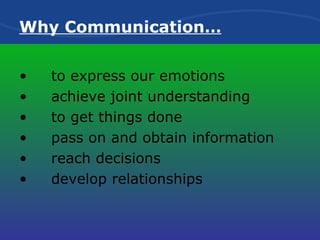
Why Communication… to express our emotions achieve joint understanding to get things done pass on and obtain information reach decisions develop relationships
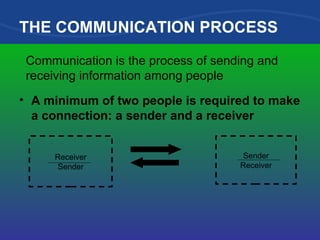
THE COMMUNICATION PROCESS A minimum of two people is required to make a connection: a sender and a receiver  Communication is the process of sending and receiving information among people Receiver Sender Sender Receiver
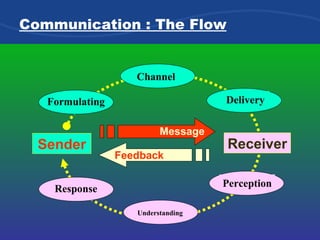
Communication : The Flow Sender Receiver Message Feedback Channel Perception Delivery Formulating Response Understanding
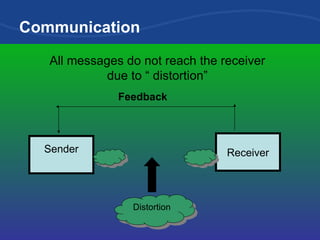
Communication Sender Receiver Distortion Feedback All messages do not reach the receiver due to “ distortion”
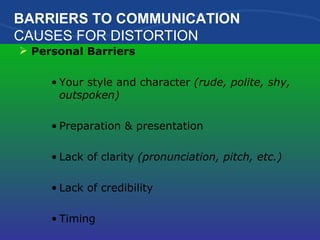
Personal Barriers Your style and character  (rude, polite, shy, outspoken) Preparation & presentation  Lack of clarity  (pronunciation, pitch, etc.)  Lack of credibility Timing BARRIERS TO COMMUNICATION   CAUSES FOR DISTORTION
BARRIERSTO COMMUNICATION Organisational Barriers Culture Environment Size & structure Pace of activity
Process Barriers Channel/Medium Irrelevant Information loading Lack of Response or Feedback Inappropriate Questions BARRIERSTO COMMUNICATION
OVERCOMING COMMUNICATION BARRIERS Constrain Emotions Watch Verbal Cues Use feedback Simplify language Listen actively
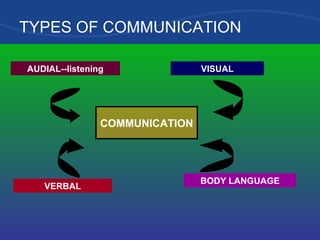
TYPES OF COMMUNICATION AUDIAL--listening VISUAL BODY LANGUAGE VERBAL COMMUNICATION
NON VERBAL COMMUNICATION AUDIO– LISTENING This is to make an effort to hear something; attentively hear a person speaking; Take notice of Respond to advice or request of the person expressing it. A study revealed that 7 out of 10 minutes awake are spent in some form of communication activity
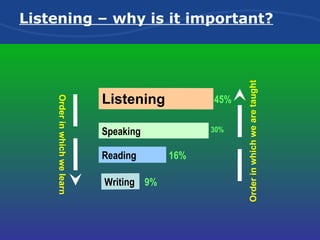
Listening – why is it important? Listening Speaking Reading Writing Order in which we learn Order in which we are taught 9% 45% 30% 16%
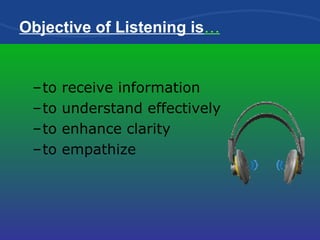
Objective of Listening is … to receive information  to understand effectively to enhance clarity to empathize
GUIDELINES FOR EFFCETIVE LISTENING Be prepared to listen Be interested Keep an open mind Listen for the main  ideas Listen critically Resist Distraction Take notes Help the speaker
THE DONT’S OF LISTENING Don’t listen without looking Don’t interrupt the speaker Don’t allow distractions Don’t appear judgmental Don’t look bored Don’t yawn during a meeting or  conversation
The Listener keeps looking at the speaker The Listener’s body is in ‘open’  position The listener is smiling with a pleasant & encouraging expression Listener looks relaxed but alert, neither  tense  nor slouching Listener utters humming sounds   WHAT LISTENING LOOKS LIKE...
OBSERVATION It means “ to perceive, to note, to take notice; become conscious of; watch carefully’. It is closely related to listening and they are inseparable in their communication functions You can’t be an active listener without being a good observer of people and your environment. 7% of communication systems are verbal and 93% are non verbal
Q & A Question and Answer Session
BODY LANGUAGE Facial Expressions Gestures Posture
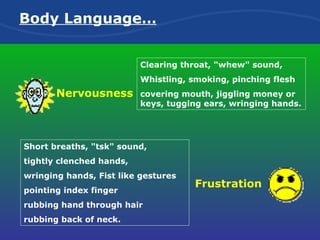
Body Language… Frustration Clearing throat, "whew" sound, Whistling, smoking, pinching flesh  covering mouth, jiggling money or keys, tugging ears, wringing hands. Short breaths, "tsk" sound,  tightly clenched hands,  wringing hands, Fist like gestures  pointing index finger  rubbing hand through hair  rubbing back of neck. Nervousness
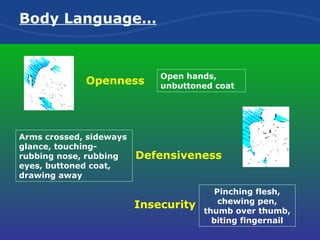
Body Language… Defensiveness Open hands, unbuttoned coat Arms crossed, sideways glance, touching-rubbing nose, rubbing eyes, buttoned coat, drawing away Openness Insecurity Pinching flesh, chewing pen, thumb over thumb, biting fingernail
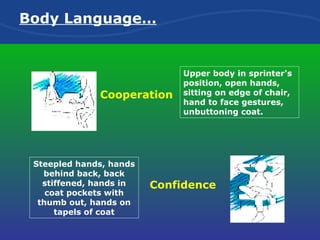
Body Language… Confidence Cooperation Upper body in sprinter's position, open hands, sitting on edge of chair, hand to face gestures, unbuttoning coat. Steepled hands, hands behind back, back stiffened, hands in coat pockets with thumb out, hands on tapels of coat
SPEAKING SKILLS VERBAL SKILLS
SPEAKING… “ A wise man reflects  before He speaks;  a fool speaks, and then  reflects on what  he has uttered.” - French Proverb.
WHILE SPEAKING Speak with confidence. Remain calm and courteous. Speak with a logical sequence. Learn to be comfortable in front of others. Rephrase to ensure clarity.
SPEAK EFFECTIVELY Be generous with praise. Be friendly and cordial. Call people by name. Paraphrase questions you are asked to make meanings clear. Vary your tone, pace, and volume to keep others interested.
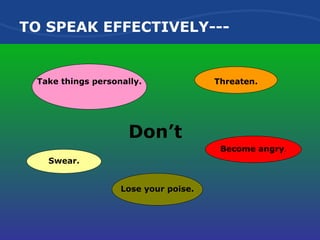
TO SPEAK EFFECTIVELY--- Don’t Threaten. Become angry . Swear. Lose your poise. Take things personally.
FEEDBACK Art of giving efficient and useful  response to an information given or actions taken. It can be through written or oral communication or both One must always know why you want to give feedback or receive it as communication is always Result Oriented
EFFECTIVE FEEDBACK Must be constructive, reinforcing and redirectional. Must be believable.  Must be multidirectional Must be supportive Must be continual Should never be delayed
A Planning Form for Constructive Feedback Answer these questions: W hat  is your purpose in giving the feedback   What  specific actions do you want to reinforce or correct?  What  are the consequences of the action?  What  do you want to accomplish in this discussion  What  specific information do you need to learn;  What  questions do you need answered  What  issues of timing, location, advance preparation, or other logistics do you need to consider to get the most out of the discussion
Effective Communication   Focus the discussion on the information needed   Use closed ended questions to prompt for specifics….. KEY TECHNIQUES Use open-ended questions to expand the discussion
Effective Communication KEY TECHNIQUES Encourage dialogue through eye contact and expression State your understanding of what you are hearing Summarize the key points
EXERCISE--- KNOW YOUR COMMUNICATION STYLE
Thank you .

Communicationsoftskills

  • 1.
  • 2.
    Communication: Definition Communication– act of “imparting information” for the purpose of “evoking understanding”
  • 3.
    Why Communication… toexpress our emotions achieve joint understanding to get things done pass on and obtain information reach decisions develop relationships
  • 4.
    THE COMMUNICATION PROCESSA minimum of two people is required to make a connection: a sender and a receiver Communication is the process of sending and receiving information among people Receiver Sender Sender Receiver
  • 5.
    Communication : TheFlow Sender Receiver Message Feedback Channel Perception Delivery Formulating Response Understanding
  • 6.
    Communication Sender ReceiverDistortion Feedback All messages do not reach the receiver due to “ distortion”
  • 7.
    Personal Barriers Yourstyle and character (rude, polite, shy, outspoken) Preparation & presentation Lack of clarity (pronunciation, pitch, etc.) Lack of credibility Timing BARRIERS TO COMMUNICATION CAUSES FOR DISTORTION
  • 8.
    BARRIERSTO COMMUNICATION OrganisationalBarriers Culture Environment Size & structure Pace of activity
  • 9.
    Process Barriers Channel/MediumIrrelevant Information loading Lack of Response or Feedback Inappropriate Questions BARRIERSTO COMMUNICATION
  • 10.
    OVERCOMING COMMUNICATION BARRIERSConstrain Emotions Watch Verbal Cues Use feedback Simplify language Listen actively
  • 11.
    TYPES OF COMMUNICATIONAUDIAL--listening VISUAL BODY LANGUAGE VERBAL COMMUNICATION
  • 12.
    NON VERBAL COMMUNICATIONAUDIO– LISTENING This is to make an effort to hear something; attentively hear a person speaking; Take notice of Respond to advice or request of the person expressing it. A study revealed that 7 out of 10 minutes awake are spent in some form of communication activity
  • 13.
    Listening – whyis it important? Listening Speaking Reading Writing Order in which we learn Order in which we are taught 9% 45% 30% 16%
  • 14.
    Objective of Listeningis … to receive information to understand effectively to enhance clarity to empathize
  • 15.
    GUIDELINES FOR EFFCETIVELISTENING Be prepared to listen Be interested Keep an open mind Listen for the main ideas Listen critically Resist Distraction Take notes Help the speaker
  • 16.
    THE DONT’S OFLISTENING Don’t listen without looking Don’t interrupt the speaker Don’t allow distractions Don’t appear judgmental Don’t look bored Don’t yawn during a meeting or conversation
  • 17.
    The Listener keepslooking at the speaker The Listener’s body is in ‘open’ position The listener is smiling with a pleasant & encouraging expression Listener looks relaxed but alert, neither tense nor slouching Listener utters humming sounds WHAT LISTENING LOOKS LIKE...
  • 18.
    OBSERVATION It means“ to perceive, to note, to take notice; become conscious of; watch carefully’. It is closely related to listening and they are inseparable in their communication functions You can’t be an active listener without being a good observer of people and your environment. 7% of communication systems are verbal and 93% are non verbal
  • 19.
    Q & AQuestion and Answer Session
  • 20.
    BODY LANGUAGE FacialExpressions Gestures Posture
  • 21.
    Body Language… FrustrationClearing throat, "whew" sound, Whistling, smoking, pinching flesh covering mouth, jiggling money or keys, tugging ears, wringing hands. Short breaths, "tsk" sound, tightly clenched hands, wringing hands, Fist like gestures pointing index finger rubbing hand through hair rubbing back of neck. Nervousness
  • 22.
    Body Language… DefensivenessOpen hands, unbuttoned coat Arms crossed, sideways glance, touching-rubbing nose, rubbing eyes, buttoned coat, drawing away Openness Insecurity Pinching flesh, chewing pen, thumb over thumb, biting fingernail
  • 23.
    Body Language… ConfidenceCooperation Upper body in sprinter's position, open hands, sitting on edge of chair, hand to face gestures, unbuttoning coat. Steepled hands, hands behind back, back stiffened, hands in coat pockets with thumb out, hands on tapels of coat
  • 24.
  • 25.
    SPEAKING… “ Awise man reflects before He speaks; a fool speaks, and then reflects on what he has uttered.” - French Proverb.
  • 26.
    WHILE SPEAKING Speakwith confidence. Remain calm and courteous. Speak with a logical sequence. Learn to be comfortable in front of others. Rephrase to ensure clarity.
  • 27.
    SPEAK EFFECTIVELY Begenerous with praise. Be friendly and cordial. Call people by name. Paraphrase questions you are asked to make meanings clear. Vary your tone, pace, and volume to keep others interested.
  • 28.
    TO SPEAK EFFECTIVELY---Don’t Threaten. Become angry . Swear. Lose your poise. Take things personally.
  • 29.
    FEEDBACK Art ofgiving efficient and useful response to an information given or actions taken. It can be through written or oral communication or both One must always know why you want to give feedback or receive it as communication is always Result Oriented
  • 30.
    EFFECTIVE FEEDBACK Mustbe constructive, reinforcing and redirectional. Must be believable. Must be multidirectional Must be supportive Must be continual Should never be delayed
  • 31.
    A Planning Formfor Constructive Feedback Answer these questions: W hat is your purpose in giving the feedback What specific actions do you want to reinforce or correct? What are the consequences of the action? What do you want to accomplish in this discussion What specific information do you need to learn; What questions do you need answered What issues of timing, location, advance preparation, or other logistics do you need to consider to get the most out of the discussion
  • 32.
    Effective Communication Focus the discussion on the information needed Use closed ended questions to prompt for specifics….. KEY TECHNIQUES Use open-ended questions to expand the discussion
  • 33.
    Effective Communication KEYTECHNIQUES Encourage dialogue through eye contact and expression State your understanding of what you are hearing Summarize the key points
  • 34.
    EXERCISE--- KNOW YOURCOMMUNICATION STYLE
  • 35.