Writing Business
     Reports and
       Proposals


©       Business Communication Today 8e 13 -
                                Chapter
Three-Step Writing
          Process
• Planning
• Writing
• Completing


©            Business Communication Today 8e 13 -
                                     Chapter
Adapting to the Audience

• Be sensitive to their needs
• Build strong relationships
• Control style and tone


©           Business Communication Today 8e 13 -
                                    Chapter
Composing Reports
        and Proposals
•   Type of document
•   Purpose of document
•   Structure of document
•   Length and depth of material
•   Degree of formality
•   Audience relationship

©             Business Communication Today 8e 13 -
                                      Chapter
The Introduction

• Report context
• Subject or purpose
• Main ideas
• Overall tone


©              Business Communication Today 8e 13 -
                                       Chapter
The Body Chapters

• Present
• Analyze
• Interpret
• Support


©             Business Communication Today 8e 13 -
                                      Chapter
The Closing Section

• Emphasizes main points
• Summarizes benefits
• Reinforces structure
• Brings together action items


©           Business Communication Today 8e 13 -
                                    Chapter
Drafting Report Content

• Accurate
• Complete
• Balanced
• Structured
• Documented


©              Business Communication Today 8e 13 -
                                       Chapter
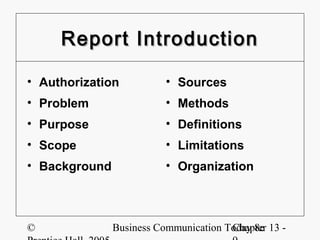
Report Introduction

• Authorization           • Sources
• Problem                 • Methods
• Purpose                 • Definitions
• Scope                   • Limitations
• Background              • Organization


©              Business Communication Today 8e 13 -
                                       Chapter
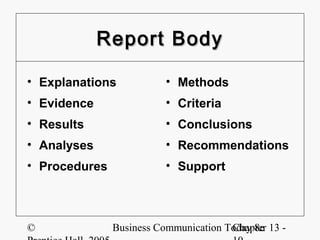
Report Body

• Explanations            • Methods
• Evidence                • Criteria
• Results                 • Conclusions
• Analyses                • Recommendations
• Procedures              • Support


©              Business Communication Today 8e 13 -
                                       Chapter
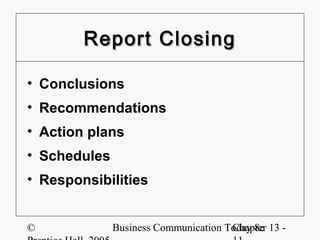
Report Closing

• Conclusions
• Recommendations
• Action plans
• Schedules
• Responsibilities


©             Business Communication Today 8e 13 -
                                      Chapter
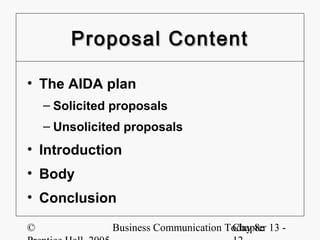
Proposal Content

• The AIDA plan
    – Solicited proposals
    – Unsolicited proposals
• Introduction
• Body
• Conclusion

©              Business Communication Today 8e 13 -
                                       Chapter
Strategies for
    Successful Proposals
• Demonstrate your knowledge
• Provide concrete examples
• Research the competition
• Prove that your proposal is workable
• Adopt a “you” attitude
• Package your proposal attractively

©           Business Communication Today 8e 13 -
                                    Chapter
Proposal Introduction

• Problem or background
• Proposed solution
• Scope or delimitations
• Organization


©           Business Communication Today 8e 13 -
                                    Chapter
Proposal Body

• Proposed approach
• Work plan
• Qualifications
• Detailed costs


©             Business Communication Today 8e 13 -
                                      Chapter
Proposal Closing

• Key points
• Benefits and merits
• Qualifications
• Final decisions


©              Business Communication Today 8e 13 -
                                       Chapter
Consistent Perspective

• Time frame
• Verb tenses
• Chronology


©          Business Communication Today 8e 13 -
                                   Chapter
Guiding the Readers

• Headings and subheadings
• Transitional devices
• Previews and reviews


©           Business Communication Today 8e 13 -
                                    Chapter
Technology for
    Reports and Proposals
• Templates
• Linked files
• Embedded files
• Electronic forms
• Electronic documents
• Multimedia documents
©             Business Communication Today 8e 13 -
                                      Chapter

Ch 13 (2)

  • 1.
    Writing Business Reports and Proposals © Business Communication Today 8e 13 - Chapter
  • 2.
    Three-Step Writing Process • Planning • Writing • Completing © Business Communication Today 8e 13 - Chapter
  • 3.
    Adapting to theAudience • Be sensitive to their needs • Build strong relationships • Control style and tone © Business Communication Today 8e 13 - Chapter
  • 4.
    Composing Reports and Proposals • Type of document • Purpose of document • Structure of document • Length and depth of material • Degree of formality • Audience relationship © Business Communication Today 8e 13 - Chapter
  • 5.
    The Introduction • Reportcontext • Subject or purpose • Main ideas • Overall tone © Business Communication Today 8e 13 - Chapter
  • 6.
    The Body Chapters •Present • Analyze • Interpret • Support © Business Communication Today 8e 13 - Chapter
  • 7.
    The Closing Section •Emphasizes main points • Summarizes benefits • Reinforces structure • Brings together action items © Business Communication Today 8e 13 - Chapter
  • 8.
    Drafting Report Content •Accurate • Complete • Balanced • Structured • Documented © Business Communication Today 8e 13 - Chapter
  • 9.
    Report Introduction • Authorization • Sources • Problem • Methods • Purpose • Definitions • Scope • Limitations • Background • Organization © Business Communication Today 8e 13 - Chapter
  • 10.
    Report Body • Explanations • Methods • Evidence • Criteria • Results • Conclusions • Analyses • Recommendations • Procedures • Support © Business Communication Today 8e 13 - Chapter
  • 11.
    Report Closing • Conclusions •Recommendations • Action plans • Schedules • Responsibilities © Business Communication Today 8e 13 - Chapter
  • 12.
    Proposal Content • TheAIDA plan – Solicited proposals – Unsolicited proposals • Introduction • Body • Conclusion © Business Communication Today 8e 13 - Chapter
  • 13.
    Strategies for Successful Proposals • Demonstrate your knowledge • Provide concrete examples • Research the competition • Prove that your proposal is workable • Adopt a “you” attitude • Package your proposal attractively © Business Communication Today 8e 13 - Chapter
  • 14.
    Proposal Introduction • Problemor background • Proposed solution • Scope or delimitations • Organization © Business Communication Today 8e 13 - Chapter
  • 15.
    Proposal Body • Proposedapproach • Work plan • Qualifications • Detailed costs © Business Communication Today 8e 13 - Chapter
  • 16.
    Proposal Closing • Keypoints • Benefits and merits • Qualifications • Final decisions © Business Communication Today 8e 13 - Chapter
  • 17.
    Consistent Perspective • Timeframe • Verb tenses • Chronology © Business Communication Today 8e 13 - Chapter
  • 18.
    Guiding the Readers •Headings and subheadings • Transitional devices • Previews and reviews © Business Communication Today 8e 13 - Chapter
  • 19.
    Technology for Reports and Proposals • Templates • Linked files • Embedded files • Electronic forms • Electronic documents • Multimedia documents © Business Communication Today 8e 13 - Chapter

Editor's Notes

  • #4 To ensure your own success with reports, be sensitive to audience needs, build strong relationships with your audience, and control your style and tone. The following four aspects of audience sensitivity apply to reports and proposals: adopting the "you" attitude, maintaining a strong sense of etiquette, emphasizing the positive, and using bias-free language. With previews, summaries, appendixes, and other elements, you can meet the needs of a diverse audience—provided you plan for these elements in advance. Whether your report is intended for people inside or outside the company, be sure to plan how you will adapt your style and your language to reflect the image of your organization. Bear in mind that some reports can take on lives of their own, reaching a wider audience than you ever imagined and being read years after you wrote them, so choose your content and language with care. Whether you’re writing a report or a proposal, you'll need to decide on the appropriate style and tone. Make your tone too informal, and your audience might be put off by your casual approach. Make it too formal, and you could come across as impersonal and distant, perhaps too rigid to form a strong working relationship with others. Your level of formality is closely related to your document’s format, length, and organization, as well as to your relationship with the audience. If you know your readers reasonably well and your report is likely to meet with their approval, you can generally adopt a fairly informal tone. To make your tone more formal, use the impersonal journalism style: Emphasize objectivity, ensure that content is free from personal opinion, and build your argument on provable facts. A more formal tone is appropriate for longer reports, especially those dealing with controversial or complex information. Also, communicating with people in other cultures often calls for more formality—for two reasons. First, the business environment outside the United States tends to be more formal in general, and that formality must be reflected in your communication. Second, the things you do to make a document informal (such as using humor and idiomatic language) tend to translate poorly or not at all from one culture to another.