






Defining Oral Presentations
Types
Elements to consider
Process of the presentations
Seven Factors to remember


The action of communication in which one speaker is
doing most of the sending and a number of listeners
are doing most of the receiving.
1.
2.
3.

4.

Prepared/Extemporaneous
Reading or Manuscripts
Memorization
Impromptu









The Venue
The Organizers
The Occasion
The Time available
Other Speakers
The Audience
1.
2.
3.

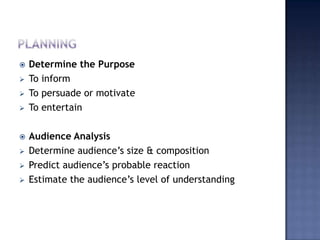
Planning
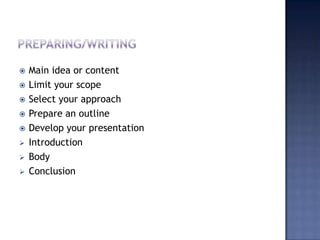
Preparing/Writing
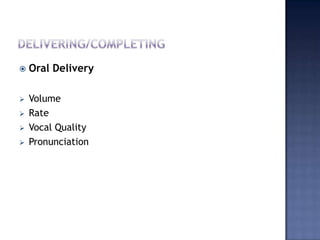
Delivering/Completing











Determine the Purpose
To inform
To persuade or motivate
To entertain
Audience Analysis
Determine audience’s size & composition
Predict audience’s probable reaction
Estimate the audience’s level of understanding











Main idea or content
Limit your scope
Select your approach
Prepare an outline
Develop your presentation
Introduction
Body
Conclusion


Oral Delivery



Volume
Rate
Vocal Quality
Pronunciation







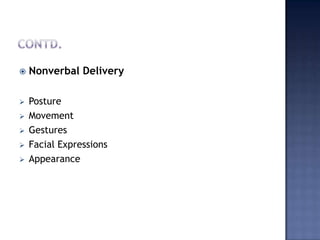
Nonverbal Delivery



Posture
Movement
Gestures
Facial Expressions
Appearance





1.

The Start



Do not apologize
Be confident
Know the topic well



2. Audience Mood


Be empathic with your audience’s mood



Watch your audience’s body language; their facial
expressions, glances exchanged, shuffling of feet etc.



Project the right degree of formality



Use good pace and drive



Don’t be arrogant - this will turn your audience
against you



Control your enthusiasm
3. Your Voice


Be clearly audible



Use a microphone if necessary



Keep your head up



Open your mouth wider than during normal speech



Speak comparatively slow so the audience can digest what
you are saying



Keep right level of stress, accent, and speed of speaking



Use a good pitch – the musical tone – vary it. High notes
convey urgency, the low notes convey emphasis
4. Body Language



Positioning of your body – stand in a good posture, do not
pace around too much



Use your hands in proper gestures to support your points



Good use of eye contact – gains and holds attention and
establishes rapport



Avoid mannerisms that irritate, e.g. swaying side to side,
fiddling with marker, fidgeting with fingers, swirling to and
fro etc.



Avoid hands in pockets
5. Your Visual Aids



When using flip charts or white boards, write from the side



Write legibly



Stand so that you do not block the view of the screen



Do not speak to the board or screen
6. Timing



Make sure you end on time



Observe the division of time from the introduction to
body and to the conclusion
7. Conclusion



Finish with equal enthusiasm as was on start



Ask the audience for action



Leave no doubt in your audience’s mind that you have
come to an end of your presentation
“There are no secrets to success. It is the result of
preparation, hard work, and learning from failure.”
Gen. Colin L. Powell




Adair, J. (2003). Adair on Communication and Presentation
Skills. Thorogood: London. pp. 36-41
Abhiyan, S. (2003). Module on Communication Skills in
English. New Delhi: India. pp. 146-157
Oral presentations
Oral presentations

Oral presentations