
Superconductivity
Course: B.Tech
Subject: Engineering Physics
Unit: III
Chapter: 2
Introduction of superconductivity
• Electrical resistivity ↓ Temp. ↓
• 0 º K Electrical resistivity is 0 for perfectly pure
metal
• Any metal can’t be perfectly pure.
• The more impure the metal Electrical resistivity ↑
• Certain metals when they cooled their electrical
resistivity decreases but at Tc resistivity is 0 this
state of metal is called __________.
• Finder – K Onnes 1911
Properties of Superconductors
Electrical Resistance
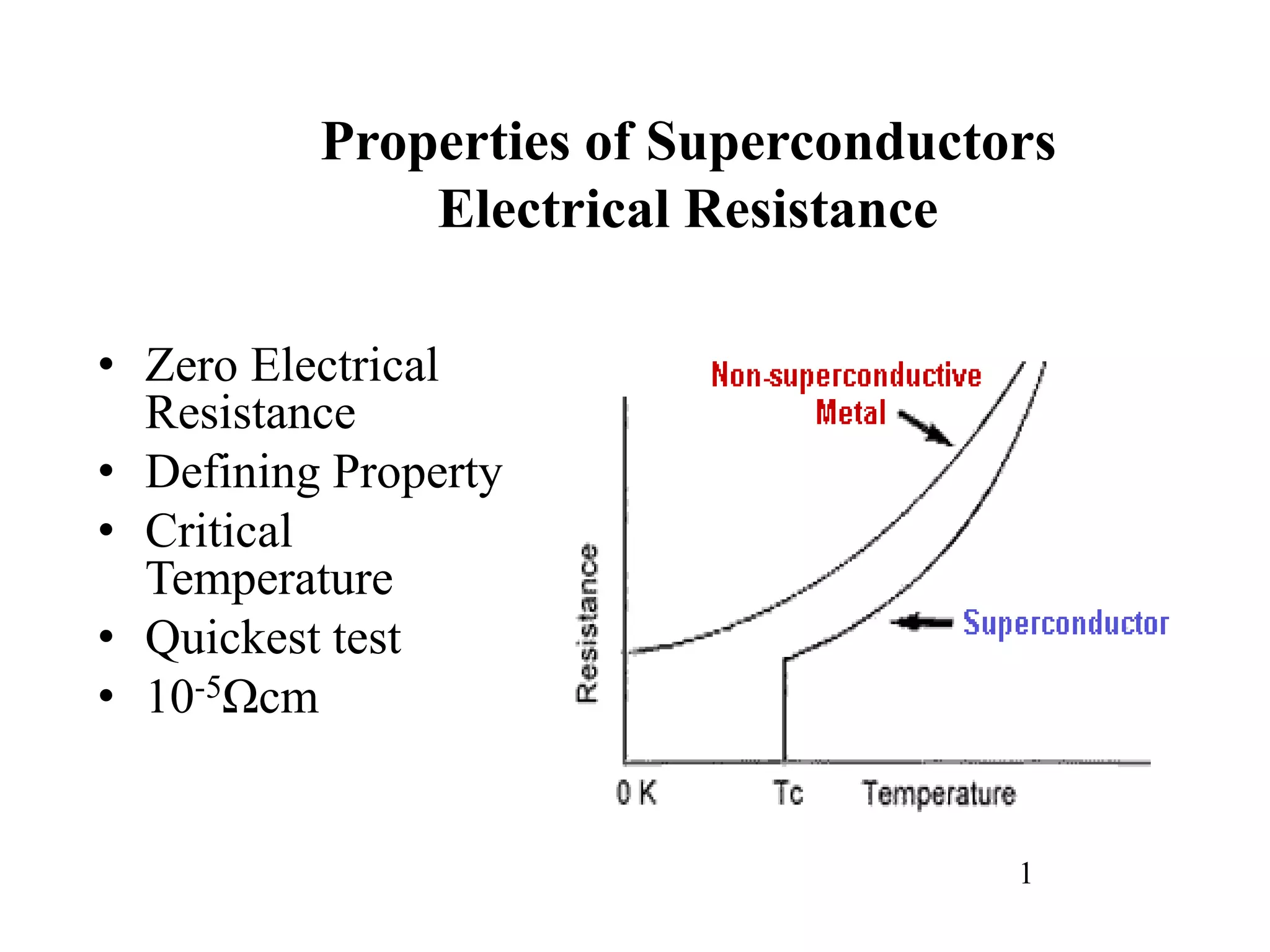
• Zero Electrical
Resistance
• Defining Property
• Critical
Temperature
• Quickest test
• 10-5Ωcm
1
Effect of Magnetic Field
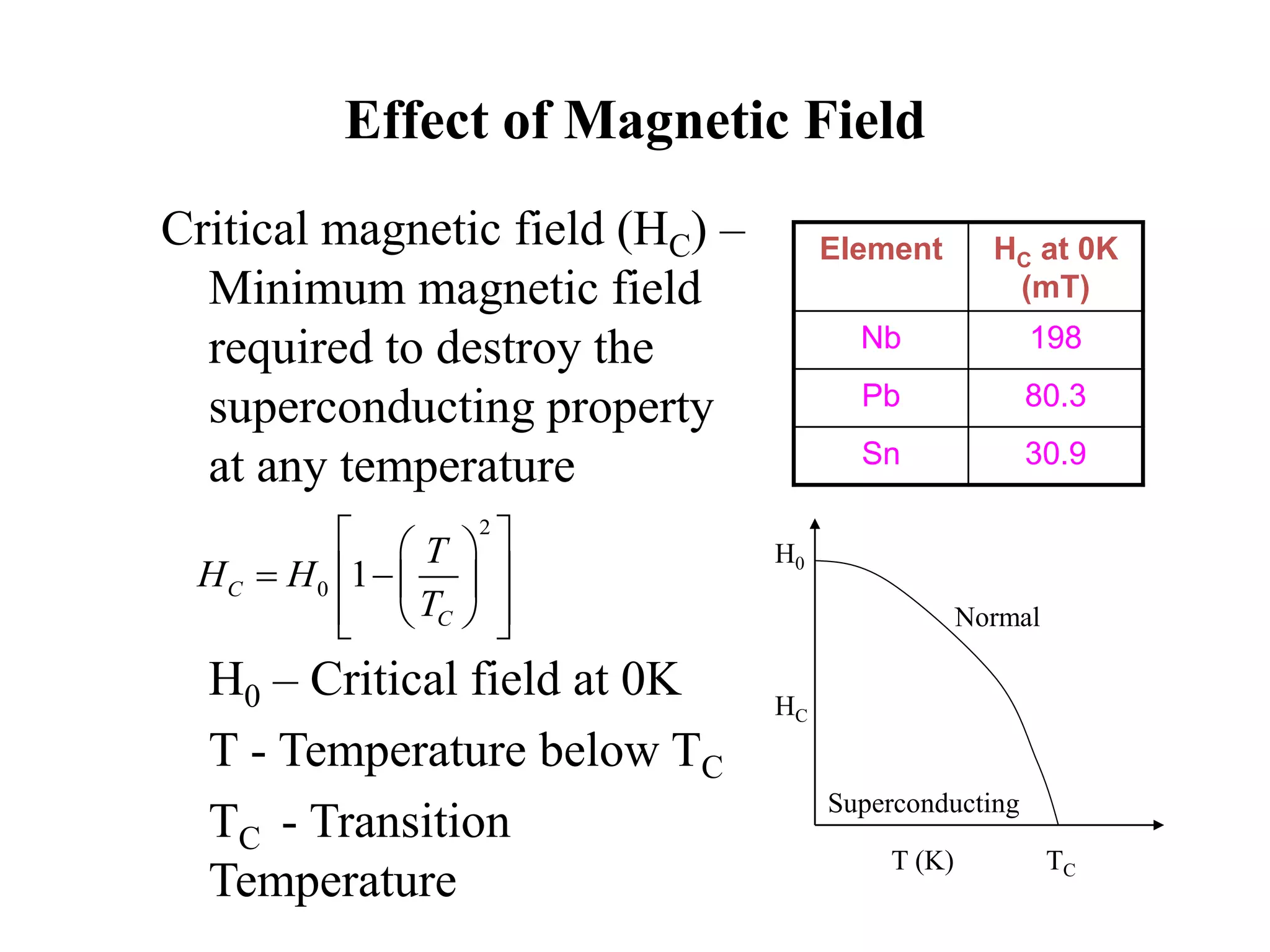
Critical magnetic field (HC) –
Minimum magnetic field
required to destroy the
superconducting property
at any temperature
H0 – Critical field at 0K
T - Temperature below TC
TC - Transition
Temperature
Element HC at 0K
(mT)
Nb 198
Pb 80.3
Sn 30.9
Superconducting
Normal
T (K) TC
H0
HC
2
0 1C
C
T
H H
T
  
   
   
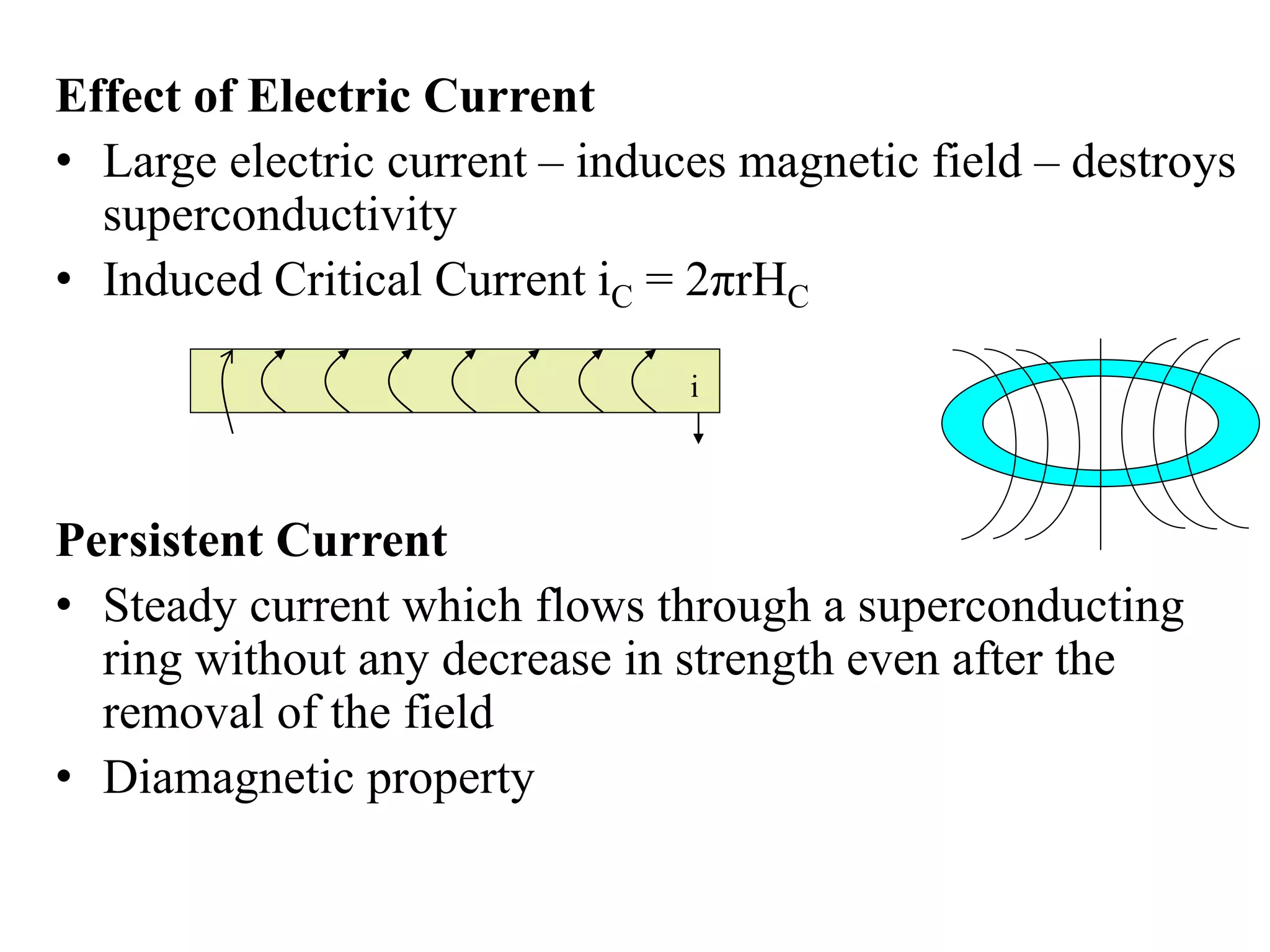
Effect of Electric Current
• Large electric current – induces magnetic field – destroys
superconductivity
• Induced Critical Current iC = 2πrHC
Persistent Current
• Steady current which flows through a superconducting
ring without any decrease in strength even after the
removal of the field
• Diamagnetic property
i
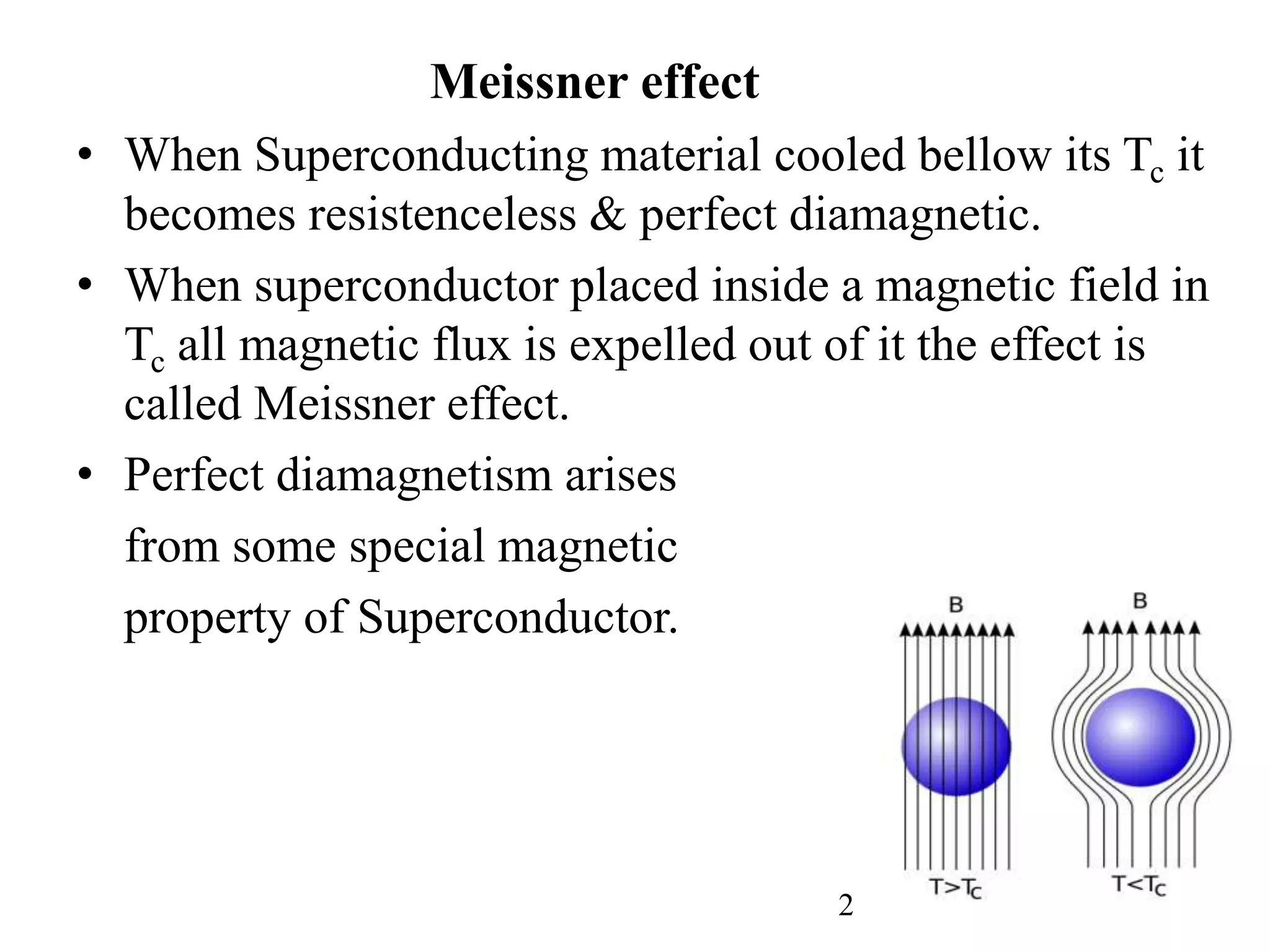
Meissner effect
• When Superconducting material cooled bellow its Tc it
becomes resistenceless & perfect diamagnetic.
• When superconductor placed inside a magnetic field in
Tc all magnetic flux is expelled out of it the effect is
called Meissner effect.
• Perfect diamagnetism arises
from some special magnetic
property of Superconductor.
2
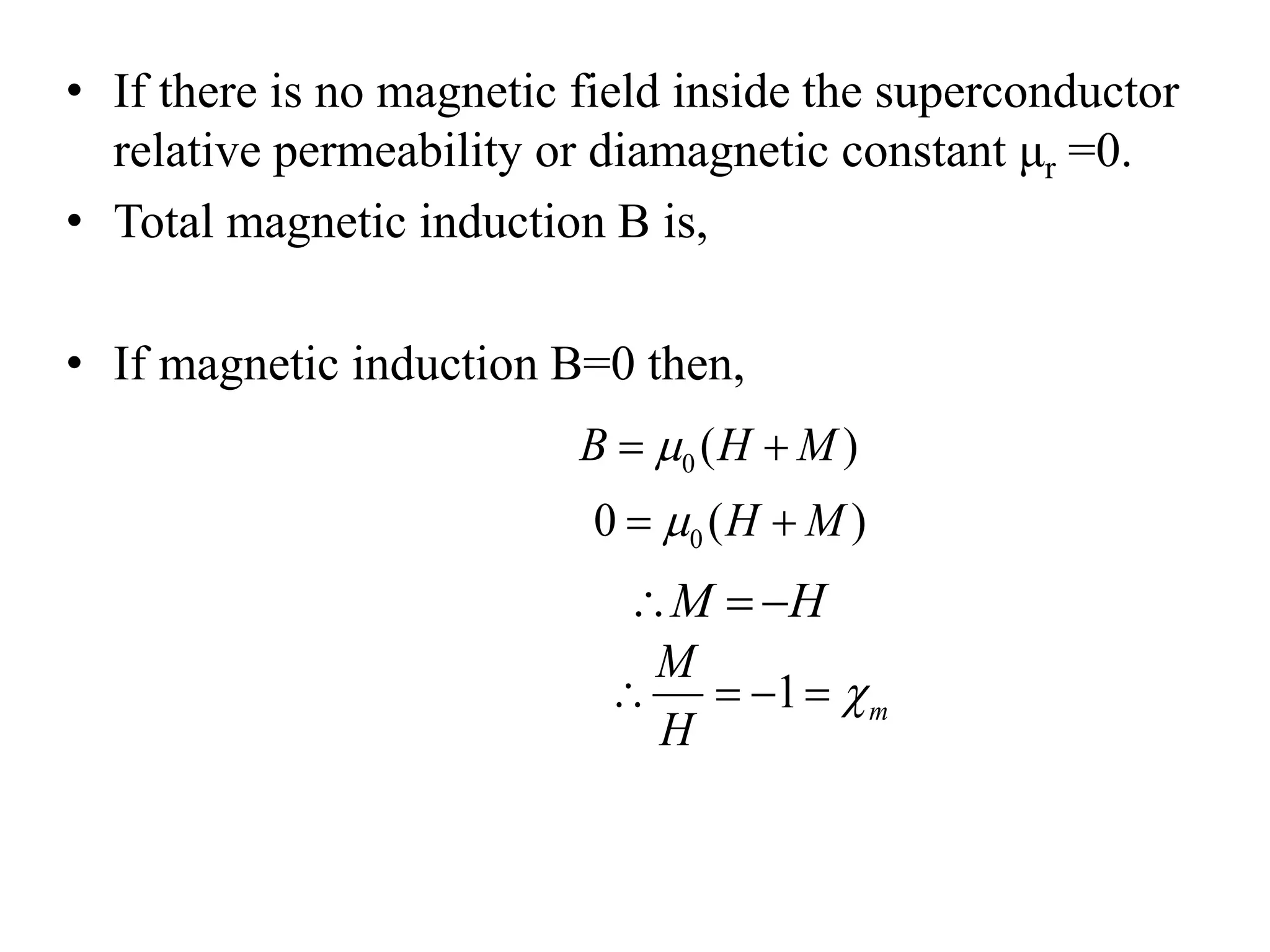
• If there is no magnetic field inside the superconductor
relative permeability or diamagnetic constant μr =0.
• Total magnetic induction B is,
• If magnetic induction B=0 then,
0 ( )B H M 
00 ( )H M 
M H  
1 m
M
H
   
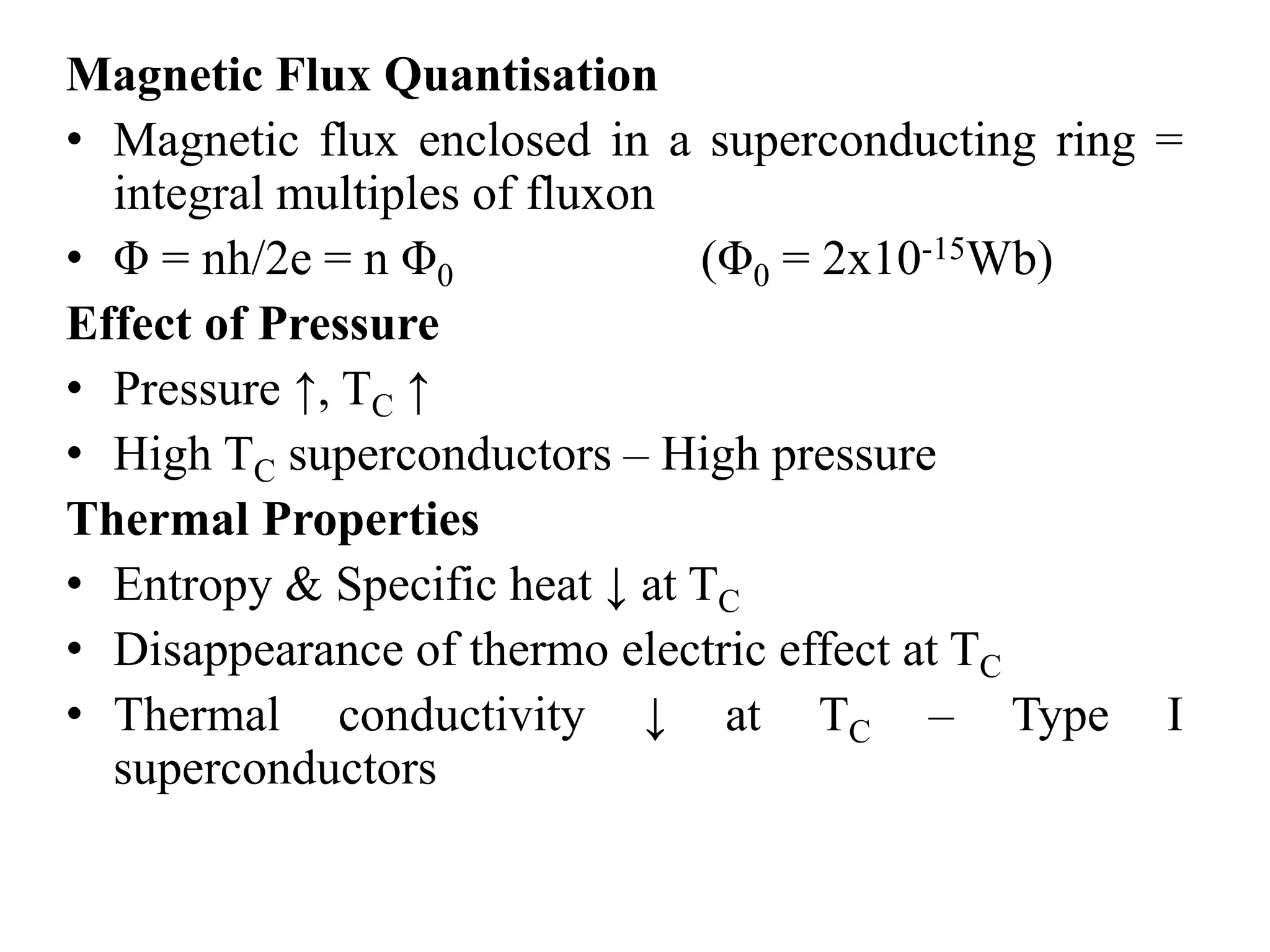
Magnetic Flux Quantisation
• Magnetic flux enclosed in a superconducting ring =
integral multiples of fluxon
• Φ = nh/2e = n Φ0 (Φ0 = 2x10-15Wb)
Effect of Pressure
• Pressure ↑, TC ↑
• High TC superconductors – High pressure
Thermal Properties
• Entropy & Specific heat ↓ at TC
• Disappearance of thermo electric effect at TC
• Thermal conductivity ↓ at TC – Type I
superconductors
Stress
• Stress ↑, dimension ↑, TC ↑, HC affected
Frequency
• Frequency ↑, Zero resistance – modified, TC not affected
Impurities
• Magnetic properties affected
Size
• Size < 10-4cm – superconducting state modified
General Properties
• No change in crystal structure
• No change in elastic & photo-electric properties
• No change in volume at TC in the absence of magnetic
field
Isotope Effect
• Maxwell
• TC = Constant / Mα
• TC Mα = Constant (α – Isotope Effect coefficient)
• α = 0.15 – 0.5
• α = 0 (No isotope effect)
• TC√M = constant
Classification & characterization of super
conductor
• Type I or soft super conductor
– Exhibit complete Meissner effect.
– Bellow Hc super conductor above Hc Normal
– Value of Hc is order of 0.1 T.
– Aluminum, lead & Indium are type I super conductor
– Not used as strong electromagnets
3
• Type II or Hard super conductor
– Exhibit complete Meissner effect bellow a certain
critical field Hc1 at this point diamagnetism &
superconductivity ↓. This state is mix state called
vortex state.
– At certain critical field Hc2 superconductivity
disappears.
– Niobium, Aluminum, silicon, ceramic are type II
superconductors.
– Pb is type I superconductor ac Hc =600 gauss at 4º K
when a small impurity of In is added it becomes type
II superconductor with Hc1 =400 gauss & Hc2 =1000
gauss.
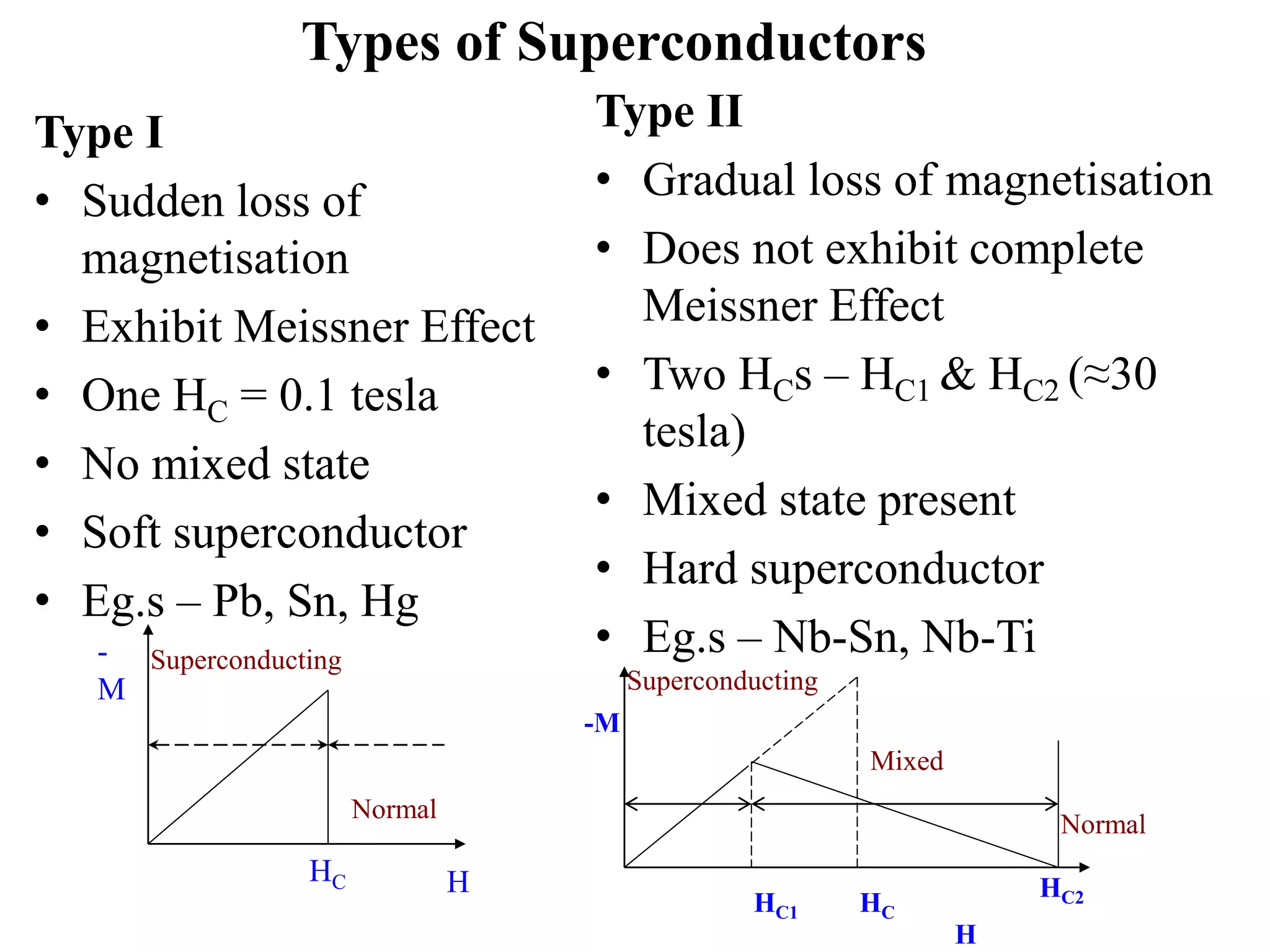
Types of Superconductors
Type I
• Sudden loss of
magnetisation
• Exhibit Meissner Effect
• One HC = 0.1 tesla
• No mixed state
• Soft superconductor
• Eg.s – Pb, Sn, Hg
Type II
• Gradual loss of magnetisation
• Does not exhibit complete
Meissner Effect
• Two HCs – HC1 & HC2 (≈30
tesla)
• Mixed state present
• Hard superconductor
• Eg.s – Nb-Sn, Nb-Ti-
M
HHC
Superconducting
Normal
Superconducting
-M
Normal
Mixed
HC1 HC
HC2
H
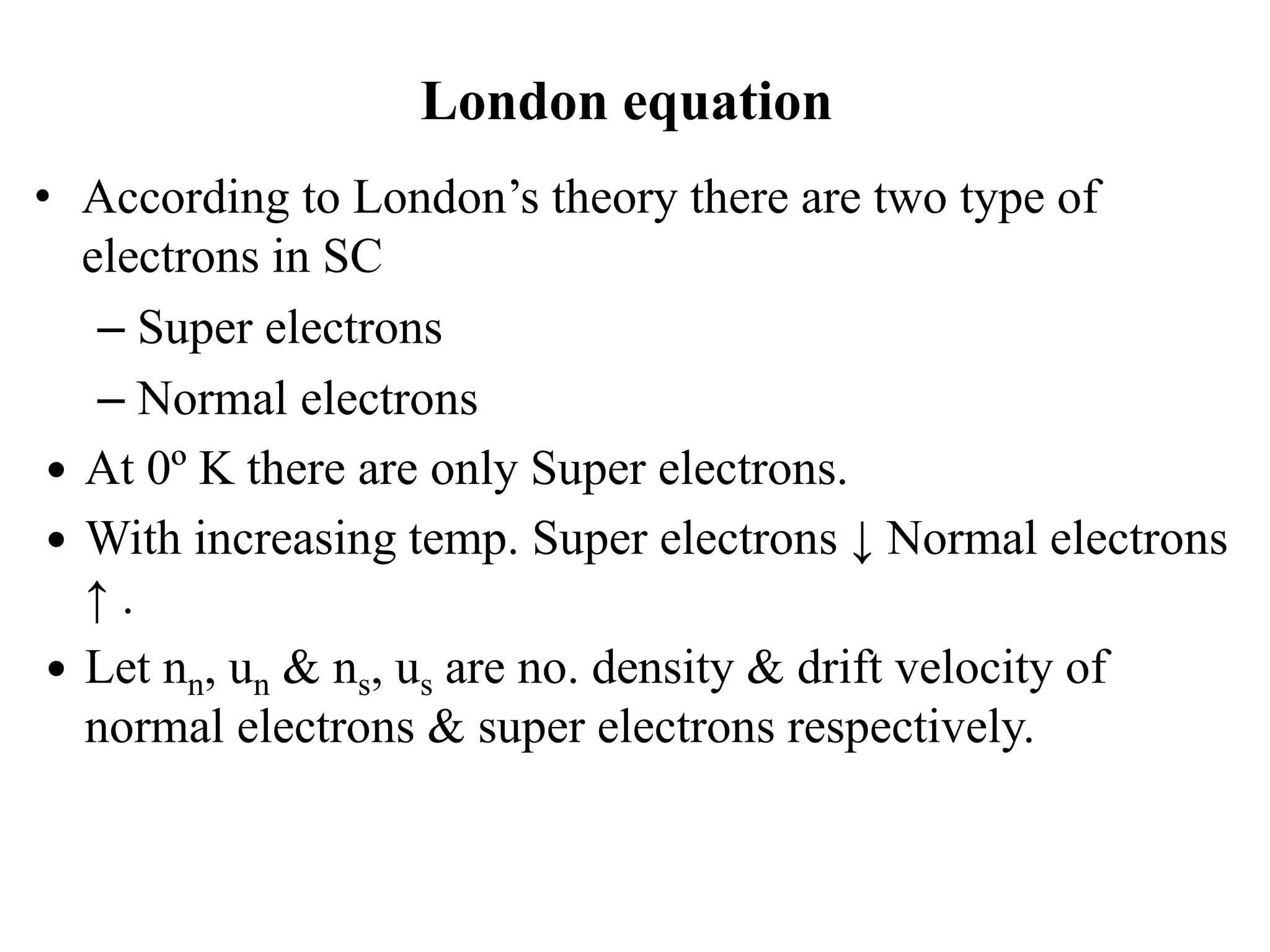
London equation
• According to London’s theory there are two type of
electrons in SC
– Super electrons
– Normal electrons
 At 0º K there are only Super electrons.
 With increasing temp. Super electrons ↓ Normal electrons
↑ .
 Let nn, un & ns, us are no. density & drift velocity of
normal electrons & super electrons respectively.
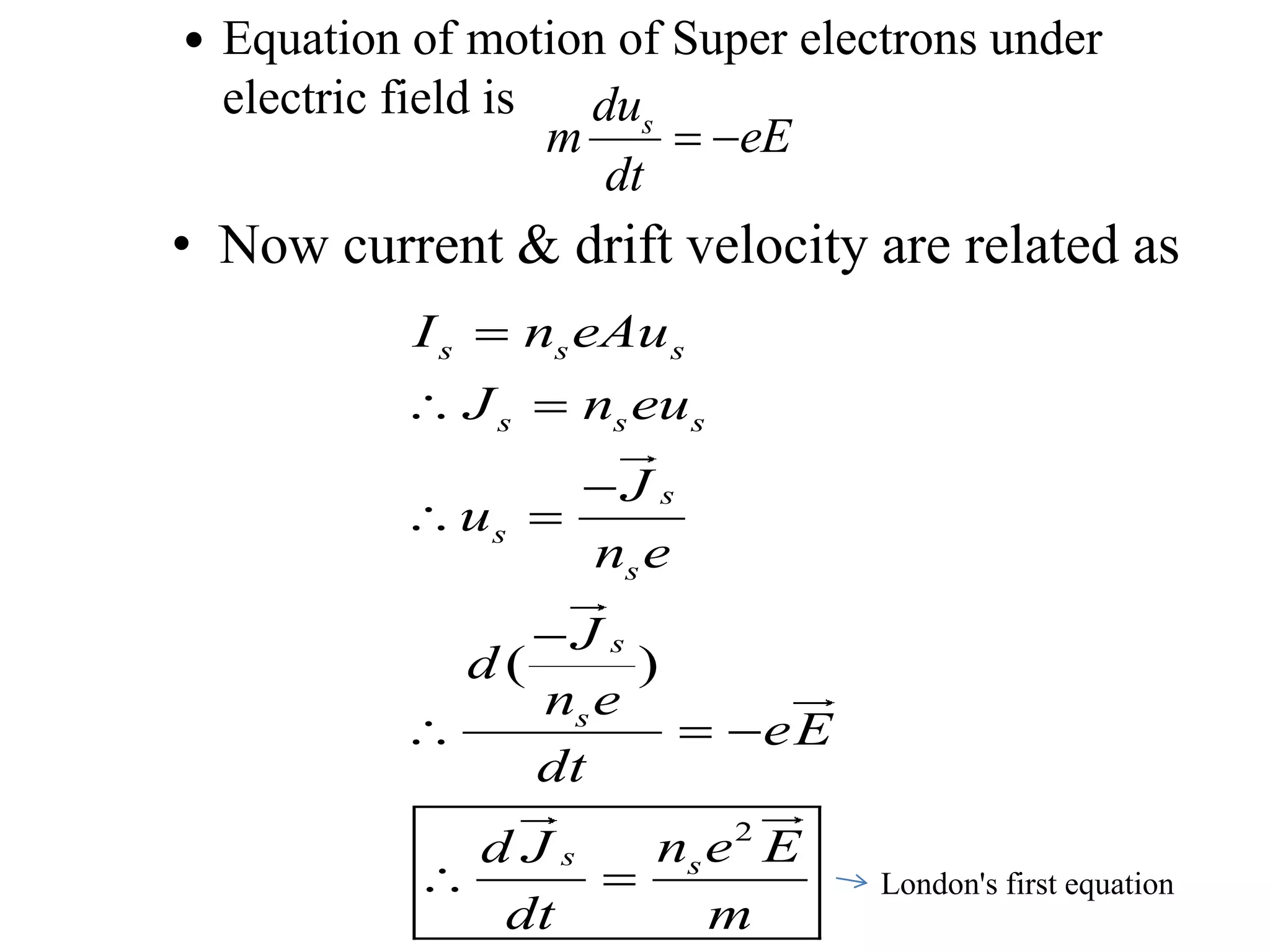
 Equation of motion of Super electrons under
electric field is
• Now current & drift velocity are related as
sdu
m eE
dt
 
2
( )
s s s
s s s
s
s
s
s
s
s s
I n eAu
J n eu
J
u
n e
J
d
n e
eE
dt
n e Ed J
dt m

 

 

  
  London's first equation
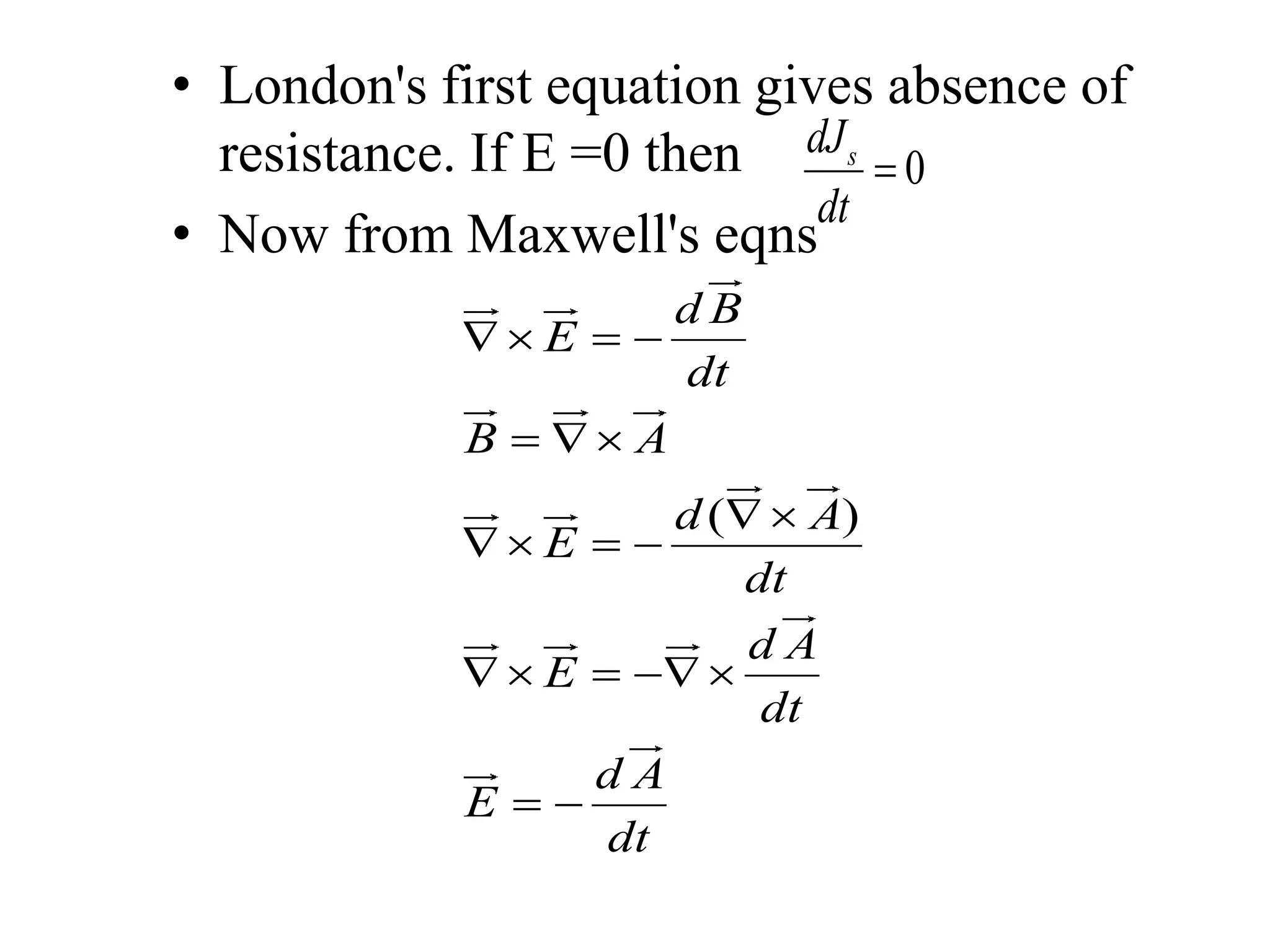
• London's first equation gives absence of
resistance. If E =0 then
• Now from Maxwell's eqns
0sdJ
dt

( )
d B
E
dt
B A
d A
E
dt
d A
E
dt
d A
E
dt
  
 

  
  
 
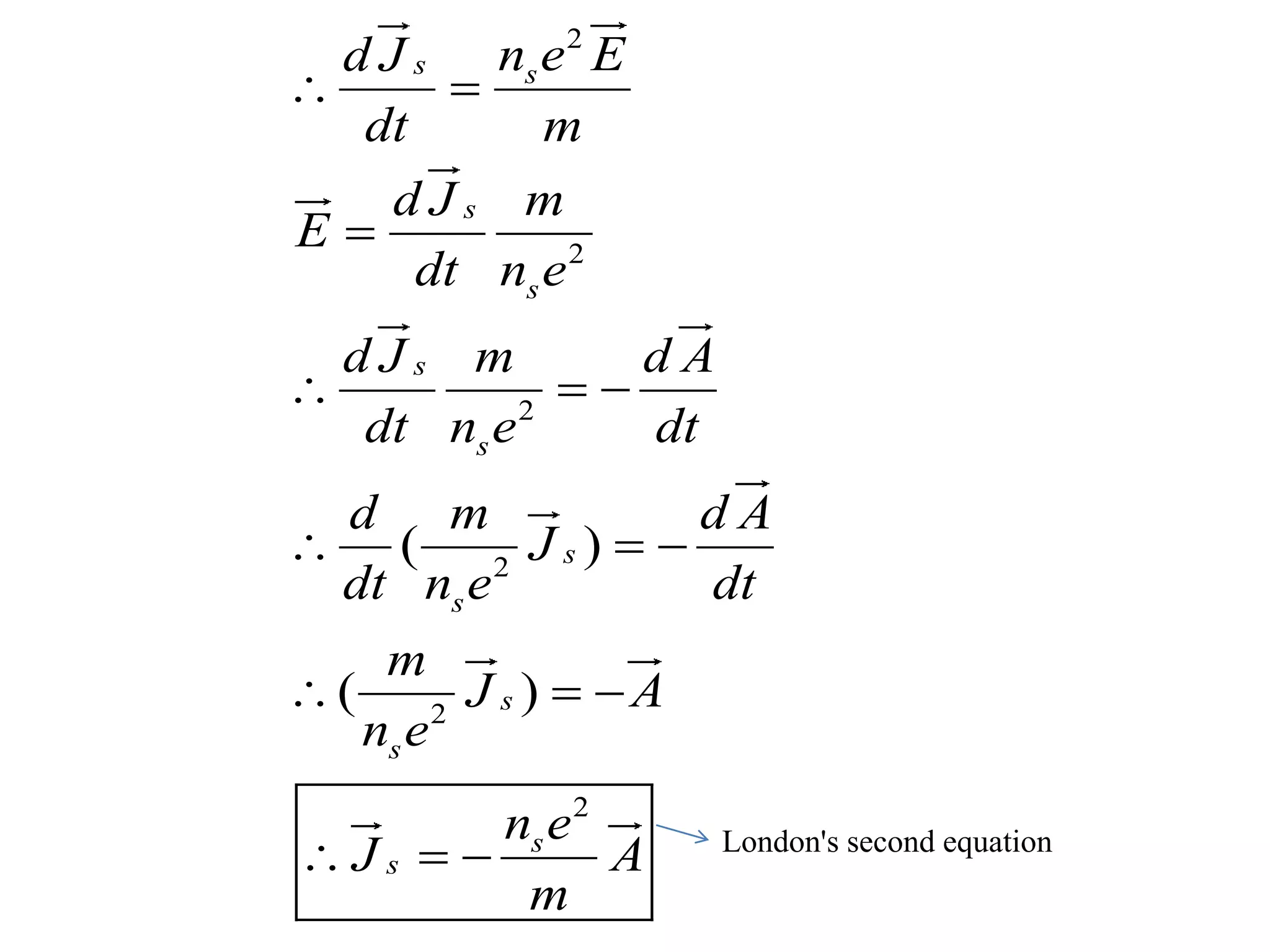
2
2
2
2
2
2
( )
( )
s s
s
s
s
s
s
s
s
s
s
s
n e Ed J
dt m
d J m
E
dt n e
d J m d A
dt n e dt
d m d A
J
dt n e dt
m
J A
n e
n e
J A
m
 

  
  
  
   London's second equation
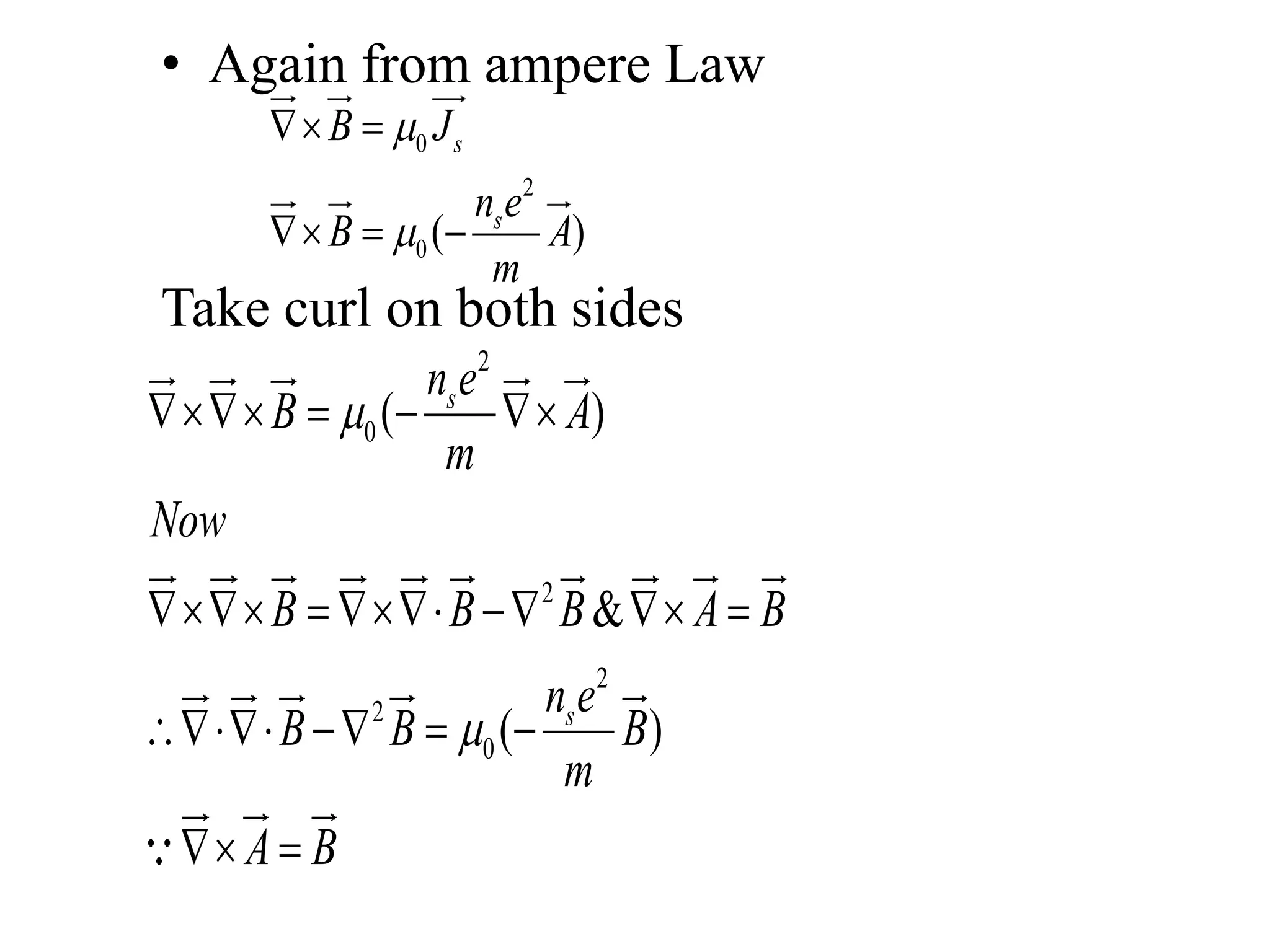
• Again from ampere Law
Take curl on both sides
0
2
0 ( )
s
s
B J
n e
B A
m


 
  
2
0
2
2
2
0
( )
&
( )
s
s
n e
B A
m
Now
B B B A B
n e
B B B
m
A B


   
     
   
 
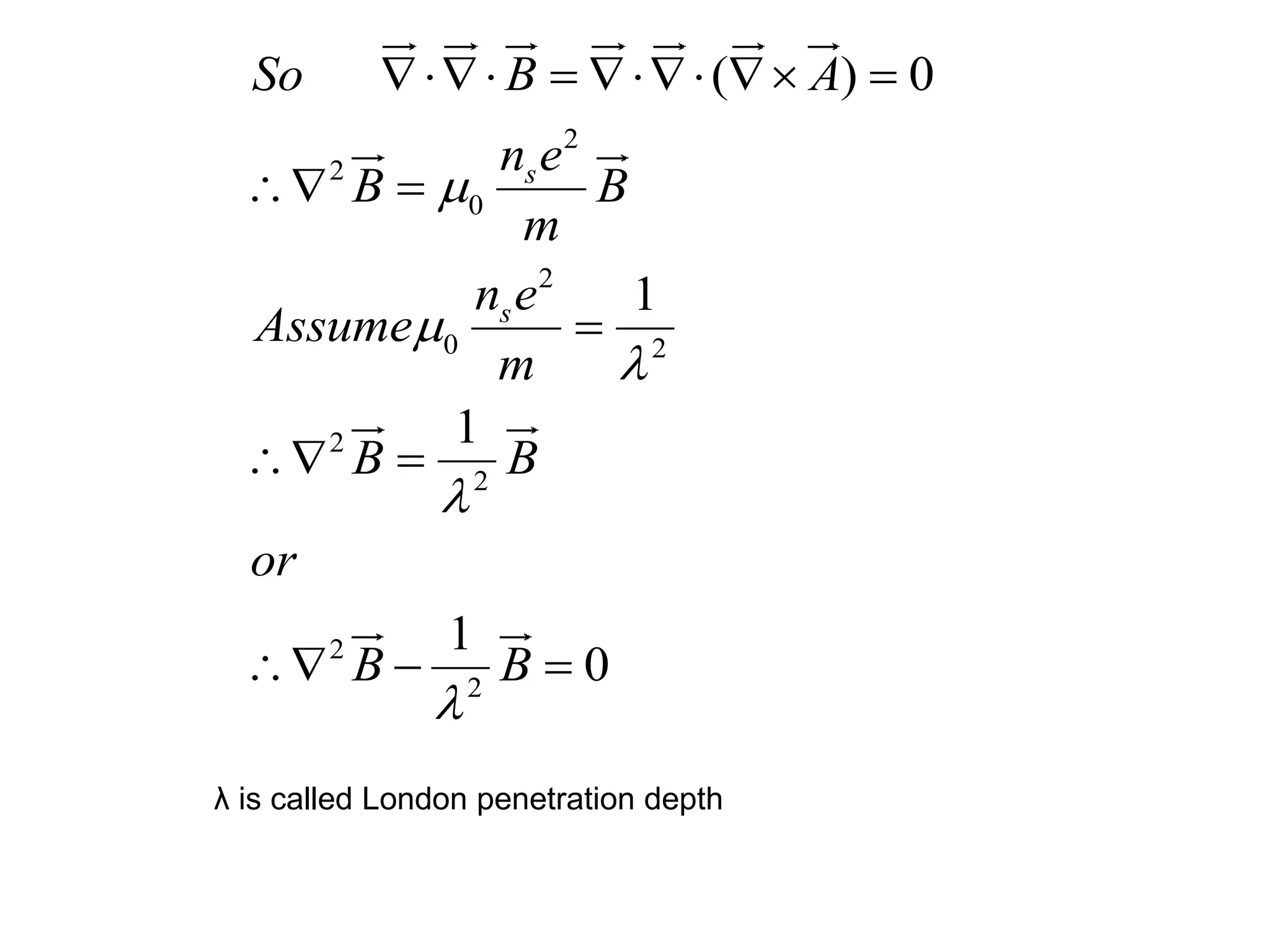
2
2
0
2
0 2
2
2
2
2
( ) 0
1
1
1
0
s
s
So B A
n e
B B
m
n e
Assume
m
B B
or
B B





    
 

 
  
λ is called London penetration depth
Elements of BCS Theory
• BCS Theory of Superconductivity
• The properties of Type I superconductors were modeled
successfully by the efforts of John Bardeen, Leon Cooper, and
Robert Schrieffer in what is commonly called the BCS theory.
• A key conceptual element in this theory is the pairing of
electrons close to the Fermi level into Cooper pairs through
interaction with the crystal lattice.
• This pairing results form a slight attraction between the
electrons related to lattice vibrations; the coupling to the
lattice is called a phonon interaction.
• Pairs of electrons can behave very differently from single
electrons which are fermions and must obey the Pauli
exclusion principle.
• The pairs of electrons act more like bosons which can
condense into the same energy level.
• The electron pairs have a slightly lower energy and leave
an energy gap above them on the order of 0.001eV which
inhibits the kind of collision interactions which lead to
ordinary resistivity.
• For temperatures such that the thermal energy is less than
the band gap, the material exhibits zero resistivity.
• Bardeen, Cooper, and Schrieffer received the Nobel
Prize in 1972 for the development of the theory of
superconductivity.
• Cooper Pairs
• The transition of a metal from the normal to the
superconducting state has the nature of a condensation of
the electrons into a state which leaves a band gap above
them.
• This kind of condensation is seen with super fluid helium,
but helium is made up of bosons -- multiple electrons can't
collect into a single state because of the Pauli exclusion
principle.
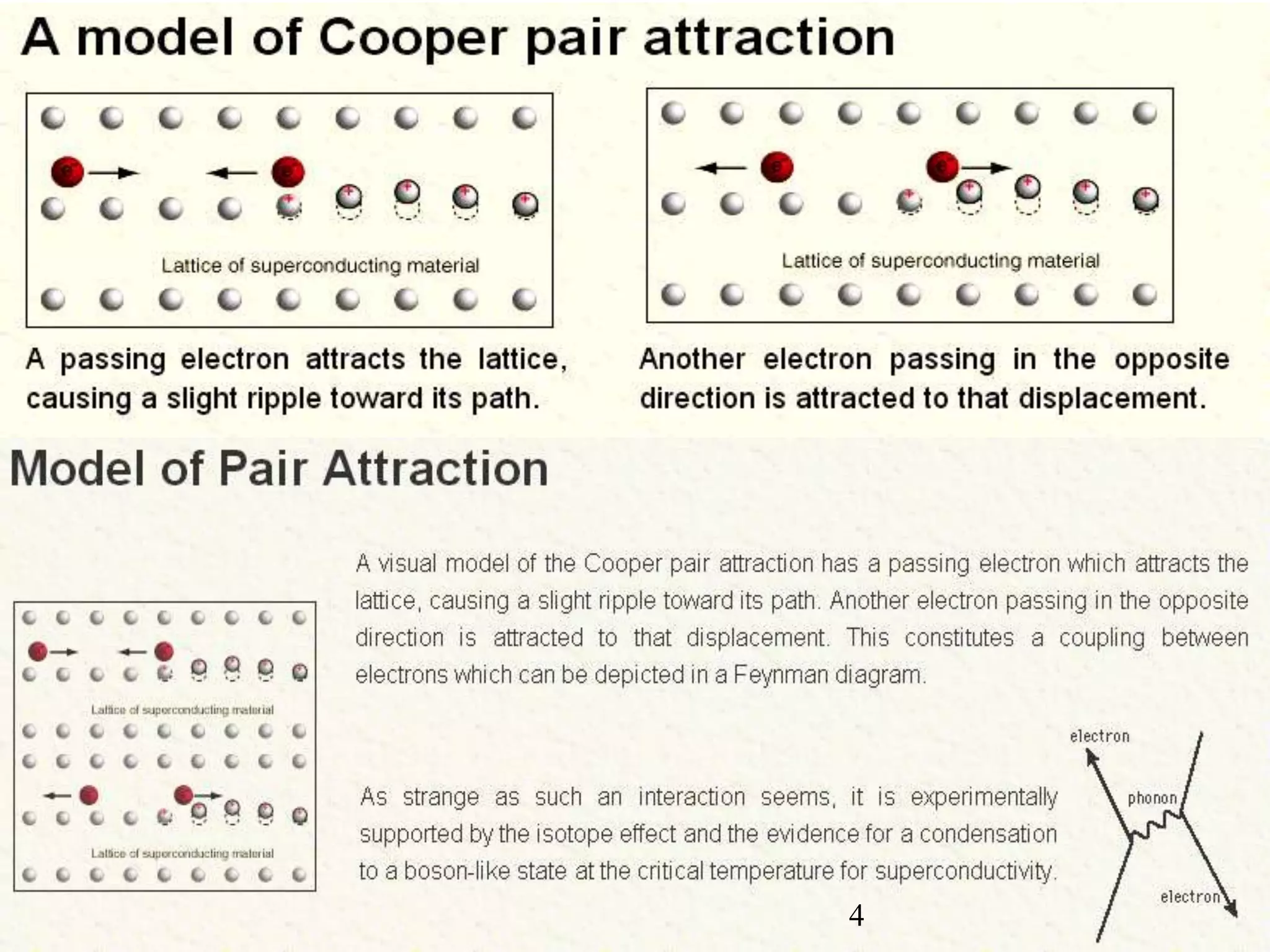
• Froehlich was first to suggest that the electrons act as pairs
coupled by lattice vibrations in the material.
• This coupling is viewed as an exchange of phonons,
phonons being the quanta of lattice vibration energy.
• Experimental corroboration of an interaction with the
lattice was provided by the isotope effect on the
superconducting transition temperature.
• The boson-like behavior of such electron pairs was
further investigated by Cooper and they are called
"Cooper pairs".
• The condensation of Cooper pairs is the foundation of
the BCS theory of superconductivity.
4
• In the normal state of a metal, electrons move
independently, whereas in the BCS state, they are bound
into "Cooper pairs" by the attractive interaction. The
BCS formalism is based on the "reduced" potential for
the electrons attraction.
• You have to provide energy equal to the 'energy gap' to
break a pair, to break one pair you have to change
energies of all other pairs.
• This is unlike the normal metal, in which the state of an
electron can be changed by adding a arbitrary small
amount of energy.
• The energy gap is highest at low temperatures but does
not exist at temperatures higher than the transition
temperature.
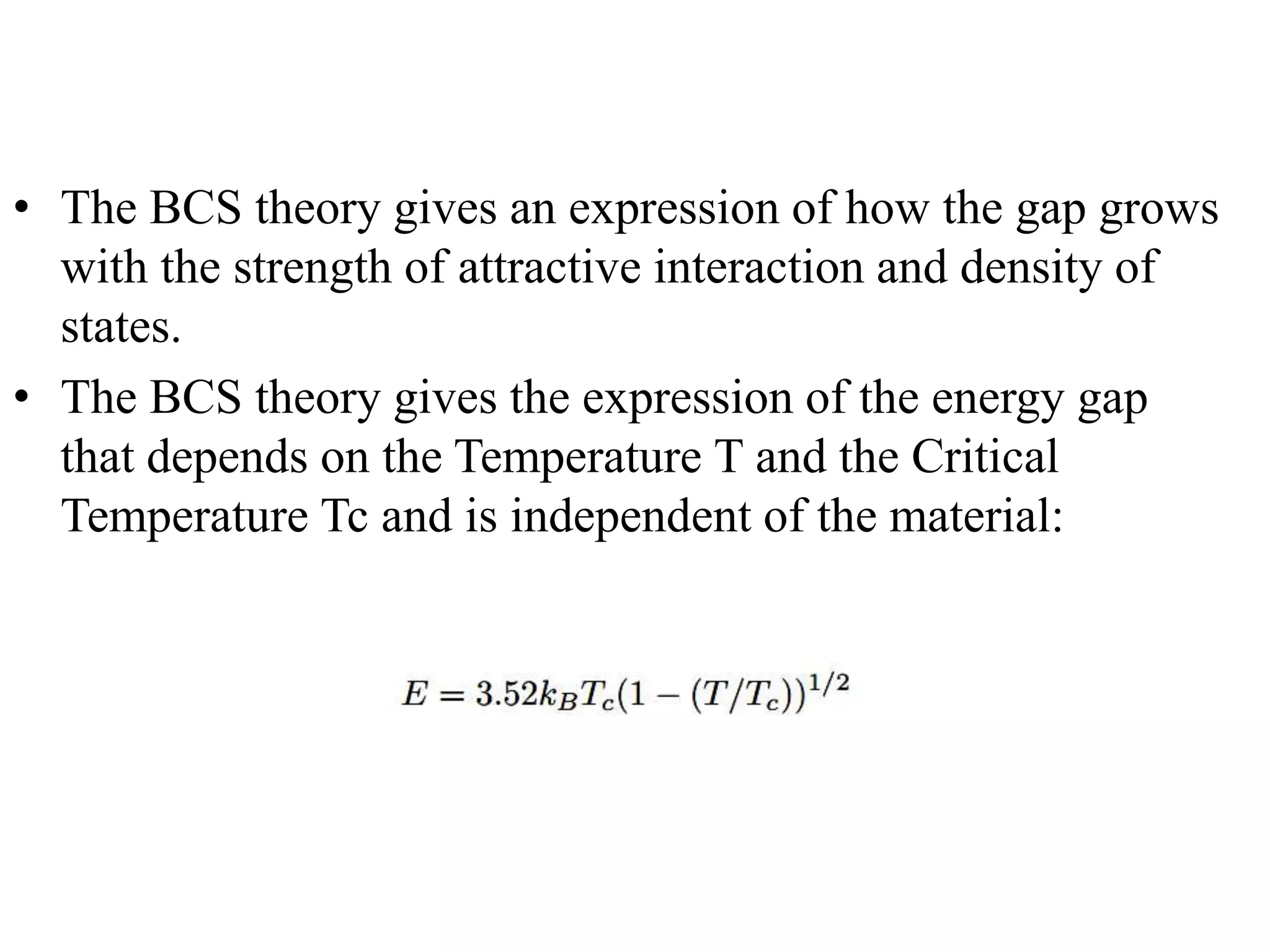
• The BCS theory gives an expression of how the gap grows
with the strength of attractive interaction and density of
states.
• The BCS theory gives the expression of the energy gap
that depends on the Temperature T and the Critical
Temperature Tc and is independent of the material:
APPLICATIONSOF
SUPER CONDUCTORS
1. Engineering
• Transmission of power
• Switching devices
• Sensitive electrical instruments
• Memory (or) storage element in computers.
• Manufacture of electrical generators and transformers
2. Medical
•Nuclear Magnetic Resonance (NMR)
•Diagnosis of brain tumor
•Magneto – hydrodynamic power generation
JOSEPHSON
DEVICES
by Brian Josephson
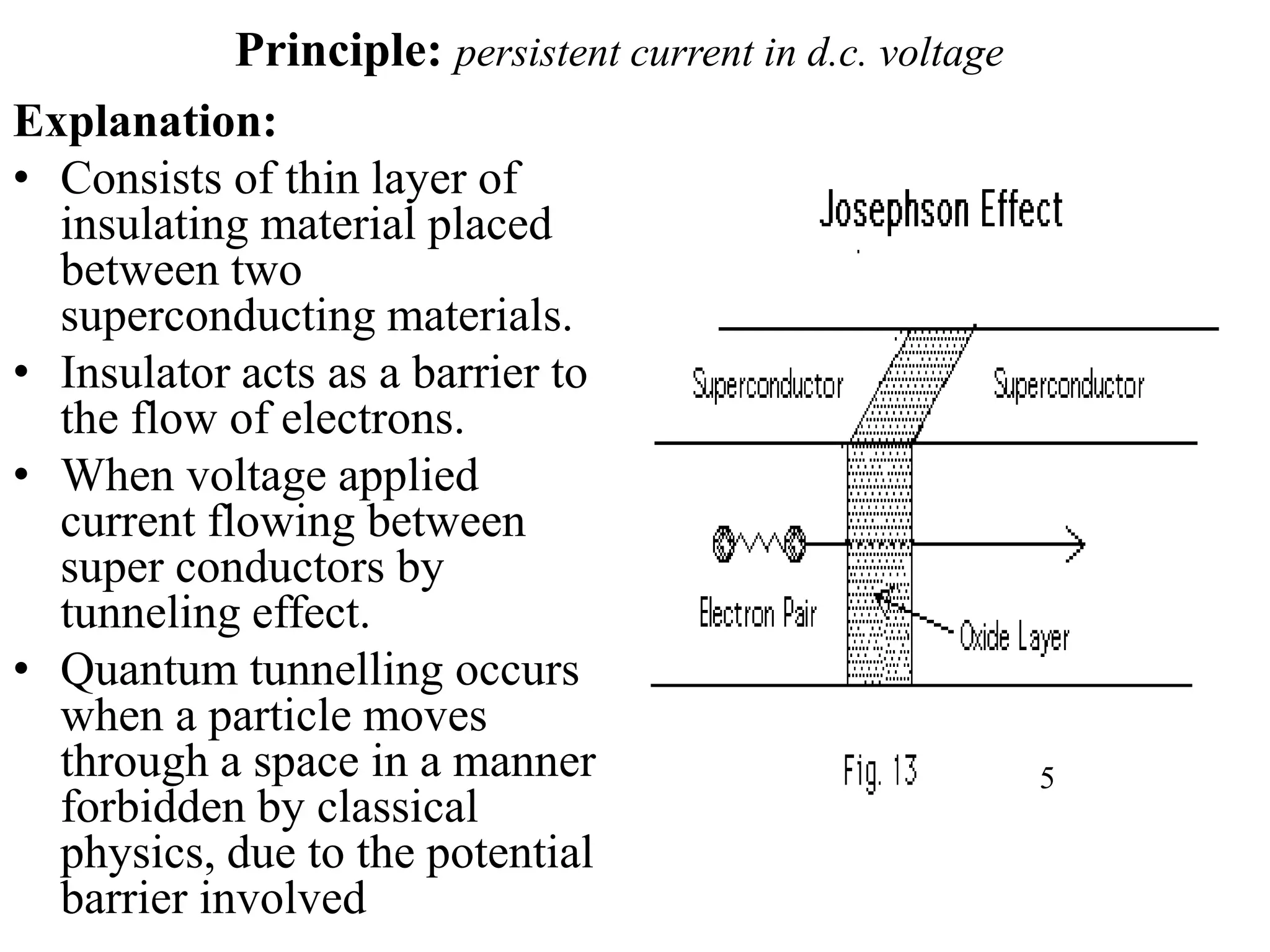
Principle: persistent current in d.c. voltage
Explanation:
• Consists of thin layer of
insulating material placed
between two
superconducting materials.
• Insulator acts as a barrier to
the flow of electrons.
• When voltage applied
current flowing between
super conductors by
tunneling effect.
• Quantum tunnelling occurs
when a particle moves
through a space in a manner
forbidden by classical
physics, due to the potential
barrier involved
5
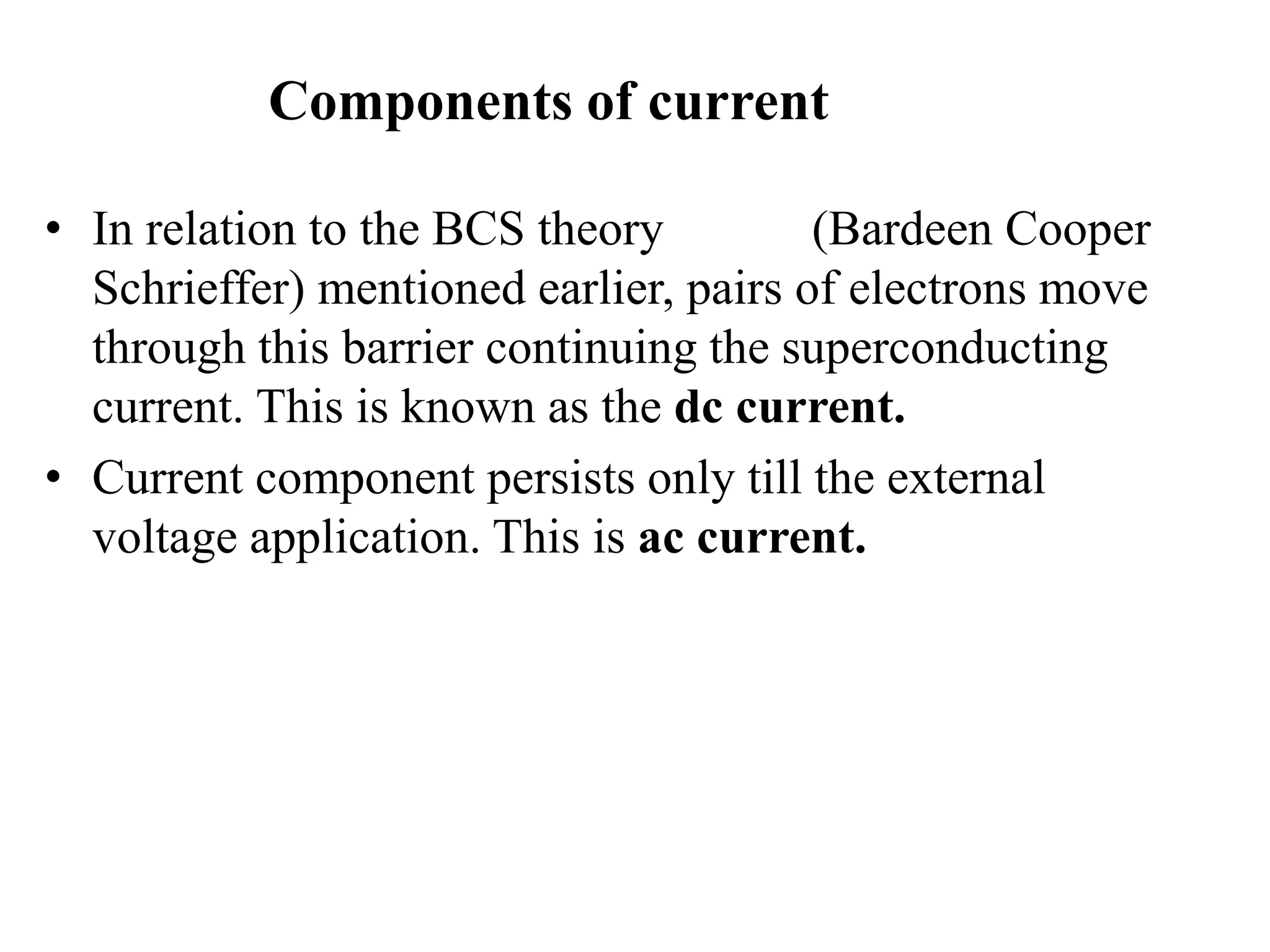
Components of current
• In relation to the BCS theory (Bardeen Cooper
Schrieffer) mentioned earlier, pairs of electrons move
through this barrier continuing the superconducting
current. This is known as the dc current.
• Current component persists only till the external
voltage application. This is ac current.
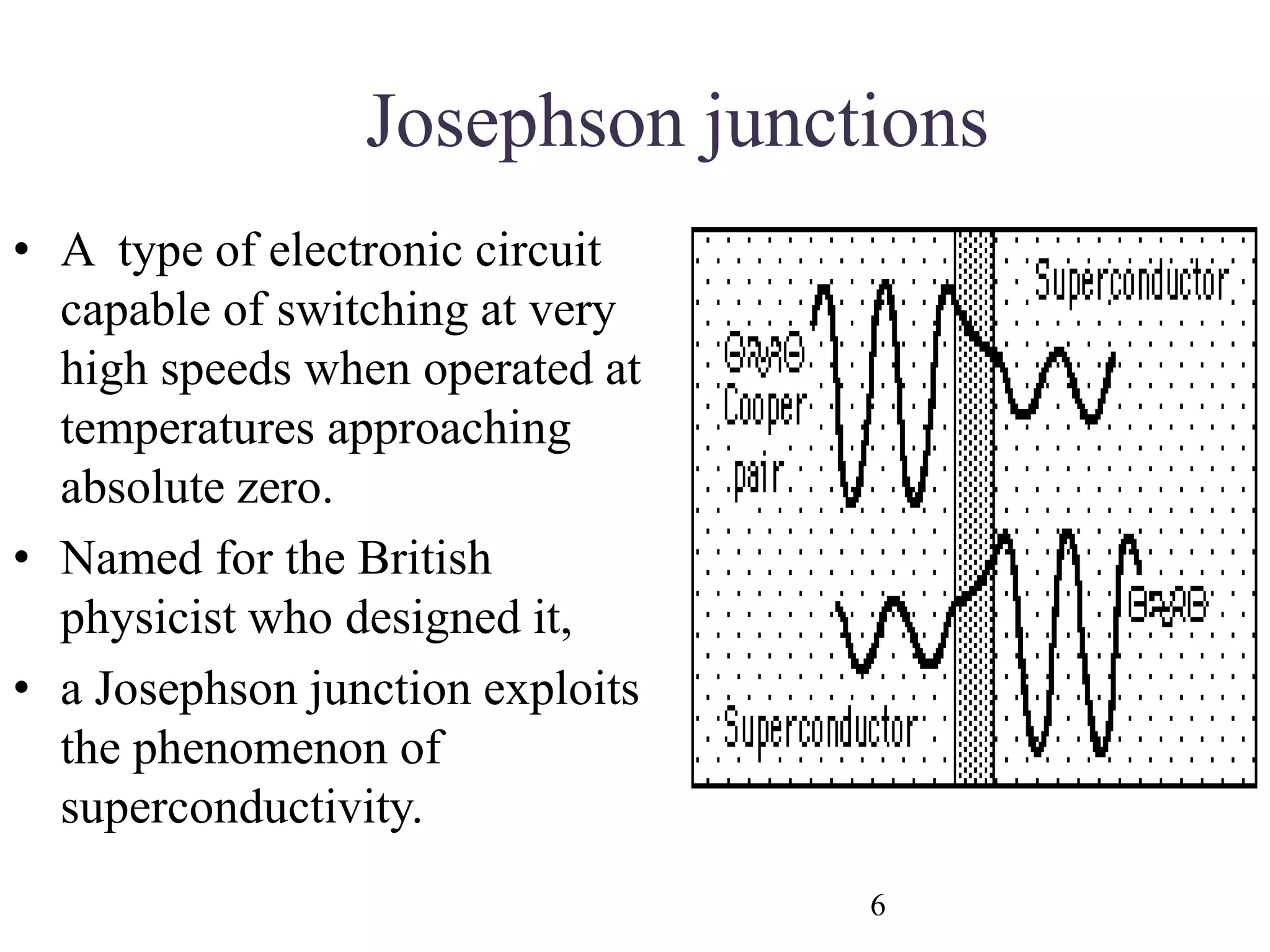
Josephson junctions
• A type of electronic circuit
capable of switching at very
high speeds when operated at
temperatures approaching
absolute zero.
• Named for the British
physicist who designed it,
• a Josephson junction exploits
the phenomenon of
superconductivity.
6
Construction
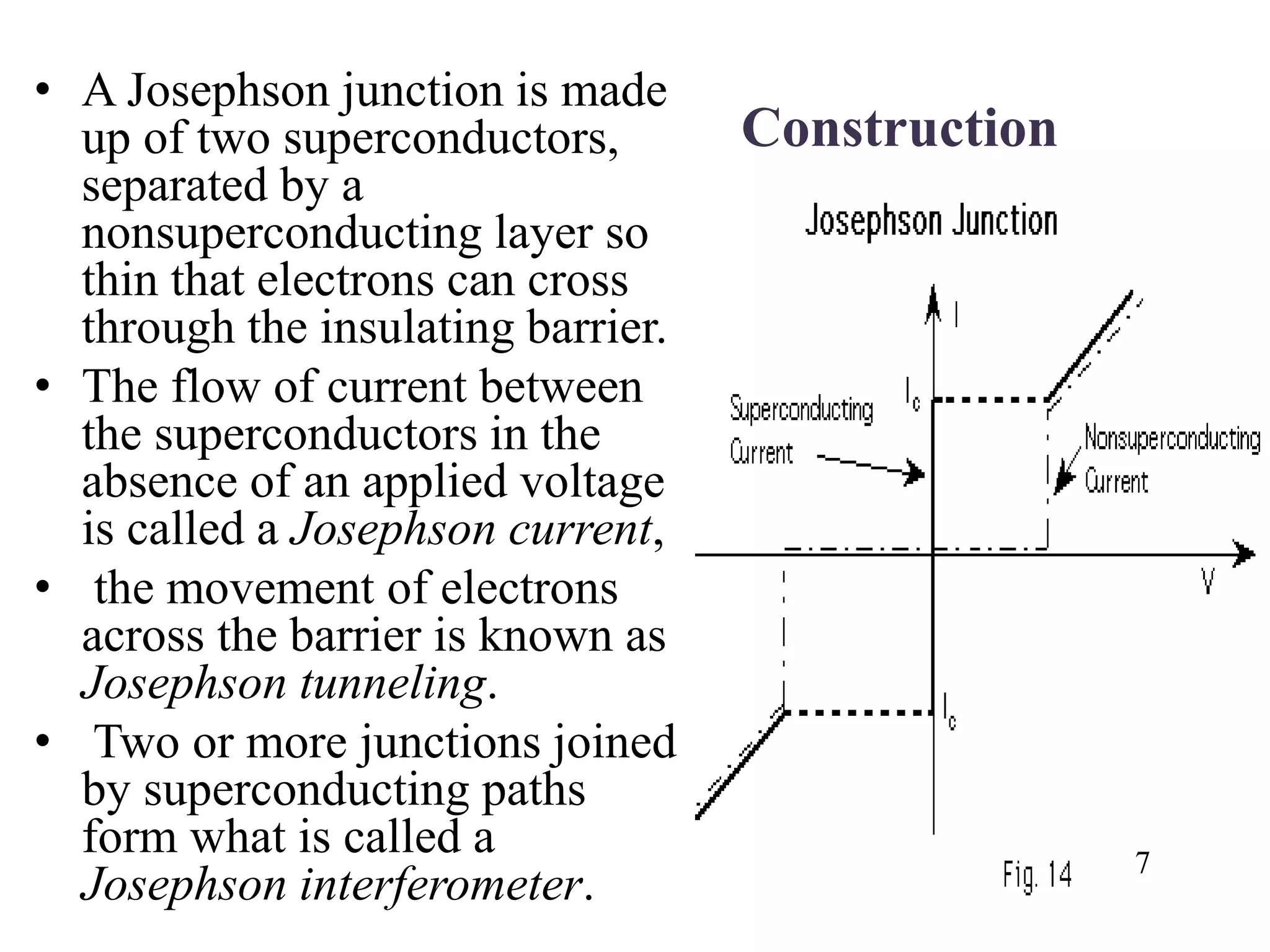
• A Josephson junction is made
up of two superconductors,
separated by a
nonsuperconducting layer so
thin that electrons can cross
through the insulating barrier.
• The flow of current between
the superconductors in the
absence of an applied voltage
is called a Josephson current,
• the movement of electrons
across the barrier is known as
Josephson tunneling.
• Two or more junctions joined
by superconducting paths
form what is called a
Josephson interferometer.
7
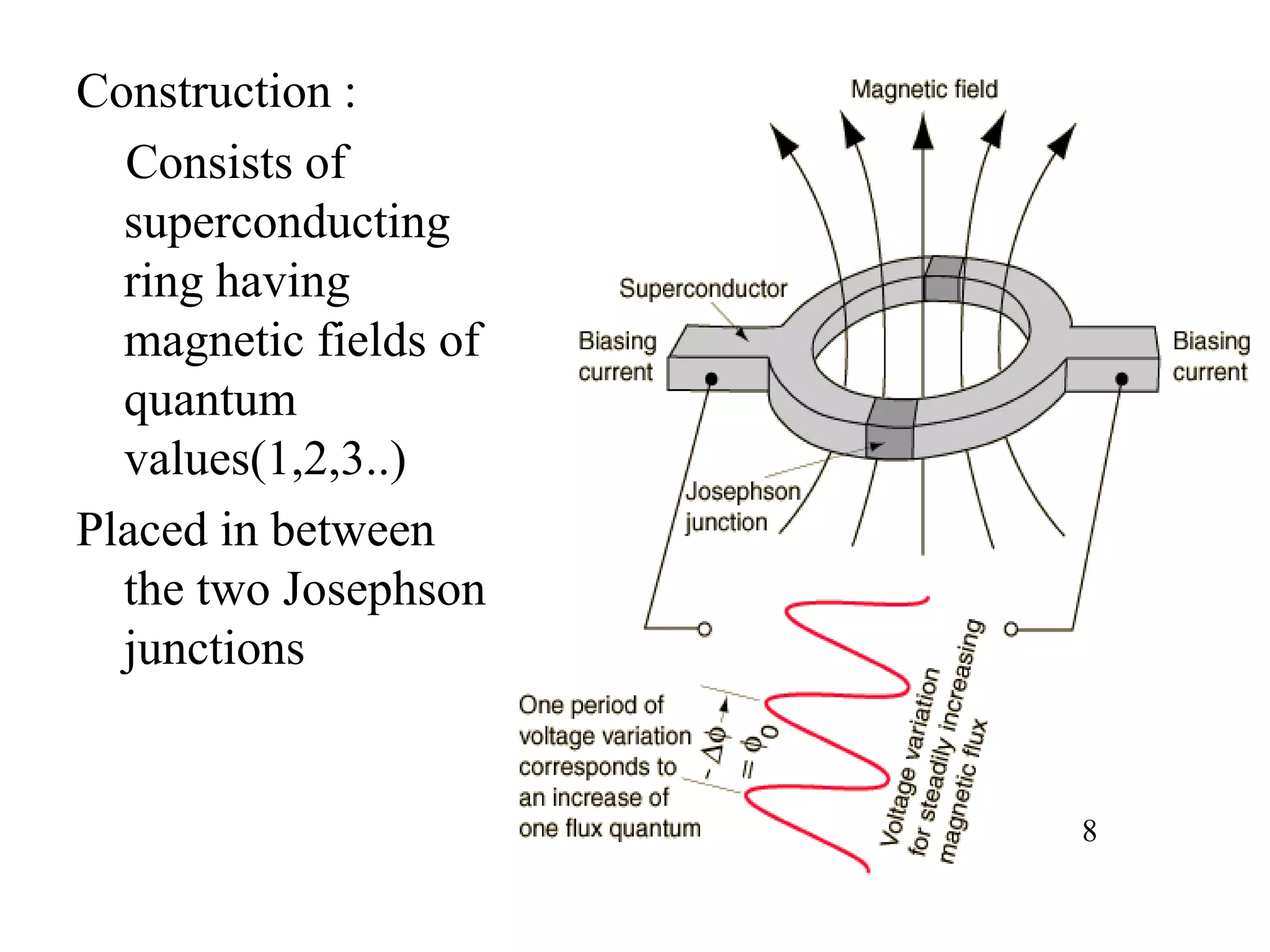
Construction :
Consists of
superconducting
ring having
magnetic fields of
quantum
values(1,2,3..)
Placed in between
the two Josephson
junctions
8
Explanation :
• When the magnetic field is applied perpendicular to
the ring current is induced at the two junctions
• Induced current flows around the ring thereby
magnetic flux in the ring has quantum value of field
applied
• Therefore used to detect the variation of very minute
magnetic signals
Uses of Josephson devices
• Magnetic Sensors
• Gradiometers
• Oscilloscopes
• Decoders
• Analogue to Digital converters
• Oscillators
• Microwave amplifiers
• Sensors for biomedical, scientific and defence
purposes
• Digital circuit development for Integrated circuits
• Microprocessors
• Random Access Memories (RAMs)
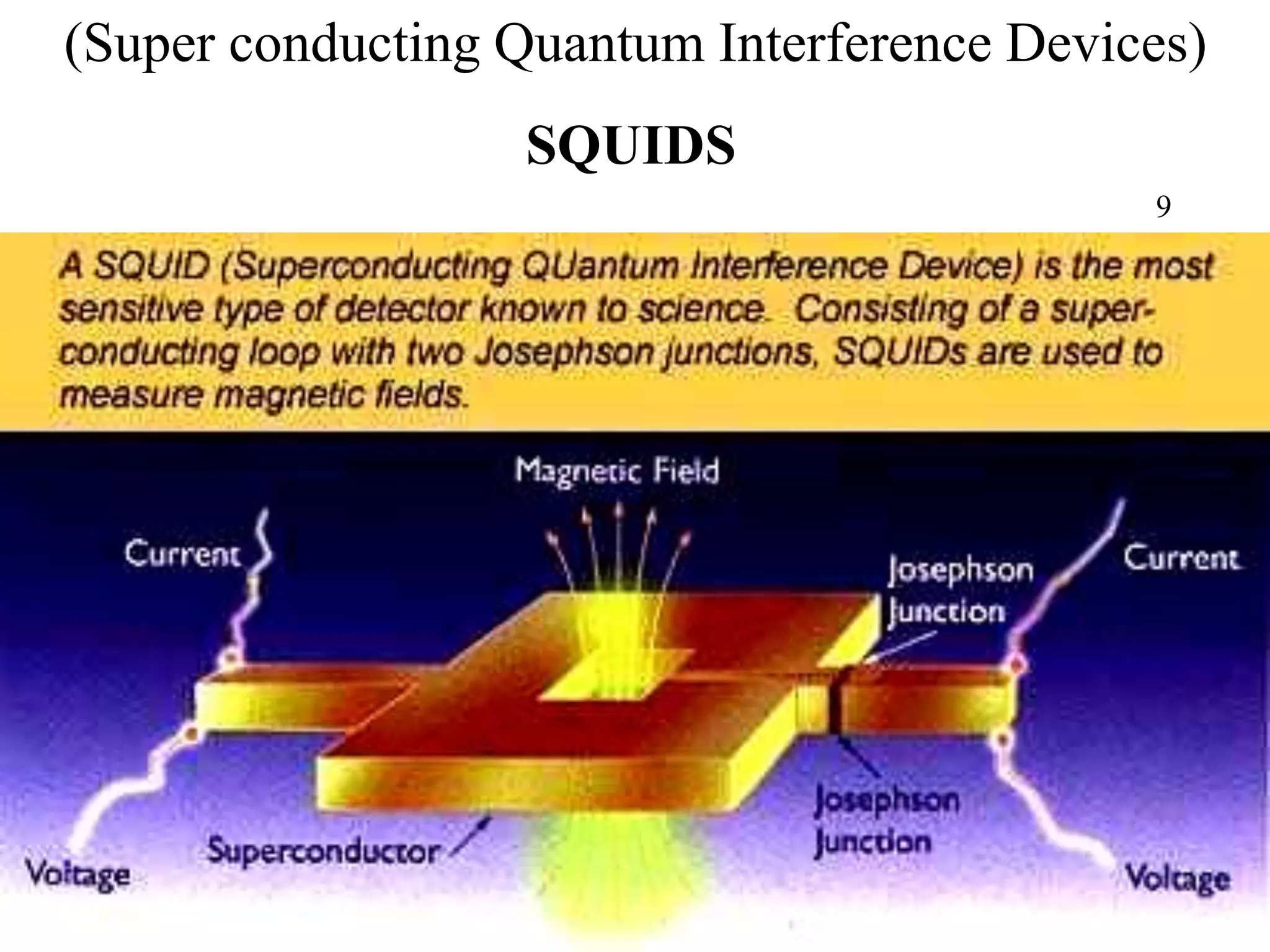
SQUIDS
(Super conducting Quantum Interference Devices)
9
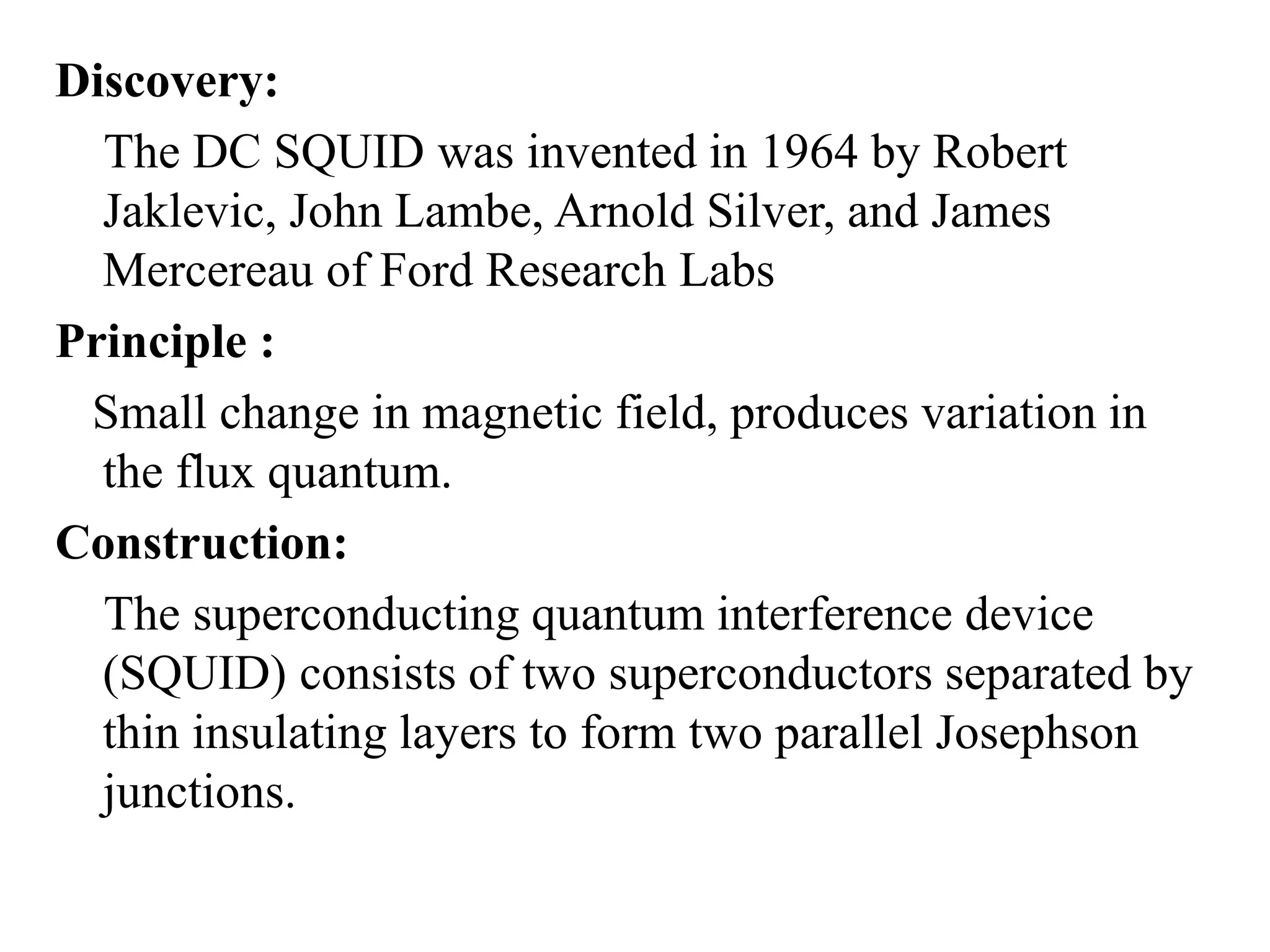
Discovery:
The DC SQUID was invented in 1964 by Robert
Jaklevic, John Lambe, Arnold Silver, and James
Mercereau of Ford Research Labs
Principle :
Small change in magnetic field, produces variation in
the flux quantum.
Construction:
The superconducting quantum interference device
(SQUID) consists of two superconductors separated by
thin insulating layers to form two parallel Josephson
junctions.
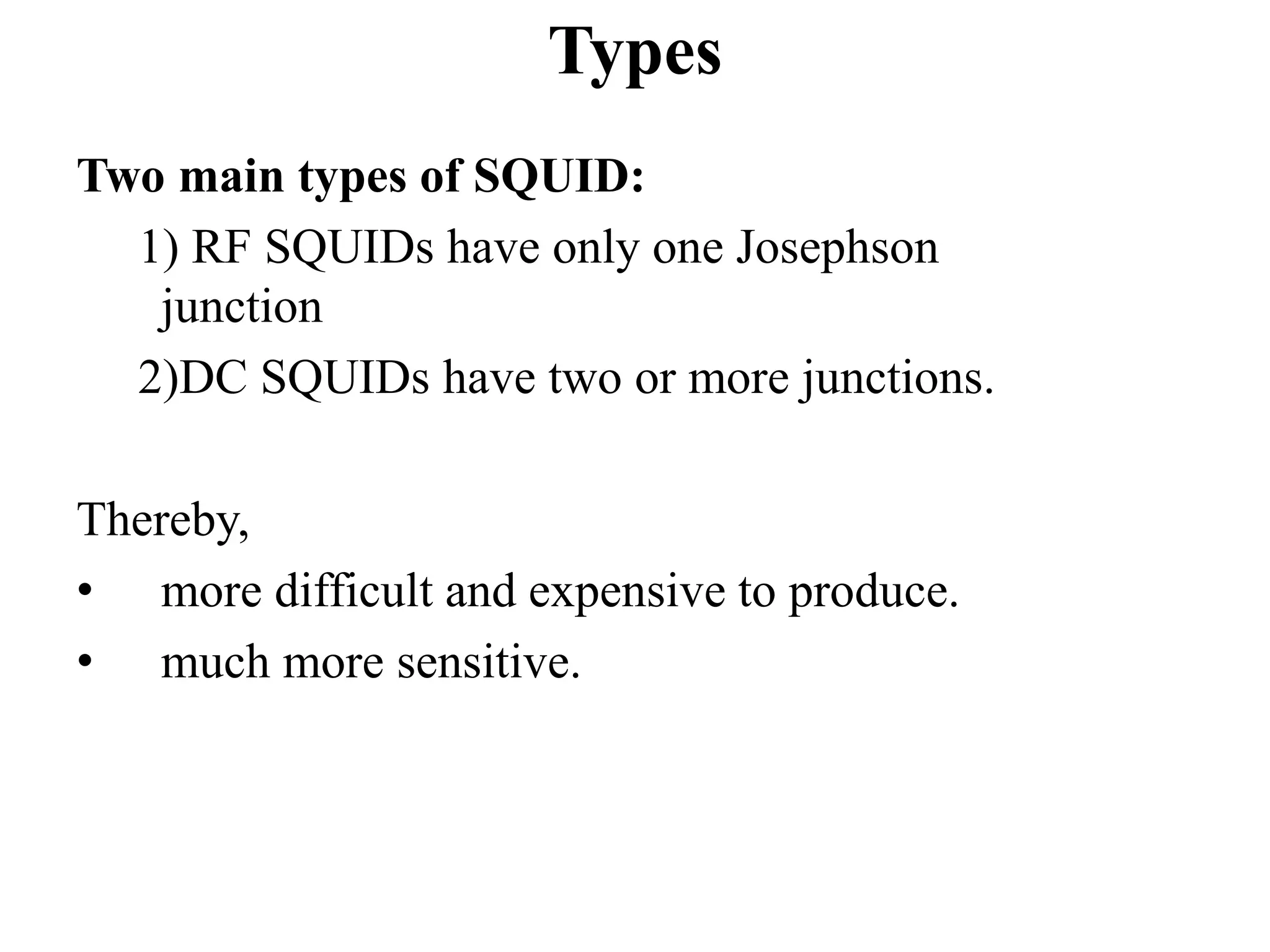
Types
Two main types of SQUID:
1) RF SQUIDs have only one Josephson
junction
2)DC SQUIDs have two or more junctions.
Thereby,
• more difficult and expensive to produce.
• much more sensitive.
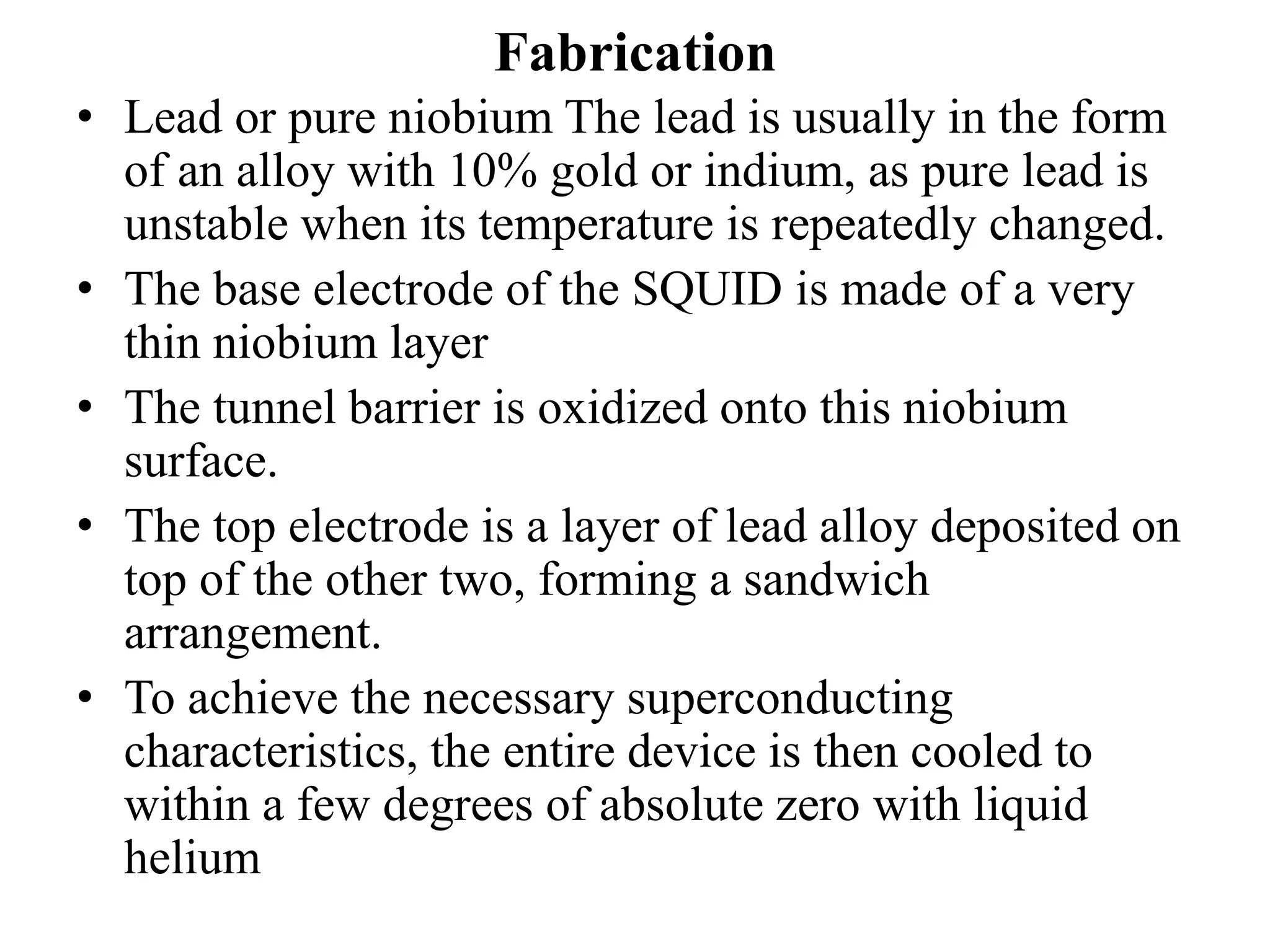
Fabrication
• Lead or pure niobium The lead is usually in the form
of an alloy with 10% gold or indium, as pure lead is
unstable when its temperature is repeatedly changed.
• The base electrode of the SQUID is made of a very
thin niobium layer
• The tunnel barrier is oxidized onto this niobium
surface.
• The top electrode is a layer of lead alloy deposited on
top of the other two, forming a sandwich
arrangement.
• To achieve the necessary superconducting
characteristics, the entire device is then cooled to
within a few degrees of absolute zero with liquid
helium
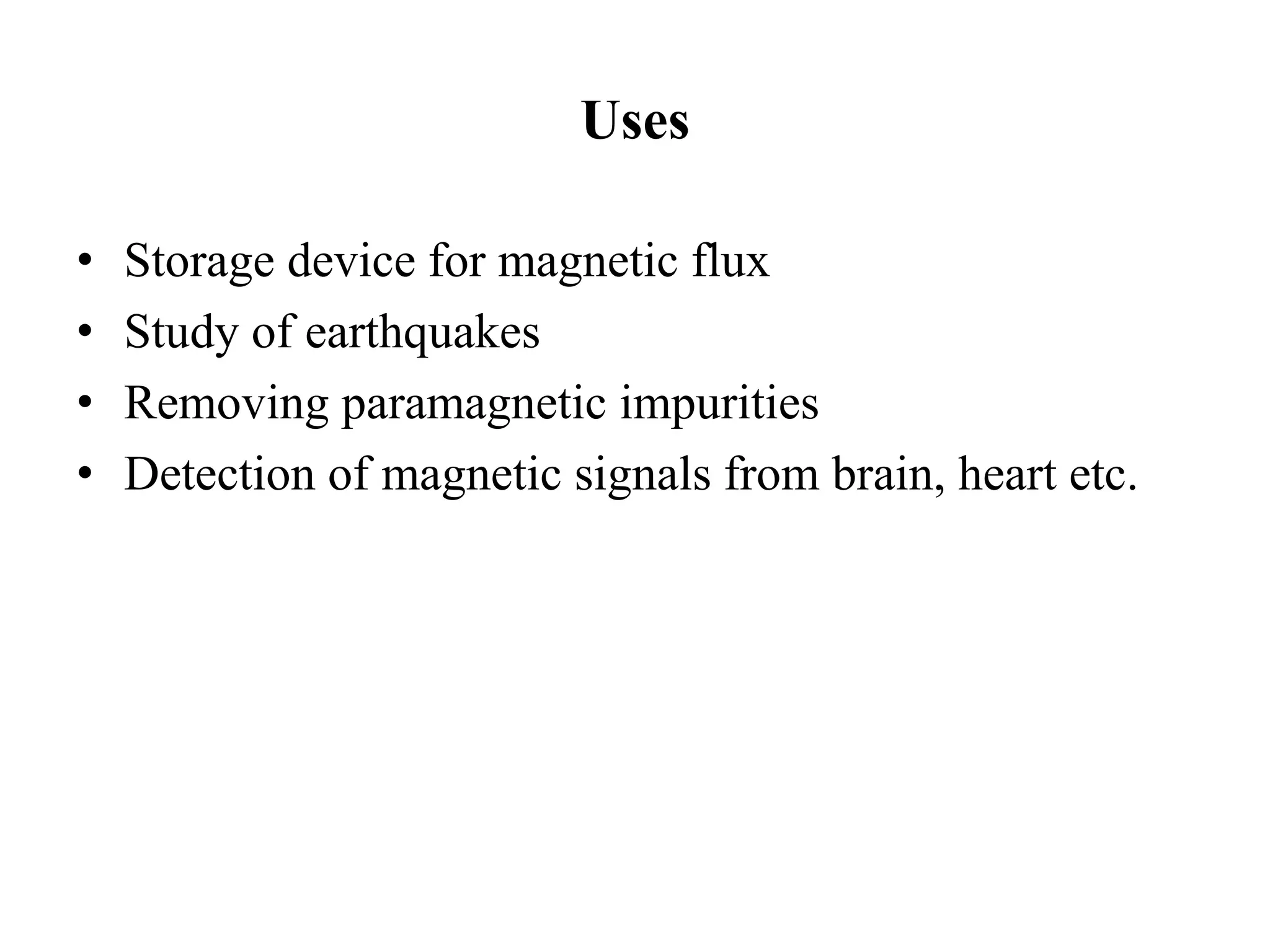
Uses
• Storage device for magnetic flux
• Study of earthquakes
• Removing paramagnetic impurities
• Detection of magnetic signals from brain, heart etc.
Cryotron
The cryotron is a switch that operates using
superconductivity. The cryotron works on the
principle that magnetic fields destroy
superconductivity. The cryotron is a piece of tantalum
wrapped with a coil of niobium placed in a liquid
helium bath. When the current flows through the
tantalum wire it is superconducting, but when a
current flows through the niobium a magnetic field is
produced. This destroys the superconductivity which
makes the current slow down or stop.
Magnetic Levitated Train
Principle: Electro-magnetic induction
Introduction:
Magnetic levitation transport, or maglev, is a form of
transportation that suspends, guides and propels
vehicles via electromagnetic force. This method can be
faster than wheeled mass transit systems, potentially
reaching velocities comparable to turboprop and jet
aircraft (500 to 580 km/h).
• Superconductors may be considered perfect diamagnets
(μr = 0), completely expelling magnetic fields due to the
Meissner effect.
• The levitation of the magnet is stabilized due to flux
pinning within the superconductor.
• This principle is exploited by EDS (Electrodynamic
suspension) magnetic levitation trains.
•In trains where the weight of the large electromagnet is a
major design issue (a very strong magnetic field is required
to levitate a massive train) superconductors are used for the
electromagnet, since they can produce a stronger magnetic
field for the same weight.
Why superconductor ?
How to use a Super conductor
• Electrodynamics suspension
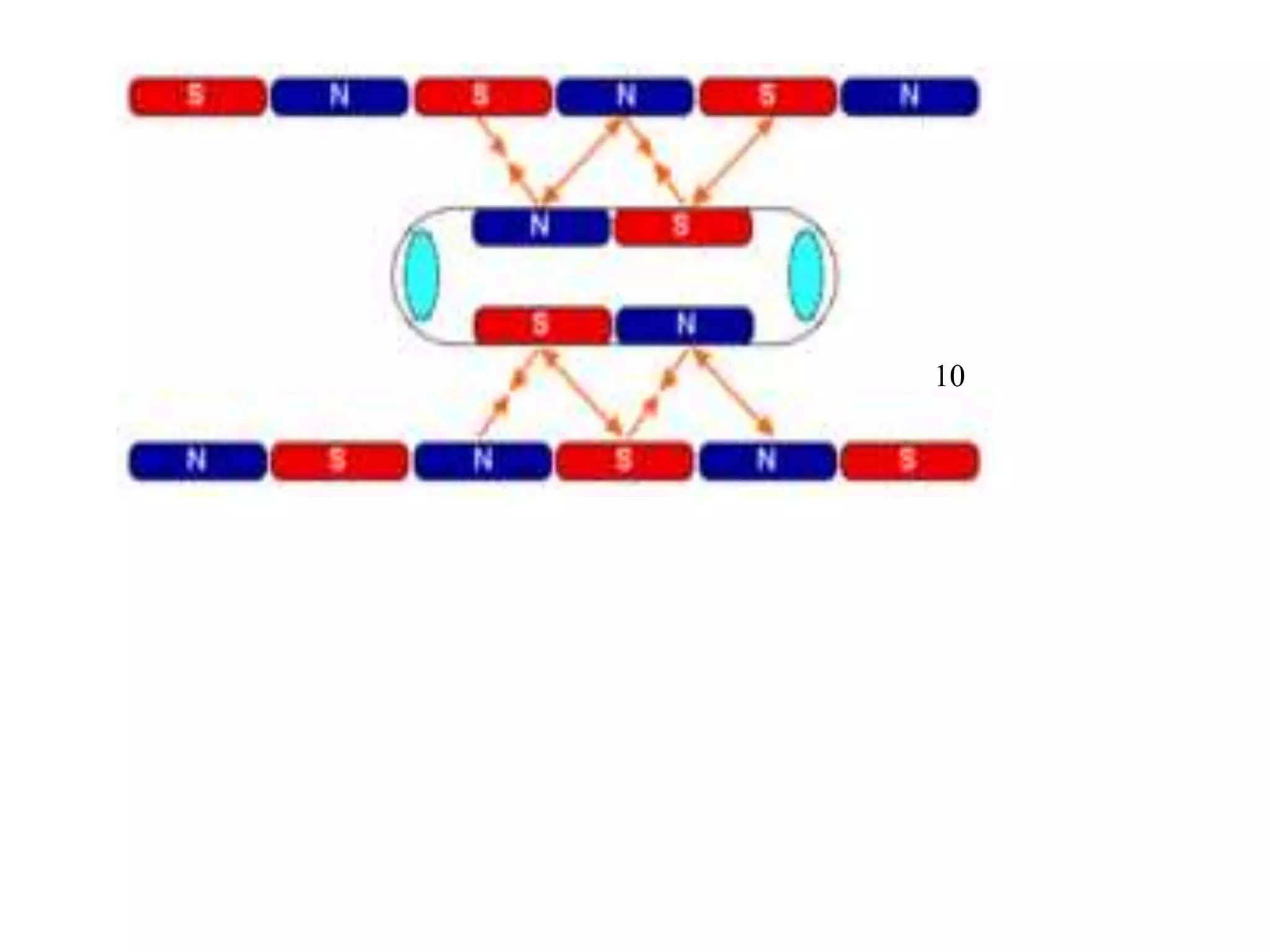
• In Electrodynamic suspension (EDS), both the rail and the train
exert a magnetic field, and the train is levitated by the repulsive
force between these magnetic fields.
• The magnetic field in the train is produced by either
electromagnets or by an array of permanent magnets.
• The repulsive force in the track is created by an induced
magnetic field in wires or other conducting strips in the track.
• At slow speeds, the current induced in these coils and the
resultant magnetic flux is not large enough to support the weight
of the train.
• For this reason the train must have wheels or some other form of
landing gear to support the train until it reaches a speed that can
sustain levitation.
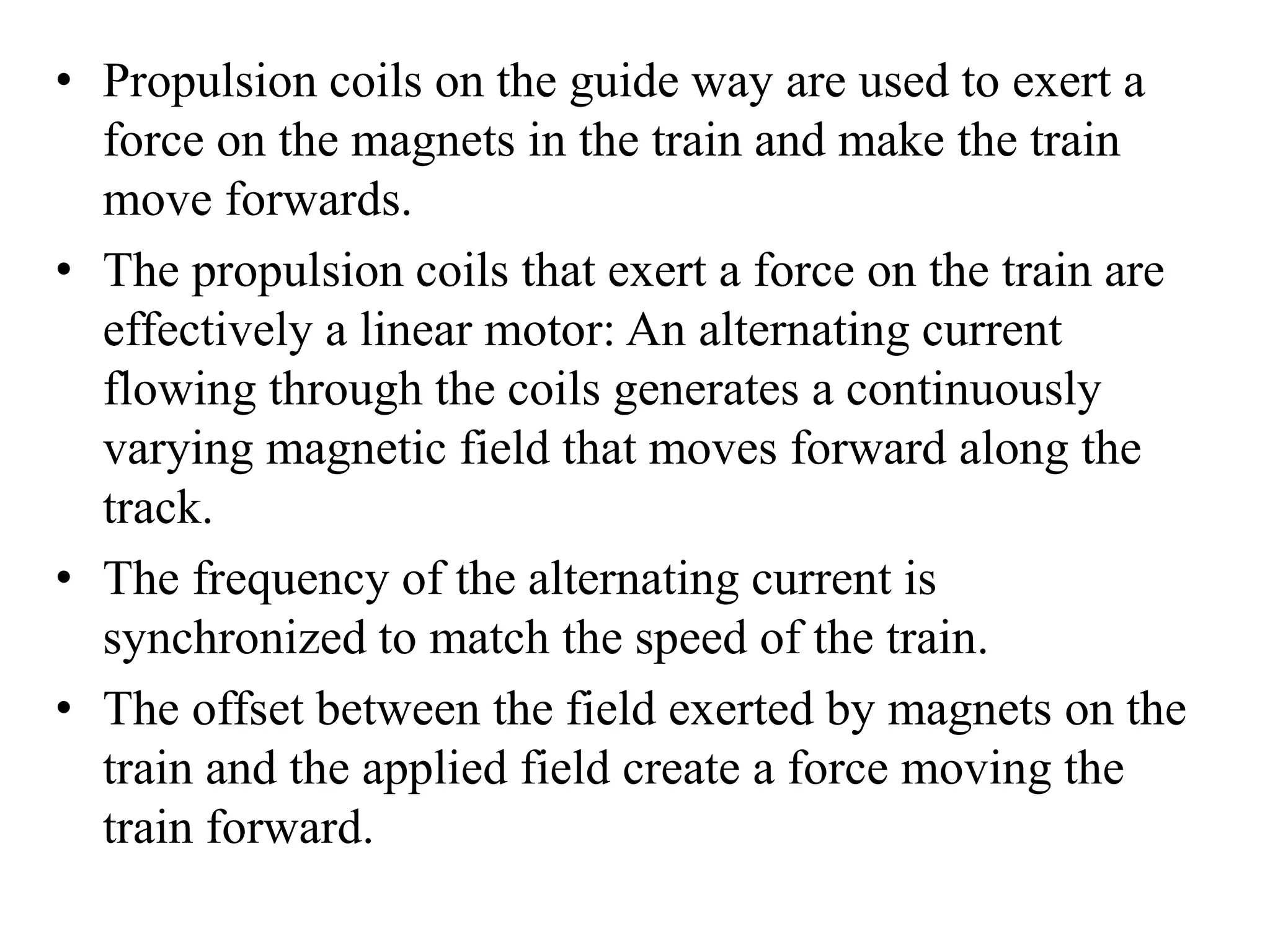
• Propulsion coils on the guide way are used to exert a
force on the magnets in the train and make the train
move forwards.
• The propulsion coils that exert a force on the train are
effectively a linear motor: An alternating current
flowing through the coils generates a continuously
varying magnetic field that moves forward along the
track.
• The frequency of the alternating current is
synchronized to match the speed of the train.
• The offset between the field exerted by magnets on the
train and the applied field create a force moving the
train forward.
10
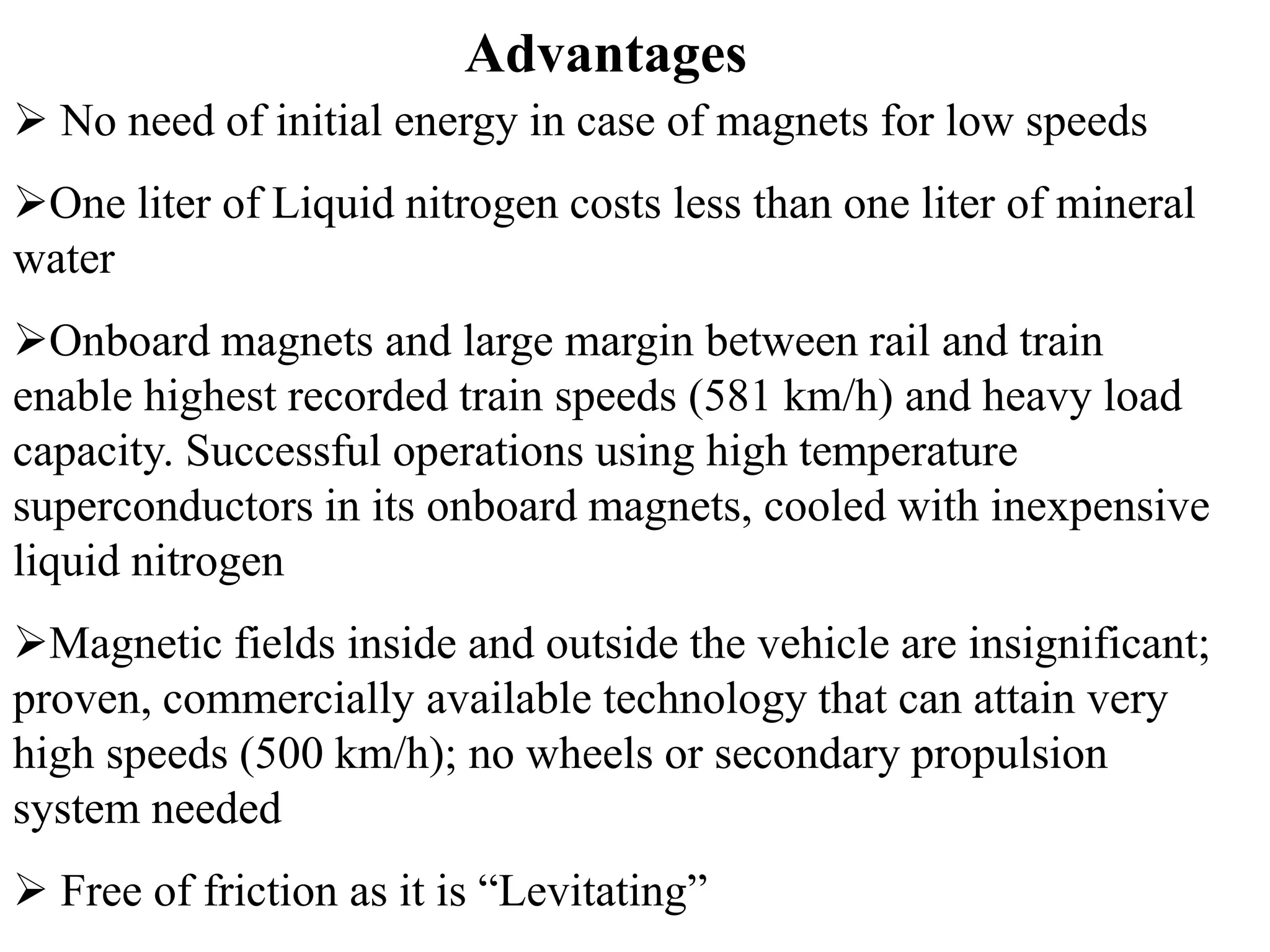
Advantages
 No need of initial energy in case of magnets for low speeds
One liter of Liquid nitrogen costs less than one liter of mineral
water
Onboard magnets and large margin between rail and train
enable highest recorded train speeds (581 km/h) and heavy load
capacity. Successful operations using high temperature
superconductors in its onboard magnets, cooled with inexpensive
liquid nitrogen
Magnetic fields inside and outside the vehicle are insignificant;
proven, commercially available technology that can attain very
high speeds (500 km/h); no wheels or secondary propulsion
system needed
 Free of friction as it is “Levitating”
Engineering physics By Dr. M N Avadhnulu, S
Chand publication
Engineering physics by G Vijayakumari
http://www.cengage.com/resource_uploads/static_re
sources/0534493394/4891/SerwayCh12-
Superconductivity.pdf
https://www.repository.cam.ac.uk/bitstream/handle/1
810/34597/Chapter%201.pdf?sequence=5
http://chabanoiscedric.tripod.com/NSCHSS.PDF
http://www.physics.usyd.edu.au/~khachan/PTF/Supe
rconductivity.pdf
Image references links
1. http://s6.postimg.org/brbxzhti5/New_Picture_8.png
2. http://s6.postimg.org/mlte1fcm5/New_Picture_9.png
3. http://s6.postimg.org/xvm3wdhnh/New_Picture_10.png
4. http://s6.postimg.org/6rj35ad99/New_Picture_11.png
5. http://s6.postimg.org/cjelyoxp9/New_Picture_12.png
6. http://s6.postimg.org/ilm8p6m59/New_Picture_13.png
7. http://s6.postimg.org/dkeunteot/New_Picture_14.png
8. http://s6.postimg.org/sy8jb9fod/New_Picture_15.png
9. http://s6.postimg.org/qkqlk9199/New_Picture_16.png
10. http://s6.postimg.org/uftzmtkf1/New_Picture_17.png

B.tech sem i engineering physics u iii chapter 2-superconductivity

  • 1.
  • 2.
    Introduction of superconductivity •Electrical resistivity ↓ Temp. ↓ • 0 º K Electrical resistivity is 0 for perfectly pure metal • Any metal can’t be perfectly pure. • The more impure the metal Electrical resistivity ↑ • Certain metals when they cooled their electrical resistivity decreases but at Tc resistivity is 0 this state of metal is called __________. • Finder – K Onnes 1911
  • 3.
    Properties of Superconductors ElectricalResistance • Zero Electrical Resistance • Defining Property • Critical Temperature • Quickest test • 10-5Ωcm 1
  • 4.
    Effect of MagneticField Critical magnetic field (HC) – Minimum magnetic field required to destroy the superconducting property at any temperature H0 – Critical field at 0K T - Temperature below TC TC - Transition Temperature Element HC at 0K (mT) Nb 198 Pb 80.3 Sn 30.9 Superconducting Normal T (K) TC H0 HC 2 0 1C C T H H T           
  • 5.
    Effect of ElectricCurrent • Large electric current – induces magnetic field – destroys superconductivity • Induced Critical Current iC = 2πrHC Persistent Current • Steady current which flows through a superconducting ring without any decrease in strength even after the removal of the field • Diamagnetic property i
  • 6.
    Meissner effect • WhenSuperconducting material cooled bellow its Tc it becomes resistenceless & perfect diamagnetic. • When superconductor placed inside a magnetic field in Tc all magnetic flux is expelled out of it the effect is called Meissner effect. • Perfect diamagnetism arises from some special magnetic property of Superconductor. 2
  • 7.
    • If thereis no magnetic field inside the superconductor relative permeability or diamagnetic constant μr =0. • Total magnetic induction B is, • If magnetic induction B=0 then, 0 ( )B H M  00 ( )H M  M H   1 m M H    
  • 8.
    Magnetic Flux Quantisation •Magnetic flux enclosed in a superconducting ring = integral multiples of fluxon • Φ = nh/2e = n Φ0 (Φ0 = 2x10-15Wb) Effect of Pressure • Pressure ↑, TC ↑ • High TC superconductors – High pressure Thermal Properties • Entropy & Specific heat ↓ at TC • Disappearance of thermo electric effect at TC • Thermal conductivity ↓ at TC – Type I superconductors
  • 9.
    Stress • Stress ↑,dimension ↑, TC ↑, HC affected Frequency • Frequency ↑, Zero resistance – modified, TC not affected Impurities • Magnetic properties affected Size • Size < 10-4cm – superconducting state modified General Properties • No change in crystal structure • No change in elastic & photo-electric properties • No change in volume at TC in the absence of magnetic field
  • 10.
    Isotope Effect • Maxwell •TC = Constant / Mα • TC Mα = Constant (α – Isotope Effect coefficient) • α = 0.15 – 0.5 • α = 0 (No isotope effect) • TC√M = constant
  • 11.
    Classification & characterizationof super conductor • Type I or soft super conductor – Exhibit complete Meissner effect. – Bellow Hc super conductor above Hc Normal – Value of Hc is order of 0.1 T. – Aluminum, lead & Indium are type I super conductor – Not used as strong electromagnets 3
  • 12.
    • Type IIor Hard super conductor – Exhibit complete Meissner effect bellow a certain critical field Hc1 at this point diamagnetism & superconductivity ↓. This state is mix state called vortex state. – At certain critical field Hc2 superconductivity disappears. – Niobium, Aluminum, silicon, ceramic are type II superconductors. – Pb is type I superconductor ac Hc =600 gauss at 4º K when a small impurity of In is added it becomes type II superconductor with Hc1 =400 gauss & Hc2 =1000 gauss.
  • 13.
    Types of Superconductors TypeI • Sudden loss of magnetisation • Exhibit Meissner Effect • One HC = 0.1 tesla • No mixed state • Soft superconductor • Eg.s – Pb, Sn, Hg Type II • Gradual loss of magnetisation • Does not exhibit complete Meissner Effect • Two HCs – HC1 & HC2 (≈30 tesla) • Mixed state present • Hard superconductor • Eg.s – Nb-Sn, Nb-Ti- M HHC Superconducting Normal Superconducting -M Normal Mixed HC1 HC HC2 H
  • 14.
    London equation • Accordingto London’s theory there are two type of electrons in SC – Super electrons – Normal electrons  At 0º K there are only Super electrons.  With increasing temp. Super electrons ↓ Normal electrons ↑ .  Let nn, un & ns, us are no. density & drift velocity of normal electrons & super electrons respectively.
  • 15.
     Equation ofmotion of Super electrons under electric field is • Now current & drift velocity are related as sdu m eE dt   2 ( ) s s s s s s s s s s s s s I n eAu J n eu J u n e J d n e eE dt n e Ed J dt m             London's first equation
  • 16.
    • London's firstequation gives absence of resistance. If E =0 then • Now from Maxwell's eqns 0sdJ dt  ( ) d B E dt B A d A E dt d A E dt d A E dt              
  • 17.
    2 2 2 2 2 2 ( ) ( ) ss s s s s s s s s s s n e Ed J dt m d J m E dt n e d J m d A dt n e dt d m d A J dt n e dt m J A n e n e J A m                London's second equation
  • 18.
    • Again fromampere Law Take curl on both sides 0 2 0 ( ) s s B J n e B A m        2 0 2 2 2 0 ( ) & ( ) s s n e B A m Now B B B A B n e B B B m A B                  
  • 19.
    2 2 0 2 0 2 2 2 2 2 ( )0 1 1 1 0 s s So B A n e B B m n e Assume m B B or B B                   λ is called London penetration depth
  • 20.
    Elements of BCSTheory • BCS Theory of Superconductivity • The properties of Type I superconductors were modeled successfully by the efforts of John Bardeen, Leon Cooper, and Robert Schrieffer in what is commonly called the BCS theory. • A key conceptual element in this theory is the pairing of electrons close to the Fermi level into Cooper pairs through interaction with the crystal lattice. • This pairing results form a slight attraction between the electrons related to lattice vibrations; the coupling to the lattice is called a phonon interaction. • Pairs of electrons can behave very differently from single electrons which are fermions and must obey the Pauli exclusion principle.
  • 21.
    • The pairsof electrons act more like bosons which can condense into the same energy level. • The electron pairs have a slightly lower energy and leave an energy gap above them on the order of 0.001eV which inhibits the kind of collision interactions which lead to ordinary resistivity. • For temperatures such that the thermal energy is less than the band gap, the material exhibits zero resistivity. • Bardeen, Cooper, and Schrieffer received the Nobel Prize in 1972 for the development of the theory of superconductivity.
  • 22.
    • Cooper Pairs •The transition of a metal from the normal to the superconducting state has the nature of a condensation of the electrons into a state which leaves a band gap above them. • This kind of condensation is seen with super fluid helium, but helium is made up of bosons -- multiple electrons can't collect into a single state because of the Pauli exclusion principle. • Froehlich was first to suggest that the electrons act as pairs coupled by lattice vibrations in the material. • This coupling is viewed as an exchange of phonons, phonons being the quanta of lattice vibration energy.
  • 23.
    • Experimental corroborationof an interaction with the lattice was provided by the isotope effect on the superconducting transition temperature. • The boson-like behavior of such electron pairs was further investigated by Cooper and they are called "Cooper pairs". • The condensation of Cooper pairs is the foundation of the BCS theory of superconductivity.
  • 24.
  • 25.
    • In thenormal state of a metal, electrons move independently, whereas in the BCS state, they are bound into "Cooper pairs" by the attractive interaction. The BCS formalism is based on the "reduced" potential for the electrons attraction. • You have to provide energy equal to the 'energy gap' to break a pair, to break one pair you have to change energies of all other pairs. • This is unlike the normal metal, in which the state of an electron can be changed by adding a arbitrary small amount of energy. • The energy gap is highest at low temperatures but does not exist at temperatures higher than the transition temperature.
  • 26.
    • The BCStheory gives an expression of how the gap grows with the strength of attractive interaction and density of states. • The BCS theory gives the expression of the energy gap that depends on the Temperature T and the Critical Temperature Tc and is independent of the material:
  • 27.
  • 28.
    1. Engineering • Transmissionof power • Switching devices • Sensitive electrical instruments • Memory (or) storage element in computers. • Manufacture of electrical generators and transformers 2. Medical •Nuclear Magnetic Resonance (NMR) •Diagnosis of brain tumor •Magneto – hydrodynamic power generation
  • 29.
  • 30.
    Principle: persistent currentin d.c. voltage Explanation: • Consists of thin layer of insulating material placed between two superconducting materials. • Insulator acts as a barrier to the flow of electrons. • When voltage applied current flowing between super conductors by tunneling effect. • Quantum tunnelling occurs when a particle moves through a space in a manner forbidden by classical physics, due to the potential barrier involved 5
  • 31.
    Components of current •In relation to the BCS theory (Bardeen Cooper Schrieffer) mentioned earlier, pairs of electrons move through this barrier continuing the superconducting current. This is known as the dc current. • Current component persists only till the external voltage application. This is ac current.
  • 32.
    Josephson junctions • Atype of electronic circuit capable of switching at very high speeds when operated at temperatures approaching absolute zero. • Named for the British physicist who designed it, • a Josephson junction exploits the phenomenon of superconductivity. 6
  • 33.
    Construction • A Josephsonjunction is made up of two superconductors, separated by a nonsuperconducting layer so thin that electrons can cross through the insulating barrier. • The flow of current between the superconductors in the absence of an applied voltage is called a Josephson current, • the movement of electrons across the barrier is known as Josephson tunneling. • Two or more junctions joined by superconducting paths form what is called a Josephson interferometer. 7
  • 34.
    Construction : Consists of superconducting ringhaving magnetic fields of quantum values(1,2,3..) Placed in between the two Josephson junctions 8
  • 35.
    Explanation : • Whenthe magnetic field is applied perpendicular to the ring current is induced at the two junctions • Induced current flows around the ring thereby magnetic flux in the ring has quantum value of field applied • Therefore used to detect the variation of very minute magnetic signals
  • 36.
    Uses of Josephsondevices • Magnetic Sensors • Gradiometers • Oscilloscopes • Decoders • Analogue to Digital converters • Oscillators • Microwave amplifiers • Sensors for biomedical, scientific and defence purposes • Digital circuit development for Integrated circuits • Microprocessors • Random Access Memories (RAMs)
  • 37.
    SQUIDS (Super conducting QuantumInterference Devices) 9
  • 38.
    Discovery: The DC SQUIDwas invented in 1964 by Robert Jaklevic, John Lambe, Arnold Silver, and James Mercereau of Ford Research Labs Principle : Small change in magnetic field, produces variation in the flux quantum. Construction: The superconducting quantum interference device (SQUID) consists of two superconductors separated by thin insulating layers to form two parallel Josephson junctions.
  • 39.
    Types Two main typesof SQUID: 1) RF SQUIDs have only one Josephson junction 2)DC SQUIDs have two or more junctions. Thereby, • more difficult and expensive to produce. • much more sensitive.
  • 40.
    Fabrication • Lead orpure niobium The lead is usually in the form of an alloy with 10% gold or indium, as pure lead is unstable when its temperature is repeatedly changed. • The base electrode of the SQUID is made of a very thin niobium layer • The tunnel barrier is oxidized onto this niobium surface. • The top electrode is a layer of lead alloy deposited on top of the other two, forming a sandwich arrangement. • To achieve the necessary superconducting characteristics, the entire device is then cooled to within a few degrees of absolute zero with liquid helium
  • 41.
    Uses • Storage devicefor magnetic flux • Study of earthquakes • Removing paramagnetic impurities • Detection of magnetic signals from brain, heart etc.
  • 42.
    Cryotron The cryotron isa switch that operates using superconductivity. The cryotron works on the principle that magnetic fields destroy superconductivity. The cryotron is a piece of tantalum wrapped with a coil of niobium placed in a liquid helium bath. When the current flows through the tantalum wire it is superconducting, but when a current flows through the niobium a magnetic field is produced. This destroys the superconductivity which makes the current slow down or stop.
  • 43.
    Magnetic Levitated Train Principle:Electro-magnetic induction Introduction: Magnetic levitation transport, or maglev, is a form of transportation that suspends, guides and propels vehicles via electromagnetic force. This method can be faster than wheeled mass transit systems, potentially reaching velocities comparable to turboprop and jet aircraft (500 to 580 km/h).
  • 44.
    • Superconductors maybe considered perfect diamagnets (μr = 0), completely expelling magnetic fields due to the Meissner effect. • The levitation of the magnet is stabilized due to flux pinning within the superconductor. • This principle is exploited by EDS (Electrodynamic suspension) magnetic levitation trains. •In trains where the weight of the large electromagnet is a major design issue (a very strong magnetic field is required to levitate a massive train) superconductors are used for the electromagnet, since they can produce a stronger magnetic field for the same weight. Why superconductor ?
  • 45.
    How to usea Super conductor • Electrodynamics suspension • In Electrodynamic suspension (EDS), both the rail and the train exert a magnetic field, and the train is levitated by the repulsive force between these magnetic fields. • The magnetic field in the train is produced by either electromagnets or by an array of permanent magnets. • The repulsive force in the track is created by an induced magnetic field in wires or other conducting strips in the track. • At slow speeds, the current induced in these coils and the resultant magnetic flux is not large enough to support the weight of the train. • For this reason the train must have wheels or some other form of landing gear to support the train until it reaches a speed that can sustain levitation.
  • 46.
    • Propulsion coilson the guide way are used to exert a force on the magnets in the train and make the train move forwards. • The propulsion coils that exert a force on the train are effectively a linear motor: An alternating current flowing through the coils generates a continuously varying magnetic field that moves forward along the track. • The frequency of the alternating current is synchronized to match the speed of the train. • The offset between the field exerted by magnets on the train and the applied field create a force moving the train forward.
  • 47.
  • 48.
    Advantages  No needof initial energy in case of magnets for low speeds One liter of Liquid nitrogen costs less than one liter of mineral water Onboard magnets and large margin between rail and train enable highest recorded train speeds (581 km/h) and heavy load capacity. Successful operations using high temperature superconductors in its onboard magnets, cooled with inexpensive liquid nitrogen Magnetic fields inside and outside the vehicle are insignificant; proven, commercially available technology that can attain very high speeds (500 km/h); no wheels or secondary propulsion system needed  Free of friction as it is “Levitating”
  • 49.
    Engineering physics ByDr. M N Avadhnulu, S Chand publication Engineering physics by G Vijayakumari http://www.cengage.com/resource_uploads/static_re sources/0534493394/4891/SerwayCh12- Superconductivity.pdf https://www.repository.cam.ac.uk/bitstream/handle/1 810/34597/Chapter%201.pdf?sequence=5 http://chabanoiscedric.tripod.com/NSCHSS.PDF http://www.physics.usyd.edu.au/~khachan/PTF/Supe rconductivity.pdf
  • 50.
    Image references links 1.http://s6.postimg.org/brbxzhti5/New_Picture_8.png 2. http://s6.postimg.org/mlte1fcm5/New_Picture_9.png 3. http://s6.postimg.org/xvm3wdhnh/New_Picture_10.png 4. http://s6.postimg.org/6rj35ad99/New_Picture_11.png 5. http://s6.postimg.org/cjelyoxp9/New_Picture_12.png 6. http://s6.postimg.org/ilm8p6m59/New_Picture_13.png 7. http://s6.postimg.org/dkeunteot/New_Picture_14.png 8. http://s6.postimg.org/sy8jb9fod/New_Picture_15.png 9. http://s6.postimg.org/qkqlk9199/New_Picture_16.png 10. http://s6.postimg.org/uftzmtkf1/New_Picture_17.png