SUPERCONDUCTIVITY
1
1. SUPERCONDUCTIVITY :
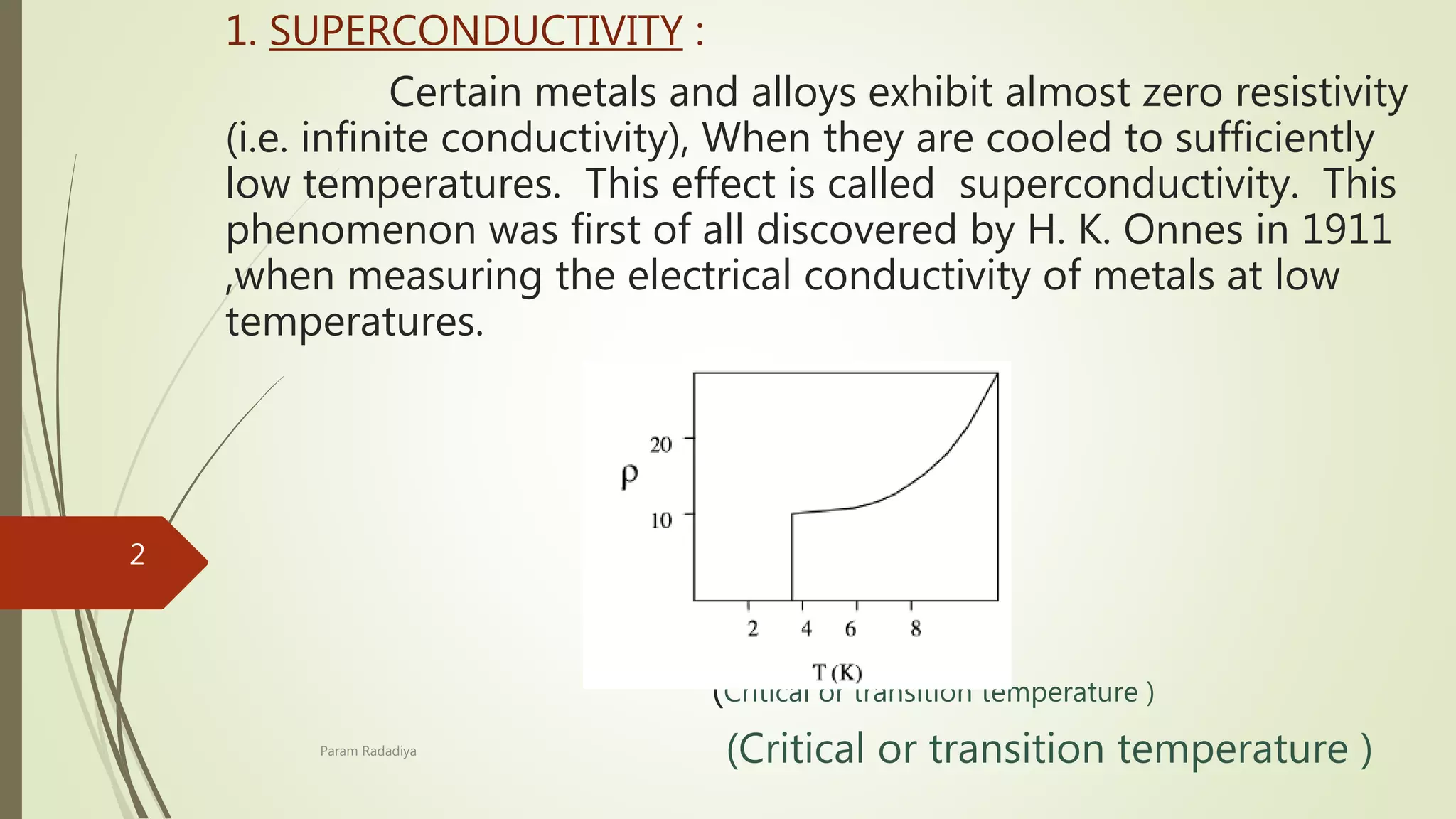
Certain metals and alloys exhibit almost zero resistivity
(i.e. infinite conductivity), When they are cooled to sufficiently
low temperatures. This effect is called superconductivity. This
phenomenon was first of all discovered by H. K. Onnes in 1911
,when measuring the electrical conductivity of metals at low
temperatures.
(Critical or transition temperature )
(Critical or transition temperature )Param Radadiya
2
The temperature at which the transition from normal
state to superco -ducting state takes place on cooling in the
absence of magnetic field is called critical temperature or
transition temperature.
2. GENERAL PROPERTIES OF SUPERCONDUCTORS:-
PROPERTIES OF SUPERCONDUCTORS:-
1. It is a low temperature phenomenon.
2. The transition temperature is different for different substances.
3. Materials having high normal resistivities exhibit superconductivity.
4. Materials for which 6 10= ρ Z (where Z is a atomic number and
ρ is resistivity) show superconductivity.
Param Radadiya
3
5. For chemically pure and structurally perfect specimen, the
superconductivity is very sharp.
6. Ferro magnetic and Anti ferromagnetic materials are not
superconductors.
7. Below the transition temperature the magnetic flux lines are rejected out of the
superconductors.
8. Superconducting elements, in general, lie in the inner columns of the
periodic table.
9. Those metallic elements having their valence electrons lies between 2 to 8 exhibit
superconductivity.
10. Below the transition temperature the specific heat curve is discontinuous.
3. The Meissner effect
When a weak magnetic is applied to a superconducting
specimen at a temperature below transition temperature C T the
magnetic flux lines are expelled. This phenomenon is called
Meissner effect.
Param Radadiya
4
Under normal state the magnetic induction inside the specimen is
Where H is the external applied magnetic field and I is the magnetization produced
inside the specimen.
When the specimen is in superconducting state 0 =B (Meissner effect)
0 = µ (H+1) OR H=-1
𝜒 =
1
𝐻
=-1
Thus the material is act as a perfectly diamagnetic for diamagnetic material (𝜒=-1).
Let us consider a superconducting material is in normal state. From ohms law, the electric
field E= Jρ .
On cooling the material to its transition temperature ρ tends to zero. If J is held finite E
must be zero.
Param Radadiya
5
On cooling the material to its transition temperature ρ tends to zero. If J is held finite
E must be zero.
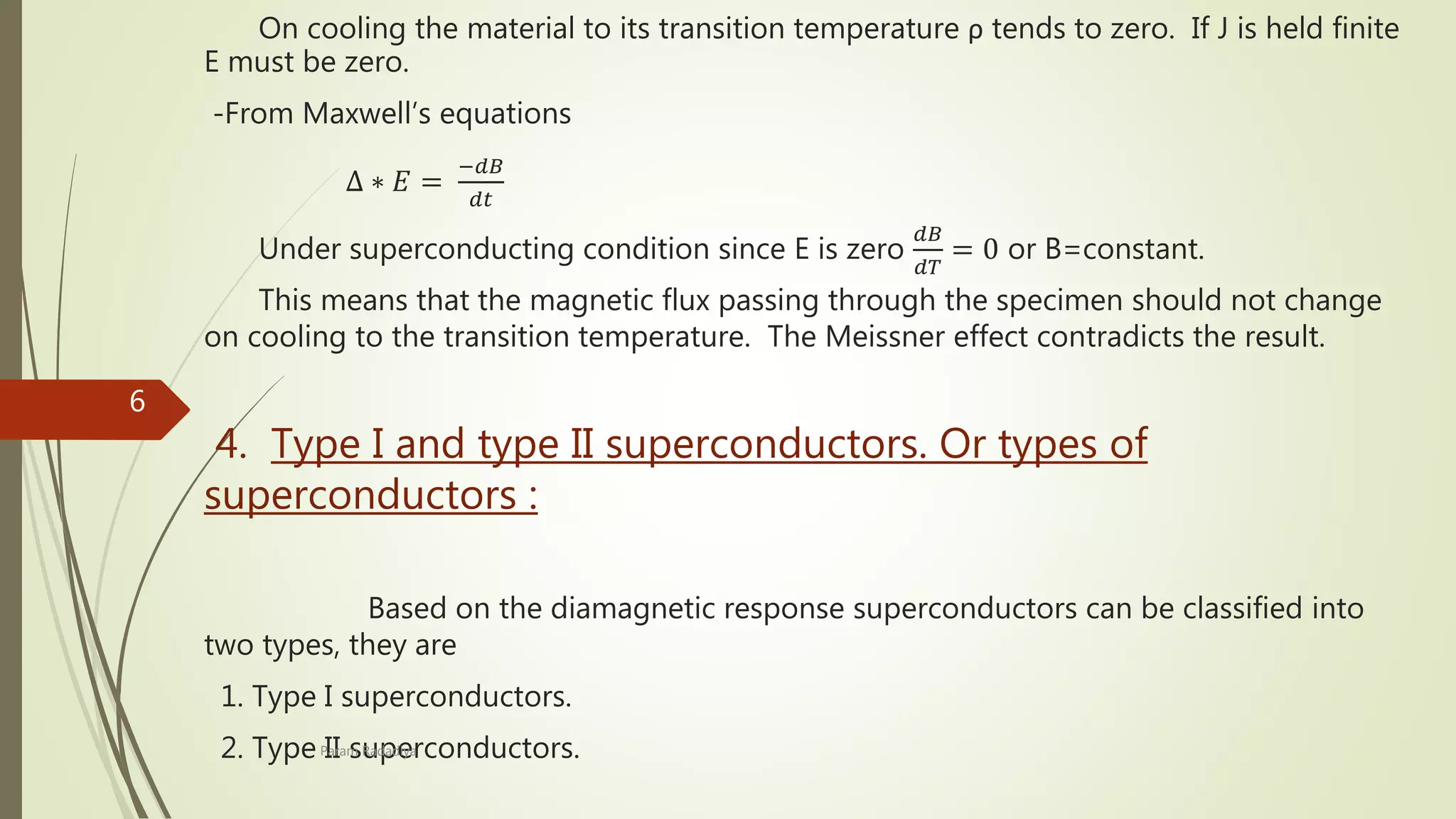
-From Maxwell’s equations
Δ ∗ 𝐸 =
−𝑑𝐵
𝑑𝑡
Under superconducting condition since E is zero
𝑑𝐵
𝑑𝑇
= 0 or B=constant.
This means that the magnetic flux passing through the specimen should not change
on cooling to the transition temperature. The Meissner effect contradicts the result.
4. Type I and type II superconductors. Or types of
superconductors :
Based on the diamagnetic response superconductors can be classified into
two types, they are
1. Type I superconductors.
2. Type II superconductors.Param Radadiya
6
 TYPE I SUPERCONDUCTORS:-
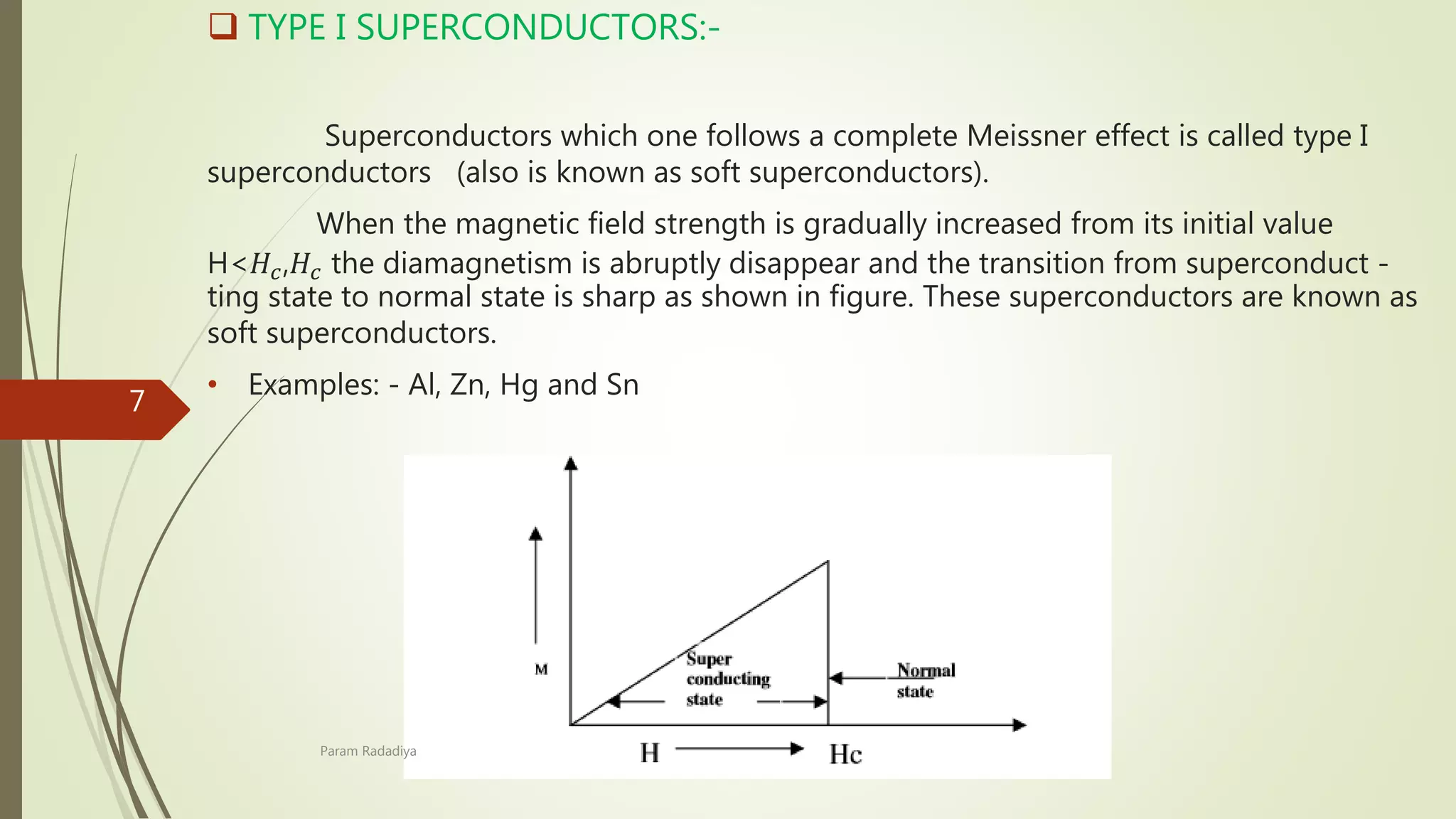
Superconductors which one follows a complete Meissner effect is called type I
superconductors (also is known as soft superconductors).
When the magnetic field strength is gradually increased from its initial value
H<𝐻𝑐,𝐻𝑐 the diamagnetism is abruptly disappear and the transition from superconduct -
ting state to normal state is sharp as shown in figure. These superconductors are known as
soft superconductors.
• Examples: - Al, Zn, Hg and Sn
Param Radadiya
7
 Type II superconductors:-
Superconductors which does not follow the complete Meissner effect is called type
I superconductors (also is known as hard superconductors).
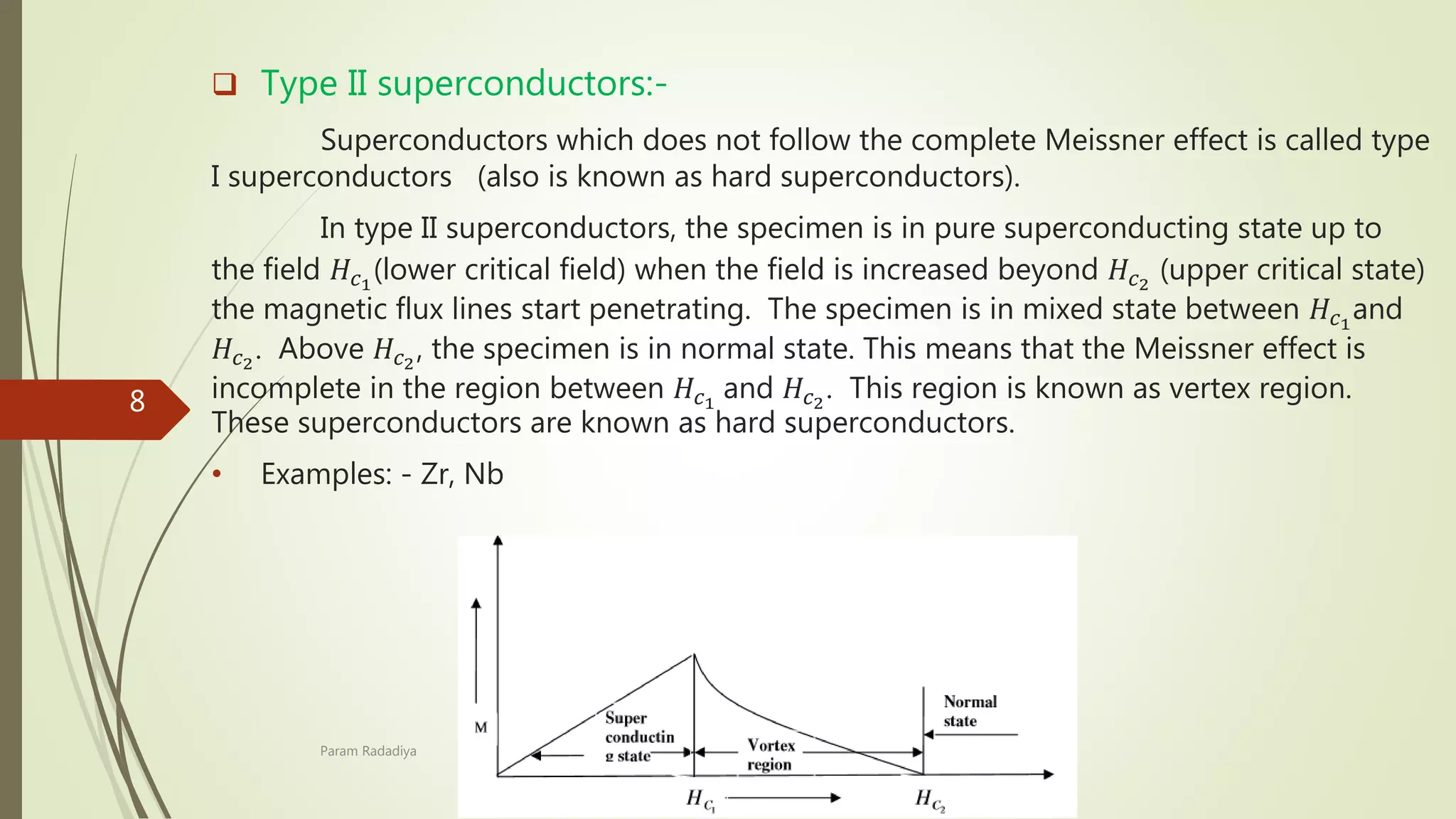
In type II superconductors, the specimen is in pure superconducting state up to
the field 𝐻𝑐1
(lower critical field) when the field is increased beyond 𝐻𝑐2
(upper critical state)
the magnetic flux lines start penetrating. The specimen is in mixed state between 𝐻𝑐1
and
𝐻𝑐2
. Above 𝐻𝑐2
, the specimen is in normal state. This means that the Meissner effect is
incomplete in the region between 𝐻𝑐1
and 𝐻𝑐2
. This region is known as vertex region.
These superconductors are known as hard superconductors.
• Examples: - Zr, Nb
Param Radadiya
8
Param Radadiya
9
5. Penetration depth
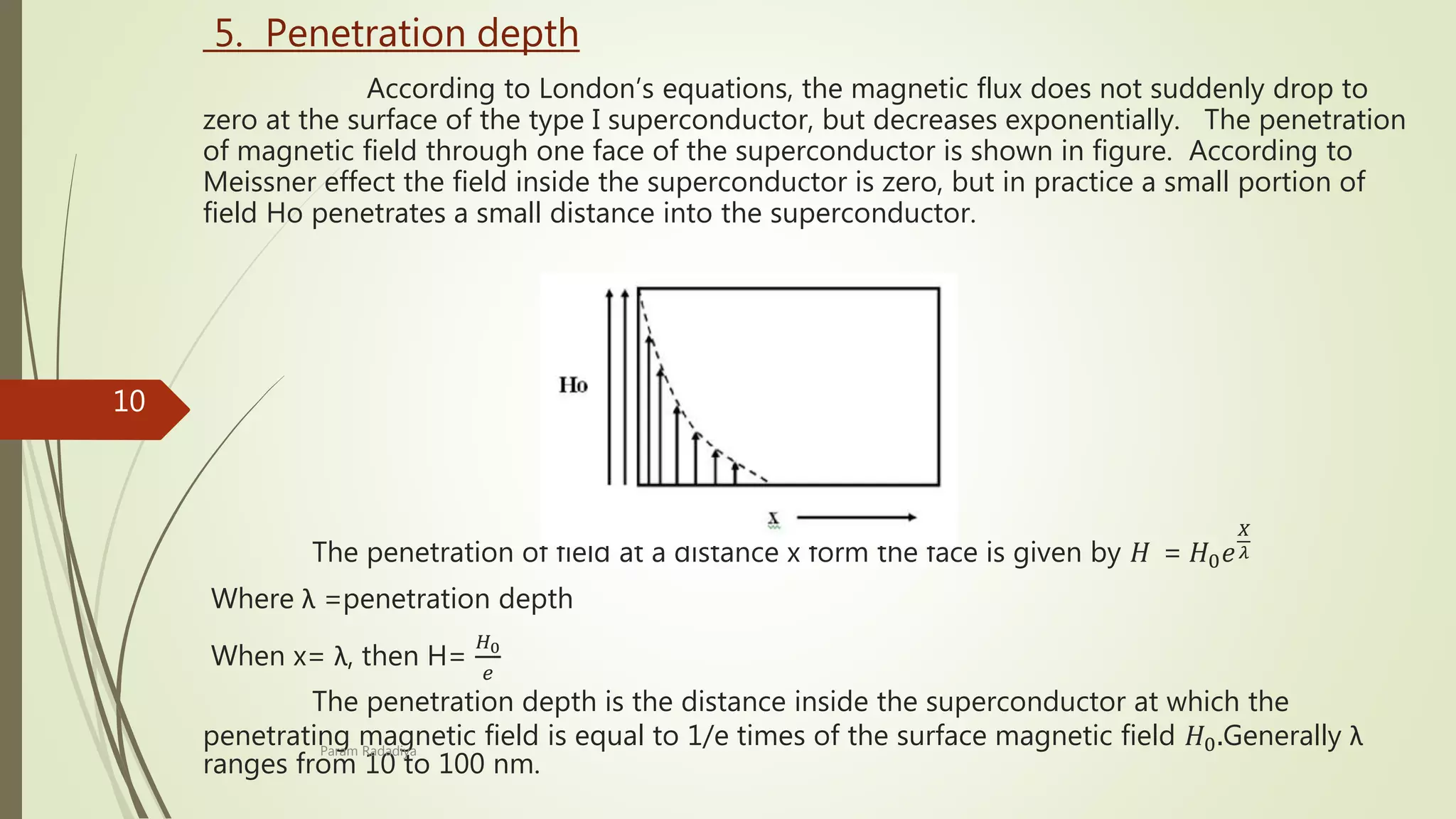
According to London’s equations, the magnetic flux does not suddenly drop to
zero at the surface of the type I superconductor, but decreases exponentially. The penetration
of magnetic field through one face of the superconductor is shown in figure. According to
Meissner effect the field inside the superconductor is zero, but in practice a small portion of
field Ho penetrates a small distance into the superconductor.
The penetration of field at a distance x form the face is given by 𝐻 = 𝐻0 𝑒
𝑋
𝜆
Where λ =penetration depth
When x= λ, then H=
𝐻0
𝑒
The penetration depth is the distance inside the superconductor at which the
penetrating magnetic field is equal to 1/e times of the surface magnetic field 𝐻0.Generally λ
ranges from 10 to 100 nm.
Param Radadiya
10
The variation of H w.r.t x is shown in figure.
The penetration depth depends upon the temperature is given by the
relation
𝜆(𝑇) =
𝜆(0)
1 −
𝑇4
𝑇𝑐
4
1
2
Where λ (0)is the penetration depth at T=0K.
Param Radadiya
11
6. JOSEPHSON EFFECT
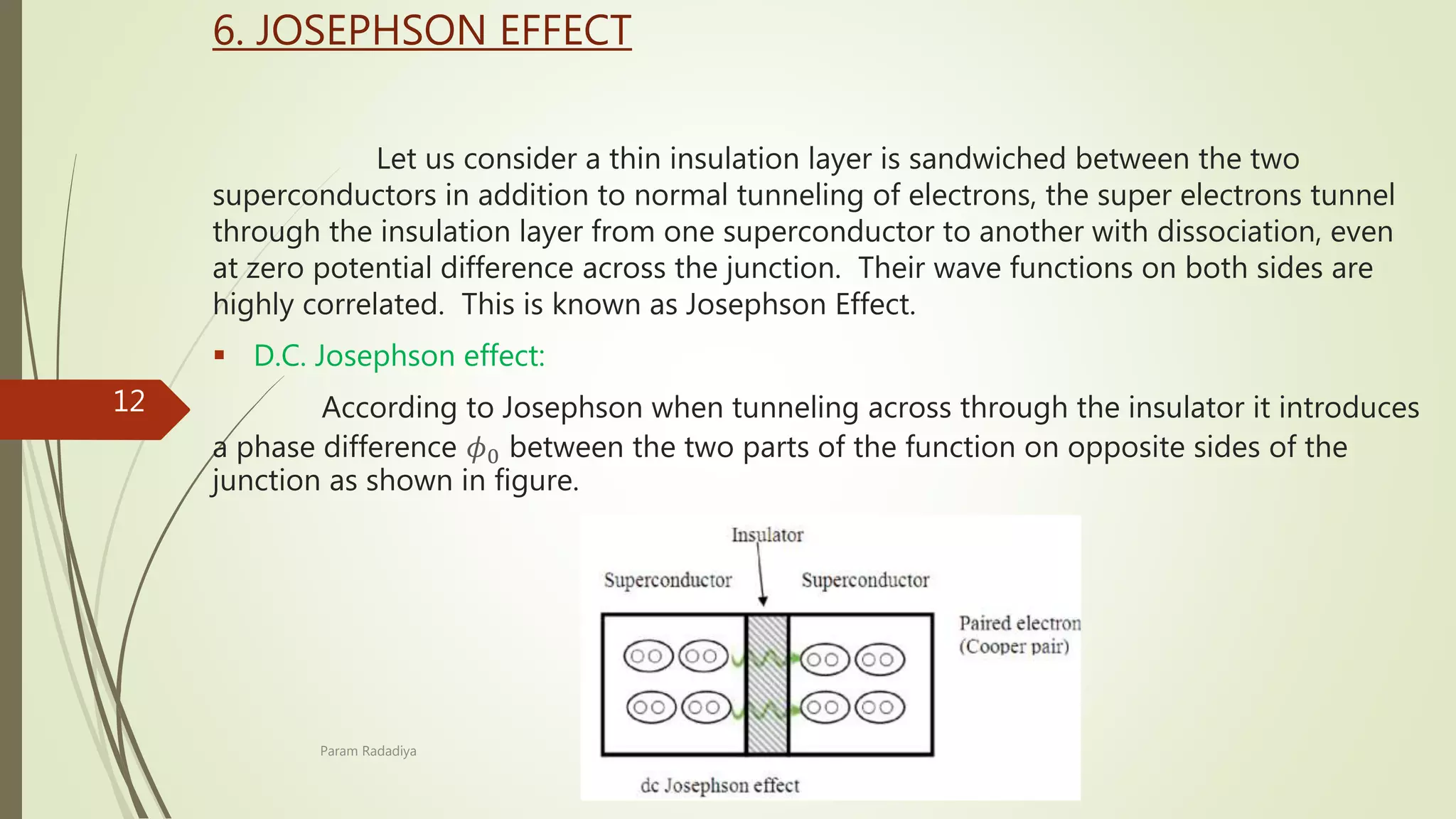
Let us consider a thin insulation layer is sandwiched between the two
superconductors in addition to normal tunneling of electrons, the super electrons tunnel
through the insulation layer from one superconductor to another with dissociation, even
at zero potential difference across the junction. Their wave functions on both sides are
highly correlated. This is known as Josephson Effect.
 D.C. Josephson effect:
According to Josephson when tunneling across through the insulator it introduces
a phase difference 𝜙0 between the two parts of the function on opposite sides of the
junction as shown in figure.
Param Radadiya
12
The tunneling current is given by el 𝐼 = 𝐼0 sin(𝜙0)
Where 𝐼0 is the maximum current that flows through the junction without any potential
difference across the junction. This effect is called D.C Josephson effect.
 A.C. Josephson effect:
Let a static potential difference is applied across the junction, an additional phase
is introduced by the cooper pairs during tunneling across the junction. This additional
phase change (∆ φ) at any time t can be calculated using quantum mechanics.
Param Radadiya
13
Δϕ =
𝐸𝑡
ℏ
Where E denotes the total energy of the system. In present case E= 2𝑒𝑉0
Hence,
Δϕ =
2𝑒𝑉0 𝑡
ℏ
The tunneling current can be written as
𝐼 = 𝐼0 sin 𝜙0 +
2𝑒𝑉0 𝑡
ℏ
𝐼 = 𝐼0 sin 𝜙0 + 𝜔𝑡
Where 𝜔=
2𝑒𝑉0
ℏ
This represents alternating current with angular frequency ω . This is A.C Josephson
effect.
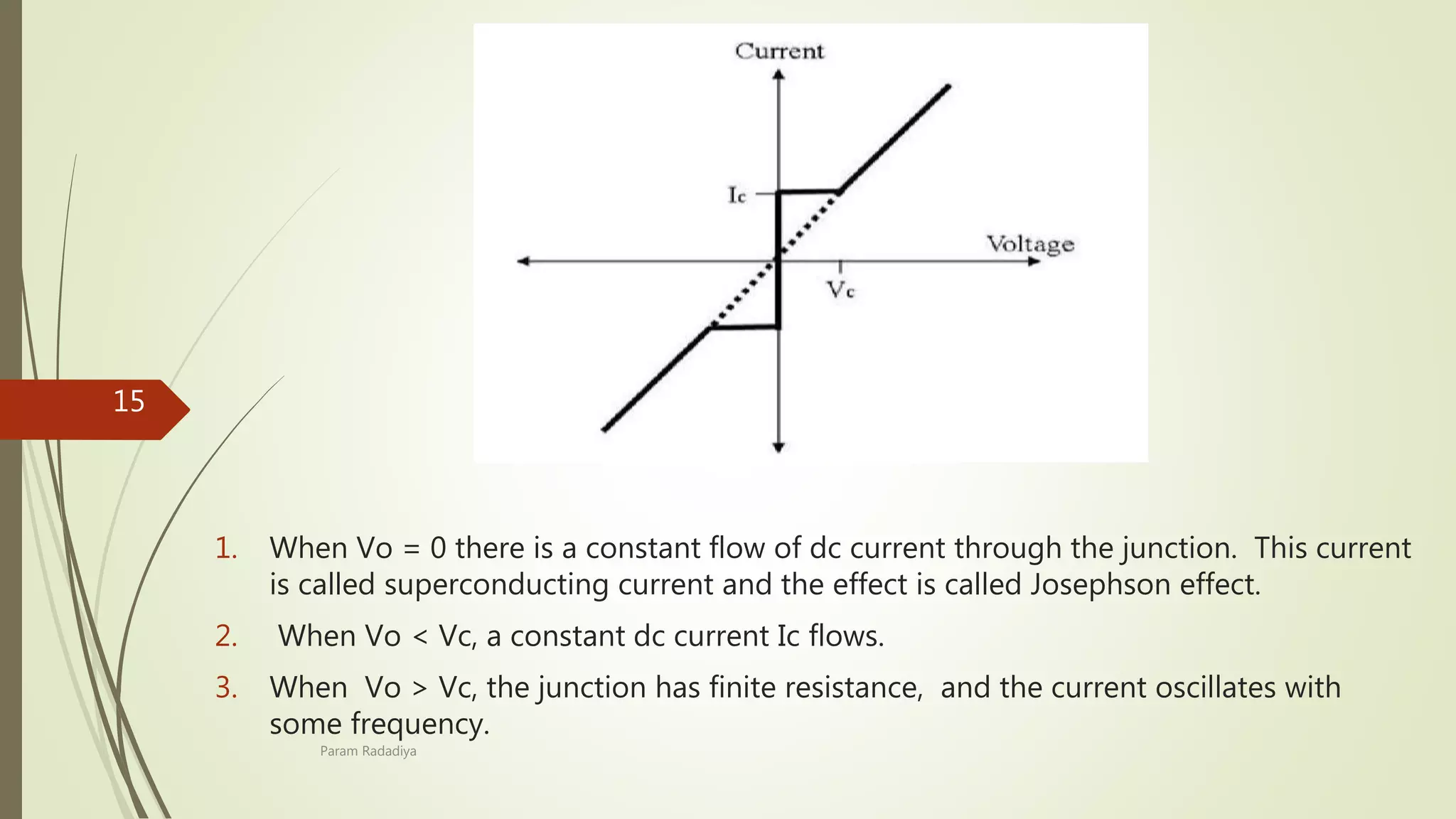
Current voltage characteristic of a junction is shown in figure.
Param Radadiya
14
1. When Vo = 0 there is a constant flow of dc current through the junction. This current
is called superconducting current and the effect is called Josephson effect.
2. When Vo < Vc, a constant dc current Ic flows.
3. When Vo > Vc, the junction has finite resistance, and the current oscillates with
some frequency.
Param Radadiya
15
 Applications of Josephson Effect
1. Josephson effect is used to generate micro waves frequency with
𝜔 =
2𝑒𝑉0
ℏ
2. A.C Josephson effect is used to define standard volt.
3. A.C Josephson effect is used to measure very low temperatures based on
the variation of frequency of the emitted radiation with temperature.
4. A.C Josephson effect is used for switching of signals from one circuit to
another.
Param Radadiya
16
7. BCS theory
BCS theory of superconductor was put forward by Bardeen, Cooper and
Schrieffer in 1957 and hence named as BCS theory. This theory could explain the effects
such as zero resistivity, Meissner effect, isotopic effect etc.
Electron lattice interaction via lattice deformation.
Let us consider an electron is passing through the lattice positive ions. The
electron is attracted by the neighboring lattice positive ions as shown in figure 1. Due to
the attraction of electron and ion core, the lattice gets deformed on scale. So electron get
partially positive charge. Now if another electron passes by the side of assembly of said
electron and ion core, it gets attracted towards the assembly.
Param Radadiya
17
The second electron interacts with the first electron due to the
exchange of virtual photon q, between two electrons. The interaction
process can be written in terms the wave vector k as
𝑘1
′
= 𝑘1 − 𝑞 and 𝑘2
′
= 𝑘1 + 𝑞
These two electrons together form a cooper pair and is known as
cooper electron.
Param Radadiya
18
COOPER PAIRS
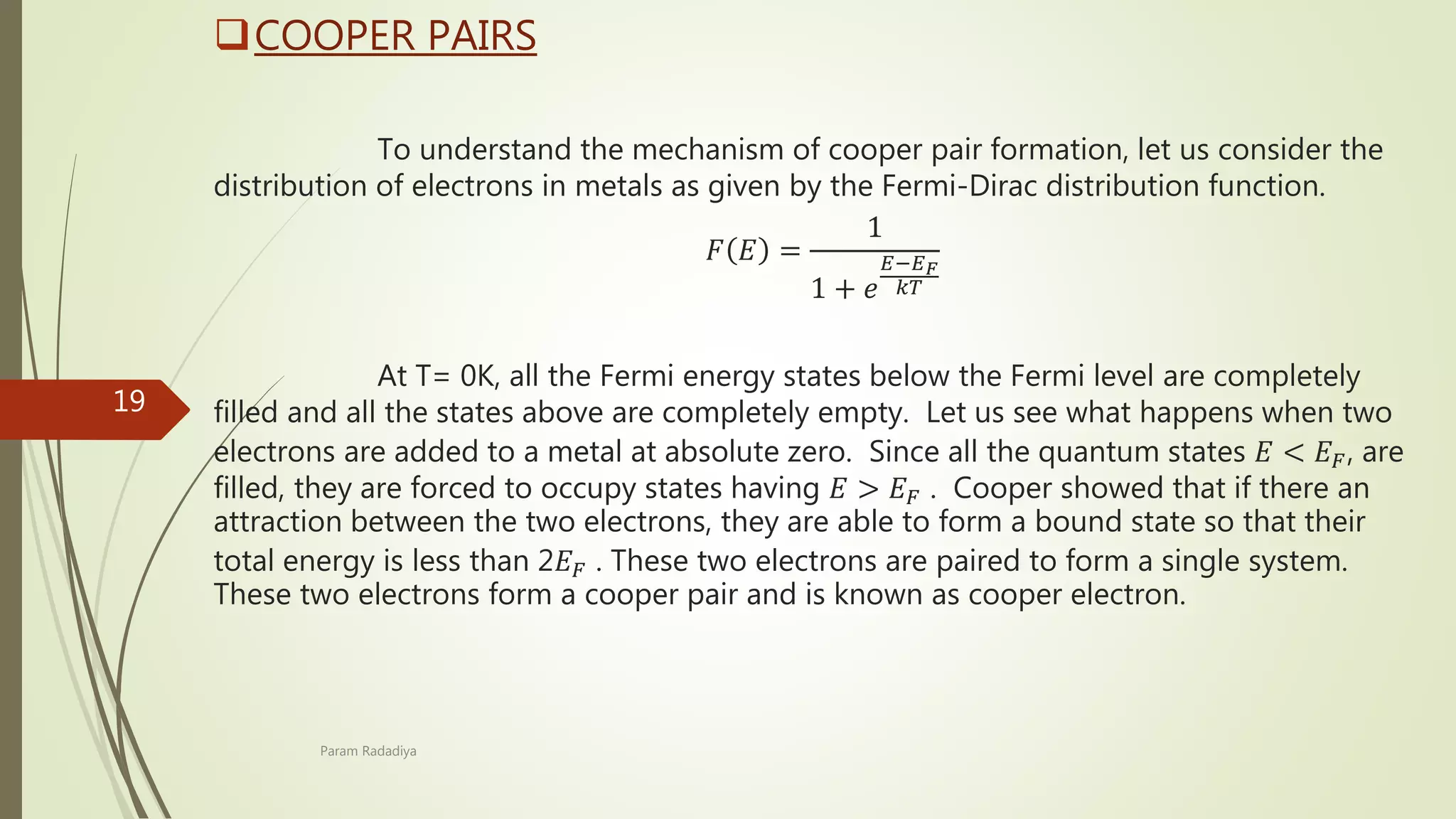
To understand the mechanism of cooper pair formation, let us consider the
distribution of electrons in metals as given by the Fermi-Dirac distribution function.
𝐹 𝐸 =
1
1 + 𝑒
𝐸−𝐸 𝐹
𝑘𝑇
At T= 0K, all the Fermi energy states below the Fermi level are completely
filled and all the states above are completely empty. Let us see what happens when two
electrons are added to a metal at absolute zero. Since all the quantum states 𝐸 < 𝐸 𝐹, are
filled, they are forced to occupy states having 𝐸 > 𝐸 𝐹 . Cooper showed that if there an
attraction between the two electrons, they are able to form a bound state so that their
total energy is less than 2𝐸 𝐹 . These two electrons are paired to form a single system.
These two electrons form a cooper pair and is known as cooper electron.
Param Radadiya
19
8. FLUX QUANTIZATION
According to quantum mechanics matter, energy and charge is quantized.
Similarly the magnetic flux passing the superconducting ring is also quantized. Consider
a superconducting conducting ring in a magnetic field. If the temperature of the
superconductor is greater than its critical temperature, the magnetic flux lines are passed
through it as shown in figure (1).
Even when the applied magnetic field is removed, some magnetic flux is inside the hollow
ring as shown in figure.
Param Radadiya
20
The flux inside the ring is given by
∅ =
𝑛ℎ
2𝑒
,Where n is =1,2,3,4,…
Where h is Planck’s constant and e is charge of electron.
Thus the flux passing through the superconducting ring is equal to integral
multiple of
𝑛ℎ
2𝑒
or quantized.
 CRITICAL PARAMETERS OF SUPERCONDUCTIVITY
• Effect of magnetic field
Superconductivity of a metal mainly depends on the temperature and
strength of the magnetic field in which the metal is placed. Superconductivity
disappears if the temperature of the specimen is raised above 𝑇𝑐 or a strong
enough magnetic field is applied. At temperatures below 𝑇𝑐 , in the absence of
magnetic field, the material is in superconducting state.
Param Radadiya
21
When the strength of the magnetic field is applied to a critical value 𝐻𝑐 the
superconductivity disappears.
The dependence of critical field upon the temperature is given by
𝐻𝑐 𝑇 = 𝐻𝑐(0) 1 −
𝑇
𝑇𝑐
2
The variation of HC w.r.t. T is shown in figure.
Param Radadiya
22
Effect of current
An electric current is passing through the superconducting material it self may
gives rise to necessary magnetic field. For example, when the current is passing a
superconducting ring, it gives rise to its own magnetic field. As the current increases to
critical value 𝑇𝑐 , the associated magnetic field becomes 𝐻𝑐 . And the superconductivity
Disappears. 𝐼𝑐 = 2𝜋𝑟𝐻𝑐
Isotopic effect In superconducting materials the transition temperature varies with
the average isotopic mass of their constituents. The variation is found to be in general
form
𝑇𝑐 ∝ 𝑀−∝
or 𝑇𝑐 𝑀−∝
= 𝑐𝑜𝑛𝑠𝑡𝑎𝑛𝑡
Where ∝is the isotopic effect coefficient and is defined as
∝=
𝜕 ln 𝑇𝑐
𝜕 ln 𝑀
The value of α is approximately 0.5. For example, the average mass varies from 199.5 to
203.4 atomic mass units and accordingly the transition temperature varies from 4.185K to
4.146K.
Param Radadiya
23
Param Radadiya
24

Superconductivity

  • 1.
  • 2.
    1. SUPERCONDUCTIVITY : Certainmetals and alloys exhibit almost zero resistivity (i.e. infinite conductivity), When they are cooled to sufficiently low temperatures. This effect is called superconductivity. This phenomenon was first of all discovered by H. K. Onnes in 1911 ,when measuring the electrical conductivity of metals at low temperatures. (Critical or transition temperature ) (Critical or transition temperature )Param Radadiya 2
  • 3.
    The temperature atwhich the transition from normal state to superco -ducting state takes place on cooling in the absence of magnetic field is called critical temperature or transition temperature. 2. GENERAL PROPERTIES OF SUPERCONDUCTORS:- PROPERTIES OF SUPERCONDUCTORS:- 1. It is a low temperature phenomenon. 2. The transition temperature is different for different substances. 3. Materials having high normal resistivities exhibit superconductivity. 4. Materials for which 6 10= ρ Z (where Z is a atomic number and ρ is resistivity) show superconductivity. Param Radadiya 3
  • 4.
    5. For chemicallypure and structurally perfect specimen, the superconductivity is very sharp. 6. Ferro magnetic and Anti ferromagnetic materials are not superconductors. 7. Below the transition temperature the magnetic flux lines are rejected out of the superconductors. 8. Superconducting elements, in general, lie in the inner columns of the periodic table. 9. Those metallic elements having their valence electrons lies between 2 to 8 exhibit superconductivity. 10. Below the transition temperature the specific heat curve is discontinuous. 3. The Meissner effect When a weak magnetic is applied to a superconducting specimen at a temperature below transition temperature C T the magnetic flux lines are expelled. This phenomenon is called Meissner effect. Param Radadiya 4
  • 5.
    Under normal statethe magnetic induction inside the specimen is Where H is the external applied magnetic field and I is the magnetization produced inside the specimen. When the specimen is in superconducting state 0 =B (Meissner effect) 0 = µ (H+1) OR H=-1 𝜒 = 1 𝐻 =-1 Thus the material is act as a perfectly diamagnetic for diamagnetic material (𝜒=-1). Let us consider a superconducting material is in normal state. From ohms law, the electric field E= Jρ . On cooling the material to its transition temperature ρ tends to zero. If J is held finite E must be zero. Param Radadiya 5
  • 6.
    On cooling thematerial to its transition temperature ρ tends to zero. If J is held finite E must be zero. -From Maxwell’s equations Δ ∗ 𝐸 = −𝑑𝐵 𝑑𝑡 Under superconducting condition since E is zero 𝑑𝐵 𝑑𝑇 = 0 or B=constant. This means that the magnetic flux passing through the specimen should not change on cooling to the transition temperature. The Meissner effect contradicts the result. 4. Type I and type II superconductors. Or types of superconductors : Based on the diamagnetic response superconductors can be classified into two types, they are 1. Type I superconductors. 2. Type II superconductors.Param Radadiya 6
  • 7.
     TYPE ISUPERCONDUCTORS:- Superconductors which one follows a complete Meissner effect is called type I superconductors (also is known as soft superconductors). When the magnetic field strength is gradually increased from its initial value H<𝐻𝑐,𝐻𝑐 the diamagnetism is abruptly disappear and the transition from superconduct - ting state to normal state is sharp as shown in figure. These superconductors are known as soft superconductors. • Examples: - Al, Zn, Hg and Sn Param Radadiya 7
  • 8.
     Type IIsuperconductors:- Superconductors which does not follow the complete Meissner effect is called type I superconductors (also is known as hard superconductors). In type II superconductors, the specimen is in pure superconducting state up to the field 𝐻𝑐1 (lower critical field) when the field is increased beyond 𝐻𝑐2 (upper critical state) the magnetic flux lines start penetrating. The specimen is in mixed state between 𝐻𝑐1 and 𝐻𝑐2 . Above 𝐻𝑐2 , the specimen is in normal state. This means that the Meissner effect is incomplete in the region between 𝐻𝑐1 and 𝐻𝑐2 . This region is known as vertex region. These superconductors are known as hard superconductors. • Examples: - Zr, Nb Param Radadiya 8
  • 9.
  • 10.
    5. Penetration depth Accordingto London’s equations, the magnetic flux does not suddenly drop to zero at the surface of the type I superconductor, but decreases exponentially. The penetration of magnetic field through one face of the superconductor is shown in figure. According to Meissner effect the field inside the superconductor is zero, but in practice a small portion of field Ho penetrates a small distance into the superconductor. The penetration of field at a distance x form the face is given by 𝐻 = 𝐻0 𝑒 𝑋 𝜆 Where λ =penetration depth When x= λ, then H= 𝐻0 𝑒 The penetration depth is the distance inside the superconductor at which the penetrating magnetic field is equal to 1/e times of the surface magnetic field 𝐻0.Generally λ ranges from 10 to 100 nm. Param Radadiya 10
  • 11.
    The variation ofH w.r.t x is shown in figure. The penetration depth depends upon the temperature is given by the relation 𝜆(𝑇) = 𝜆(0) 1 − 𝑇4 𝑇𝑐 4 1 2 Where λ (0)is the penetration depth at T=0K. Param Radadiya 11
  • 12.
    6. JOSEPHSON EFFECT Letus consider a thin insulation layer is sandwiched between the two superconductors in addition to normal tunneling of electrons, the super electrons tunnel through the insulation layer from one superconductor to another with dissociation, even at zero potential difference across the junction. Their wave functions on both sides are highly correlated. This is known as Josephson Effect.  D.C. Josephson effect: According to Josephson when tunneling across through the insulator it introduces a phase difference 𝜙0 between the two parts of the function on opposite sides of the junction as shown in figure. Param Radadiya 12
  • 13.
    The tunneling currentis given by el 𝐼 = 𝐼0 sin(𝜙0) Where 𝐼0 is the maximum current that flows through the junction without any potential difference across the junction. This effect is called D.C Josephson effect.  A.C. Josephson effect: Let a static potential difference is applied across the junction, an additional phase is introduced by the cooper pairs during tunneling across the junction. This additional phase change (∆ φ) at any time t can be calculated using quantum mechanics. Param Radadiya 13
  • 14.
    Δϕ = 𝐸𝑡 ℏ Where Edenotes the total energy of the system. In present case E= 2𝑒𝑉0 Hence, Δϕ = 2𝑒𝑉0 𝑡 ℏ The tunneling current can be written as 𝐼 = 𝐼0 sin 𝜙0 + 2𝑒𝑉0 𝑡 ℏ 𝐼 = 𝐼0 sin 𝜙0 + 𝜔𝑡 Where 𝜔= 2𝑒𝑉0 ℏ This represents alternating current with angular frequency ω . This is A.C Josephson effect. Current voltage characteristic of a junction is shown in figure. Param Radadiya 14
  • 15.
    1. When Vo= 0 there is a constant flow of dc current through the junction. This current is called superconducting current and the effect is called Josephson effect. 2. When Vo < Vc, a constant dc current Ic flows. 3. When Vo > Vc, the junction has finite resistance, and the current oscillates with some frequency. Param Radadiya 15
  • 16.
     Applications ofJosephson Effect 1. Josephson effect is used to generate micro waves frequency with 𝜔 = 2𝑒𝑉0 ℏ 2. A.C Josephson effect is used to define standard volt. 3. A.C Josephson effect is used to measure very low temperatures based on the variation of frequency of the emitted radiation with temperature. 4. A.C Josephson effect is used for switching of signals from one circuit to another. Param Radadiya 16
  • 17.
    7. BCS theory BCStheory of superconductor was put forward by Bardeen, Cooper and Schrieffer in 1957 and hence named as BCS theory. This theory could explain the effects such as zero resistivity, Meissner effect, isotopic effect etc. Electron lattice interaction via lattice deformation. Let us consider an electron is passing through the lattice positive ions. The electron is attracted by the neighboring lattice positive ions as shown in figure 1. Due to the attraction of electron and ion core, the lattice gets deformed on scale. So electron get partially positive charge. Now if another electron passes by the side of assembly of said electron and ion core, it gets attracted towards the assembly. Param Radadiya 17
  • 18.
    The second electroninteracts with the first electron due to the exchange of virtual photon q, between two electrons. The interaction process can be written in terms the wave vector k as 𝑘1 ′ = 𝑘1 − 𝑞 and 𝑘2 ′ = 𝑘1 + 𝑞 These two electrons together form a cooper pair and is known as cooper electron. Param Radadiya 18
  • 19.
    COOPER PAIRS To understandthe mechanism of cooper pair formation, let us consider the distribution of electrons in metals as given by the Fermi-Dirac distribution function. 𝐹 𝐸 = 1 1 + 𝑒 𝐸−𝐸 𝐹 𝑘𝑇 At T= 0K, all the Fermi energy states below the Fermi level are completely filled and all the states above are completely empty. Let us see what happens when two electrons are added to a metal at absolute zero. Since all the quantum states 𝐸 < 𝐸 𝐹, are filled, they are forced to occupy states having 𝐸 > 𝐸 𝐹 . Cooper showed that if there an attraction between the two electrons, they are able to form a bound state so that their total energy is less than 2𝐸 𝐹 . These two electrons are paired to form a single system. These two electrons form a cooper pair and is known as cooper electron. Param Radadiya 19
  • 20.
    8. FLUX QUANTIZATION Accordingto quantum mechanics matter, energy and charge is quantized. Similarly the magnetic flux passing the superconducting ring is also quantized. Consider a superconducting conducting ring in a magnetic field. If the temperature of the superconductor is greater than its critical temperature, the magnetic flux lines are passed through it as shown in figure (1). Even when the applied magnetic field is removed, some magnetic flux is inside the hollow ring as shown in figure. Param Radadiya 20
  • 21.
    The flux insidethe ring is given by ∅ = 𝑛ℎ 2𝑒 ,Where n is =1,2,3,4,… Where h is Planck’s constant and e is charge of electron. Thus the flux passing through the superconducting ring is equal to integral multiple of 𝑛ℎ 2𝑒 or quantized.  CRITICAL PARAMETERS OF SUPERCONDUCTIVITY • Effect of magnetic field Superconductivity of a metal mainly depends on the temperature and strength of the magnetic field in which the metal is placed. Superconductivity disappears if the temperature of the specimen is raised above 𝑇𝑐 or a strong enough magnetic field is applied. At temperatures below 𝑇𝑐 , in the absence of magnetic field, the material is in superconducting state. Param Radadiya 21
  • 22.
    When the strengthof the magnetic field is applied to a critical value 𝐻𝑐 the superconductivity disappears. The dependence of critical field upon the temperature is given by 𝐻𝑐 𝑇 = 𝐻𝑐(0) 1 − 𝑇 𝑇𝑐 2 The variation of HC w.r.t. T is shown in figure. Param Radadiya 22
  • 23.
    Effect of current Anelectric current is passing through the superconducting material it self may gives rise to necessary magnetic field. For example, when the current is passing a superconducting ring, it gives rise to its own magnetic field. As the current increases to critical value 𝑇𝑐 , the associated magnetic field becomes 𝐻𝑐 . And the superconductivity Disappears. 𝐼𝑐 = 2𝜋𝑟𝐻𝑐 Isotopic effect In superconducting materials the transition temperature varies with the average isotopic mass of their constituents. The variation is found to be in general form 𝑇𝑐 ∝ 𝑀−∝ or 𝑇𝑐 𝑀−∝ = 𝑐𝑜𝑛𝑠𝑡𝑎𝑛𝑡 Where ∝is the isotopic effect coefficient and is defined as ∝= 𝜕 ln 𝑇𝑐 𝜕 ln 𝑀 The value of α is approximately 0.5. For example, the average mass varies from 199.5 to 203.4 atomic mass units and accordingly the transition temperature varies from 4.185K to 4.146K. Param Radadiya 23
  • 24.