GANDHINAGAR INSTITUTE 
OF TECHNOLOGY 
Active Learning Assignment 
on 
SSUUPPEERRCCOONNDDUUCCTTIIVVIITTYY 
Branch – Computer Engineering 
Division – A 
Subject – Physics (2110005)
Name of the group members: 
1. Hardik Soni – 140120107053 
2. Simran Gurwani – 140120107051 
3. Ramya Iyer – 140120107055 
Batch – A3 
Group – 1 
Name of the Faculty – Prof. Nirav Pandya
CONTENTS 
 Superconductors 
 Discovery 
 Properties 
 Important factors 
 Types 
 High Tc Superconductors 
 Magnetic Levitation and its application 
 Josephson effect 
 Application of superconductors
Introduction 
– What are superconductors? 
• Superconductors are the material having almost 
zero resistivity and behave as diamagnetic below 
the superconducting transiting temperature 
• Superconductivity is the flow of electric current 
without resistance in certain metals, alloys, and 
ceramics at temperatures near absolute zero, and 
in some cases at temperatures hundreds of degrees 
above absolute zero = -273ÂşK.
Discoverer of 
Superconductivity 
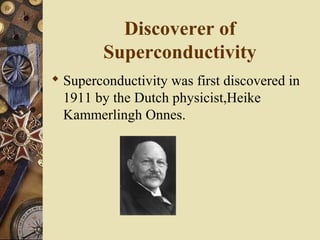
 Superconductivity was first discovered in 
1911 by the Dutch physicist,Heike 
Kammerlingh Onnes.
The Discovery 
 Onnes, felt that a cold wire's resistance would dissipate. 
This suggested that there would be a steady decrease in 
electrical resistance, allowing for better conduction of 
electricity. 
 At some very low temperature point, scientists felt that 
there would be a leveling off as the resistance reached 
some ill-defined minimum value allowing the current to 
flow with little or no resistance. 
 Onnes passed a current through a very pure mercury wire 
and measured its resistance as he steadily lowered the 
temperature. Much to his surprise there was no resistance 
at 4.2K.
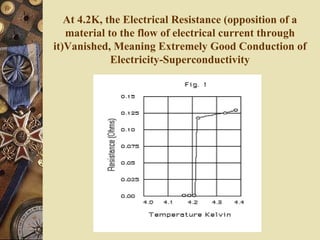
At 4.2K, the Electrical Resistance (opposition of a 
material to the flow of electrical current through 
it)Vanished, Meaning Extremely Good Conduction of 
Electricity-Superconductivity
General Properties of 
Superconductors 
• Electrical resistance: Virtually zero electrical resistance. 
• Effect of impurities: When impurities are added to 
superconducting elements, the superconductivity is not loss 
but the T 
c 
is lowered. 
• Effects of pressures and stress: certain materials exhibits 
superconductivity on increasing the pressure in 
superconductors, the increase in stress results in increase of 
the T 
c 
value.
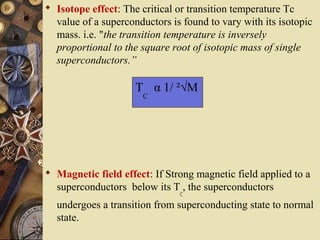
 Isotope effect: The critical or transition temperature Tc 
value of a superconductors is found to vary with its isotopic 
mass. i.e. "the transition temperature is inversely 
proportional to the square root of isotopic mass of single 
superconductors.” 
T 
C 
α 1/ ²√M 
 Magnetic field effect: If Strong magnetic field applied to a 
superconductors below its T 
C 
, the superconductors 
undergoes a transition from superconducting state to normal 
state.
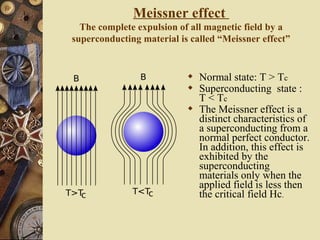
Meissner effect 
The complete expulsion of all magnetic field by a 
superconducting material is called “Meissner effect” 
 Normal state: T > Tc 
 Superconducting state : 
T < Tc 
 The Meissner effect is a 
distinct characteristics of 
a superconducting from a 
normal perfect conductor. 
In addition, this effect is 
exhibited by the 
superconducting 
materials only when the 
applied field is less then 
the critical field Hc.
Important Factors to define a 
Superconducting State 
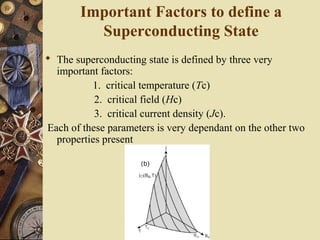
 The superconducting state is defined by three very 
important factors: 
1. critical temperature (Tc) 
2. critical field (Hc) 
3. critical current density (Jc). 
Each of these parameters is very dependant on the other two 
properties present
CRITICAL TEMPERATURE 
 The temperature at which a 
material electrical resistivity 
drops to absolute zero is called 
the Critical Temperature or 
Transition Temperature. 
 Below critical temperature, 
material is said to be in 
superconducting and above this it 
is said to in normal state. Below 
this temperature the 
superconductors also exhibits a 
variety of several astonishing 
magnetic and electrical 
properties. 
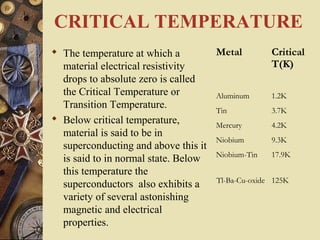
Metal Critical 
T(K) 
Aluminum 1.2K 
Tin 3.7K 
Mercury 4.2K 
Niobium 9.3K 
Niobium-Tin 17.9K 
Tl-Ba-Cu-oxide 125K
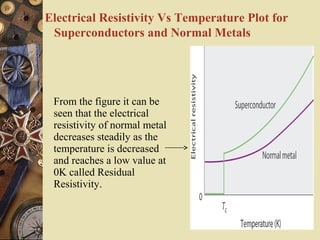
Electrical Resistivity Vs Temperature Plot for 
Superconductors and Normal Metals 
From the figure it can be 
seen that the electrical 
resistivity of normal metal 
decreases steadily as the 
temperature is decreased 
and reaches a low value at 
0K called Residual 
Resistivity.
• Critical magnetic field (Hc ) Above this value of an 
externally applied magnetic field a superconductor becomes 
non-superconducting .This minimum magnetic fields required 
to destroy the superconducting state is called the critical 
magnetic field Hc 
Hc = Ho[1-(T/Tc)2] 
• Critical current density (Jc) The maximum value of 
electrical current per unit of cross-sectional area that a
TYPES OF SUPERCONDUCTORS 
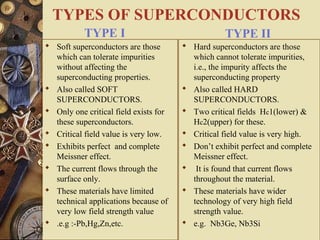
TYPE I 
 Soft superconductors are those 
which can tolerate impurities 
without affecting the 
superconducting properties. 
 Also called SOFT 
SUPERCONDUCTORS. 
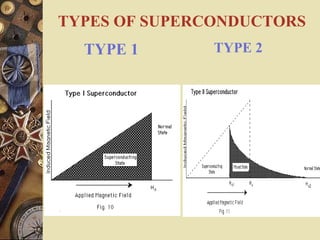
 Only one critical field exists for 
these superconductors. 
 Critical field value is very low. 
 Exhibits perfect and complete 
Meissner effect. 
 The current flows through the 
surface only. 
 These materials have limited 
technical applications because of 
very low field strength value 
 .e.g :-Pb,Hg,Zn,etc. 
TYPE II 
 Hard superconductors are those 
which cannot tolerate impurities, 
i.e., the impurity affects the 
superconducting property 
 Also called HARD 
SUPERCONDUCTORS. 
 Two critical fields Hc1(lower) & 
Hc2(upper) for these. 
 Critical field value is very high. 
 Don’t exhibit perfect and complete 
Meissner effect. 
 It is found that current flows 
throughout the material. 
 These materials have wider 
technology of very high field 
strength value. 
 e.g. Nb3Ge, Nb3Si
TYPES OF SUPERCONDUCTORS 
TYPE 1 TYPE 2
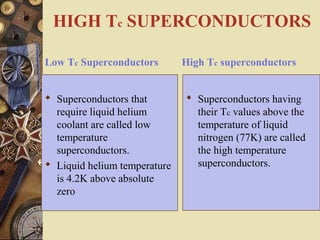
HIGH Tc SUPERCONDUCTORS 
Low Tc Superconductors 
 Superconductors that 
require liquid helium 
coolant are called low 
temperature 
superconductors. 
 Liquid helium temperature 
is 4.2K above absolute 
zero 
High Tc superconductors 
 Superconductors having 
their Tc values above the 
temperature of liquid 
nitrogen (77K) are called 
the high temperature 
superconductors.
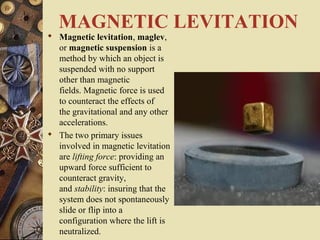
MAGNETIC LEVITATION 
 Magnetic levitation, maglev, 
or magnetic suspension is a 
method by which an object is 
suspended with no support 
other than magnetic 
fields. Magnetic force is used 
to counteract the effects of 
the gravitational and any other 
accelerations. 
 The two primary issues 
involved in magnetic levitation 
are lifting force: providing an 
upward force sufficient to 
counteract gravity, 
and stability: insuring that the 
system does not spontaneously 
slide or flip into a 
configuration where the lift is 
neutralized.
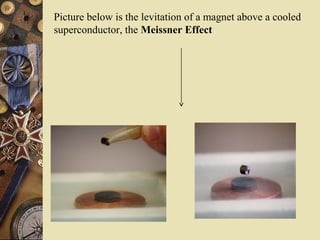
Picture below is the levitation of a magnet above a cooled 
superconductor, the Meissner Effect
APPLICATIONS 
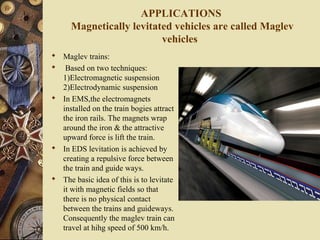
Magnetically levitated vehicles are called Maglev 
vehicles 
 Maglev trains: 
 Based on two techniques: 
1)Electromagnetic suspension 
2)Electrodynamic suspension 
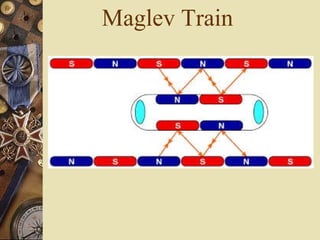
 In EMS,the electromagnets 
installed on the train bogies attract 
the iron rails. The magnets wrap 
around the iron & the attractive 
upward force is lift the train. 
 In EDS levitation is achieved by 
creating a repulsive force between 
the train and guide ways. 
 The basic idea of this is to levitate 
it with magnetic fields so that 
there is no physical contact 
between the trains and guideways. 
Consequently the maglev train can 
travel at hihg speed of 500 km/h.
Maglev Train
JOSEPHSON EFFECT 
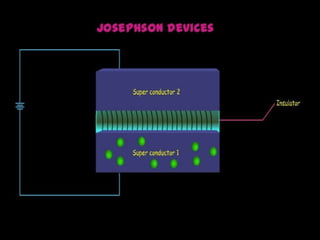
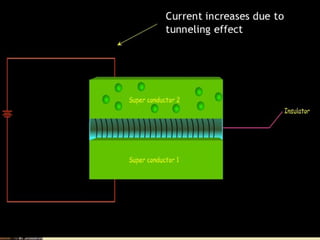
 Two superconductors separated by a very thin strip of an installer 
forms a Josephson junction. 
 The wave nature of moving particles make electrons to tunnel 
through the barrier. As a consequence of tunneling of electrons 
across the insulator there is net current across the junction. This is 
called d.c.josephson effect. The current flows even in absence of 
potential difference. 
 The magnitude of current depends on the thickness of the insulators, 
the nature of the materials and the temperature. 
 On the other hand when potential difference V is applied between the 
two sides of the junction there will be an oscillation of tunneling 
current with angular frequency v=2eV/h. This is called a.c.josephson 
effect.
APPLICATION OF 
SUPERCONDUCTORS 
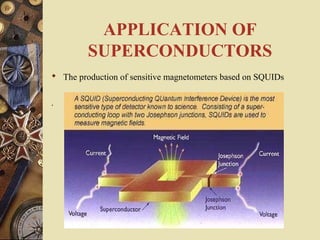
 The production of sensitive magnetometers based on SQUIDs 
.
• Powerful superconducting electromagnets used 
in maglev trains, Magnetic Resonance Imaging (MRI) 
and Nuclear magnetic resonance (NMR) machines, 
magnetic confinement fusion reactors (e.g. tokomaks), 
and the beam-steering and focusing magnets used in 
particle accelerators. 
• Superconducting generators has the benefit of small 
size and low energy consumption than the conventional 
generators. 
• Very fast and accurate computers can be constructed 
using superconductors and the power consumption is 
also very low. Superconductors can be used to transmit 
electrical power over very long distances without any 
power or any voltage drop
Reference 
 Wikipedia 
 Engineering Physics (G Vijayakumari) 
 Google images 
 YouTube 
 Hyperphysics.edu
Thank 
You

Superconductors

  • 1.
    GANDHINAGAR INSTITUTE OFTECHNOLOGY Active Learning Assignment on SSUUPPEERRCCOONNDDUUCCTTIIVVIITTYY Branch – Computer Engineering Division – A Subject – Physics (2110005)
  • 2.
    Name of thegroup members: 1. Hardik Soni – 140120107053 2. Simran Gurwani – 140120107051 3. Ramya Iyer – 140120107055 Batch – A3 Group – 1 Name of the Faculty – Prof. Nirav Pandya
  • 3.
    CONTENTS  Superconductors  Discovery  Properties  Important factors  Types  High Tc Superconductors  Magnetic Levitation and its application  Josephson effect  Application of superconductors
  • 4.
    Introduction – Whatare superconductors? • Superconductors are the material having almost zero resistivity and behave as diamagnetic below the superconducting transiting temperature • Superconductivity is the flow of electric current without resistance in certain metals, alloys, and ceramics at temperatures near absolute zero, and in some cases at temperatures hundreds of degrees above absolute zero = -273ºK.
  • 5.
    Discoverer of Superconductivity  Superconductivity was first discovered in 1911 by the Dutch physicist,Heike Kammerlingh Onnes.
  • 6.
    The Discovery Onnes, felt that a cold wire's resistance would dissipate. This suggested that there would be a steady decrease in electrical resistance, allowing for better conduction of electricity.  At some very low temperature point, scientists felt that there would be a leveling off as the resistance reached some ill-defined minimum value allowing the current to flow with little or no resistance.  Onnes passed a current through a very pure mercury wire and measured its resistance as he steadily lowered the temperature. Much to his surprise there was no resistance at 4.2K.
  • 7.
    At 4.2K, theElectrical Resistance (opposition of a material to the flow of electrical current through it)Vanished, Meaning Extremely Good Conduction of Electricity-Superconductivity
  • 8.
    General Properties of Superconductors • Electrical resistance: Virtually zero electrical resistance. • Effect of impurities: When impurities are added to superconducting elements, the superconductivity is not loss but the T c is lowered. • Effects of pressures and stress: certain materials exhibits superconductivity on increasing the pressure in superconductors, the increase in stress results in increase of the T c value.
  • 9.
     Isotope effect:The critical or transition temperature Tc value of a superconductors is found to vary with its isotopic mass. i.e. "the transition temperature is inversely proportional to the square root of isotopic mass of single superconductors.” T C α 1/ ²√M  Magnetic field effect: If Strong magnetic field applied to a superconductors below its T C , the superconductors undergoes a transition from superconducting state to normal state.
  • 10.
    Meissner effect Thecomplete expulsion of all magnetic field by a superconducting material is called “Meissner effect”  Normal state: T > Tc  Superconducting state : T < Tc  The Meissner effect is a distinct characteristics of a superconducting from a normal perfect conductor. In addition, this effect is exhibited by the superconducting materials only when the applied field is less then the critical field Hc.
  • 11.
    Important Factors todefine a Superconducting State  The superconducting state is defined by three very important factors: 1. critical temperature (Tc) 2. critical field (Hc) 3. critical current density (Jc). Each of these parameters is very dependant on the other two properties present
  • 12.
    CRITICAL TEMPERATURE The temperature at which a material electrical resistivity drops to absolute zero is called the Critical Temperature or Transition Temperature.  Below critical temperature, material is said to be in superconducting and above this it is said to in normal state. Below this temperature the superconductors also exhibits a variety of several astonishing magnetic and electrical properties. Metal Critical T(K) Aluminum 1.2K Tin 3.7K Mercury 4.2K Niobium 9.3K Niobium-Tin 17.9K Tl-Ba-Cu-oxide 125K
  • 13.
    Electrical Resistivity VsTemperature Plot for Superconductors and Normal Metals From the figure it can be seen that the electrical resistivity of normal metal decreases steadily as the temperature is decreased and reaches a low value at 0K called Residual Resistivity.
  • 14.
    • Critical magneticfield (Hc ) Above this value of an externally applied magnetic field a superconductor becomes non-superconducting .This minimum magnetic fields required to destroy the superconducting state is called the critical magnetic field Hc Hc = Ho[1-(T/Tc)2] • Critical current density (Jc) The maximum value of electrical current per unit of cross-sectional area that a
  • 15.
    TYPES OF SUPERCONDUCTORS TYPE I  Soft superconductors are those which can tolerate impurities without affecting the superconducting properties.  Also called SOFT SUPERCONDUCTORS.  Only one critical field exists for these superconductors.  Critical field value is very low.  Exhibits perfect and complete Meissner effect.  The current flows through the surface only.  These materials have limited technical applications because of very low field strength value  .e.g :-Pb,Hg,Zn,etc. TYPE II  Hard superconductors are those which cannot tolerate impurities, i.e., the impurity affects the superconducting property  Also called HARD SUPERCONDUCTORS.  Two critical fields Hc1(lower) & Hc2(upper) for these.  Critical field value is very high.  Don’t exhibit perfect and complete Meissner effect.  It is found that current flows throughout the material.  These materials have wider technology of very high field strength value.  e.g. Nb3Ge, Nb3Si
  • 16.
  • 17.
    HIGH Tc SUPERCONDUCTORS Low Tc Superconductors  Superconductors that require liquid helium coolant are called low temperature superconductors.  Liquid helium temperature is 4.2K above absolute zero High Tc superconductors  Superconductors having their Tc values above the temperature of liquid nitrogen (77K) are called the high temperature superconductors.
  • 18.
    MAGNETIC LEVITATION Magnetic levitation, maglev, or magnetic suspension is a method by which an object is suspended with no support other than magnetic fields. Magnetic force is used to counteract the effects of the gravitational and any other accelerations.  The two primary issues involved in magnetic levitation are lifting force: providing an upward force sufficient to counteract gravity, and stability: insuring that the system does not spontaneously slide or flip into a configuration where the lift is neutralized.
  • 19.
    Picture below isthe levitation of a magnet above a cooled superconductor, the Meissner Effect
  • 20.
    APPLICATIONS Magnetically levitatedvehicles are called Maglev vehicles  Maglev trains:  Based on two techniques: 1)Electromagnetic suspension 2)Electrodynamic suspension  In EMS,the electromagnets installed on the train bogies attract the iron rails. The magnets wrap around the iron & the attractive upward force is lift the train.  In EDS levitation is achieved by creating a repulsive force between the train and guide ways.  The basic idea of this is to levitate it with magnetic fields so that there is no physical contact between the trains and guideways. Consequently the maglev train can travel at hihg speed of 500 km/h.
  • 21.
  • 22.
    JOSEPHSON EFFECT Two superconductors separated by a very thin strip of an installer forms a Josephson junction.  The wave nature of moving particles make electrons to tunnel through the barrier. As a consequence of tunneling of electrons across the insulator there is net current across the junction. This is called d.c.josephson effect. The current flows even in absence of potential difference.  The magnitude of current depends on the thickness of the insulators, the nature of the materials and the temperature.  On the other hand when potential difference V is applied between the two sides of the junction there will be an oscillation of tunneling current with angular frequency v=2eV/h. This is called a.c.josephson effect.
  • 25.
    APPLICATION OF SUPERCONDUCTORS  The production of sensitive magnetometers based on SQUIDs .
  • 26.
    • Powerful superconductingelectromagnets used in maglev trains, Magnetic Resonance Imaging (MRI) and Nuclear magnetic resonance (NMR) machines, magnetic confinement fusion reactors (e.g. tokomaks), and the beam-steering and focusing magnets used in particle accelerators. • Superconducting generators has the benefit of small size and low energy consumption than the conventional generators. • Very fast and accurate computers can be constructed using superconductors and the power consumption is also very low. Superconductors can be used to transmit electrical power over very long distances without any power or any voltage drop
  • 27.
    Reference  Wikipedia  Engineering Physics (G Vijayakumari)  Google images  YouTube  Hyperphysics.edu
  • 28.