1/23/2017 1
Dr A K Mishra, Academic Coordinator,
JIT Jahangirabad
Engineering Physics II Unit V
Presentation By
Dr.A.K.Mishra
Associate Professor
Jahangirabad Institute of Technology, Barabanki
Email: akmishra.phy@gmail.com
Arun.Kumar@jit.edu.in
Superconductors
• In 1911 superconductivity was first observed in mercury by
Dutch physicist Heike Kamerlingh Onnes of Leiden University .
• When he cooled it to the temperature of liquid helium, 4
degrees Kelvin (-452F, -269C), its resistance suddenly
disappeared.
• Later, in 1913, he won a Nobel Prize in physics for his research
in this area.
• Superconductors, materials that have no resistance to the
flow of electricity, are one of the last great frontiers of
scientific discovery
• At the critical temprature the resistance falls to zero
1/23/2017
Dr A K Mishra, Academic Coordinator,
JIT Jahangirabad
2
Continued……………..
• These can be used to make low loss power line and very good
electromagnets.
1/23/2017
Dr A K Mishra, Academic Coordinator,
JIT Jahangirabad
3
Temperature (K)
Resistance
TC
O
Temperature (K)
Resistance
4.0 4.1 4.2 4.3 4.4
0.0
1.0
1.5
Temperature dependence of resistivity in
superconducting materials
• Superconductivity in the metal are depend on the intensity of
the field and temperature.
• to maintain the Superconductivity both the parameter should
be less than their critical values.
1/23/2017
Dr A K Mishra, Academic Coordinator,
JIT Jahangirabad 4
Normal Metal
Superconductor
Tc0
0
Continued……………..
• The dependence of the temperature on magnetic field can be
represented by following equation,
• Where Hc is the critical field strength, Hc(0) is the maximum field
strength at absolute zero and Tc is the critical temperature. it is clear
from the fig the temperature below Tc the materials remains in the
superconducting state till a corresponding critical magnetic field is
applied when the field is higher than the Hc the superconducting
state is destroyed and the materials comes to its normal state.
1/23/2017
Dr A K Mishra, Academic Coordinator,
JIT Jahangirabad
5
]
c
-Hc(0)[1=Hc
T
T
2






Meissner Effect (Effect of magnetic field)
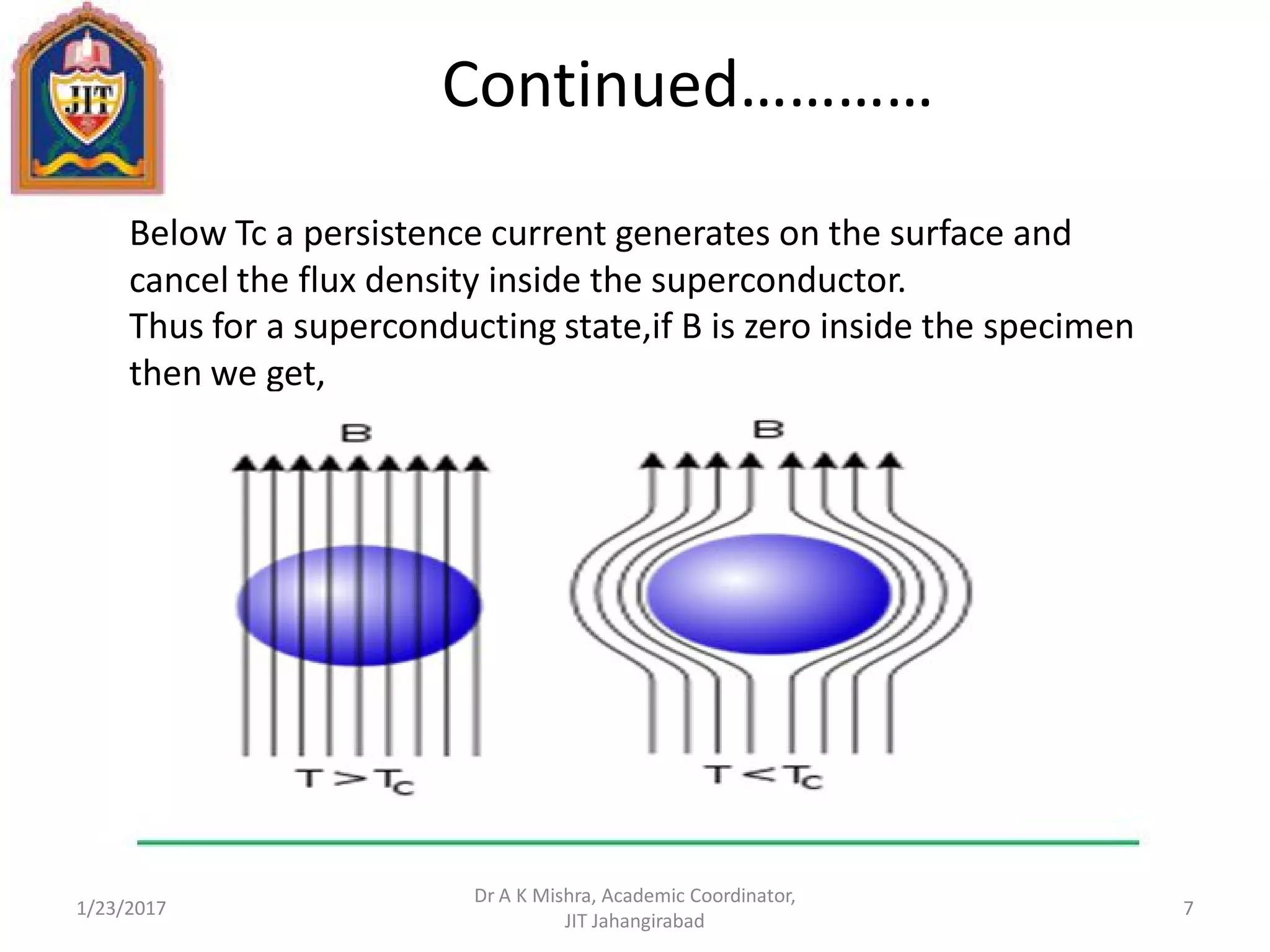
• When a material makes transition from normal to
superconducting state, it excludes magnetic field from its
interior.
• This phenomenon is called the meissner effect.
• Meissner and Ochsenfield (1953) concluded that when
superconductor is cooled in longitudinal magnetic field,then
above its transition temperature magnetic lines pass through
specimen but below transition temperature the magnetic flux
is pushed out of the specimen,this indicates that below Tc the
metal become perfectely diamagnetic.
• Thus phenomenon of exclusion of magnetic flux from the
interior of a superconductor below Tc is the Meissner effect.
1/23/2017
Dr A K Mishra, Academic Coordinator,
JIT Jahangirabad
6
Continued…………
1/23/2017
Dr A K Mishra, Academic Coordinator,
JIT Jahangirabad
7
Below Tc a persistence current generates on the surface and
cancel the flux density inside the superconductor.
Thus for a superconducting state,if B is zero inside the specimen
then we get,
Continued…………
1/23/2017
Dr A K Mishra, Academic Coordinator,
JIT Jahangirabad
8
tyconductiviisWhere
E=J
lawOhmsfromNow
c.diamagnetiperfectaisstatectingsuperconduhence
metal,cdiamagnetitheofconditiontheisThis
1-=
H
M
=lity,susceptibiMagnetic
H-=M
M)+(H=0
M)+(H=B
0
0





Continued…………
1/23/2017
Dr A K Mishra, Academic Coordinator,
JIT Jahangirabad
9
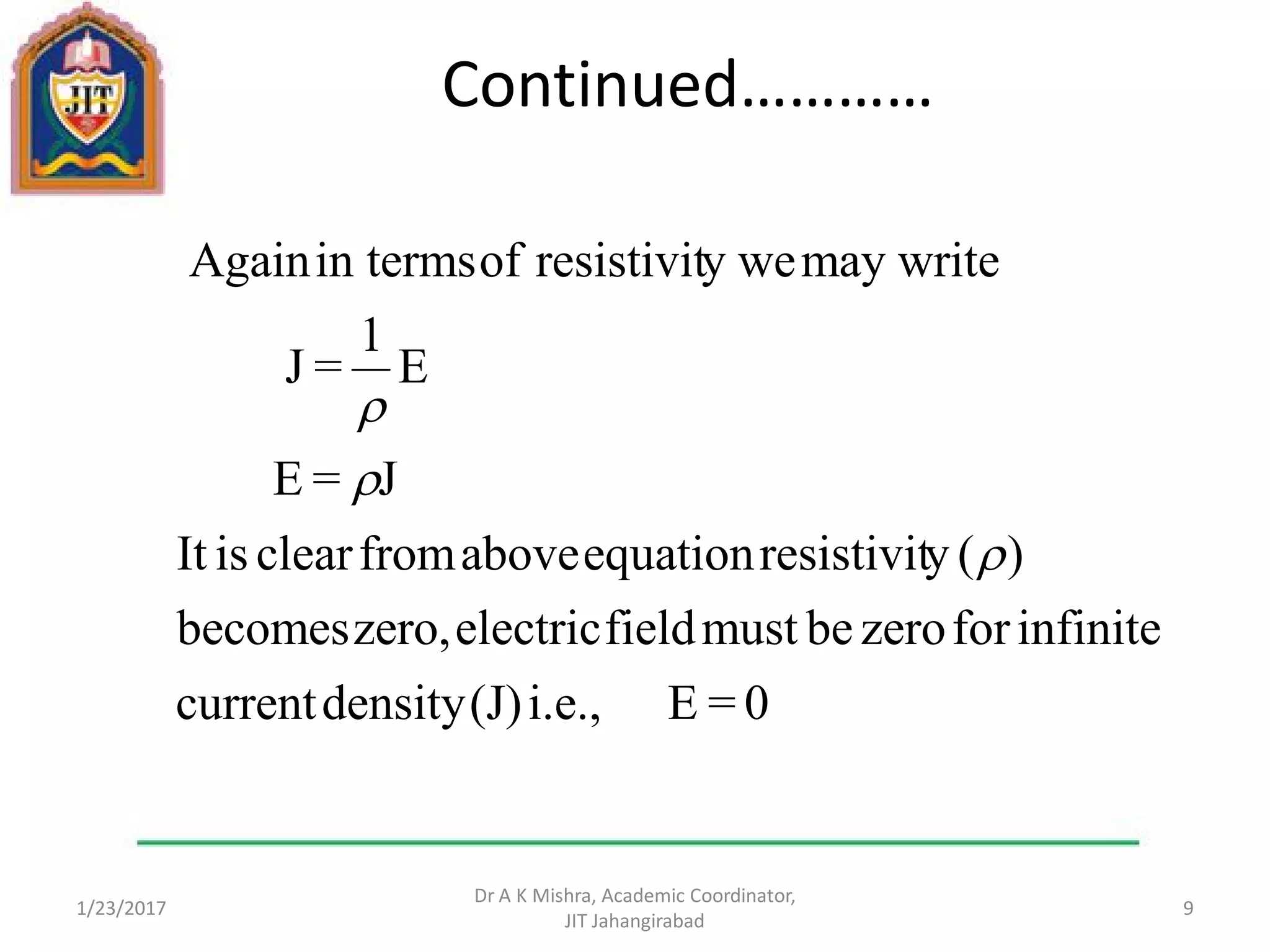
0=Ei.e.,(J)densitycurrent
infiniteforzerobemustfieldelectriczero,becomes
)(yresistivitequationabovefromclearisIt
J=E
E
1
=J
may writey weresistivitofin termsAgain



Continued…………
1/23/2017
Dr A K Mishra, Academic Coordinator,
JIT Jahangirabad
10
ctor.superconduaofproperties
essentialandtindependentwothearesmdiamagneti
perfectandyresistivittheHenceeffect.Meissnerthe
contradictthisTcoftindependenisctorsupercondu
theinsidefluxmagnetictheshowsThis
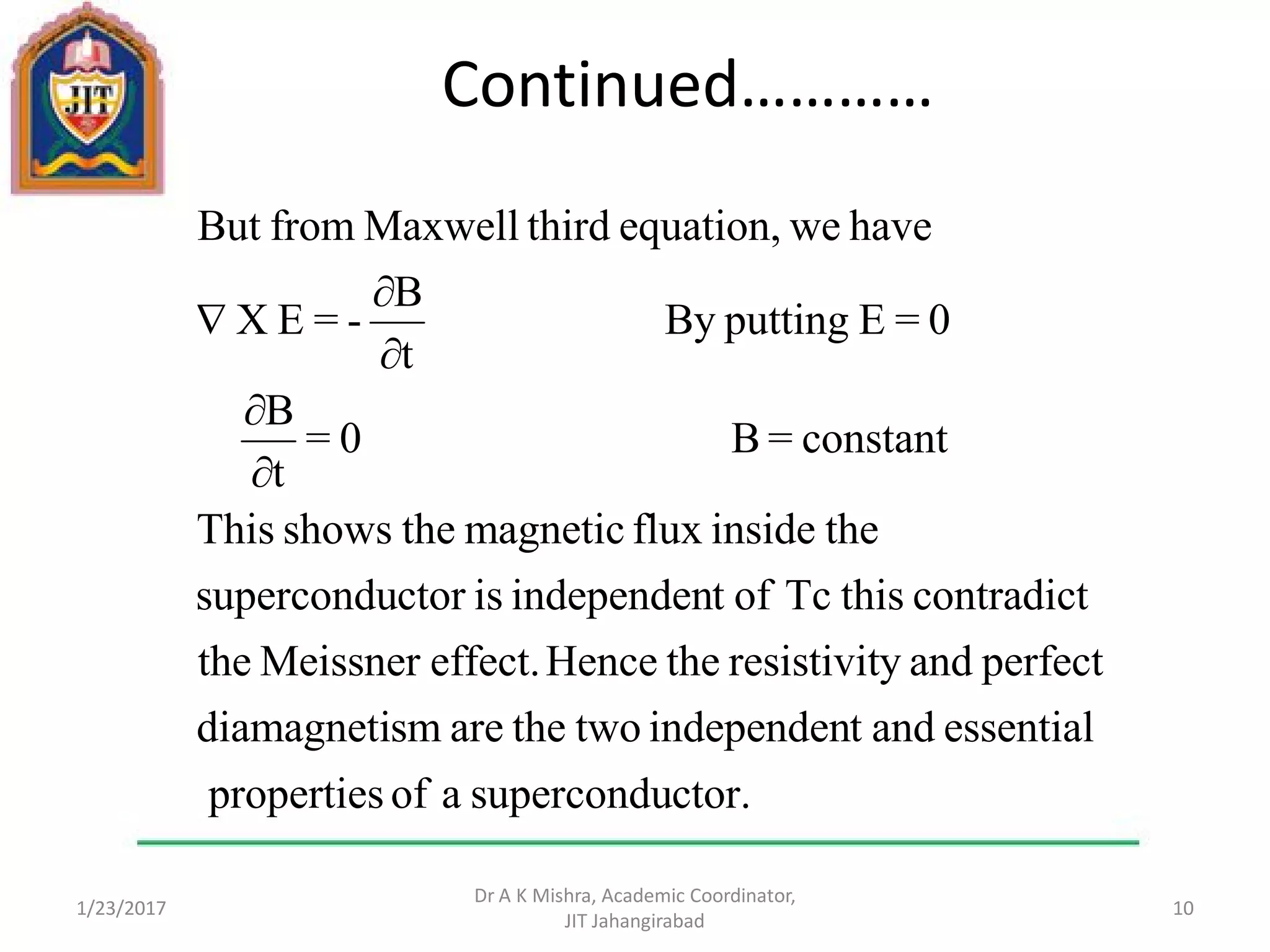
constant=B0=
t
B
0=EputtingBy
t
B
-=EX
haveweequation,thirdMaxwellfromBut





Persistent current
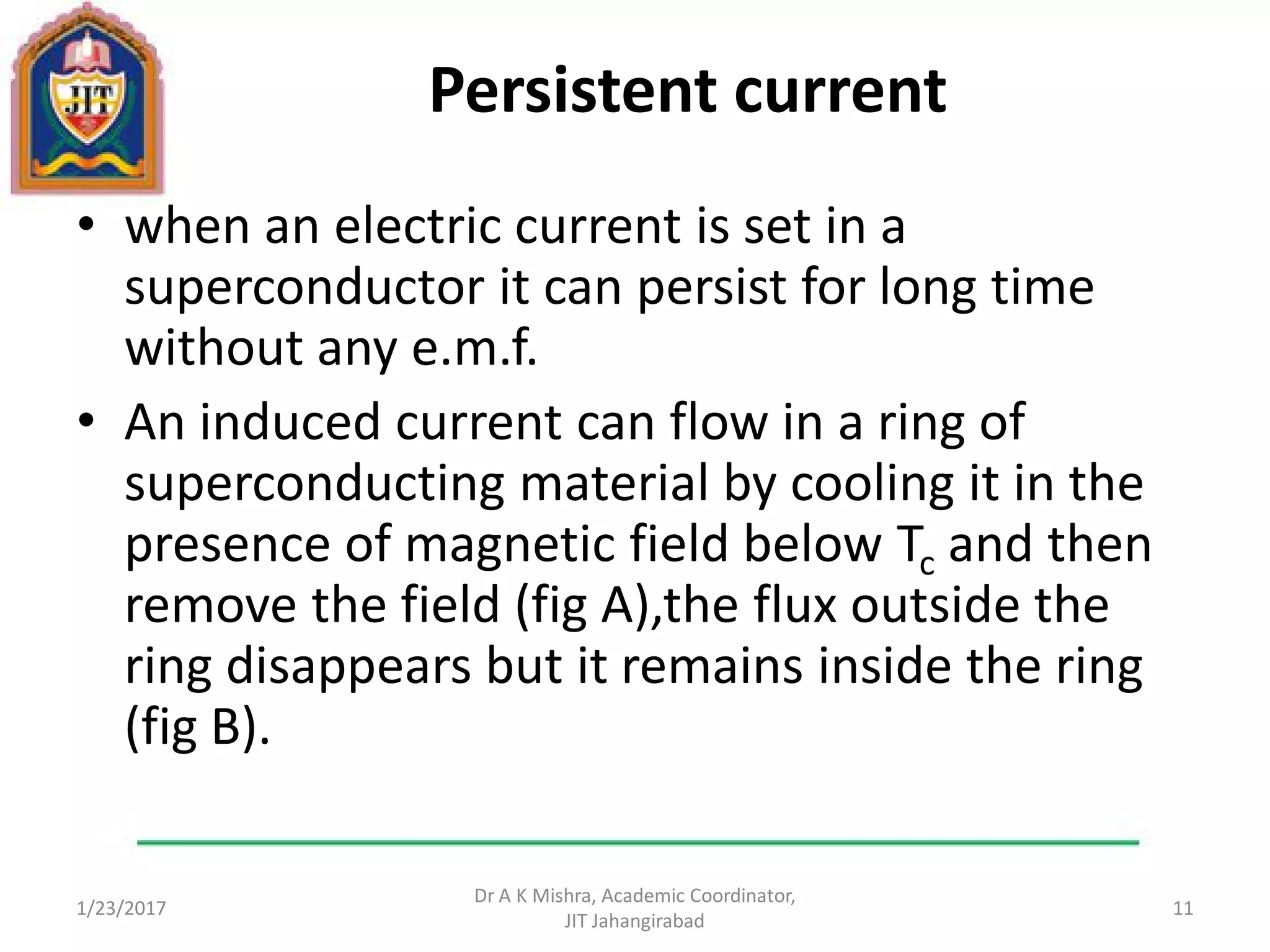
• when an electric current is set in a
superconductor it can persist for long time
without any e.m.f.
• An induced current can flow in a ring of
superconducting material by cooling it in the
presence of magnetic field below Tc and then
remove the field (fig A),the flux outside the
ring disappears but it remains inside the ring
(fig B).
1/23/2017
Dr A K Mishra, Academic Coordinator,
JIT Jahangirabad
11
TYPE OF SUPERCONDUCTORS
• Superconductors are divided in to two parts depending on the
mechanism from superconducting state to normal state due
to exceed of critical field.
TYPE I SUPERCONDUCTORS OR SOFT SUPERCONDUCTOR
• Type 1 superconductors - characterized as the "soft"
superconductors - were discovered first and require the
coldest temperatures to become superconductive.
• They exhibit a very sharp transition to a superconducting state
and "perfect" diamagnetism - the ability to repel a magnetic
field completely.
• Type 1 superconductors along with the critical transition
temperature (known as Tc) below which each superconducts.
1/23/2017
Dr A K Mishra, Academic Coordinator,
JIT Jahangirabad
12
Continued………..
• Surprisingly, copper, silver and gold, three of the best metallic
conductors, do not rank among the superconductive elements.
For type I superconductor
magnetic flux is expelled
producing magnetization
with increasing field until
is reached, at which it
falls to zero with a normal
conductor.
1/23/2017
Dr A K Mishra, Academic Coordinator,
JIT Jahangirabad
13
Applied Magnetic field (H)
Magnetization(M)
HC
IType
HC
Magnetization(M)
HC
IType
TYPE II SUPERCONDUCTORS OR Hard
SUPERCONDUCTOR
• Except for the elements vanadium, technetium and niobium,
the Type 2 category of superconductors is comprised of
metallic compounds and alloys.
• Type II have two critical
field ( & )
below behave as
type I and above
behave as normal
conductor.
1/23/2017
Dr A K Mishra, Academic Coordinator,
JIT Jahangirabad
14
Magnetization(M)
HC
IIType
HC1
HC2
HC1
HC2
HC1
HC2
Continued…………..
• This new category of superconductors was identified by L.V.
Shubnikov at the Kharkov Institute of Science and Technology
in the Ukraine in 1936(1) when he found two distinct critical
magnetic fields (known as Hc1 and Hc2) in PbTl2.
• The first of the oxide superconductors was created in 1973 by
DuPont researcher Art Sleight when Ba(Pb,Bi)O3 was found to
have a Tc of 13K.
• Type 2 superconductors - also known as the "hard"
superconductors - differ from Type 1 in that their transition
from a normal to a superconducting state is gradual across a
region of "mixed state" behavior. Since a Type 2 will allow
some penetration by an external magnetic field into its
surface.
1/23/2017
Dr A K Mishra, Academic Coordinator,
JIT Jahangirabad
15
London Penetration depth
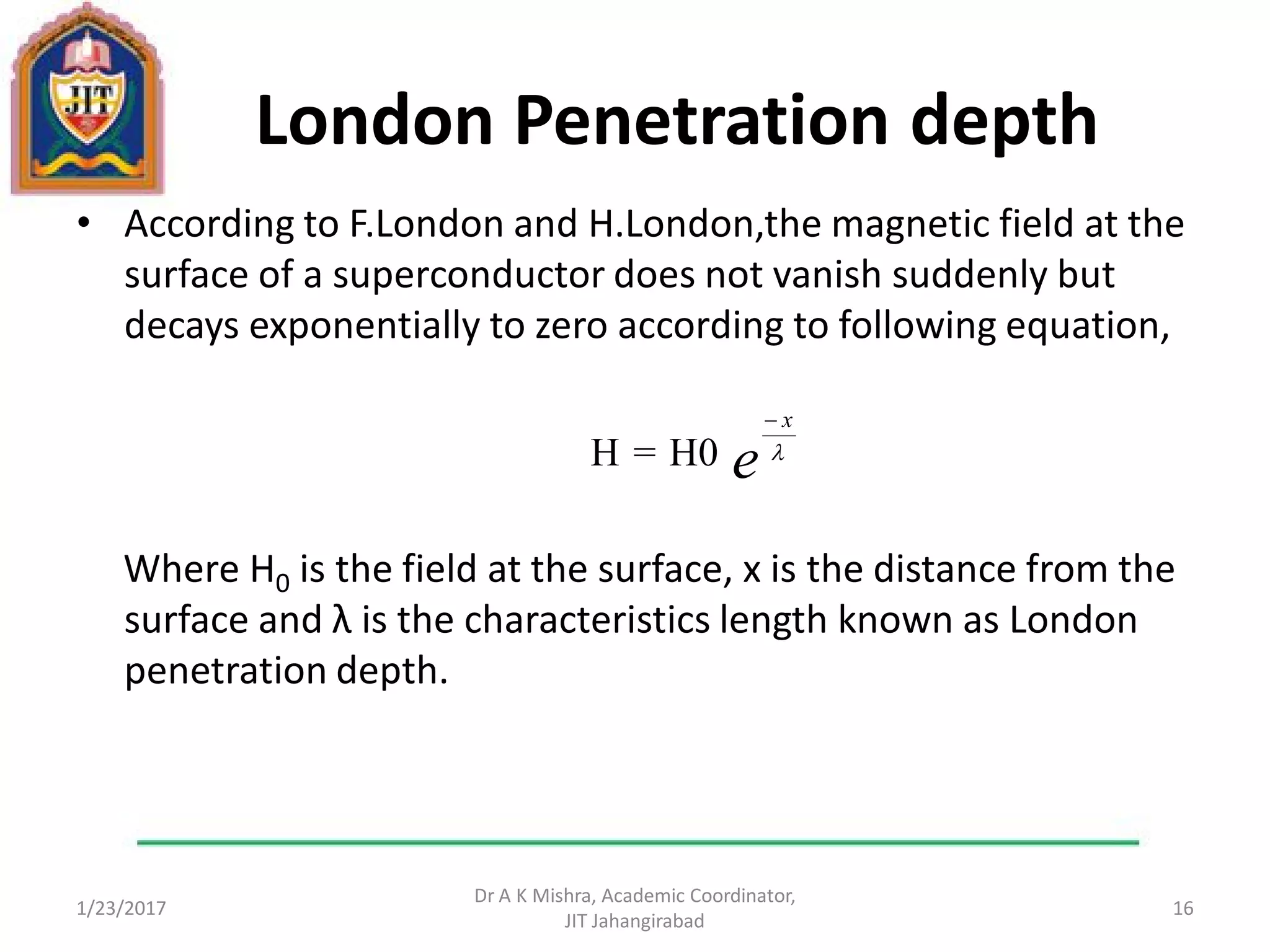
• According to F.London and H.London,the magnetic field at the
surface of a superconductor does not vanish suddenly but
decays exponentially to zero according to following equation,
Where H0 is the field at the surface, x is the distance from the
surface and λ is the characteristics length known as London
penetration depth.
1/23/2017
Dr A K Mishra, Academic Coordinator,
JIT Jahangirabad
16
e
x


H0=H
Continued………….
• The magnetic field at the surface of the superconductor
decays to at a distance in the interior of superconductor.
1/23/2017
Dr A K Mishra, Academic Coordinator,
JIT Jahangirabad
17
e
B 0
x
0x 
x
B0
B
eB
-x
0
(x)B 
BCS THEORY
• The first widely accepted quantum mechanical explanation of
superconductivity was presented by J.Barden, L N Copper and
John Schriffer (BCS) in 1957.
• This theory based on the electron-electron interaction via
phonon as a mediator.
• Under certain restricted conditions, the electron couple
together electron-lattice electron interactions.
• Therefore, the electron and phonon interaction is the basic
mechanism responsible for superconductivity.
1/23/2017
Dr A K Mishra, Academic Coordinator,
JIT Jahangirabad
18
Continued………….
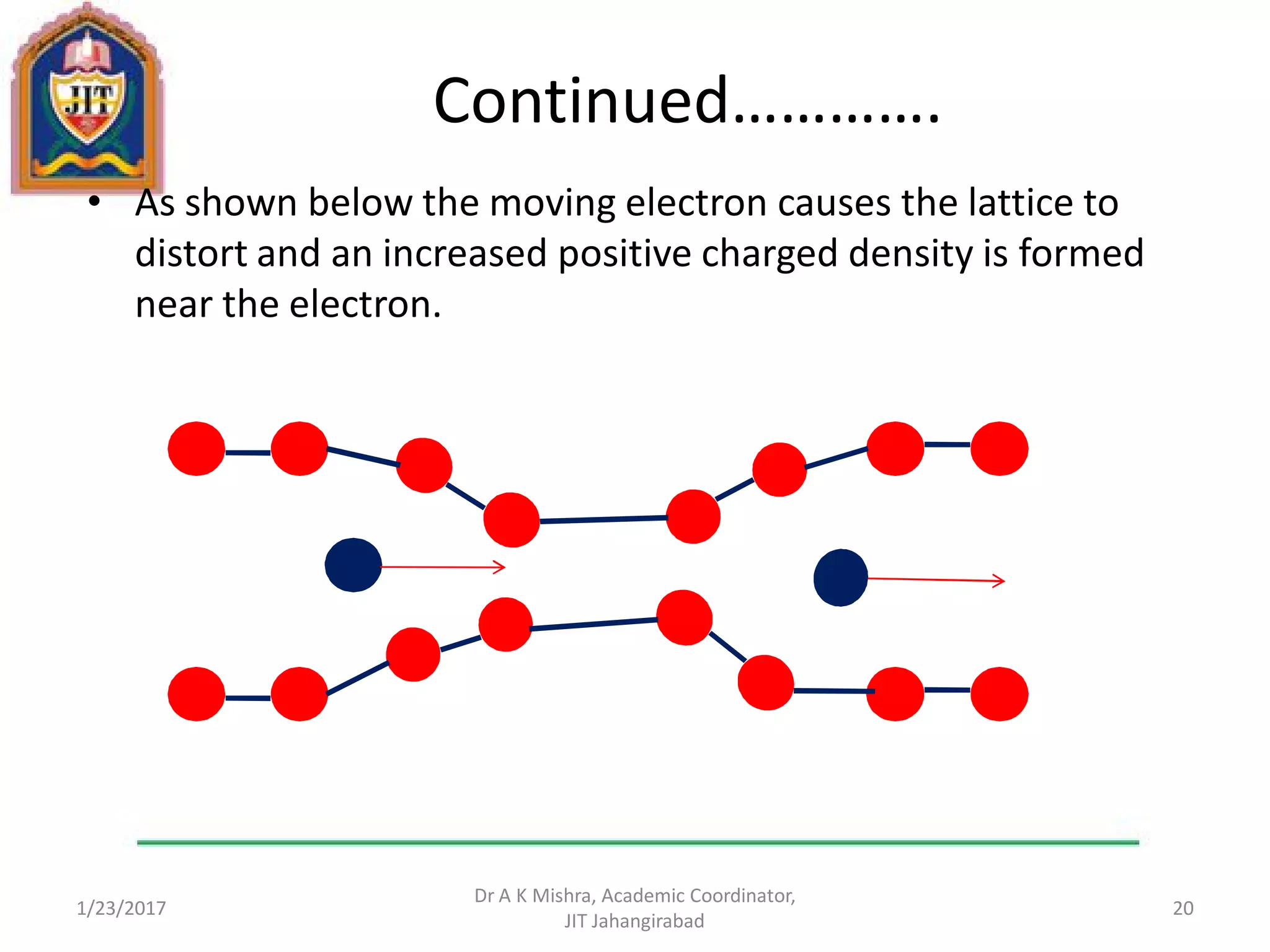
• Atoms in a crystal lattice are constantly vibrating. Because
they are all connected, these vibrating atoms create waves
throughout the metal.
• These waves are called phonons.
• The more the atoms are vibrating (ie. the hotter the material),
the larger the phonons.
• In superconductors (at low temperatures) the phonons are
small, and any distortion caused by the electrons is reflected
in phonons.
• These phonons can attract electrons to form cooper pairs.
1/23/2017
Dr A K Mishra, Academic Coordinator,
JIT Jahangirabad
19
Continued………….
• As shown below the moving electron causes the lattice to
distort and an increased positive charged density is formed
near the electron.
1/23/2017
Dr A K Mishra, Academic Coordinator,
JIT Jahangirabad
20
Continued………….
• To counter-act this a second electron is attracted towards the
electron (even though the two electrons repel).
• This pair of electrons are called a Cooper pair, which move
easily through the material.
• This is because their strong negative charge will repel any
positive atoms that it gets close to, thus no collisions occur
and electron flow is not resisted.
1/23/2017
Dr A K Mishra, Academic Coordinator,
JIT Jahangirabad
21
Applications of Superconductivity
• The early superconductors were chunks of metal. A breakthrough came in
the 1960s with the development of a superconducting wire, an alloy of
niobium and titanium. With this wire, engineers could wind electromagnet
coils. These superconducting coils permit the construction of extremely
powerful electromagnets. As with many engineering advances, there are
tradeoffs:
Cost Saving: Since the magnet is operated with the wire at
superconducting temperatures, the resistance of the coils is zero and no
energy is lost to heating the coils. For superconducting magnets, a small
power supply is sufficient to initiate the flow of current.
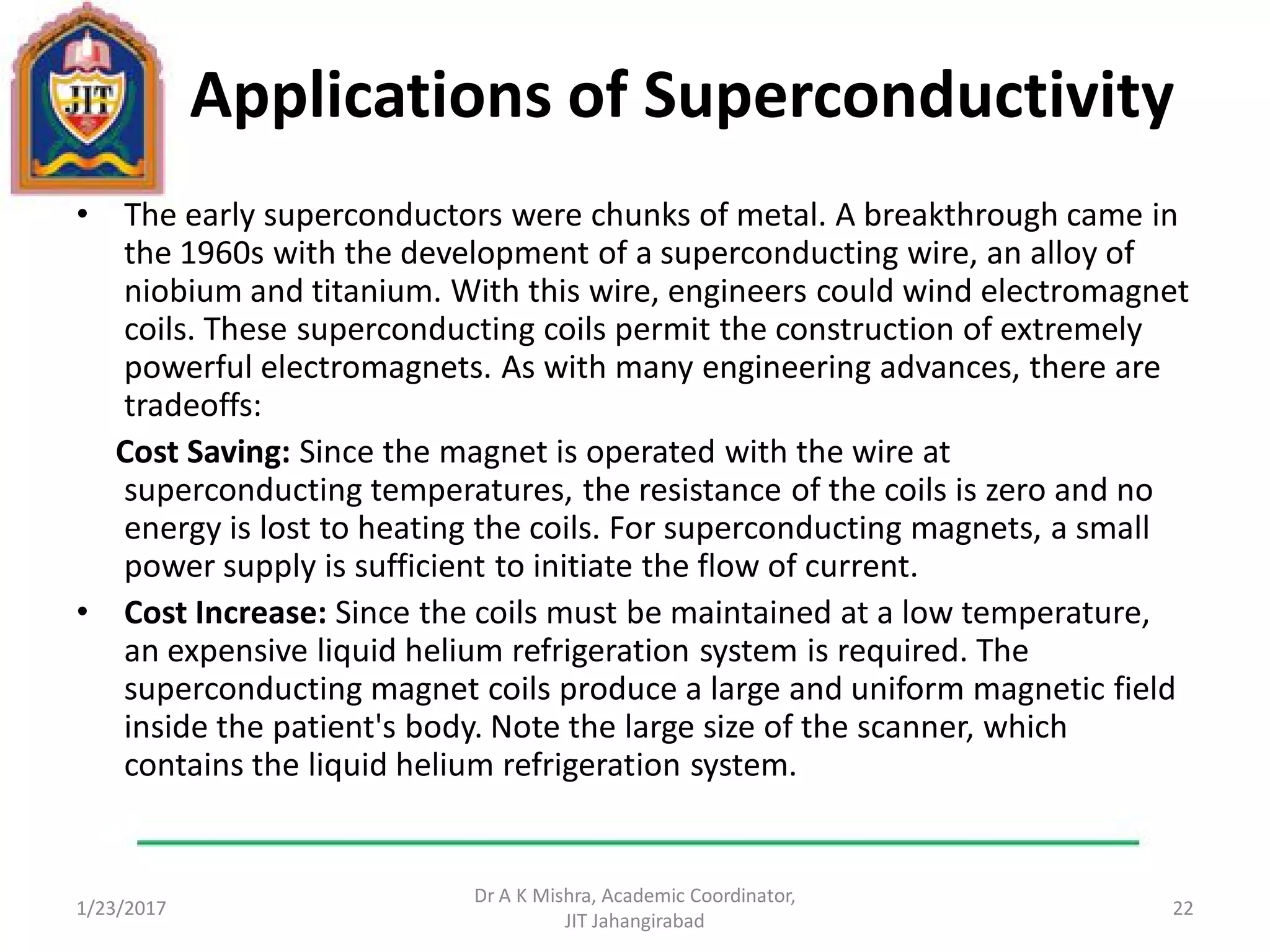
• Cost Increase: Since the coils must be maintained at a low temperature,
an expensive liquid helium refrigeration system is required. The
superconducting magnet coils produce a large and uniform magnetic field
inside the patient's body. Note the large size of the scanner, which
contains the liquid helium refrigeration system.
1/23/2017
Dr A K Mishra, Academic Coordinator,
JIT Jahangirabad
22
• Maglev Train
• To minimize friction, powerful onboard superconducting magnets
support this train above the tracks.
• The train reached a speed of 411 km/hr (256 mi/hr). Running
alongside the track are walls (see photo) with a continuous series of
vertical coils of wire mounted inside.
• The wire in these coils is not a superconductor. As the train passes
each coil, the motion of the superconducting magnet on the train
induces a current in these coils, making them electromagnets.
• The electromagnets on the train and outside produce forces that
levitate the train and keep it centered above the track.
• In addition, a wave of electric current sweeps down these outside
coils and propels the train forward .
1/23/2017
Dr A K Mishra, Academic Coordinator,
JIT Jahangirabad
23
NANOTECHNOLOGY
• Nanotechnology is the engineering of functional systems at
the molecular scale. 'nanotechnology' refers to the projected
ability to construct items from the bottom up, using techniques
and tools being developed today to make complete, high
performance products.
• Nanomaterials can be fabricated in two ways, top down and
bottom up. In top down nonmaterial's are constructed by
removing existing materials from larger entities. This is used in
manufacturing microprocessors. In bottom up, materials are
built up atom by atom or molecule by molecule. This approach
is more time consuming therefore self assembly process is
usually employed so that atoms spontaneously arrange
themselves into final product.
1/23/2017
Dr A K Mishra, Academic Coordinator,
JIT Jahangirabad
24
Properties of nanomaterial's
• Nanomaterials have the following properties:
• They are very hard.
• They are ductile at high temperatures.
• They are chemically very active.
• They are exponentially strong.
• Category of nanomaterials:
• Fullerences
• Nanoparticles
• Fullerences:The third form of carbon was discovered in 1985.it is cluster of
60 carbon atoms like a football.
• Buckministerfullerence the name was given by the architect R.
Buckministerfuller.
1/23/2017
Dr A K Mishra, Academic Coordinator,
JIT Jahangirabad
25
Continued……….
• it has carbon atoms at 60 chemically equivalent vertices,
which are connected by 32 faces,12 of which are pentagons
and 20 hexagons.
• These are allotrops of carbon which are basically grapheme
sheets rolled into tubes or spheres,Graphene is a one atom
thick layer of graphite.
• Buckminister C60 is also known as buckyboll,is the smallest
member of the fullerence family. Carbonnanotube (CNT) are
also member of this family.
1/23/2017
Dr A K Mishra, Academic Coordinator,
JIT Jahangirabad
26
Continued……….
• Fullerene are produced by sending large current between two
nearby graphite electrodes.
Referred from Google image
1/23/2017
Dr A K Mishra, Academic Coordinator,
JIT Jahangirabad
27
Continued……….
• this results into carbon plasma arc between
electrodes, which gives fullerence on cooling.
• Buckminsterfullerene C60, also known as the
buckyball, is a representative member of the carbon
structures known as fullerenes.
• Members of the fullerene family are a major subject
of research falling under the nanotechnology
umbrella.
1/23/2017
Dr A K Mishra, Academic Coordinator,
JIT Jahangirabad
28
Production of Buckyballs
• Buckyballs can be produced by vaporizing carbon
placed between two carbon electrodes.
• when electric arc is produced between electrodes
placed in the vicinity of each other in a low pressure
reaction chamber,buckyballs generated along the
carbon.
• They can be separated with the help of solvent like
benzene.
1/23/2017
Dr A K Mishra, Academic Coordinator,
JIT Jahangirabad
29
Properties of Buckyballs
• Buckyballs can be used in many applications
because of their unusual hollow structure.
• Buckyballs are extremely stable, and can bear
very high temperature and pressure.
• Even after reaction with other atoms and
molecules, their stable spherical structure
remains intact.
• Addition of other molecules at the outside and
trapping of smaller molecules inside a buckyball
creates new molecule.
1/23/2017
Dr A K Mishra, Academic Coordinator,
JIT Jahangirabad
30
Uses of Buckyballs
• Buckyballs becomes a superconductor when dopped with a
little amount of potassium or cesium.this is the best
superconductor known to us.
• Buckyballs can better storage of hydrogen because when
the C60 molecules absorb one molecule of hydrogen, its
structure does not disrupt.
• Bucky balls can deliver drugs directly to the infected region
of the body, they also have the ability to act as
antioxidants, thereby counteracting free radicals in the
human body.
• Anti- ageing and anti-wrinkle creams are being
manufactured by using buck balls.
• Bucky balls are also used as cutting tools.
1/23/2017
Dr A K Mishra, Academic Coordinator,
JIT Jahangirabad
31
Carbon Nano tubes (CNTs)
• Carbon nanotubes were first discovered by Somio
Iijima in 1991. cnt belongs to the family of
graphite.
• the structure of graphite is one-atom thick planar
network of interconnected hexagonal ring of
carbon atoms.
• these sheets of carbon are staked on the top of
one another such that they are able to slide over
each other. This is responsible for the softness of
graphite; hence graphite can be used as a
lubricant.
1/23/2017
Dr A K Mishra, Academic Coordinator,
JIT Jahangirabad
32
Continued……………..
• When graphite sheets are rolled into cylinder and their edges
are joined they form carbon nanotubes.
What is a Carbon Nanotube:
A Carbon Nanotube is a tube-shaped material, made of
carbon, having a diameter measuring on the nanometer scale.
A nanometer is one-billionth of a meter, or about one ten-
thousandth of the thickness of a human hair. The graphite
layer appears somewhat like a rolled-up chicken wire with a
continuous unbroken hexagonal mesh and carbon molecules
at the apexes of the hexagons.
1/23/2017
Dr A K Mishra, Academic Coordinator,
JIT Jahangirabad
33
Continued……………..
• Carbon Nanotubes have many structures, differing in
length, thickness, and in the type of helicity and number
of layers. Although they are formed from essentially the
same graphite sheet, their electrical characteristics differ
depending on these variations, acting either as metals or
as semiconductors.
• As a group, Carbon Nanotubes typically have diameters
ranging from <1 nm up to 50 nm. Their lengths are
typically several microns, but recent advancements have
made the nanotubes much longer, and measured in
centimeters.
1/23/2017
Dr A K Mishra, Academic Coordinator,
JIT Jahangirabad
34
Continued……………
• Carbon Nanotubes can be categorized by their
structures.
• Single-wall Nanotubes (SWNT)
• Multi-wall Nanotubes (MWNT)
• Double-wall Nanotubes (DWNT)
• What are the Properties of a Carbon
Nanotube?
1/23/2017
Dr A K Mishra, Academic Coordinator,
JIT Jahangirabad
35
Continued………….
• The intrinsic mechanical and transport properties of Carbon
Nanotubes make them the ultimate carbon fibers. Overall,
Carbon Nanotubes show a unique combination of stiffness,
strength, and tenacity compared to other fiber materials
which usually lack one or more of these properties. Thermal
and electrical conductivity are also very high, and comparable
to other conductive materials.
• What are the Potential Applications for Carbon Nanotubes?
Carbon Nanotube Technology can be used for a wide range of
new and existing applications:
1/23/2017
Dr A K Mishra, Academic Coordinator,
JIT Jahangirabad
36
Continued………….
• Conductive plastics
• Structural composite materials
• Flat-panel displays
• Gas storage
• Antifouling paint
• Micro- and nano-electronics
• Radar-absorbing coating
• Technical textiles
• Ultra-capacitors
• Atomic Force Microscope (AFM) tips
• Batteries with improved lifetime
• Biosensors for harmful gases
• Extra strong fibers
1/23/2017
Dr A K Mishra, Academic Coordinator,
JIT Jahangirabad
37
Continued………….
• Nanocyl uses the "Catalytic Carbon Vapor
Deposition" method for producing Carbon
Nanotube Technologies. This proven industrial
process is well known for its reliability and
scalability. It involves growing nanotubes on
substrates, thus enabling uniform, large-scale
production of the highest-quality carbon
nanotubes worldwide.
1/23/2017
Dr A K Mishra, Academic Coordinator,
JIT Jahangirabad
38

Superconductors and NANOTECHNOLOGY

  • 1.
    1/23/2017 1 Dr AK Mishra, Academic Coordinator, JIT Jahangirabad Engineering Physics II Unit V Presentation By Dr.A.K.Mishra Associate Professor Jahangirabad Institute of Technology, Barabanki Email: akmishra.phy@gmail.com Arun.Kumar@jit.edu.in
  • 2.
    Superconductors • In 1911superconductivity was first observed in mercury by Dutch physicist Heike Kamerlingh Onnes of Leiden University . • When he cooled it to the temperature of liquid helium, 4 degrees Kelvin (-452F, -269C), its resistance suddenly disappeared. • Later, in 1913, he won a Nobel Prize in physics for his research in this area. • Superconductors, materials that have no resistance to the flow of electricity, are one of the last great frontiers of scientific discovery • At the critical temprature the resistance falls to zero 1/23/2017 Dr A K Mishra, Academic Coordinator, JIT Jahangirabad 2
  • 3.
    Continued…………….. • These canbe used to make low loss power line and very good electromagnets. 1/23/2017 Dr A K Mishra, Academic Coordinator, JIT Jahangirabad 3 Temperature (K) Resistance TC O Temperature (K) Resistance 4.0 4.1 4.2 4.3 4.4 0.0 1.0 1.5
  • 4.
    Temperature dependence ofresistivity in superconducting materials • Superconductivity in the metal are depend on the intensity of the field and temperature. • to maintain the Superconductivity both the parameter should be less than their critical values. 1/23/2017 Dr A K Mishra, Academic Coordinator, JIT Jahangirabad 4 Normal Metal Superconductor Tc0 0
  • 5.
    Continued…………….. • The dependenceof the temperature on magnetic field can be represented by following equation, • Where Hc is the critical field strength, Hc(0) is the maximum field strength at absolute zero and Tc is the critical temperature. it is clear from the fig the temperature below Tc the materials remains in the superconducting state till a corresponding critical magnetic field is applied when the field is higher than the Hc the superconducting state is destroyed and the materials comes to its normal state. 1/23/2017 Dr A K Mishra, Academic Coordinator, JIT Jahangirabad 5 ] c -Hc(0)[1=Hc T T 2      
  • 6.
    Meissner Effect (Effectof magnetic field) • When a material makes transition from normal to superconducting state, it excludes magnetic field from its interior. • This phenomenon is called the meissner effect. • Meissner and Ochsenfield (1953) concluded that when superconductor is cooled in longitudinal magnetic field,then above its transition temperature magnetic lines pass through specimen but below transition temperature the magnetic flux is pushed out of the specimen,this indicates that below Tc the metal become perfectely diamagnetic. • Thus phenomenon of exclusion of magnetic flux from the interior of a superconductor below Tc is the Meissner effect. 1/23/2017 Dr A K Mishra, Academic Coordinator, JIT Jahangirabad 6
  • 7.
    Continued………… 1/23/2017 Dr A KMishra, Academic Coordinator, JIT Jahangirabad 7 Below Tc a persistence current generates on the surface and cancel the flux density inside the superconductor. Thus for a superconducting state,if B is zero inside the specimen then we get,
  • 8.
    Continued………… 1/23/2017 Dr A KMishra, Academic Coordinator, JIT Jahangirabad 8 tyconductiviisWhere E=J lawOhmsfromNow c.diamagnetiperfectaisstatectingsuperconduhence metal,cdiamagnetitheofconditiontheisThis 1-= H M =lity,susceptibiMagnetic H-=M M)+(H=0 M)+(H=B 0 0     
  • 9.
    Continued………… 1/23/2017 Dr A KMishra, Academic Coordinator, JIT Jahangirabad 9 0=Ei.e.,(J)densitycurrent infiniteforzerobemustfieldelectriczero,becomes )(yresistivitequationabovefromclearisIt J=E E 1 =J may writey weresistivitofin termsAgain   
  • 10.
    Continued………… 1/23/2017 Dr A KMishra, Academic Coordinator, JIT Jahangirabad 10 ctor.superconduaofproperties essentialandtindependentwothearesmdiamagneti perfectandyresistivittheHenceeffect.Meissnerthe contradictthisTcoftindependenisctorsupercondu theinsidefluxmagnetictheshowsThis constant=B0= t B 0=EputtingBy t B -=EX haveweequation,thirdMaxwellfromBut     
  • 11.
    Persistent current • whenan electric current is set in a superconductor it can persist for long time without any e.m.f. • An induced current can flow in a ring of superconducting material by cooling it in the presence of magnetic field below Tc and then remove the field (fig A),the flux outside the ring disappears but it remains inside the ring (fig B). 1/23/2017 Dr A K Mishra, Academic Coordinator, JIT Jahangirabad 11
  • 12.
    TYPE OF SUPERCONDUCTORS •Superconductors are divided in to two parts depending on the mechanism from superconducting state to normal state due to exceed of critical field. TYPE I SUPERCONDUCTORS OR SOFT SUPERCONDUCTOR • Type 1 superconductors - characterized as the "soft" superconductors - were discovered first and require the coldest temperatures to become superconductive. • They exhibit a very sharp transition to a superconducting state and "perfect" diamagnetism - the ability to repel a magnetic field completely. • Type 1 superconductors along with the critical transition temperature (known as Tc) below which each superconducts. 1/23/2017 Dr A K Mishra, Academic Coordinator, JIT Jahangirabad 12
  • 13.
    Continued……….. • Surprisingly, copper,silver and gold, three of the best metallic conductors, do not rank among the superconductive elements. For type I superconductor magnetic flux is expelled producing magnetization with increasing field until is reached, at which it falls to zero with a normal conductor. 1/23/2017 Dr A K Mishra, Academic Coordinator, JIT Jahangirabad 13 Applied Magnetic field (H) Magnetization(M) HC IType HC Magnetization(M) HC IType
  • 14.
    TYPE II SUPERCONDUCTORSOR Hard SUPERCONDUCTOR • Except for the elements vanadium, technetium and niobium, the Type 2 category of superconductors is comprised of metallic compounds and alloys. • Type II have two critical field ( & ) below behave as type I and above behave as normal conductor. 1/23/2017 Dr A K Mishra, Academic Coordinator, JIT Jahangirabad 14 Magnetization(M) HC IIType HC1 HC2 HC1 HC2 HC1 HC2
  • 15.
    Continued………….. • This newcategory of superconductors was identified by L.V. Shubnikov at the Kharkov Institute of Science and Technology in the Ukraine in 1936(1) when he found two distinct critical magnetic fields (known as Hc1 and Hc2) in PbTl2. • The first of the oxide superconductors was created in 1973 by DuPont researcher Art Sleight when Ba(Pb,Bi)O3 was found to have a Tc of 13K. • Type 2 superconductors - also known as the "hard" superconductors - differ from Type 1 in that their transition from a normal to a superconducting state is gradual across a region of "mixed state" behavior. Since a Type 2 will allow some penetration by an external magnetic field into its surface. 1/23/2017 Dr A K Mishra, Academic Coordinator, JIT Jahangirabad 15
  • 16.
    London Penetration depth •According to F.London and H.London,the magnetic field at the surface of a superconductor does not vanish suddenly but decays exponentially to zero according to following equation, Where H0 is the field at the surface, x is the distance from the surface and λ is the characteristics length known as London penetration depth. 1/23/2017 Dr A K Mishra, Academic Coordinator, JIT Jahangirabad 16 e x   H0=H
  • 17.
    Continued…………. • The magneticfield at the surface of the superconductor decays to at a distance in the interior of superconductor. 1/23/2017 Dr A K Mishra, Academic Coordinator, JIT Jahangirabad 17 e B 0 x 0x  x B0 B eB -x 0 (x)B 
  • 18.
    BCS THEORY • Thefirst widely accepted quantum mechanical explanation of superconductivity was presented by J.Barden, L N Copper and John Schriffer (BCS) in 1957. • This theory based on the electron-electron interaction via phonon as a mediator. • Under certain restricted conditions, the electron couple together electron-lattice electron interactions. • Therefore, the electron and phonon interaction is the basic mechanism responsible for superconductivity. 1/23/2017 Dr A K Mishra, Academic Coordinator, JIT Jahangirabad 18
  • 19.
    Continued…………. • Atoms ina crystal lattice are constantly vibrating. Because they are all connected, these vibrating atoms create waves throughout the metal. • These waves are called phonons. • The more the atoms are vibrating (ie. the hotter the material), the larger the phonons. • In superconductors (at low temperatures) the phonons are small, and any distortion caused by the electrons is reflected in phonons. • These phonons can attract electrons to form cooper pairs. 1/23/2017 Dr A K Mishra, Academic Coordinator, JIT Jahangirabad 19
  • 20.
    Continued…………. • As shownbelow the moving electron causes the lattice to distort and an increased positive charged density is formed near the electron. 1/23/2017 Dr A K Mishra, Academic Coordinator, JIT Jahangirabad 20
  • 21.
    Continued…………. • To counter-actthis a second electron is attracted towards the electron (even though the two electrons repel). • This pair of electrons are called a Cooper pair, which move easily through the material. • This is because their strong negative charge will repel any positive atoms that it gets close to, thus no collisions occur and electron flow is not resisted. 1/23/2017 Dr A K Mishra, Academic Coordinator, JIT Jahangirabad 21
  • 22.
    Applications of Superconductivity •The early superconductors were chunks of metal. A breakthrough came in the 1960s with the development of a superconducting wire, an alloy of niobium and titanium. With this wire, engineers could wind electromagnet coils. These superconducting coils permit the construction of extremely powerful electromagnets. As with many engineering advances, there are tradeoffs: Cost Saving: Since the magnet is operated with the wire at superconducting temperatures, the resistance of the coils is zero and no energy is lost to heating the coils. For superconducting magnets, a small power supply is sufficient to initiate the flow of current. • Cost Increase: Since the coils must be maintained at a low temperature, an expensive liquid helium refrigeration system is required. The superconducting magnet coils produce a large and uniform magnetic field inside the patient's body. Note the large size of the scanner, which contains the liquid helium refrigeration system. 1/23/2017 Dr A K Mishra, Academic Coordinator, JIT Jahangirabad 22
  • 23.
    • Maglev Train •To minimize friction, powerful onboard superconducting magnets support this train above the tracks. • The train reached a speed of 411 km/hr (256 mi/hr). Running alongside the track are walls (see photo) with a continuous series of vertical coils of wire mounted inside. • The wire in these coils is not a superconductor. As the train passes each coil, the motion of the superconducting magnet on the train induces a current in these coils, making them electromagnets. • The electromagnets on the train and outside produce forces that levitate the train and keep it centered above the track. • In addition, a wave of electric current sweeps down these outside coils and propels the train forward . 1/23/2017 Dr A K Mishra, Academic Coordinator, JIT Jahangirabad 23
  • 24.
    NANOTECHNOLOGY • Nanotechnology isthe engineering of functional systems at the molecular scale. 'nanotechnology' refers to the projected ability to construct items from the bottom up, using techniques and tools being developed today to make complete, high performance products. • Nanomaterials can be fabricated in two ways, top down and bottom up. In top down nonmaterial's are constructed by removing existing materials from larger entities. This is used in manufacturing microprocessors. In bottom up, materials are built up atom by atom or molecule by molecule. This approach is more time consuming therefore self assembly process is usually employed so that atoms spontaneously arrange themselves into final product. 1/23/2017 Dr A K Mishra, Academic Coordinator, JIT Jahangirabad 24
  • 25.
    Properties of nanomaterial's •Nanomaterials have the following properties: • They are very hard. • They are ductile at high temperatures. • They are chemically very active. • They are exponentially strong. • Category of nanomaterials: • Fullerences • Nanoparticles • Fullerences:The third form of carbon was discovered in 1985.it is cluster of 60 carbon atoms like a football. • Buckministerfullerence the name was given by the architect R. Buckministerfuller. 1/23/2017 Dr A K Mishra, Academic Coordinator, JIT Jahangirabad 25
  • 26.
    Continued………. • it hascarbon atoms at 60 chemically equivalent vertices, which are connected by 32 faces,12 of which are pentagons and 20 hexagons. • These are allotrops of carbon which are basically grapheme sheets rolled into tubes or spheres,Graphene is a one atom thick layer of graphite. • Buckminister C60 is also known as buckyboll,is the smallest member of the fullerence family. Carbonnanotube (CNT) are also member of this family. 1/23/2017 Dr A K Mishra, Academic Coordinator, JIT Jahangirabad 26
  • 27.
    Continued………. • Fullerene areproduced by sending large current between two nearby graphite electrodes. Referred from Google image 1/23/2017 Dr A K Mishra, Academic Coordinator, JIT Jahangirabad 27
  • 28.
    Continued………. • this resultsinto carbon plasma arc between electrodes, which gives fullerence on cooling. • Buckminsterfullerene C60, also known as the buckyball, is a representative member of the carbon structures known as fullerenes. • Members of the fullerene family are a major subject of research falling under the nanotechnology umbrella. 1/23/2017 Dr A K Mishra, Academic Coordinator, JIT Jahangirabad 28
  • 29.
    Production of Buckyballs •Buckyballs can be produced by vaporizing carbon placed between two carbon electrodes. • when electric arc is produced between electrodes placed in the vicinity of each other in a low pressure reaction chamber,buckyballs generated along the carbon. • They can be separated with the help of solvent like benzene. 1/23/2017 Dr A K Mishra, Academic Coordinator, JIT Jahangirabad 29
  • 30.
    Properties of Buckyballs •Buckyballs can be used in many applications because of their unusual hollow structure. • Buckyballs are extremely stable, and can bear very high temperature and pressure. • Even after reaction with other atoms and molecules, their stable spherical structure remains intact. • Addition of other molecules at the outside and trapping of smaller molecules inside a buckyball creates new molecule. 1/23/2017 Dr A K Mishra, Academic Coordinator, JIT Jahangirabad 30
  • 31.
    Uses of Buckyballs •Buckyballs becomes a superconductor when dopped with a little amount of potassium or cesium.this is the best superconductor known to us. • Buckyballs can better storage of hydrogen because when the C60 molecules absorb one molecule of hydrogen, its structure does not disrupt. • Bucky balls can deliver drugs directly to the infected region of the body, they also have the ability to act as antioxidants, thereby counteracting free radicals in the human body. • Anti- ageing and anti-wrinkle creams are being manufactured by using buck balls. • Bucky balls are also used as cutting tools. 1/23/2017 Dr A K Mishra, Academic Coordinator, JIT Jahangirabad 31
  • 32.
    Carbon Nano tubes(CNTs) • Carbon nanotubes were first discovered by Somio Iijima in 1991. cnt belongs to the family of graphite. • the structure of graphite is one-atom thick planar network of interconnected hexagonal ring of carbon atoms. • these sheets of carbon are staked on the top of one another such that they are able to slide over each other. This is responsible for the softness of graphite; hence graphite can be used as a lubricant. 1/23/2017 Dr A K Mishra, Academic Coordinator, JIT Jahangirabad 32
  • 33.
    Continued…………….. • When graphitesheets are rolled into cylinder and their edges are joined they form carbon nanotubes. What is a Carbon Nanotube: A Carbon Nanotube is a tube-shaped material, made of carbon, having a diameter measuring on the nanometer scale. A nanometer is one-billionth of a meter, or about one ten- thousandth of the thickness of a human hair. The graphite layer appears somewhat like a rolled-up chicken wire with a continuous unbroken hexagonal mesh and carbon molecules at the apexes of the hexagons. 1/23/2017 Dr A K Mishra, Academic Coordinator, JIT Jahangirabad 33
  • 34.
    Continued…………….. • Carbon Nanotubeshave many structures, differing in length, thickness, and in the type of helicity and number of layers. Although they are formed from essentially the same graphite sheet, their electrical characteristics differ depending on these variations, acting either as metals or as semiconductors. • As a group, Carbon Nanotubes typically have diameters ranging from <1 nm up to 50 nm. Their lengths are typically several microns, but recent advancements have made the nanotubes much longer, and measured in centimeters. 1/23/2017 Dr A K Mishra, Academic Coordinator, JIT Jahangirabad 34
  • 35.
    Continued…………… • Carbon Nanotubescan be categorized by their structures. • Single-wall Nanotubes (SWNT) • Multi-wall Nanotubes (MWNT) • Double-wall Nanotubes (DWNT) • What are the Properties of a Carbon Nanotube? 1/23/2017 Dr A K Mishra, Academic Coordinator, JIT Jahangirabad 35
  • 36.
    Continued…………. • The intrinsicmechanical and transport properties of Carbon Nanotubes make them the ultimate carbon fibers. Overall, Carbon Nanotubes show a unique combination of stiffness, strength, and tenacity compared to other fiber materials which usually lack one or more of these properties. Thermal and electrical conductivity are also very high, and comparable to other conductive materials. • What are the Potential Applications for Carbon Nanotubes? Carbon Nanotube Technology can be used for a wide range of new and existing applications: 1/23/2017 Dr A K Mishra, Academic Coordinator, JIT Jahangirabad 36
  • 37.
    Continued…………. • Conductive plastics •Structural composite materials • Flat-panel displays • Gas storage • Antifouling paint • Micro- and nano-electronics • Radar-absorbing coating • Technical textiles • Ultra-capacitors • Atomic Force Microscope (AFM) tips • Batteries with improved lifetime • Biosensors for harmful gases • Extra strong fibers 1/23/2017 Dr A K Mishra, Academic Coordinator, JIT Jahangirabad 37
  • 38.
    Continued…………. • Nanocyl usesthe "Catalytic Carbon Vapor Deposition" method for producing Carbon Nanotube Technologies. This proven industrial process is well known for its reliability and scalability. It involves growing nanotubes on substrates, thus enabling uniform, large-scale production of the highest-quality carbon nanotubes worldwide. 1/23/2017 Dr A K Mishra, Academic Coordinator, JIT Jahangirabad 38