MAGNETOMETER
PRESENTED
BY
Ijaz Ul Haq
M Bilal younis
Moazam Ali
1
MAGNETOMETER
 Definition
Magnetometer are measurement instruments
used for two general purposes: to measure
the magnetization of a magnetic material like
a ferromagnet, or to measure the strength
and, in some cases, the direction of
the magnetic field at a point in space.
2
OUTLINE
 Magnetometer data: what are we
measuring?
 Ground magnetic signatures of
 Earth’s magnetic field
 Ring currents
 Auroral currents
3
MAGNETIC FIELD
MEASUREMENT
 magnetic field sensors can be divided into
two components
I. vector component
II. Scalar magnitude types.
4
MAGNETIC FIELD FUNDAMENTALS
 The vector types can be further divided into
sensors that are used to measure low fields
(<1 mT) and high fields (>1 mT).
5
 Instruments that measure low fields are
commonly called magnetometers
 High-field instruments are usually called
gaussmeters.
 Magnetic field sensors are divided into two
categories based on their field strengths and
measurement
 Range: magnetometers measure low fields
and gaussmeters measure high fields.
6
MAGNETIC FIELD SENSOR
7
MAGNETIC FIELD FUNDAMENTALS
 An understanding of the nature of magnetic
fields is necessary in order to understand
the
techniques used for measuring magnetic
field
strength. The most familiar source of a
magnetic field is the bar magnet.
8
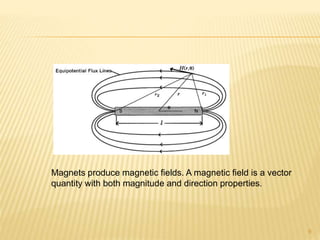
Magnets produce magnetic fields. A magnetic field is a vector
quantity with both magnitude and direction properties.
9
 The field it produces is shown in Figure.
Magnetic field is a vector quantity; that is, it
has both a magnitude and a direction.
The field of a bar magnet or any other
magnetized object, when measured at a
distance much greater than its longest
dimension, is described by Equation
H = 3 ( m × ar ) ar – m / r³
10
Magnetic fields are also produced by electric
currents
11
MAGNETOMETER
 Definition
Magnetometer are measurement instruments
used for two general purposes: to measure
the magnetization of a magnetic material like
a ferromagnet, or to measure the strength
and, in some cases, the direction of
the magnetic field at a point in space.
12
OBJECTIVES
 Magnetometers are widely used for
measuring the Earth's magnetic field and
in geophysical surveys to detect magnetic
anomalies of various types
 They are also used militarily to detect
submarines
13
TYPES OF MAGNETOMETER
 There are two basic types of magnetometer
measurement
1. Vector magnetometers
2. scalar magnetometers
14
1. VECTOR MAGNETOMETERS
 Vector magnetometers measure the vector
components of a magnetic field
 measure the component of the magnetic field
in a particular direction, relative to the spatial
orientation of the device.
15
VECTOR MAGNETOMETERS
 Low-Field Vector Magnetometers
 The Induction Coil Magnetometer
 The Fluxgate Magnetomete
 The SQUID Magnetometer
16
THE INDUCTION COIL MAGNETOMETER
 The induction or search coil, which is one of
the simplest magnetic field sensing devices,
is
based on Faraday’s law.
17
 This law states that if a loop of wire is
subjected to a changing magnetic flux, f,
through the area enclosed by the loop, then
a
voltage will be induced in the loop that is
proportional to the rate of change of the flux:
e (t )= - dɸ / dt
18
Induction or search coil sensors consist of a loop of wire (or a
solenoid), which may or may not surround a ferromagnetic core. (a)
Air core loop antenna; (b) solenoid induction coil antenna with
ferromagnetic core
19
THE FLUXGATE MAGNETOMETER
 The fluxgate magnetometer has been and is
the workhorse of magnetic field strength
instruments both on Earth and in space. It is
rugged, reliable, physically small, and
requires
very little power to operate.
20
(a) and ring core
(b) fluxgate sensors, the excitation field is at right angles to the
signal winding axis. This configuration minimizes coupling
between the excitation field and the signal winding
21
THE FLUXGATE
 The heart of the magnetometer is the
fluxgate. It is the transducer that converts a
magnetic field into an electric voltage
22
2. SCALAR MAGNETOMETERS
 Total field magnetometers or scalar
magnetometers measure the magnitude of
the vector magnetic field
 measures the total strength of the magnetic
field they are subject to
23
SCALAR MAGNETOMETERS
The two most widely used scalar
magnetometers are the
1. proton precession
2. optically pumped magnetometer
24
PROTON PRECESSION
 They have a limited magnetic field magnitude
measurement range: typically 20 mT to 100
mT. And they have limitations with respect to
the orientation of the magnetic field vector
relative to the sensor element
25
OUTLINE
 Magnetometer data: what are we
measuring?
 Ground magnetic signatures of
 Earth’s magnetic field
 Ring currents
 Auroral currents
26
EARTH’S MAGNETIC FIELDS
 The Earth's magnetic field is both expansive
and complicated. It is generated by electric
currents that are deep within the Earth and
high above the surface. All of these currents
contribute to the total geomagnetic field
27
CONTINUE
 In some ways, one can consider the Earth's
magnetic field, measured at a particular
instance and at a particular location, to be
the superposition of symptoms of a myriad of
physical processes occurring everywhere
else in the world.
 Magnetic fields are vectors: they have a
strength (magnitude) and a direction just like
velocity
28
MAGNETIC FIELD STRENGTH
 The strength of a magnetic field is the
magnetic flux density, B.
 The units of magnetic flux density is the Tesla
or the Gauss
29
 1 Tesla (T) = 104 Gauss (G)
 The most powerful magnets in the world are
superconducting electromagnets. These
magnets have magnetic fields of around 20
T.
30
CONTIUE
• Earth’s magnetic field is
 0.000 052T = 52,000 nanotesla (nT) = 0.5 gauss
(G)
• 1 nanotesla = 10-9 T
• Changes in Earth’s magnetic field are
typically 5-100 nT
31
TESLA
 The applied magnetic field will be one tesla
when one coulumb charge enters in it
perpendicularly with velocity 1 m/s and
experience 1N magnetic force.
 Also Wb/m2 is the unit of magnetic field.
32
HOW MAGNETOMETERS WORK
 Magnetometer measures the magnetic field it
is applied to. The magnetometer outputs
three magnitudes: X, Y and Z. From these
three values you can construct the magnetic
field vector (magnitude and direction)
B= [X, Y, Z]
33
COORDINATE SYSTEMS
 Because magnetic fields have a direction, in
order to communicate about magnetic fields,
we need to define a coordinate system.
 Three main coordinate systems are used for
magnetometer data:
– Geographic (XYZ)
– Geomagnetic (XYZ or HDZ - BEWARE!!)
– Compass-type (HDZ)
34
SOME IMAGES OF EARTH MAGNETIC FIELD
35
36
37
38

Persentation on magnetometer

  • 1.
    MAGNETOMETER PRESENTED BY Ijaz Ul Haq MBilal younis Moazam Ali 1
  • 2.
    MAGNETOMETER  Definition Magnetometer aremeasurement instruments used for two general purposes: to measure the magnetization of a magnetic material like a ferromagnet, or to measure the strength and, in some cases, the direction of the magnetic field at a point in space. 2
  • 3.
    OUTLINE  Magnetometer data:what are we measuring?  Ground magnetic signatures of  Earth’s magnetic field  Ring currents  Auroral currents 3
  • 4.
    MAGNETIC FIELD MEASUREMENT  magneticfield sensors can be divided into two components I. vector component II. Scalar magnitude types. 4
  • 5.
    MAGNETIC FIELD FUNDAMENTALS The vector types can be further divided into sensors that are used to measure low fields (<1 mT) and high fields (>1 mT). 5
  • 6.
     Instruments thatmeasure low fields are commonly called magnetometers  High-field instruments are usually called gaussmeters.  Magnetic field sensors are divided into two categories based on their field strengths and measurement  Range: magnetometers measure low fields and gaussmeters measure high fields. 6
  • 7.
  • 8.
    MAGNETIC FIELD FUNDAMENTALS An understanding of the nature of magnetic fields is necessary in order to understand the techniques used for measuring magnetic field strength. The most familiar source of a magnetic field is the bar magnet. 8
  • 9.
    Magnets produce magneticfields. A magnetic field is a vector quantity with both magnitude and direction properties. 9
  • 10.
     The fieldit produces is shown in Figure. Magnetic field is a vector quantity; that is, it has both a magnitude and a direction. The field of a bar magnet or any other magnetized object, when measured at a distance much greater than its longest dimension, is described by Equation H = 3 ( m × ar ) ar – m / r³ 10
  • 11.
    Magnetic fields arealso produced by electric currents 11
  • 12.
    MAGNETOMETER  Definition Magnetometer aremeasurement instruments used for two general purposes: to measure the magnetization of a magnetic material like a ferromagnet, or to measure the strength and, in some cases, the direction of the magnetic field at a point in space. 12
  • 13.
    OBJECTIVES  Magnetometers arewidely used for measuring the Earth's magnetic field and in geophysical surveys to detect magnetic anomalies of various types  They are also used militarily to detect submarines 13
  • 14.
    TYPES OF MAGNETOMETER There are two basic types of magnetometer measurement 1. Vector magnetometers 2. scalar magnetometers 14
  • 15.
    1. VECTOR MAGNETOMETERS Vector magnetometers measure the vector components of a magnetic field  measure the component of the magnetic field in a particular direction, relative to the spatial orientation of the device. 15
  • 16.
    VECTOR MAGNETOMETERS  Low-FieldVector Magnetometers  The Induction Coil Magnetometer  The Fluxgate Magnetomete  The SQUID Magnetometer 16
  • 17.
    THE INDUCTION COILMAGNETOMETER  The induction or search coil, which is one of the simplest magnetic field sensing devices, is based on Faraday’s law. 17
  • 18.
     This lawstates that if a loop of wire is subjected to a changing magnetic flux, f, through the area enclosed by the loop, then a voltage will be induced in the loop that is proportional to the rate of change of the flux: e (t )= - dɸ / dt 18
  • 19.
    Induction or searchcoil sensors consist of a loop of wire (or a solenoid), which may or may not surround a ferromagnetic core. (a) Air core loop antenna; (b) solenoid induction coil antenna with ferromagnetic core 19
  • 20.
    THE FLUXGATE MAGNETOMETER The fluxgate magnetometer has been and is the workhorse of magnetic field strength instruments both on Earth and in space. It is rugged, reliable, physically small, and requires very little power to operate. 20
  • 21.
    (a) and ringcore (b) fluxgate sensors, the excitation field is at right angles to the signal winding axis. This configuration minimizes coupling between the excitation field and the signal winding 21
  • 22.
    THE FLUXGATE  Theheart of the magnetometer is the fluxgate. It is the transducer that converts a magnetic field into an electric voltage 22
  • 23.
    2. SCALAR MAGNETOMETERS Total field magnetometers or scalar magnetometers measure the magnitude of the vector magnetic field  measures the total strength of the magnetic field they are subject to 23
  • 24.
    SCALAR MAGNETOMETERS The twomost widely used scalar magnetometers are the 1. proton precession 2. optically pumped magnetometer 24
  • 25.
    PROTON PRECESSION  Theyhave a limited magnetic field magnitude measurement range: typically 20 mT to 100 mT. And they have limitations with respect to the orientation of the magnetic field vector relative to the sensor element 25
  • 26.
    OUTLINE  Magnetometer data:what are we measuring?  Ground magnetic signatures of  Earth’s magnetic field  Ring currents  Auroral currents 26
  • 27.
    EARTH’S MAGNETIC FIELDS The Earth's magnetic field is both expansive and complicated. It is generated by electric currents that are deep within the Earth and high above the surface. All of these currents contribute to the total geomagnetic field 27
  • 28.
    CONTINUE  In someways, one can consider the Earth's magnetic field, measured at a particular instance and at a particular location, to be the superposition of symptoms of a myriad of physical processes occurring everywhere else in the world.  Magnetic fields are vectors: they have a strength (magnitude) and a direction just like velocity 28
  • 29.
    MAGNETIC FIELD STRENGTH The strength of a magnetic field is the magnetic flux density, B.  The units of magnetic flux density is the Tesla or the Gauss 29
  • 30.
     1 Tesla(T) = 104 Gauss (G)  The most powerful magnets in the world are superconducting electromagnets. These magnets have magnetic fields of around 20 T. 30
  • 31.
    CONTIUE • Earth’s magneticfield is  0.000 052T = 52,000 nanotesla (nT) = 0.5 gauss (G) • 1 nanotesla = 10-9 T • Changes in Earth’s magnetic field are typically 5-100 nT 31
  • 32.
    TESLA  The appliedmagnetic field will be one tesla when one coulumb charge enters in it perpendicularly with velocity 1 m/s and experience 1N magnetic force.  Also Wb/m2 is the unit of magnetic field. 32
  • 33.
    HOW MAGNETOMETERS WORK Magnetometer measures the magnetic field it is applied to. The magnetometer outputs three magnitudes: X, Y and Z. From these three values you can construct the magnetic field vector (magnitude and direction) B= [X, Y, Z] 33
  • 34.
    COORDINATE SYSTEMS  Becausemagnetic fields have a direction, in order to communicate about magnetic fields, we need to define a coordinate system.  Three main coordinate systems are used for magnetometer data: – Geographic (XYZ) – Geomagnetic (XYZ or HDZ - BEWARE!!) – Compass-type (HDZ) 34
  • 35.
    SOME IMAGES OFEARTH MAGNETIC FIELD 35
  • 36.
  • 37.
  • 38.