SUPERCONDUCTORS
By: Islam Mohamed Abou Tabl
OUTLINE
 What are superconductors?
 Classification of superconductors.
 Properties of superconductors
 Applications of superconductors.
WHAT ARE SUPERCONDUCTORS?
 Superconductors are material that have zero electrical
resistance.
 They repel any magnetic fields applied to them so, it does not
penetrate it’s bulk (inside)
 They conduct electricity more efficiently than other conductors
due to their zero resistance.
CLASSIFICATION OF
SUPERCONDUCTORS
 Superconductors can be classified by their critical temperature or
by the material used.
 Considering their critical temperature, there is high temperature
superconductors that reaches its superconducting state at
temperatures less than (-196.15 °C).
 This temperature can be reached by cooling using liquid
Nitrogen.
 There is low temperature superconductors that reaches their
superconducting state at lower temperatures so, they need
aggressive cooling techniques to be cooled to these low
temperatures.
CLASSIFICATION OF
SUPERCONDUCTORS
 Superconductors can also be classified by the type of material
used.
 There are superconductors made from chemical elements.
 Others from alloys like Niobium-Titanium.
 And others from organic material like Fullerenes and Carbon
Nanotubes.
PROPERTIES OF SUPERCONDUCTORS
 They have zero electrical resistance which can be proved by
measuring the voltage it and using the rule 𝑅 =
𝑉
𝐼
.
 Every superconductor has a critical temperature below which it
reaches its superconducting state.
 Every superconductor has a critical magnetic field temperature
after which the superconductor cannot exist in the
superconducting state.
PROPERTIES OF SUPERCONDUCTORS
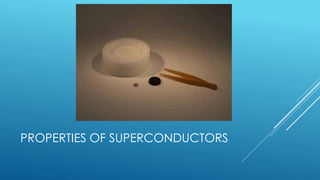
 Superconductors are characterized by the Meissner Effect.
 When a superconductor is put in a magnetic field and cooled,
an electric current is induced inside the superconductor.
 Due to the zero resistance, the current does not stop or dissipate.
 This current produces a magnetic field that opposes the applied
field.
 This produced magnetic field repels the applied magnetic field
and repels its source (The magnet) and the magnet will levitate
above the superconductor.
 In the next slide, there is a video that shows this effect in reality.
APPLICATIONS OF
SUPERCONDUCTORS
 In Biomagnetism, a strong magnetic field is produced using a
superconductor and impinged into the human body.
 Hydrogen atoms inside the body are forced to accept the
energy due to the field. And then it release the energy at
different frequencies.
 These frequencies can be detected and graphically displayed
by a computer.
APPLICATIONS ON
SUPERCONDUCTORS
 Electric generators can be made with superconductor wires.
 These electric generators are 99% more efficient than
conventional ones.
 Specific type of trains called Maglev uses superconducting coils
to accelerate.
 The superconducting coils are used to produce a strong
magnetic field that is used to attract the train to move forward or
backward.
Superconductors presentation

Superconductors presentation

  • 1.
  • 2.
    OUTLINE  What aresuperconductors?  Classification of superconductors.  Properties of superconductors  Applications of superconductors.
  • 3.
    WHAT ARE SUPERCONDUCTORS? Superconductors are material that have zero electrical resistance.  They repel any magnetic fields applied to them so, it does not penetrate it’s bulk (inside)  They conduct electricity more efficiently than other conductors due to their zero resistance.
  • 4.
    CLASSIFICATION OF SUPERCONDUCTORS  Superconductorscan be classified by their critical temperature or by the material used.  Considering their critical temperature, there is high temperature superconductors that reaches its superconducting state at temperatures less than (-196.15 °C).  This temperature can be reached by cooling using liquid Nitrogen.  There is low temperature superconductors that reaches their superconducting state at lower temperatures so, they need aggressive cooling techniques to be cooled to these low temperatures.
  • 5.
    CLASSIFICATION OF SUPERCONDUCTORS  Superconductorscan also be classified by the type of material used.  There are superconductors made from chemical elements.  Others from alloys like Niobium-Titanium.  And others from organic material like Fullerenes and Carbon Nanotubes.
  • 6.
    PROPERTIES OF SUPERCONDUCTORS They have zero electrical resistance which can be proved by measuring the voltage it and using the rule 𝑅 = 𝑉 𝐼 .  Every superconductor has a critical temperature below which it reaches its superconducting state.  Every superconductor has a critical magnetic field temperature after which the superconductor cannot exist in the superconducting state.
  • 7.
    PROPERTIES OF SUPERCONDUCTORS Superconductors are characterized by the Meissner Effect.  When a superconductor is put in a magnetic field and cooled, an electric current is induced inside the superconductor.  Due to the zero resistance, the current does not stop or dissipate.  This current produces a magnetic field that opposes the applied field.  This produced magnetic field repels the applied magnetic field and repels its source (The magnet) and the magnet will levitate above the superconductor.  In the next slide, there is a video that shows this effect in reality.
  • 8.
    APPLICATIONS OF SUPERCONDUCTORS  InBiomagnetism, a strong magnetic field is produced using a superconductor and impinged into the human body.  Hydrogen atoms inside the body are forced to accept the energy due to the field. And then it release the energy at different frequencies.  These frequencies can be detected and graphically displayed by a computer.
  • 9.
    APPLICATIONS ON SUPERCONDUCTORS  Electricgenerators can be made with superconductor wires.  These electric generators are 99% more efficient than conventional ones.  Specific type of trains called Maglev uses superconducting coils to accelerate.  The superconducting coils are used to produce a strong magnetic field that is used to attract the train to move forward or backward.