Josphenson junction 
JOSPHSON JUNCTION 
Guided by- submitted by- 
Prof. Ajit Satapathy Sai Smruti Nayak 
EEE deaprtment (1101298116)
Outline of Presentation 
Introduction 
Superconductivity 
Messiner – Oschenfield effect 
Josephson Equations 
Types of Josephson Effect 
Cooper pair 
Application 
References 
2
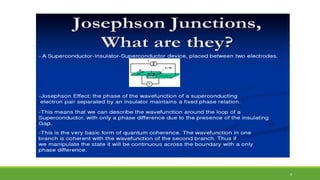
JOSEPHSON JUNCTION 
• A Josephson junction is a type of electronic circuit capable of switching at very high speeds 
when operated at temperatures approaching absolute zero. 
• The ability of certain materials to conduct electric current with practically zero resistance.
4
Superconductivity 
In 1911 superconductivity was first observed in mercury by Dutch physicist 
Heike Kamerlingh Onnes. 
Definition : 
Property of some materials to exhibit zero electrical resistance and the 
exclusion of interior magnetic field, known as Meissner’s effect, below critical 
temperature is known as Superconductivity. 
5
Types Of Superconductors 
Type I Superconductors : 
Have critical temperature range of less than 1K to 20 K. e.g. Niobium, 
Tantalum, Magnesium Diboride, some highly doped semi-conductors. 
Type II Superconductors : 
Have high critical temperature. e.g. cuprate perovskite family 
compounds(YBa2Cu3O7). 
6
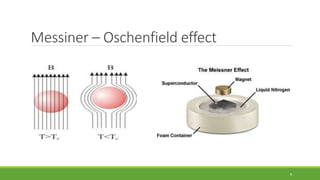
Messiner – Oschenfield effect 
There is complete expulsion of magnetic field from the interior of the Superconductor. The 
magnetic inductance becomes zero when it is cooled below TC in a week magnetic field HC, 
above which superconductivity disappears. This field is temperature dependent. The expulsion 
of magnetic flux causes source magnetic energy. 
So long as this cost is less than the consideration energy gained by going from the normal to the 
superconductivity becomes too large, the cost in magnetic energy will outweigh the gain in 
consideration energy, and the super conduction will become partially or totally normal. 
7
Messiner – Oschenfield effect 
8
Types of Josephson Effect 
1. DC Josephson Effect 
In absence of biasing voltage. 
I= Ic sin Φ. 
2. AC Josephson Effect 
When a bias voltage is applied. 
δΦ/δt= 2eV/h. 
9
DC Josephson Effect 
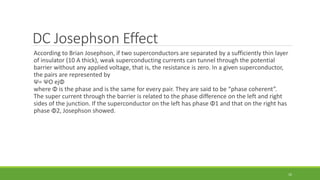
According to Brian Josephson, if two superconductors are separated by a sufficiently thin layer 
of insulator (10 A thick), weak superconducting currents can tunnel through the potential 
barrier without any applied voltage, that is, the resistance is zero. In a given superconductor, 
the pairs are represented by 
Ψ= ΨO ejΦ 
where Φ is the phase and is the same for every pair. They are said to be “phase coherent”. 
The super current through the barrier is related to the phase difference on the left and right 
sides of the junction. If the superconductor on the left has phase Φ1 and that on the right has 
phase Φ2, Josephson showed. 
10
AC Josephson Effect 
Josephson predicted that when a finite voltage V is applied across the junction there will be a 
flow of current. Solution to Schrödinger’s equation gives the expression for current as 
I = Ic sin [∂ (0) + [(2eV/h) t] (6.4) 
This shows that current oscillates with frequency ωj=2eV/h where V is the applied voltage, h is 
the constant; e is the basic electronic charge. If V is a constant then the phase difference can be 
given by the equation ∂=∂ (0) + ωj t. Then d∂/dt = ωj. That is the ratio of change of 
phase difference is directly proportional to the applied voltage. 
11
12
Cooper pair 
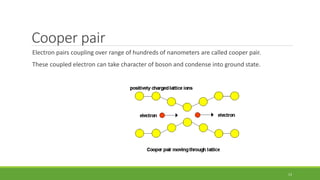
Electron pairs coupling over range of hundreds of nanometers are called cooper pair. 
These coupled electron can take character of boson and condense into ground state. 
13
Fabrication 
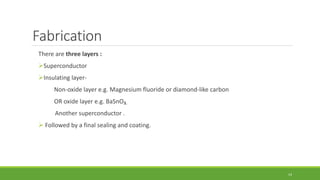
There are three layers : 
Superconductor 
Insulating layer- 
Non-oxide layer e.g. Magnesium fluoride or diamond-like carbon 
OR oxide layer e.g. BaSnO3. 
Another superconductor . 
 Followed by a final sealing and coating. 
14
Fabrication(contd..) 
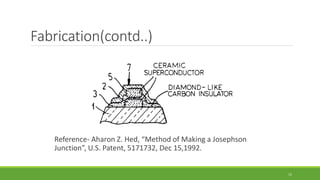
Reference- Aharon Z. Hed, “Method of Making a Josephson 
Junction”, U.S. Patent, 5171732, Dec 15,1992. 
15
Applications 
Magnetic Sensors 
Gradiometers 
Oscilloscopes 
Decoders 
Analogue to Digital converters 
Samplers 
Oscillators 
Microwave amplifiers 
Sensors for biomedical, scientific and defense purposes 
Digital circuit development for Integrated circuits 
Microprocessors 
Random Access Memories (RAM’s) 
16
CONCLUSION 
With the advent of such junctions working on the principle of superconductivity brought about a 
link between different branches of study to give us efficient and highly advanced technology. 
Before Josephson's prediction, it was only known that normal (i.e. non-superconducting) 
electrons can flow through an insulating barrier, by means of quantum tunneling. Josephson was 
the first to predict the tunneling of superconducting Cooper pairs. For this work, Josephson 
received the Nobel prize in physics in 1973.[5] Josephson junctions have important applications in 
quantum-mechanical circuits, such as SQUIDs, superconducting qubits, and RSFQ digital 
electronics. The NIST standard for one Volt is achieved by an array of 19,000 Josephson junctions 
in series 
17
References 
1. K. K. Likharev, “Dynamics of Josephson Junction and circuits” 
(Gordon and Breach, New York, 1986). 
2. M.S.Vijaya, G.Rangarajan, “Materials Science”, (Tata McGraw-Hill,2004). 
3. J.Clarke, “The New Superconducting Electronics”, 
(Kluwer Dordrech,1993). 
4. Insang Song, Yunsung Huh and Gwangseo Park, “Microwave Coupling Of The Josephson Junction Arrays 
With An External Source”, IEEE Transactions On Applied Superconductivity, vol-7, June, 1997 
5. M. Tachiki, S. E. Shafranjuk, “Vortex Lattice Structure And Josephson Junction Plasma in High Tc 
Superconductors”,Chinese Jounal Of Physics, vol-36, April, 1998. 
18
ANY QUERIES ?? 
19
THANK YOU 
20