Haroon Hussain Moidu
Lecturer
Department of Physics
MAMO College, Manassery
University of Calicut
Superconductiv
ity
IntroductionS
u
p
e
r
c
o
n
d
u
c
t
i
v
i
t
y
 As the temperature decreases, the electrical
resistivity of all metals and alloys decreases.
 In pure metal, resistivity is due to the thermal
vibrations of the lattice (phonons) only.
 But in real metals, electrons are scattered by
impurities too which is more or less independent
of temperature - Residual resistivity which
remains at the lowest temperature.
 Superconductivity - It is a phenomenon in
which certain metals , alloys and ceramics
conduct electricity without resistance when it is
cooled below a certain temperature called the
‘critical temperature’.
Variation of resistance of
superconductors with temperature
S
u
p
e
r
c
o
n
d
u
c
t
i
v
i
t
y
A survey of superconductivityS
u
p
e
r
c
o
n
d
u
c
t
i
v
i
t
y
 In 1911 – Dutch physicist Heike Kamerlingh Onnes.
 Resistance of mercury dropped from 0.08 𝛺 to 3×10⁻⁶
at 4 K over a temperature interval of 0.01 K.
 Not all metals found to be superconductors – eg:
copper, iron and sodium.
 Superconductivity can be shown by conductors which
are not metals in ordinary sense – eg:
semiconducting mixed oxide of barium, lead and
bismuth, poly sulphurnitritde at 3K.
 Transition temperature is not very sensitive to
impurities.
 The magnetic impurities tend to lower the transition
temperatures.
 It is possible for an alloy to be superconductor even if
ExamplesS
u
p
e
r
c
o
n
d
u
c
t
i
v
i
t
y
 Hydrogen sulfide (H2S) is found to undergo superconducting
transition near 203 K (-70 °C), the highest temperature
superconductor known to date.
Element Tc (K) Element Tc(K)
Aluminium 1.196 Tantalum 4.5
Gallium 1.09 Thalium 2.4
Tin 3.72 Rhenium 1.7
Mercury 4.12 Thorium 1.4
Lead 7.175 Zirconium 0.8
Niobium 9.3 Bismuth Cuprates 108
Zinc 0.9 Thalium Cuprates 125
Properties of
superconductors
S
u
p
e
r
c
o
n
d
u
c
t
i
v
i
t
y
 The current in a superconductor persists for a long time.
 Metallic substances with number of valence electrons lies
between 2 and 8 exhibit superconductivity.
 The magnetic field does not penetrate into the body of the
superconductor – Meissner Effect
 When the B is greater than a critical value, the SC becomes a
normal conductor.
 SCy occurs in materials having high normal resistivities. [ nρ >
106; n – No of Valance electrons per cm3; ρ – resistivity].
 When the current through the SC is increased beyond a critical
value Ic(T), SC again become a normal conductor.
 The specific heat of the materials show an abrupt change at T
=Tc, jumping to a large value for T<Tc.
General feature of SCsS
u
p
e
r
c
o
n
d
u
c
t
i
v
i
t
y
 Monovalent metals are generally not
SCs.
 Ferromagnetic and antiferromagnetic
materials are not SCs.
 Good conductors at room temperature
are not SCs and SCs are not good
conductors at room temperature.
 Amorphous thin films of Be, Bi, and Fe
show SCy.
 Bismuth, antimony and tellurium become
SCing under high pressure.
Effects of magnetic fieldS
u
p
e
r
c
o
n
d
u
c
t
i
v
i
t
y
 The SCing state of a metal exists only in a
particular range of temperature and field
strength.
 SCy will disappear if the temp of the
specimen is raised above Tc or if a
sufficiently strong magnetic field is
employed.
 The value of magnetic field at which the SCy
vanishes at any temp(T) is called critical
magnetic field (Hc).
 The curve between the critical magnetic field
versus temp is nearly parabolic.
Effects of magnetic fieldS
u
p
e
r
c
o
n
d
u
c
t
i
v
i
t
y
ProblemsS
u
p
e
r
c
o
n
d
u
c
t
i
v
i
t
y
 Lead in the superconducting state has a
critical temp of 6.2 K at zero magnetic
field and a critical field of 640 Acm-1 at
0K. Determine the critical field at 4K.
 For a specimen of V3Ga, the critical fields
are repectively 1.4×10⁵ and 4.2×10⁵ Am-1
for 14K and 13K . Calculate the transition
temp and critical fields at 0K and 4.2K.
 A SCing tin has a critical temp of 3.7 K in
zero magnetic field and a critical field of
0.0306 Am-1tesla at 0K. Find the critical
field.
Meissner EffectS
u
p
e
r
c
o
n
d
u
c
t
i
v
i
t
y
 Meissner and Ochsenfeld discovered in 1933.
 Perfect diamagnetism or superdiamagnetism.
 The metalic SC expels the magnetic flux as the
SC was cooled below Tc in an external
magnetic field – Meissner effect
 Magnetic field lines are excluded from a SC
when it is below its transition temp.
 The perfect diamagnetism in the sc arises
because surface screening currents circulate so
as to produce a flux density(Bi) which
everywhere inside the metal exactly cancels the
flux density due to the applied field(Ba)
S
u
p
e
r
c
o
n
d
u
c
t
i
v
i
t
y
 The perfect diamagnetism arises from some
bulk magnetic property of sc such that for a sc
metal , µr = 0 so that the flux density inside sc
B = µr Ba= 0
 The flux density in a magnetic material is given
by
where M is the magnetisation , H is magnetic
field strength.
 There fore M = - H
 Therefore susceptibility is
Meissner Effect
B = µo (H+M)
χ = M/H = -1
S
u
p
e
r
c
o
n
d
u
c
t
i
v
i
t
y
Meissner Effect
Isotope effectS
u
p
e
r
c
o
n
d
u
c
t
i
v
i
t
y
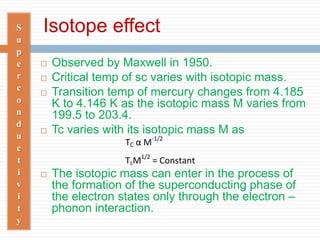
 Observed by Maxwell in 1950.
 Critical temp of sc varies with isotopic mass.
 Transition temp of mercury changes from 4.185
K to 4.146 K as the isotopic mass M varies from
199.5 to 203.4.
 Tc varies with its isotopic mass M as
 The isotopic mass can enter in the process of
the formation of the superconducting phase of
the electron states only through the electron –
phonon interaction.
TC α M-1/2
TcM1/2
= Constant
ProblemS
u
p
e
r
c
o
n
d
u
c
t
i
v
i
t
y
 The critical temp for mercury with isotopic
mass 199.5 u is 4.185 K. Calculate its
critical temp when its isotopic mass changes
to 203.4 u.
Energy GapS
u
p
e
r
c
o
n
d
u
c
t
i
v
i
t
y
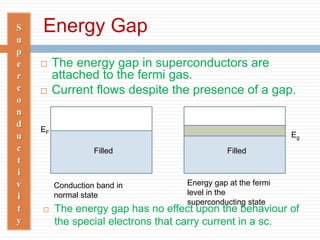
 The energy gap in superconductors are
attached to the fermi gas.
 Current flows despite the presence of a gap.
Conduction band in
normal state
Energy gap at the fermi
level in the
superconducting state
EF
Eg
FilledFilled
 The energy gap has no effect upon the behaviour of
the special electrons that carry current in a sc.
Energy gapS
u
p
e
r
c
o
n
d
u
c
t
i
v
i
t
y
 The energy gap varies
with temperature Unlike
insulators and
semiconductors.
 Max at 0K and decreases
continously to zero as the
temp is increased to the
Tc.
 At T= Tc , all the sc
electrons become normal
electrons.
Eg = 2Δ = 2 b KBTc
Eg/ KBTc = 2b
 The gap decreases from a value of
about 3.5 KBTc at 0K to zero at the
Tc.
Coherence LengthS
u
p
e
r
c
o
n
d
u
c
t
i
v
i
t
y
 The paired electrons (cooper pairs) are not
affected by lattice vibrations so they never
exchange energy.
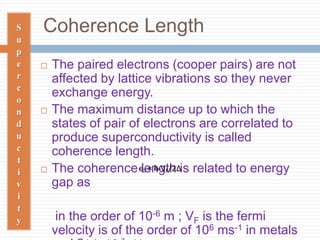
 The maximum distance up to which the
states of pair of electrons are correlated to
produce superconductivity is called
coherence length.
 The coherence length is related to energy
gap as
in the order of 10-6 m ; VF is the fermi
velocity is of the order of 106 ms-1 in metals
ϵ0 = h VF/2Δ
BCS Theory - IntroS
u
p
e
r
c
o
n
d
u
c
t
i
v
i
t
y
 Forhlich in 1950 suggested that the ions in a sc –
crystalline lattice itself must participate in the interaction of
the electrons.
 The disruption of the crystal lattice caused by moving ions
brings more obstacles for passing electrons and in effect
causes ordinary resistance in metals.
 The electron-phonon interaction itself causes
superconductivity – self contradictory.
 A strong electron – phonon interaction appears to be
favourable both to scy and to high resistance.
 A weak electron – phonon interaction means that scy is
unlikely to oocur.
 The best ordinary conductors do not become scs – solution
to self contradiction.
 At temp below Tc, the lattice- electron interaction is
stronger than the electron- electron coulomb force.
BCS Theory - IntroS
u
p
e
r
c
o
n
d
u
c
t
i
v
i
t
y
 In ordinary metals,the electrical resistance is the result of the collisions
of the conduction electrons with the vibrating ions in the crystal lattice.
 Bardeen explained scy using a different theoretical picture based on
Forhlichs suggestion.
 Superconductivity occurs because the superconducting state has lower
energy than the normal state.
 Cooper developed the theory by calculating what happens when two
electrons are added to a metal in the presence of an attractive
interaction.
 In the presence of an attractive interaction, no matter how weak, two
electrons added to the fermi sea will form a bound pair even though the
kinetic energy of the added pair is higher.
 The interaction that attracts the electrons one another can be viewed as
a scattering event involving two electrons and phonon.
 The energy lowering from the formation of a bond state will overcome
the additional kinetic energy of the electrons when the electron of a pair
have an equal and opposite momentum.
 The largest no of energy lowering scattering process can occur between
electrons of equal and opposite momentum – such bond electrons are
cooper pairs.
BCS TheoryS
u
p
e
r
c
o
n
d
u
c
t
i
v
i
t
y
 In 1957 – Bardeen , cooper and schrieffer
 BCS theory involves the electron interactions through
phonon as mediators.
 The electrons moving through the lattice distorts the lattice
and the lattice in turn acts on the electron.
 This interaction is considered to be emission and
reabsorption of phonons - virtual phonons.
 Lattice – electron – lattice interaction : strongest when the
two electrons have equal and opposite momenta and
spins.
 Let an electron of wave vector K1 emits a virtual phonon q
which is absorbed by another electron K2. K1 is thus
scattered as K1-q and K2 as K2 + q. If phonon energy
esceeds electronic energy , the interaction is attractive.
 Sc occurs when this attractive interaction dominate the
usual repulsion.
BCS TheoryS
u
p
e
r
c
o
n
d
u
c
t
i
v
i
t
y
 The energy of the pair of electrons in the bound state is less
than the energy of the pair in the free state ( electron seperated)
 The difference of the energy of the two states( free state and
bound state) is the binding energy of the cooper pair.
 At temp less than Tc, the lattice – electron interaction is stronger
than the electron – electron coulomb interaction.
 Pairing is complete at 0K and is completely broken at a critical
temp.
 Th energy difference between the free state of the electron and
the paired state appears as the energy gap at the fermi surface.
 The normal electron states are above the energy gap and
superconducting electron states are below the energy gap at the
fermi surface.
 BCS theory predicts many electron ground states as well as
excited states for the superconductor in the range 0 to Tc.
 Cooper pairs are not scattered by lattice points because of their
peculiar property of smoothly riding over the lattice imperfections
without ever exchanging energy with them.
Types of superconductorsS
u
p
e
r
c
o
n
d
u
c
t
i
v
i
t
y
 Type I or soft superconductors
 Strictly follow meissner effect.
 Exhibit perfect diamagnetism below critical field Hc which is
of the order 0.1 tesla.
 These materials give away their scy at lower field strengths –
soft.
 Eg : pure metals like aluminium, lead, and mercury
 Type II or hard sc
 Do not follow meissner effect strictly
 Magnetic fields does not penetrate these material abruptly at
Hc rather enters the material slowly with increasing the field
– hard.
 Eg :All high temperature superconductors, metal alloys,
complex oxide ceramics, Boron-doped diamond and silicon ,
niobium, vanadium, and technetium
Types of superconductorsS
u
p
e
r
c
o
n
d
u
c
t
i
v
i
t
y
ApplicationsS
u
p
e
r
c
o
n
d
u
c
t
i
v
i
t
y
 Low temperature liquid helium
superconductors have been used to fabricate
high field magnets and some electronic and
radio frequency devices.
 The sc magnets have been employed in NMR
spectrometers and NMR imaging used in
medical diagnostics.
 For effective magnetic shielding sc are used.
 SQUIDS ( super conductiong quantum
interference device)
 In computers and information processing sc
are used.

Superconductivity

  • 1.
    Haroon Hussain Moidu Lecturer Departmentof Physics MAMO College, Manassery University of Calicut Superconductiv ity
  • 2.
    IntroductionS u p e r c o n d u c t i v i t y  As thetemperature decreases, the electrical resistivity of all metals and alloys decreases.  In pure metal, resistivity is due to the thermal vibrations of the lattice (phonons) only.  But in real metals, electrons are scattered by impurities too which is more or less independent of temperature - Residual resistivity which remains at the lowest temperature.  Superconductivity - It is a phenomenon in which certain metals , alloys and ceramics conduct electricity without resistance when it is cooled below a certain temperature called the ‘critical temperature’.
  • 3.
    Variation of resistanceof superconductors with temperature S u p e r c o n d u c t i v i t y
  • 4.
    A survey ofsuperconductivityS u p e r c o n d u c t i v i t y  In 1911 – Dutch physicist Heike Kamerlingh Onnes.  Resistance of mercury dropped from 0.08 𝛺 to 3×10⁻⁶ at 4 K over a temperature interval of 0.01 K.  Not all metals found to be superconductors – eg: copper, iron and sodium.  Superconductivity can be shown by conductors which are not metals in ordinary sense – eg: semiconducting mixed oxide of barium, lead and bismuth, poly sulphurnitritde at 3K.  Transition temperature is not very sensitive to impurities.  The magnetic impurities tend to lower the transition temperatures.  It is possible for an alloy to be superconductor even if
  • 5.
    ExamplesS u p e r c o n d u c t i v i t y  Hydrogen sulfide(H2S) is found to undergo superconducting transition near 203 K (-70 °C), the highest temperature superconductor known to date. Element Tc (K) Element Tc(K) Aluminium 1.196 Tantalum 4.5 Gallium 1.09 Thalium 2.4 Tin 3.72 Rhenium 1.7 Mercury 4.12 Thorium 1.4 Lead 7.175 Zirconium 0.8 Niobium 9.3 Bismuth Cuprates 108 Zinc 0.9 Thalium Cuprates 125
  • 6.
    Properties of superconductors S u p e r c o n d u c t i v i t y  Thecurrent in a superconductor persists for a long time.  Metallic substances with number of valence electrons lies between 2 and 8 exhibit superconductivity.  The magnetic field does not penetrate into the body of the superconductor – Meissner Effect  When the B is greater than a critical value, the SC becomes a normal conductor.  SCy occurs in materials having high normal resistivities. [ nρ > 106; n – No of Valance electrons per cm3; ρ – resistivity].  When the current through the SC is increased beyond a critical value Ic(T), SC again become a normal conductor.  The specific heat of the materials show an abrupt change at T =Tc, jumping to a large value for T<Tc.
  • 7.
    General feature ofSCsS u p e r c o n d u c t i v i t y  Monovalent metals are generally not SCs.  Ferromagnetic and antiferromagnetic materials are not SCs.  Good conductors at room temperature are not SCs and SCs are not good conductors at room temperature.  Amorphous thin films of Be, Bi, and Fe show SCy.  Bismuth, antimony and tellurium become SCing under high pressure.
  • 8.
    Effects of magneticfieldS u p e r c o n d u c t i v i t y  The SCing state of a metal exists only in a particular range of temperature and field strength.  SCy will disappear if the temp of the specimen is raised above Tc or if a sufficiently strong magnetic field is employed.  The value of magnetic field at which the SCy vanishes at any temp(T) is called critical magnetic field (Hc).  The curve between the critical magnetic field versus temp is nearly parabolic.
  • 9.
    Effects of magneticfieldS u p e r c o n d u c t i v i t y
  • 10.
    ProblemsS u p e r c o n d u c t i v i t y  Lead inthe superconducting state has a critical temp of 6.2 K at zero magnetic field and a critical field of 640 Acm-1 at 0K. Determine the critical field at 4K.  For a specimen of V3Ga, the critical fields are repectively 1.4×10⁵ and 4.2×10⁵ Am-1 for 14K and 13K . Calculate the transition temp and critical fields at 0K and 4.2K.  A SCing tin has a critical temp of 3.7 K in zero magnetic field and a critical field of 0.0306 Am-1tesla at 0K. Find the critical field.
  • 11.
    Meissner EffectS u p e r c o n d u c t i v i t y  Meissnerand Ochsenfeld discovered in 1933.  Perfect diamagnetism or superdiamagnetism.  The metalic SC expels the magnetic flux as the SC was cooled below Tc in an external magnetic field – Meissner effect  Magnetic field lines are excluded from a SC when it is below its transition temp.  The perfect diamagnetism in the sc arises because surface screening currents circulate so as to produce a flux density(Bi) which everywhere inside the metal exactly cancels the flux density due to the applied field(Ba)
  • 12.
    S u p e r c o n d u c t i v i t y  The perfectdiamagnetism arises from some bulk magnetic property of sc such that for a sc metal , µr = 0 so that the flux density inside sc B = µr Ba= 0  The flux density in a magnetic material is given by where M is the magnetisation , H is magnetic field strength.  There fore M = - H  Therefore susceptibility is Meissner Effect B = µo (H+M) χ = M/H = -1
  • 13.
  • 14.
    Isotope effectS u p e r c o n d u c t i v i t y  Observedby Maxwell in 1950.  Critical temp of sc varies with isotopic mass.  Transition temp of mercury changes from 4.185 K to 4.146 K as the isotopic mass M varies from 199.5 to 203.4.  Tc varies with its isotopic mass M as  The isotopic mass can enter in the process of the formation of the superconducting phase of the electron states only through the electron – phonon interaction. TC α M-1/2 TcM1/2 = Constant
  • 15.
    ProblemS u p e r c o n d u c t i v i t y  The criticaltemp for mercury with isotopic mass 199.5 u is 4.185 K. Calculate its critical temp when its isotopic mass changes to 203.4 u.
  • 16.
    Energy GapS u p e r c o n d u c t i v i t y  Theenergy gap in superconductors are attached to the fermi gas.  Current flows despite the presence of a gap. Conduction band in normal state Energy gap at the fermi level in the superconducting state EF Eg FilledFilled  The energy gap has no effect upon the behaviour of the special electrons that carry current in a sc.
  • 17.
    Energy gapS u p e r c o n d u c t i v i t y  Theenergy gap varies with temperature Unlike insulators and semiconductors.  Max at 0K and decreases continously to zero as the temp is increased to the Tc.  At T= Tc , all the sc electrons become normal electrons. Eg = 2Δ = 2 b KBTc Eg/ KBTc = 2b  The gap decreases from a value of about 3.5 KBTc at 0K to zero at the Tc.
  • 18.
    Coherence LengthS u p e r c o n d u c t i v i t y  Thepaired electrons (cooper pairs) are not affected by lattice vibrations so they never exchange energy.  The maximum distance up to which the states of pair of electrons are correlated to produce superconductivity is called coherence length.  The coherence length is related to energy gap as in the order of 10-6 m ; VF is the fermi velocity is of the order of 106 ms-1 in metals ϵ0 = h VF/2Δ
  • 19.
    BCS Theory -IntroS u p e r c o n d u c t i v i t y  Forhlich in 1950 suggested that the ions in a sc – crystalline lattice itself must participate in the interaction of the electrons.  The disruption of the crystal lattice caused by moving ions brings more obstacles for passing electrons and in effect causes ordinary resistance in metals.  The electron-phonon interaction itself causes superconductivity – self contradictory.  A strong electron – phonon interaction appears to be favourable both to scy and to high resistance.  A weak electron – phonon interaction means that scy is unlikely to oocur.  The best ordinary conductors do not become scs – solution to self contradiction.  At temp below Tc, the lattice- electron interaction is stronger than the electron- electron coulomb force.
  • 20.
    BCS Theory -IntroS u p e r c o n d u c t i v i t y  In ordinary metals,the electrical resistance is the result of the collisions of the conduction electrons with the vibrating ions in the crystal lattice.  Bardeen explained scy using a different theoretical picture based on Forhlichs suggestion.  Superconductivity occurs because the superconducting state has lower energy than the normal state.  Cooper developed the theory by calculating what happens when two electrons are added to a metal in the presence of an attractive interaction.  In the presence of an attractive interaction, no matter how weak, two electrons added to the fermi sea will form a bound pair even though the kinetic energy of the added pair is higher.  The interaction that attracts the electrons one another can be viewed as a scattering event involving two electrons and phonon.  The energy lowering from the formation of a bond state will overcome the additional kinetic energy of the electrons when the electron of a pair have an equal and opposite momentum.  The largest no of energy lowering scattering process can occur between electrons of equal and opposite momentum – such bond electrons are cooper pairs.
  • 21.
    BCS TheoryS u p e r c o n d u c t i v i t y  In1957 – Bardeen , cooper and schrieffer  BCS theory involves the electron interactions through phonon as mediators.  The electrons moving through the lattice distorts the lattice and the lattice in turn acts on the electron.  This interaction is considered to be emission and reabsorption of phonons - virtual phonons.  Lattice – electron – lattice interaction : strongest when the two electrons have equal and opposite momenta and spins.  Let an electron of wave vector K1 emits a virtual phonon q which is absorbed by another electron K2. K1 is thus scattered as K1-q and K2 as K2 + q. If phonon energy esceeds electronic energy , the interaction is attractive.  Sc occurs when this attractive interaction dominate the usual repulsion.
  • 22.
    BCS TheoryS u p e r c o n d u c t i v i t y  Theenergy of the pair of electrons in the bound state is less than the energy of the pair in the free state ( electron seperated)  The difference of the energy of the two states( free state and bound state) is the binding energy of the cooper pair.  At temp less than Tc, the lattice – electron interaction is stronger than the electron – electron coulomb interaction.  Pairing is complete at 0K and is completely broken at a critical temp.  Th energy difference between the free state of the electron and the paired state appears as the energy gap at the fermi surface.  The normal electron states are above the energy gap and superconducting electron states are below the energy gap at the fermi surface.  BCS theory predicts many electron ground states as well as excited states for the superconductor in the range 0 to Tc.  Cooper pairs are not scattered by lattice points because of their peculiar property of smoothly riding over the lattice imperfections without ever exchanging energy with them.
  • 23.
    Types of superconductorsS u p e r c o n d u c t i v i t y Type I or soft superconductors  Strictly follow meissner effect.  Exhibit perfect diamagnetism below critical field Hc which is of the order 0.1 tesla.  These materials give away their scy at lower field strengths – soft.  Eg : pure metals like aluminium, lead, and mercury  Type II or hard sc  Do not follow meissner effect strictly  Magnetic fields does not penetrate these material abruptly at Hc rather enters the material slowly with increasing the field – hard.  Eg :All high temperature superconductors, metal alloys, complex oxide ceramics, Boron-doped diamond and silicon , niobium, vanadium, and technetium
  • 24.
  • 25.
    ApplicationsS u p e r c o n d u c t i v i t y  Low temperatureliquid helium superconductors have been used to fabricate high field magnets and some electronic and radio frequency devices.  The sc magnets have been employed in NMR spectrometers and NMR imaging used in medical diagnostics.  For effective magnetic shielding sc are used.  SQUIDS ( super conductiong quantum interference device)  In computers and information processing sc are used.