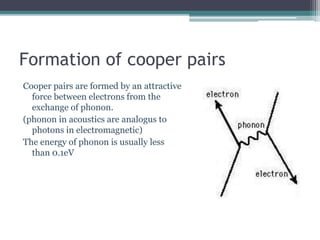
Superconductivity was discovered in 1911 by Heike Kamerlingh Onnes, who observed the electrical resistance of mercury abruptly disappeared at 4.2 K. Superconductivity occurs in certain materials at very low temperatures and is characterized by zero electrical resistance and perfect diamagnetism. The BCS theory from 1957 explained superconductivity as a superfluid of electron pairs called Cooper pairs that interact through phonon exchange. Superconductors exhibit properties like the Meissner effect, Josephson effect, and isotope effect. They are classified by critical temperature, magnetic response, and materials. Superconductors find applications in areas like magnetically levitated transportation, MRI machines, and power grid technologies.





![H =H0 [ 1 – (T/TC )2 ]
Hc = the critical field at which material goes into super
conducting state
T= operating temperature in 0K
Tc = critical temperature in 0K
H0= Value of magnetic field develop in material at 0
0K](https://image.slidesharecdn.com/superconductivity-150906080329-lva1-app6892/85/Superconductivity-21-320.jpg)


