Download as PDF, PPTX


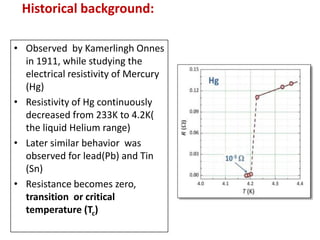









Superconductivity is a phenomenon where certain materials exhibit zero electrical resistance and expel magnetic fields when cooled below a critical temperature. Some key points: - Superconductivity was first observed in mercury in 1911 by Kamerlingh Onnes, with resistance dropping to zero below 4.2K. - Later, superconductors were found with higher critical temperatures, such as ceramics with critical temperatures up to 138K. - The BCS theory explained superconductivity as arising from electrons forming Cooper pairs mediated by phonons, allowing them to flow without resistance. - Applications of superconductors include maglev trains, MRI machines, power transmission lines, and quantum computing.


