KUCHINDA DEGREE COLLEGE
KUCHINDA
DEPARTMENT OF PHYSICS
A SEMINAR REPORT ON
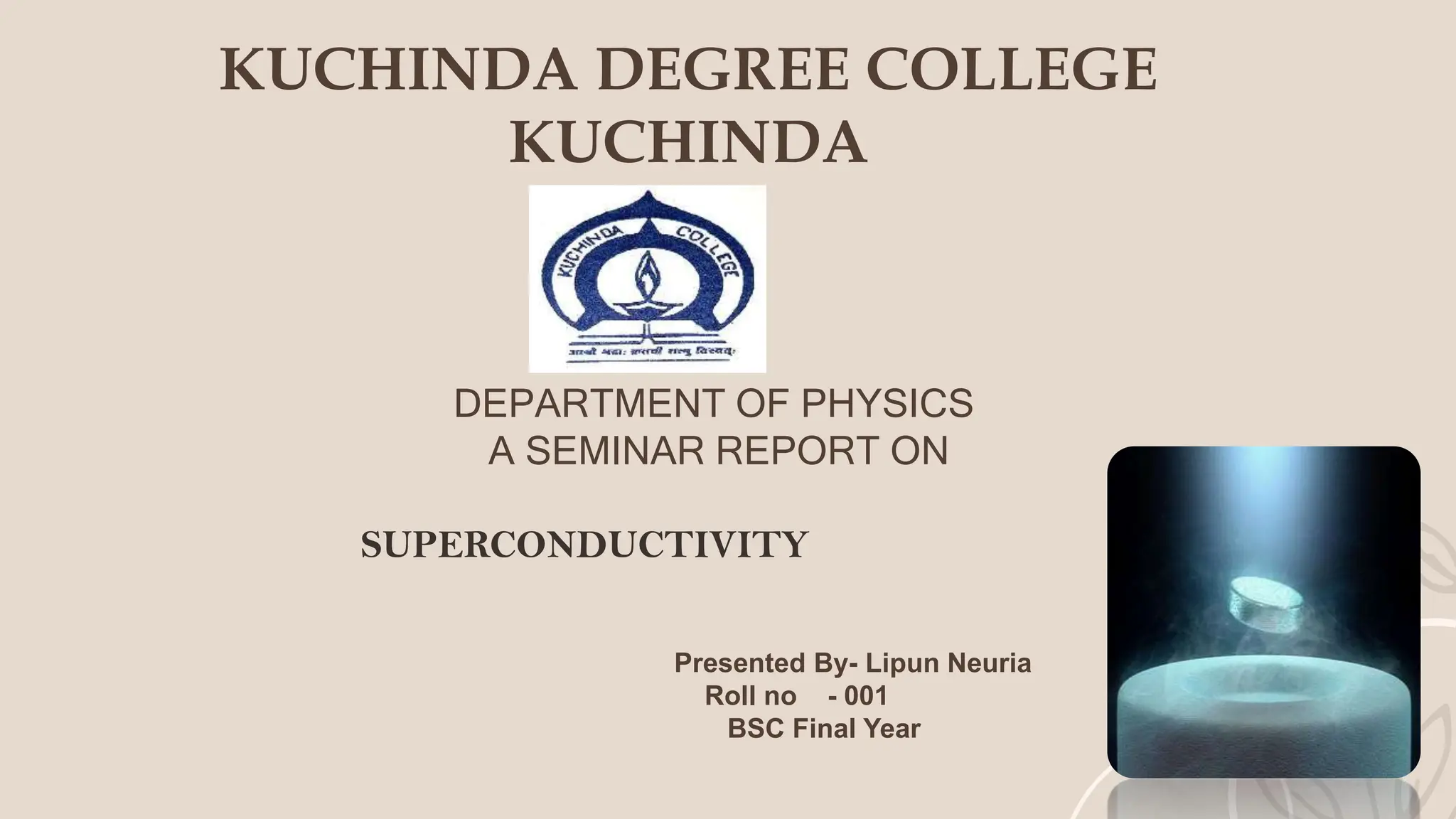
SUPERCONDUCTIVITY
Presented By- Lipun Neuria
Roll no - 001
BSC Final Year
ACKNOWLEDGEMENT
I want to thank everyone who
helped me to prepare this
presentation from the bottom of my
heart . First of all, I would like to
express my Sincere gratitude to all
the lectures for their advice and
knowledge of superconductivity
Finally, I would want to
express my gratitude to my
Friends for their unwavering
encouragement and Support for
the presentation
Lipun Neuria
+3 Final Year
BS(P)22.001
OVERVIEW:-
• Acknowledgement
• What is Superconductivity
• Discovery of Superconductor
• Critical Temperature
• Properties
• Critical Magnetic Field
• Meissner Effect
• Types of Superconductor
• BCS Theory
• Cooper Pairs
• Advantages
• Disadvantages
• Application
• Futuristic Goals
• Conclusion
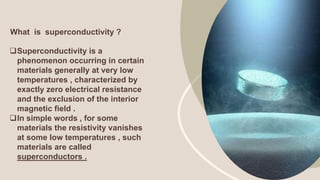
What is superconductivity ?
Superconductivity is a
phenomenon occurring in certain
materials generally at very low
temperatures , characterized by
exactly zero electrical resistance
and the exclusion of the interior
magnetic field .
In simple words , for some
materials the resistivity vanishes
at some low temperatures , such
materials are called
superconductors .
DISCOVERY
• Superconductivity was
discovered on April 8,1911 by
Heike Kammerlingh Onnes who
was studying the resistance of
solid mercury at cryogenic
temperatures using the recently
discovered liquid helium as
refrigerant .
• At the temperatures of 4.2K , he
observed that the resistance
abruptly disappeared . In
subsequent decades,
superconductivity was found in
several other materials.
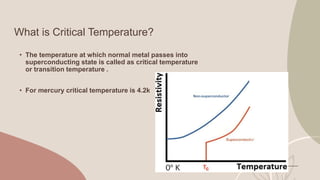
What is Critical Temperature?
• The temperature at which normal metal passes into
superconducting state is called as critical temperature
or transition temperature .
• For mercury critical temperature is 4.2k
Properties changes during super-conducting Transition :-
• The electrical properties of material get totally
changed(above critical temperature, resistance is more
and below critical temperature resistance is zero .
• The magnetic properties of the material undergo a
change in the same way as electrical properties .
• Specific heat changes discontinuously at the transition
temperature .
• All the thermoelectric effects(seeback , peltier ,
Thomson) disappear in superconductivity state .
Properties which do not change during superconducting transition :-
• The X- ray diffraction pattern is same both above and below
the critical temperature which shows that during
superconducting Transition, the crystal structure of the
material remains same .
• Electronic structure remains almost the same .
• The elastic and thermal expansion do not change during
with superconducting transition .
Critical magnetic field :-
• In 1993 , Kammerlingh onnes observed that the
superconductivity vanishes if a sufficiently strong
magnetic field is applied.
• The minimum applied magnetic field necessary to
destroy superconductivity and restore normal
resistivity is called critical magnetic field.
Meissner Effect :-
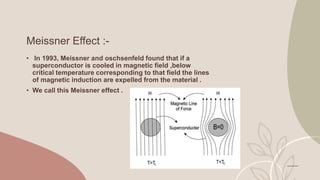
• In 1993, Meissner and oschsenfeld found that if a
superconductor is cooled in magnetic field ,below
critical temperature corresponding to that field the lines
of magnetic induction are expelled from the material .
• We call this Meissner effect .
Depending upon the behaviors of superconductor in the external magnetic field ,they
have classified in to two categories
1. Type I or soft superconductor .
2. Type ll or Hard superconductor.
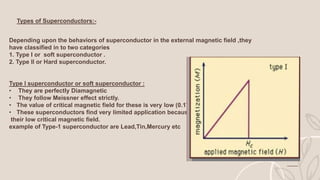
Type l superconductor or soft superconductor :
• They are perfectly Diamagnetic
• They follow Meissner effect strictly.
• The value of critical magnetic field for these is very low (0.1T)
• These superconductors find very limited application because of
their low critical magnetic field.
example of Type-1 superconductor are Lead,Tin,Mercury etc
Types of Superconductors:-
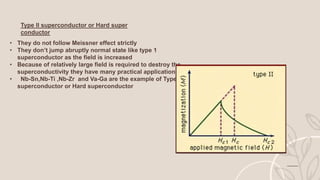
Type ll superconductor or Hard super
conductor
• They do not follow Meissner effect strictly
• They don’t jump abruptly normal state like type 1
superconductor as the field is increased
• Because of relatively large field is required to destroy the
superconductivity they have many practical application
• Nb-Sn,Nb-Ti ,Nb-Zr and Va-Ga are the example of Type ll
superconductor or Hard superconductor
BCS Theory
• The complete microscopic theory of superconductivity was
finally proposed in 1957 by three scientists named as
Bardeen,Cooper and bcs theory explained the
superconducting current as a super fluid of cooper pairs
,pairs of electron interacting through the exchange of
phonons.
• For this work authors were awarded the Nobel prize in 1972
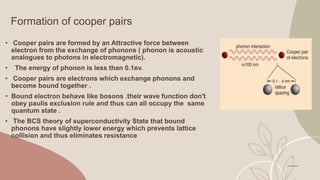
Formation of cooper pairs
• Cooper pairs are formed by an Attractive force between
electron from the exchange of phonons ( phonon is acoustic
analogues to photons in electromagnetic).
• The energy of phonon is less than 0.1ev.
• Cooper pairs are electrons which exchange phonons and
become bound together .
• Bound electron behave like bosons .their wave function don't
obey paulis exclusion rule and thus can all occupy the same
quantum state .
• The BCS theory of superconductivity State that bound
phonons have slightly lower energy which prevents lattice
collision and thus eliminates resistance
Advantages:-
• Superconductivity offers several significant advantages
due to its unique Properties, especially the zero electrical
resistance and the exclusive of magnetic fields
1. Energy Efficiency in Power Transmission .
2. Powerful magnetic field for application .
3. Compact and light weight electrical equipment .
4. Fast and powerful electronics .
5. Scientific Research .
Disadvantages:-
• Low operating Temperature .
• High costly of Materials .
• Magnetic field limitations .
Applications :-
• 1. Magnetic Resonance Imaging -
Superconducting magnets are used in MRI machines to produce
strong, stable Magnetic field essential for high quality images .
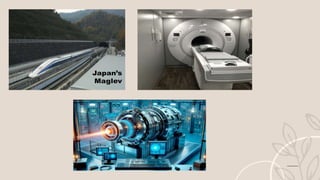
• 2. Maglev(magnetic levitation) Trains :-
Superconductors are used in maglev trains which hover above track
using magnetic fields, eliminating frictionless and allowing for high
speed
• 3. Particle accelerator:-
Superconductivity magnets help accelerate particle to high speeds in
large particle accelerators like the large hadron collider(LHC) . This
strong magnetic field keep particles on track ,facilitating advance
research in particle physics
• 4. Sensitive Measuring Instrument-
SQUID are used in scientific research and measuring extremely weak
magnetic fields, useful in fields like neuroscience and geoscience.
Futuristic Goals:-
1 . Electrification :-
Superconductivity could accelerate the shift to renewable
energy source.
2. Transportation and maglev :-
Trains Enhanced superconductors could make maglev trains
more efficient and affordable leading to high speed ,
frictionless transport with minimal energy consumption .
3. Quantum computing :-
Superconductors plays a crucial role in the future of quantum
information Technology .
4. Space Exploration :-
Superconductors could play a role in deep space mission by
making spacecraft lighter and more energy efficient .
Conclusion
"Superconductivity represents a groundbreaking
phenomenon in physics and materials science, offering
unique insights into quantum mechanics and electron
behavior. The discovery of materials that exhibit zero
electrical resistance and the expulsion of magnetic fields at
low temperatures has opened up transformative
applications, such as MRI machines, maglev trains, and
powerful particle accelerators. However, challenges remain,
particularly in achieving superconductivity at higher, more
practical temperatures, which would enable broader
industrial applications. Continued research in high-
temperature superconductors and material innovation
promises significant advances in technology and
sustainability, potentially reshaping future energy systems
and transportation solutions."
REFERENCE :-
www.google.com
www.Wikipedia.com
www.youtube.com
superconductivity and its application .pdf

superconductivity and its application .pdf

  • 1.
    KUCHINDA DEGREE COLLEGE KUCHINDA DEPARTMENTOF PHYSICS A SEMINAR REPORT ON SUPERCONDUCTIVITY Presented By- Lipun Neuria Roll no - 001 BSC Final Year
  • 2.
    ACKNOWLEDGEMENT I want tothank everyone who helped me to prepare this presentation from the bottom of my heart . First of all, I would like to express my Sincere gratitude to all the lectures for their advice and knowledge of superconductivity Finally, I would want to express my gratitude to my Friends for their unwavering encouragement and Support for the presentation Lipun Neuria +3 Final Year BS(P)22.001
  • 3.
    OVERVIEW:- • Acknowledgement • Whatis Superconductivity • Discovery of Superconductor • Critical Temperature • Properties • Critical Magnetic Field • Meissner Effect • Types of Superconductor • BCS Theory • Cooper Pairs • Advantages • Disadvantages • Application • Futuristic Goals • Conclusion
  • 4.
    What is superconductivity? Superconductivity is a phenomenon occurring in certain materials generally at very low temperatures , characterized by exactly zero electrical resistance and the exclusion of the interior magnetic field . In simple words , for some materials the resistivity vanishes at some low temperatures , such materials are called superconductors .
  • 5.
    DISCOVERY • Superconductivity was discoveredon April 8,1911 by Heike Kammerlingh Onnes who was studying the resistance of solid mercury at cryogenic temperatures using the recently discovered liquid helium as refrigerant . • At the temperatures of 4.2K , he observed that the resistance abruptly disappeared . In subsequent decades, superconductivity was found in several other materials.
  • 6.
    What is CriticalTemperature? • The temperature at which normal metal passes into superconducting state is called as critical temperature or transition temperature . • For mercury critical temperature is 4.2k
  • 7.
    Properties changes duringsuper-conducting Transition :- • The electrical properties of material get totally changed(above critical temperature, resistance is more and below critical temperature resistance is zero . • The magnetic properties of the material undergo a change in the same way as electrical properties . • Specific heat changes discontinuously at the transition temperature . • All the thermoelectric effects(seeback , peltier , Thomson) disappear in superconductivity state .
  • 8.
    Properties which donot change during superconducting transition :- • The X- ray diffraction pattern is same both above and below the critical temperature which shows that during superconducting Transition, the crystal structure of the material remains same . • Electronic structure remains almost the same . • The elastic and thermal expansion do not change during with superconducting transition .
  • 9.
    Critical magnetic field:- • In 1993 , Kammerlingh onnes observed that the superconductivity vanishes if a sufficiently strong magnetic field is applied. • The minimum applied magnetic field necessary to destroy superconductivity and restore normal resistivity is called critical magnetic field.
  • 10.
    Meissner Effect :- •In 1993, Meissner and oschsenfeld found that if a superconductor is cooled in magnetic field ,below critical temperature corresponding to that field the lines of magnetic induction are expelled from the material . • We call this Meissner effect .
  • 11.
    Depending upon thebehaviors of superconductor in the external magnetic field ,they have classified in to two categories 1. Type I or soft superconductor . 2. Type ll or Hard superconductor. Type l superconductor or soft superconductor : • They are perfectly Diamagnetic • They follow Meissner effect strictly. • The value of critical magnetic field for these is very low (0.1T) • These superconductors find very limited application because of their low critical magnetic field. example of Type-1 superconductor are Lead,Tin,Mercury etc Types of Superconductors:-
  • 12.
    Type ll superconductoror Hard super conductor • They do not follow Meissner effect strictly • They don’t jump abruptly normal state like type 1 superconductor as the field is increased • Because of relatively large field is required to destroy the superconductivity they have many practical application • Nb-Sn,Nb-Ti ,Nb-Zr and Va-Ga are the example of Type ll superconductor or Hard superconductor
  • 13.
    BCS Theory • Thecomplete microscopic theory of superconductivity was finally proposed in 1957 by three scientists named as Bardeen,Cooper and bcs theory explained the superconducting current as a super fluid of cooper pairs ,pairs of electron interacting through the exchange of phonons. • For this work authors were awarded the Nobel prize in 1972
  • 14.
    Formation of cooperpairs • Cooper pairs are formed by an Attractive force between electron from the exchange of phonons ( phonon is acoustic analogues to photons in electromagnetic). • The energy of phonon is less than 0.1ev. • Cooper pairs are electrons which exchange phonons and become bound together . • Bound electron behave like bosons .their wave function don't obey paulis exclusion rule and thus can all occupy the same quantum state . • The BCS theory of superconductivity State that bound phonons have slightly lower energy which prevents lattice collision and thus eliminates resistance
  • 15.
    Advantages:- • Superconductivity offersseveral significant advantages due to its unique Properties, especially the zero electrical resistance and the exclusive of magnetic fields 1. Energy Efficiency in Power Transmission . 2. Powerful magnetic field for application . 3. Compact and light weight electrical equipment . 4. Fast and powerful electronics . 5. Scientific Research .
  • 16.
    Disadvantages:- • Low operatingTemperature . • High costly of Materials . • Magnetic field limitations .
  • 17.
    Applications :- • 1.Magnetic Resonance Imaging - Superconducting magnets are used in MRI machines to produce strong, stable Magnetic field essential for high quality images . • 2. Maglev(magnetic levitation) Trains :- Superconductors are used in maglev trains which hover above track using magnetic fields, eliminating frictionless and allowing for high speed • 3. Particle accelerator:- Superconductivity magnets help accelerate particle to high speeds in large particle accelerators like the large hadron collider(LHC) . This strong magnetic field keep particles on track ,facilitating advance research in particle physics • 4. Sensitive Measuring Instrument- SQUID are used in scientific research and measuring extremely weak magnetic fields, useful in fields like neuroscience and geoscience.
  • 19.
    Futuristic Goals:- 1 .Electrification :- Superconductivity could accelerate the shift to renewable energy source. 2. Transportation and maglev :- Trains Enhanced superconductors could make maglev trains more efficient and affordable leading to high speed , frictionless transport with minimal energy consumption . 3. Quantum computing :- Superconductors plays a crucial role in the future of quantum information Technology . 4. Space Exploration :- Superconductors could play a role in deep space mission by making spacecraft lighter and more energy efficient .
  • 20.
    Conclusion "Superconductivity represents agroundbreaking phenomenon in physics and materials science, offering unique insights into quantum mechanics and electron behavior. The discovery of materials that exhibit zero electrical resistance and the expulsion of magnetic fields at low temperatures has opened up transformative applications, such as MRI machines, maglev trains, and powerful particle accelerators. However, challenges remain, particularly in achieving superconductivity at higher, more practical temperatures, which would enable broader industrial applications. Continued research in high- temperature superconductors and material innovation promises significant advances in technology and sustainability, potentially reshaping future energy systems and transportation solutions."
  • 21.