Electrical Engineering Materials
Superconductors
INTRODUCTION TO SUPERCONDUCTIVITY
• It was thought that the electrical resistance of a conductor becomes
zero only at absolute zero temperature. But in 1911, H. Kammerlingh
Onnes studied the properties of mercury at very low temperature
using liquid helium and is found that the resistivity of mercury drops
to zero at 4.2K and changes into a superconducting material
Mathiessen’s rule
It states that “the electrical resistivity
Definition
The ability of certain metals and alloys exhibit almost zero electrical resistivity
when they are cooled to low temperature is known as superconducting.
(ie., maximum conductivity with zero resistance at zero Kelvin)
Each of these parameters is very dependent on the other two properties present.
Critical temperature ( TC
) (or) Transition Temperature
• The temperature at which a normal conductor loses its resistivity and
becomes a superconductor is known as critical temperature (or)
Transition temperature.
• Every superconductor has its own critical temperature at which it
passes over into superconducting state.
• Depending on the transition temperature, superconductors are
classified into two groups are
• Low temperature superconductors (LTS): The superconductors which
have low transition temperature (below 30K) are known as low
temperature superconductors.
• Example: Tin (3.2K), Mercury (4.15K)
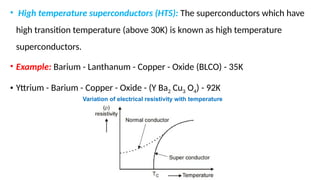
• High temperature superconductors (HTS): The superconductors which have
high transition temperature (above 30K) is known as high temperature
superconductors.
• Example: Barium - Lanthanum - Copper - Oxide (BLCO) - 35K
• Yttrium - Barium - Copper - Oxide - (Y Ba2 Cu3 O4) - 92K
Variation of electrical resistivity with temperature
PROPERTIES OF SUPERCONDUCTORS
• At Critical temperature, the following properties are observed
• The electrical resistivity drops to zero.
• The magnetic flux lines are excluded (ejected out) from the
superconductors.
• There is discontinuous change in the specific heat
• There are small changes in the thermal conductivity and volume
of the materials
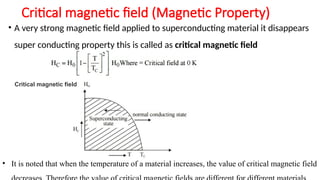
Critical magnetic field (Magnetic Property)
• A very strong magnetic field applied to superconducting material it disappears
super conducting property this is called as critical magnetic field
Critical magnetic field
• It is noted that when the temperature of a material increases, the value of critical magnetic field
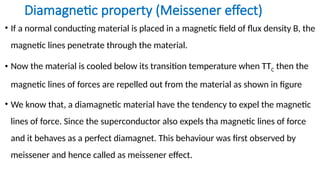
Diamagnetic property (Meissener effect)
• If a normal conducting material is placed in a magnetic field of flux density B, the
magnetic lines penetrate through the material.
• Now the material is cooled below its transition temperature when TTC then the
magnetic lines of forces are repelled out from the material as shown in figure
• We know that, a diamagnetic material have the tendency to expel the magnetic
lines of force. Since the superconductor also expels tha magnetic lines of force
and it behaves as a perfect diamagnet. This behaviour was first observed by
meissener and hence called as meissener effect.
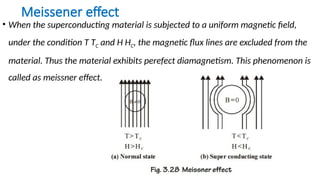
Meissener effect
• When the superconducting material is subjected to a uniform magnetic field,
under the condition T TC and H HC, the magnetic flux lines are excluded from the
material. Thus the material exhibits perefect diamagnetism. This phenomenon is
called as meissner effect.
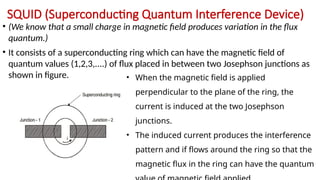
SQUID (Superconducting Quantum Interference Device)
• (We know that a small charge in magnetic field produces variation in the flux
quantum.)
• It consists of a superconducting ring which can have the magnetic field of
quantum values (1,2,3,....) of flux placed in between two Josephson junctions as
shown in figure. • When the magnetic field is applied
perpendicular to the plane of the ring, the
current is induced at the two Josephson
junctions.
• The induced current produces the interference
pattern and if flows around the ring so that the
magnetic flux in the ring can have the quantum
Applications
• SQUID can be used to defect the variation of very minute magnetic
signals in terms of quantum flux.
• It is used as a storage device for magnetic flux.
• It is used to study earth qurkes and to remove paramagnetic
impurities
Application of Meissner effect
• It is a standard test to prove whether the material is a perfect superconductor
or not.
• This effect is used for magnetic levitated train.
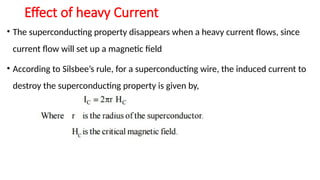
Effect of heavy Current
• The superconducting property disappears when a heavy current flows, since
current flow will set up a magnetic field
• According to Silsbee’s rule, for a superconducting wire, the induced current to
destroy the superconducting property is given by,
Persistence of Current
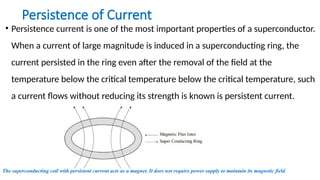
• Persistence current is one of the most important properties of a superconductor.
When a current of large magnitude is induced in a superconducting ring, the
current persisted in the ring even after the removal of the field at the
temperature below the critical temperature below the critical temperature, such
a current flows without reducing its strength is known is persistent current.
The superconducting coil with persistent current acts as a magnet. It does not require power supply to maintain its magnetic field
Effect of pressure
• If pressure increases, the critical temperature also increases.
• Therefore certain materials are brought into the superconducting state
by increasing the pressure.
• Research is going on to get the superconducting state at room
temperature by applying heavy pressure
Isotope effect
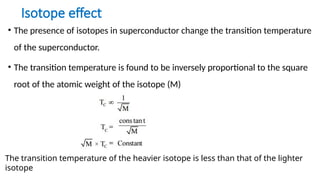
• The presence of isotopes in superconductor change the transition temperature
of the superconductor.
• The transition temperature is found to be inversely proportional to the square
root of the atomic weight of the isotope (M)
The transition temperature of the heavier isotope is less than that of the lighter
isotope
General properties
• There is no change in elastic properties, photo electric properties and crystal
structure.
• The transition temperature is unchanged with the frequency variation.
TYPES OF SUPER CONDUCTORS
• Superconductors are classified as follows
Based on the value of HC we have,
• Type I (or) Soft superconductors
• Type II (or) Hard superconductors
• Based on the value of TC we have,
• High temperature superconductors
• Low temperature superconductors
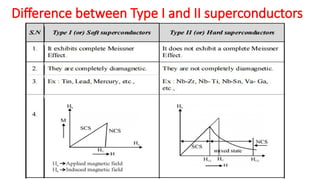
Type I Superconductor
• In type I superconductor, the magnetic field is completely excluded from the
material below the critical magnetic field and the material loses its
superconducting property abruptly at.
Characteristics
• They exhibit complete Meissner Effect
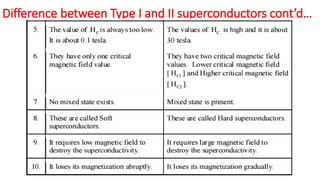
• They have only one critical magnetic field value.
• Below the material behaves as superconductor and above the
material behaves as normal conductor.
• These are called as Soft superconductors.
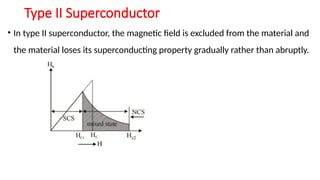
Type II Superconductor
• In type II superconductor, the magnetic field is excluded from the material and
the material loses its superconducting property gradually rather than abruptly.
Characteristics
• They do not exhibit a complete Meissner Effect.
• They have two critical magnetic field values. Lower critical magnetic filed [HCl]
and Higher critical magnetic field [HC2].
• Below HC1 the material behaves as superconductor and above the material
behaves as normal conductor. The region in between [HCl] and [HC2] is called
mixed state or vortex region.
• These are called as Hard superconductors.
Low TC Superconductors
• The superconductors having the critical temperature less than 20 K are known as
low TC Superconductors or elemental superconductors.
• The Superconductors by BCS theory.
• It is explained by BCS theory.
• It is not so useful due to its low temperature maintenance
• It is called as N-type superconductor
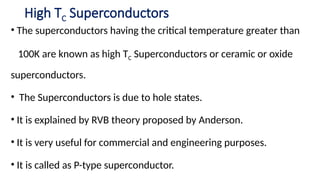
High TC Superconductors
• The superconductors having the critical temperature greater than
100K are known as high TC Superconductors or ceramic or oxide
superconductors.
• The Superconductors is due to hole states.
• It is explained by RVB theory proposed by Anderson.
• It is very useful for commercial and engineering purposes.
• It is called as P-type superconductor.
Difference between Type I and II superconductors
Difference between Type I and II superconductors cont’d…
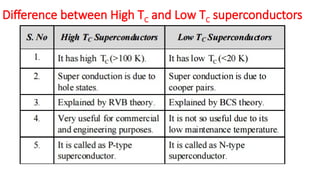
Difference between High TC and Low TC superconductors
High TC Superconductors
1. It has high TC (>100 K).
2. Super conduction is due to hole states.
3. Explained by RVB theory.
4. Very useful for commercial and engineering
purposes.
5. It is called as P-type superconductor.
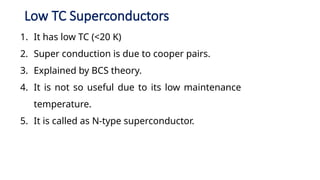
Low TC Superconductors
1. It has low TC (<20 K)
2. Super conduction is due to cooper pairs.
3. Explained by BCS theory.
4. It is not so useful due to its low maintenance
temperature.
5. It is called as N-type superconductor.
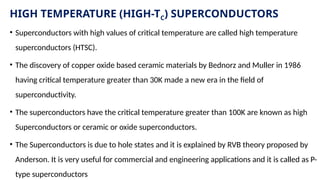
HIGH TEMPERATURE (HIGH-TC) SUPERCONDUCTORS
• Superconductors with high values of critical temperature are called high temperature
superconductors (HTSC).
• The discovery of copper oxide based ceramic materials by Bednorz and Muller in 1986
having critical temperature greater than 30K made a new era in the field of
superconductivity.
• The superconductors have the critical temperature greater than 100K are known as high
Superconductors or ceramic or oxide superconductors.
• The Superconductors is due to hole states and it is explained by RVB theory proposed by
Anderson. It is very useful for commercial and engineering applications and it is called as P-
type superconductors
Characteristics
• High TC
Superconductors have high temperatures.
• They have a modified perovskite crystal structure.
• Superconducting state is direction dependent.
• These are oxides of copper with other elements.
• These are reactive, brittle, and cannot be easily modified or joined.
• For high TC
superconductors, liquid Nitrogen is used instead of liquid
helium
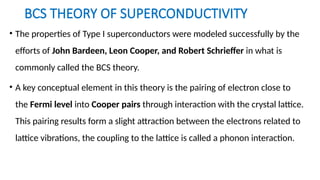
BCS THEORY OF SUPERCONDUCTIVITY
• The properties of Type I superconductors were modeled successfully by the
efforts of John Bardeen, Leon Cooper, and Robert Schrieffer in what is
commonly called the BCS theory.
• A key conceptual element in this theory is the pairing of electron close to
the Fermi level into Cooper pairs through interaction with the crystal lattice.
This pairing results form a slight attraction between the electrons related to
lattice vibrations, the coupling to the lattice is called a phonon interaction.
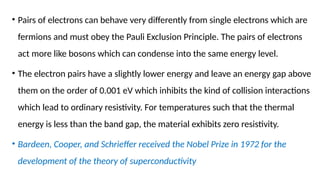
• Pairs of electrons can behave very differently from single electrons which are
fermions and must obey the Pauli Exclusion Principle. The pairs of electrons
act more like bosons which can condense into the same energy level.
• The electron pairs have a slightly lower energy and leave an energy gap above
them on the order of 0.001 eV which inhibits the kind of collision interactions
which lead to ordinary resistivity. For temperatures such that the thermal
energy is less than the band gap, the material exhibits zero resistivity.
• Bardeen, Cooper, and Schrieffer received the Nobel Prize in 1972 for the
development of the theory of superconductivity
Cooper Pairs
• The transition of a metal from the normal to the superconducting state has the nature
of a condensation of the electrons into a state which leaves a band gap above them,
this kind of condensation is seen with superfluid helium, but helium is made up of
bosons-multiple electrons can’t collect into a single state because of the Pauli Exclusion
Principle
• Froehlich was first to suggest that the electrons act as pairs coupled by lattice vibrations
in the material. This coupling is viewed as an exchange of phonons, phonons being the
quanta of lattice vibration energy.
• Experimental corroboration of an interaction with the lattice was provided by the
isotopic effect on the superconducting transition temperature.
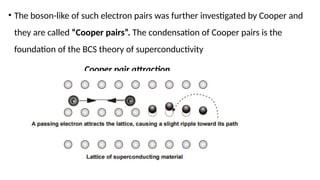
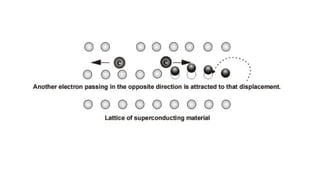
• The boson-like of such electron pairs was further investigated by Cooper and
they are called “Cooper pairs”. The condensation of Cooper pairs is the
foundation of the BCS theory of superconductivity
Cooper pair attraction
The introduction to Superconductors.pptx

The introduction to Superconductors.pptx

  • 1.
  • 2.
    INTRODUCTION TO SUPERCONDUCTIVITY •It was thought that the electrical resistance of a conductor becomes zero only at absolute zero temperature. But in 1911, H. Kammerlingh Onnes studied the properties of mercury at very low temperature using liquid helium and is found that the resistivity of mercury drops to zero at 4.2K and changes into a superconducting material
  • 3.
    Mathiessen’s rule It statesthat “the electrical resistivity Definition The ability of certain metals and alloys exhibit almost zero electrical resistivity when they are cooled to low temperature is known as superconducting. (ie., maximum conductivity with zero resistance at zero Kelvin) Each of these parameters is very dependent on the other two properties present.
  • 4.
    Critical temperature (TC ) (or) Transition Temperature • The temperature at which a normal conductor loses its resistivity and becomes a superconductor is known as critical temperature (or) Transition temperature. • Every superconductor has its own critical temperature at which it passes over into superconducting state.
  • 5.
    • Depending onthe transition temperature, superconductors are classified into two groups are • Low temperature superconductors (LTS): The superconductors which have low transition temperature (below 30K) are known as low temperature superconductors. • Example: Tin (3.2K), Mercury (4.15K)
  • 6.
    • High temperaturesuperconductors (HTS): The superconductors which have high transition temperature (above 30K) is known as high temperature superconductors. • Example: Barium - Lanthanum - Copper - Oxide (BLCO) - 35K • Yttrium - Barium - Copper - Oxide - (Y Ba2 Cu3 O4) - 92K Variation of electrical resistivity with temperature
  • 7.
    PROPERTIES OF SUPERCONDUCTORS •At Critical temperature, the following properties are observed • The electrical resistivity drops to zero. • The magnetic flux lines are excluded (ejected out) from the superconductors. • There is discontinuous change in the specific heat • There are small changes in the thermal conductivity and volume of the materials
  • 8.
    Critical magnetic field(Magnetic Property) • A very strong magnetic field applied to superconducting material it disappears super conducting property this is called as critical magnetic field Critical magnetic field • It is noted that when the temperature of a material increases, the value of critical magnetic field
  • 9.
    Diamagnetic property (Meissenereffect) • If a normal conducting material is placed in a magnetic field of flux density B, the magnetic lines penetrate through the material. • Now the material is cooled below its transition temperature when TTC then the magnetic lines of forces are repelled out from the material as shown in figure • We know that, a diamagnetic material have the tendency to expel the magnetic lines of force. Since the superconductor also expels tha magnetic lines of force and it behaves as a perfect diamagnet. This behaviour was first observed by meissener and hence called as meissener effect.
  • 10.
    Meissener effect • Whenthe superconducting material is subjected to a uniform magnetic field, under the condition T TC and H HC, the magnetic flux lines are excluded from the material. Thus the material exhibits perefect diamagnetism. This phenomenon is called as meissner effect.
  • 11.
    SQUID (Superconducting QuantumInterference Device) • (We know that a small charge in magnetic field produces variation in the flux quantum.) • It consists of a superconducting ring which can have the magnetic field of quantum values (1,2,3,....) of flux placed in between two Josephson junctions as shown in figure. • When the magnetic field is applied perpendicular to the plane of the ring, the current is induced at the two Josephson junctions. • The induced current produces the interference pattern and if flows around the ring so that the magnetic flux in the ring can have the quantum
  • 12.
    Applications • SQUID canbe used to defect the variation of very minute magnetic signals in terms of quantum flux. • It is used as a storage device for magnetic flux. • It is used to study earth qurkes and to remove paramagnetic impurities
  • 13.
    Application of Meissnereffect • It is a standard test to prove whether the material is a perfect superconductor or not. • This effect is used for magnetic levitated train.
  • 14.
    Effect of heavyCurrent • The superconducting property disappears when a heavy current flows, since current flow will set up a magnetic field • According to Silsbee’s rule, for a superconducting wire, the induced current to destroy the superconducting property is given by,
  • 15.
    Persistence of Current •Persistence current is one of the most important properties of a superconductor. When a current of large magnitude is induced in a superconducting ring, the current persisted in the ring even after the removal of the field at the temperature below the critical temperature below the critical temperature, such a current flows without reducing its strength is known is persistent current. The superconducting coil with persistent current acts as a magnet. It does not require power supply to maintain its magnetic field
  • 16.
    Effect of pressure •If pressure increases, the critical temperature also increases. • Therefore certain materials are brought into the superconducting state by increasing the pressure. • Research is going on to get the superconducting state at room temperature by applying heavy pressure
  • 17.
    Isotope effect • Thepresence of isotopes in superconductor change the transition temperature of the superconductor. • The transition temperature is found to be inversely proportional to the square root of the atomic weight of the isotope (M) The transition temperature of the heavier isotope is less than that of the lighter isotope
  • 18.
    General properties • Thereis no change in elastic properties, photo electric properties and crystal structure. • The transition temperature is unchanged with the frequency variation.
  • 19.
    TYPES OF SUPERCONDUCTORS • Superconductors are classified as follows Based on the value of HC we have, • Type I (or) Soft superconductors • Type II (or) Hard superconductors • Based on the value of TC we have, • High temperature superconductors • Low temperature superconductors
  • 20.
    Type I Superconductor •In type I superconductor, the magnetic field is completely excluded from the material below the critical magnetic field and the material loses its superconducting property abruptly at.
  • 21.
    Characteristics • They exhibitcomplete Meissner Effect • They have only one critical magnetic field value. • Below the material behaves as superconductor and above the material behaves as normal conductor. • These are called as Soft superconductors.
  • 22.
    Type II Superconductor •In type II superconductor, the magnetic field is excluded from the material and the material loses its superconducting property gradually rather than abruptly.
  • 23.
    Characteristics • They donot exhibit a complete Meissner Effect. • They have two critical magnetic field values. Lower critical magnetic filed [HCl] and Higher critical magnetic field [HC2]. • Below HC1 the material behaves as superconductor and above the material behaves as normal conductor. The region in between [HCl] and [HC2] is called mixed state or vortex region. • These are called as Hard superconductors.
  • 24.
    Low TC Superconductors •The superconductors having the critical temperature less than 20 K are known as low TC Superconductors or elemental superconductors. • The Superconductors by BCS theory. • It is explained by BCS theory. • It is not so useful due to its low temperature maintenance • It is called as N-type superconductor
  • 25.
    High TC Superconductors •The superconductors having the critical temperature greater than 100K are known as high TC Superconductors or ceramic or oxide superconductors. • The Superconductors is due to hole states. • It is explained by RVB theory proposed by Anderson. • It is very useful for commercial and engineering purposes. • It is called as P-type superconductor.
  • 26.
    Difference between TypeI and II superconductors
  • 27.
    Difference between TypeI and II superconductors cont’d…
  • 28.
    Difference between HighTC and Low TC superconductors
  • 29.
    High TC Superconductors 1.It has high TC (>100 K). 2. Super conduction is due to hole states. 3. Explained by RVB theory. 4. Very useful for commercial and engineering purposes. 5. It is called as P-type superconductor.
  • 30.
    Low TC Superconductors 1.It has low TC (<20 K) 2. Super conduction is due to cooper pairs. 3. Explained by BCS theory. 4. It is not so useful due to its low maintenance temperature. 5. It is called as N-type superconductor.
  • 31.
    HIGH TEMPERATURE (HIGH-TC)SUPERCONDUCTORS • Superconductors with high values of critical temperature are called high temperature superconductors (HTSC). • The discovery of copper oxide based ceramic materials by Bednorz and Muller in 1986 having critical temperature greater than 30K made a new era in the field of superconductivity. • The superconductors have the critical temperature greater than 100K are known as high Superconductors or ceramic or oxide superconductors. • The Superconductors is due to hole states and it is explained by RVB theory proposed by Anderson. It is very useful for commercial and engineering applications and it is called as P- type superconductors
  • 32.
    Characteristics • High TC Superconductorshave high temperatures. • They have a modified perovskite crystal structure. • Superconducting state is direction dependent. • These are oxides of copper with other elements. • These are reactive, brittle, and cannot be easily modified or joined. • For high TC superconductors, liquid Nitrogen is used instead of liquid helium
  • 33.
    BCS THEORY OFSUPERCONDUCTIVITY • The properties of Type I superconductors were modeled successfully by the efforts of John Bardeen, Leon Cooper, and Robert Schrieffer in what is commonly called the BCS theory. • A key conceptual element in this theory is the pairing of electron close to the Fermi level into Cooper pairs through interaction with the crystal lattice. This pairing results form a slight attraction between the electrons related to lattice vibrations, the coupling to the lattice is called a phonon interaction.
  • 34.
    • Pairs ofelectrons can behave very differently from single electrons which are fermions and must obey the Pauli Exclusion Principle. The pairs of electrons act more like bosons which can condense into the same energy level. • The electron pairs have a slightly lower energy and leave an energy gap above them on the order of 0.001 eV which inhibits the kind of collision interactions which lead to ordinary resistivity. For temperatures such that the thermal energy is less than the band gap, the material exhibits zero resistivity. • Bardeen, Cooper, and Schrieffer received the Nobel Prize in 1972 for the development of the theory of superconductivity
  • 35.
    Cooper Pairs • Thetransition of a metal from the normal to the superconducting state has the nature of a condensation of the electrons into a state which leaves a band gap above them, this kind of condensation is seen with superfluid helium, but helium is made up of bosons-multiple electrons can’t collect into a single state because of the Pauli Exclusion Principle • Froehlich was first to suggest that the electrons act as pairs coupled by lattice vibrations in the material. This coupling is viewed as an exchange of phonons, phonons being the quanta of lattice vibration energy. • Experimental corroboration of an interaction with the lattice was provided by the isotopic effect on the superconducting transition temperature.
  • 36.
    • The boson-likeof such electron pairs was further investigated by Cooper and they are called “Cooper pairs”. The condensation of Cooper pairs is the foundation of the BCS theory of superconductivity Cooper pair attraction