Downloaded 58 times

![Properties
Electrical resistance:
Electrical resistance of a super conductor is very low and is the order of 10-7 ohm
meter.
Effect of impurities:
When impurities are added, superconducting property is not lost but Tc value is
lowered.
Isotope effect:
The Tc is inversely proportional to the square root of isotopic mass of single
superconductor.
Magnetic field effect:
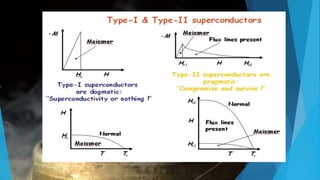
The minimum magnetic field required to destroy the superconducting state is called
the critical magnetic field (Hc).
Hc=H0[1-(T/Tc )2]](https://image.slidesharecdn.com/superconductivity-150507170054-lva1-app6891/85/Super-conductivity-3-320.jpg)
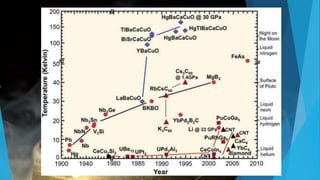
![High temperature superconductors
Until 1986, physicists had believed that BCS theory forbade superconductivity at temperatures
above about 30 K. In that year, Bednorz and Müller discovered superconductivity in a
lanthanum-based cuprate perovskite material, which had a transition temperature of 35 K (Nobel
Prize in Physics, 1987).[2] It was soon found that replacing the lanthanum with yttrium (i.e.,
making YBCO) raised the critical temperature to 92 K.[30]
Since about 1993, the highest temperature superconductor was a ceramic material consisting of
mercury, barium, calcium, copper and oxygen (HgBa2Ca2Cu3O8+δ) with Tc = 133–138
K.[34][35] The latter experiment (138 K) still awaits experimental confirmation, however.
In February 2008, an iron-based family of high-temperature superconductors was
discovered.[36][37] Hideo Hosono, of the Tokyo Institute of Technology, and colleagues found
lanthanum oxygen fluorine iron arsenide (LaO1-xFxFeAs), an oxypnictide that superconducts
below 26 K. Replacing the lanthanum in LaO1−xFxFeAs with samarium leads to
superconductors that work at 55 K.[38]](https://image.slidesharecdn.com/superconductivity-150507170054-lva1-app6891/85/Super-conductivity-7-320.jpg)






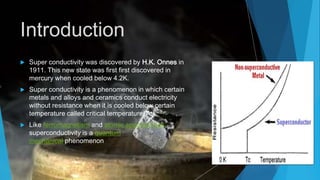
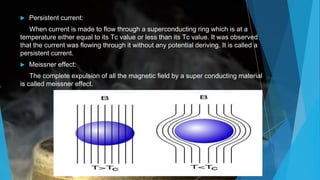
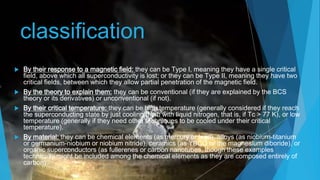
Superconductivity was discovered in 1911 by H.K. Onnes when mercury was cooled below 4.2K. Superconductors conduct electricity without resistance below a critical temperature called Tc. They expel all magnetic fields (Meissner effect) and allow persistent currents to flow without resistance. Superconductors are classified by their response to magnetic fields, theoretical explanations, critical temperatures, and materials. High temperature superconductors with Tc above 77K were discovered in 1986 and have Tc as high as 138K. Applications include SQUIDs, Josephson junctions, and future uses such as power grids, motors, and maglev trains.


