Definition
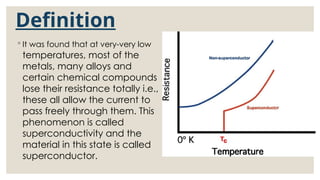
◦ It wasfound that at very-very low
temperatures, most of the
metals, many alloys and
certain chemical compounds
lose their resistance totally i.e.,
these all allow the current to
pass freely through them. This
phenomenon is called
superconductivity and the
material in this state is called
superconductor.
3.
History
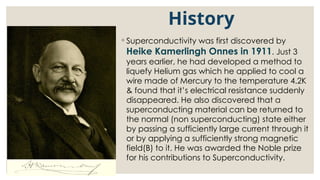
◦ Superconductivity wasfirst discovered by
Heike Kamerlingh Onnes in 1911. Just 3
years earlier, he had developed a method to
liquefy Helium gas which he applied to cool a
wire made of Mercury to the temperature 4.2K
& found that it’s electrical resistance suddenly
disappeared. He also discovered that a
superconducting material can be returned to
the normal (non superconducting) state either
by passing a sufficiently large current through it
or by applying a sufficiently strong magnetic
field(B) to it. He was awarded the Noble prize
for his contributions to Superconductivity.
4.
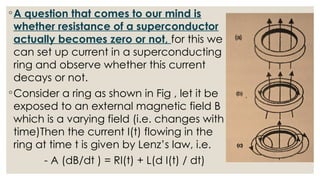
◦A question thatcomes to our mind is
whether resistance of a superconductor
actually becomes zero or not, for this we
can set up current in a superconducting
ring and observe whether this current
decays or not.
◦Consider a ring as shown in Fig , let it be
exposed to an external magnetic field B
which is a varying field (i.e. changes with
time)Then the current I(t) flowing in the
ring at time t is given by Lenz’s law, i.e.
- A (dB/dt ) = RI(t) + L(d I(t) / dt)
5.
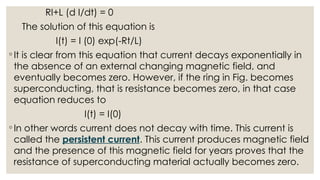
RI+L (d I/dt)= 0
The solution of this equation is
I(t) = I (0) exp(-Rt/L)
◦ It is clear from this equation that current decays exponentially in
the absence of an external changing magnetic field, and
eventually becomes zero. However, if the ring in Fig. becomes
superconducting, that is resistance becomes zero, in that case
equation reduces to
I(t) = I(0)
◦ In other words current does not decay with time. This current is
called the persistent current. This current produces magnetic field
and the presence of this magnetic field for years proves that the
resistance of superconducting material actually becomes zero.
6.
Critical Temperature
The temperatureat which electrical resistance is zero is called
the Critical temperature (T)
◦ The cooling of the material can be achieved using liquid
nitrogen or liquid helium for even more lower temperature.
• Low temperature superconductors (LTS):The superconductors
which have low transition temperature (below 30K) are known as low
temperature superconductors. Example: Tin (3.2 K), Mercury (4.15 K).
• High temperature superconductors (HTS): The superconductors
which have high transition temperature (above 30K) is known as high
temperature superconductors. Example: Barium - Lanthanum - Copper -
Oxide (BLCO)-35 K Yttrium-Barium-Copper - Oxide-(Y Ba2 Cu3 04)-92 K
7.
EFFECT OF MAGNETICFIELD
(THE CRITICAL FIELD)
◦It is observed that if the superconductor is placed in a sufficiently
strong magnetic field, the superconductor becomes a normal
conductor i.e. Resistance again comes into picture.
◦The field at which superconductivity is destroyed is called the
critical field H{c}.
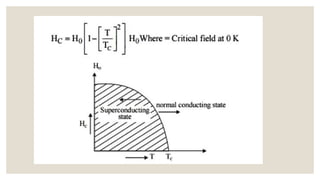
◦This critical field is a function of temperature. A graph for H,
versus temperature is shown in Fig. This type of graph is known as
magnetic phase diagram.
◦ It is found that superconducting state is stable only for certain
ranges of temperature and field. The relation between critical
field and temperature is given as…
9.
Silsbee Effect
◦It wasthought that by passing a large current through
a superconductor, a strong permanent magnet could
be produced but it was found by Silsbee in 1916 that
the magnet produced in this way also destroys the
superconductivity of the material. Hence the reason
for the destruction of superconductivity is magnetic
field associated with the current and not the current
itself. This effect poses a limit to the current to be
passed through a superconductor.
10.
MEISSNER EFFECT
(PERFECT DIAMAGNETISM)
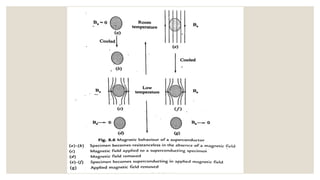
In1993 Meissner found that a superconductor expels
all the magnetic flux as soon as transition temperature
T_{c} is reached, while the sample is lying in an external
magnetic field. This means that superconductors
behave as perfect diamagnet. This situation occurs
even if T, is reached first and then applying magnetic
field. In this case again no magnetic flux enters the
sample. This phenomenon of expelling magnetic flux
by a superconductor is known as Meissner effect. This is
illustrated in Fig.
12.
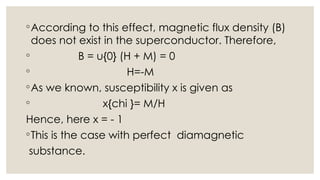
◦According to thiseffect, magnetic flux density (B)
does not exist in the superconductor. Therefore,
◦ B = u{0} (H + M) = 0
◦ H=-M
◦As we known, susceptibility x is given as
◦ x{chi }= M/H
Hence, here x = - 1
◦This is the case with perfect diamagnetic
substance.
13.
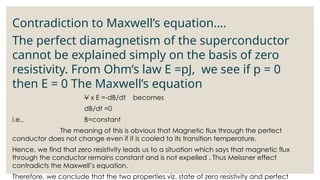
Contradiction to Maxwell’sequation….
The perfect diamagnetism of the superconductor
cannot be explained simply on the basis of zero
resistivity. From Ohm’s law E =pJ, we see if p = 0
then E = 0 The Maxwell’s equation
V x E =-dB/dt becomes
dB/dt =0
i.e., B=constant
The meaning of this is obvious that Magnetic flux through the perfect
conductor does not change even if it is cooled to its transition temperature.
Hence, we find that zero resistivity leads us to a situation which says that magnetic flux
through the conductor remains constant and is not expelled . Thus Meissner effect
contradicts the Maxwell’s equation.
Therefore, we conclude that the two properties viz. state of zero resistivity and perfect
14.
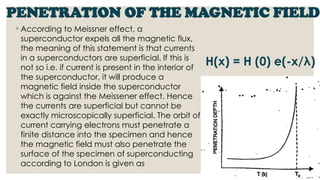
PENETRATION OF THEMAGNETIC FIELD
◦ According to Meissner effect, a
superconductor expels all the magnetic flux,
the meaning of this statement is that currents
in a superconductors are superficial. If this is
not so i.e. if current is present in the interior of
the superconductor, it will produce a
magnetic field inside the superconductor
which is against the Meissener effect. Hence
the currents are superficial but cannot be
exactly microscopically superficial. The orbit of
current carrying electrons must penetrate a
finite distance into the specimen and hence
the magnetic field must also penetrate the
surface of the specimen of superconducting
according to London is given as
H(x) = H (0) e(-x/λ)
15.
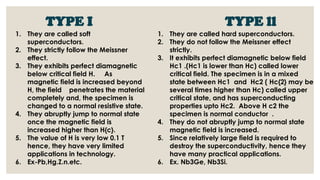
TYPE I TYPEll
1. They are called soft
superconductors.
2. They strictly follow the Meissner
effect.
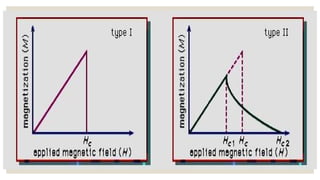
3. They exhibits perfect diamagnetic
below critical field H. As
magnetic field is increased beyond
H, the field penetrates the material
completely and, the specimen is
changed to a normal resistive state.
4. They abruptly jump to normal state
once the magnetic field is
increased higher than H{c}.
5. The value of H is very low 0.1 T
hence, they have very limited
applications in technology.
6. Ex-Pb,Hg.Z.n.etc.
1. They are called hard superconductors.
2. They do not follow the Meissner effect
strictly.
3. It exhibits perfect diamagnetic below field
Hc1 .(Hc1 is lower than Hc) called lower
critical field. The specimen is in a mixed
state between Hc1 and Hc2 ( Hc{2} may be
several times higher than Hc) called upper
critical state, and has superconducting
properties upto Hc2. Above H c2 the
specimen is normal conductor .
4. They do not abruptly jump to normal state
magnetic field is increased.
5. Since relatively large field is required to
destroy the superconductivity, hence they
have many practical applications.
6. Ex. Nb3Ge, Nb3Si.
17.
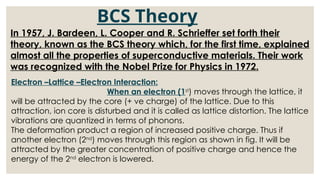
BCS Theory
In 1957,J. Bardeen, L. Cooper and R. Schrieffer set forth their
theory, known as the BCS theory which, for the first time, explained
almost all the properties of superconductive materials. Their work
was recognized with the Nobel Prize for Physics in 1972.
Electron –Lattice –Electron Interaction:
When an electron (1st
) moves through the lattice, it
will be attracted by the core (+ ve charge) of the lattice. Due to this
attraction, ion core is disturbed and it is called as lattice distortion. The lattice
vibrations are quantized in terms of phonons.
The deformation product a region of increased positive charge. Thus if
another electron (2nd
) moves through this region as shown in fig. It will be
attracted by the greater concentration of positive charge and hence the
energy of the 2nd
electron is lowered.
18.
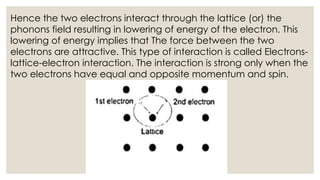
Hence the twoelectrons interact through the lattice (or) the
phonons field resulting in lowering of energy of the electron. This
lowering of energy implies that The force between the two
electrons are attractive. This type of interaction is called Electrons-
lattice-electron interaction. The interaction is strong only when the
two electrons have equal and opposite momentum and spin.
19.
Explanation
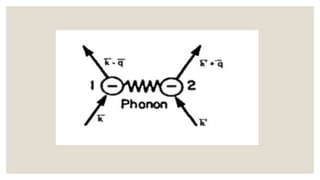
Consider the 1stelectron with wave vector k
distorts the lattice, there by emitting a phonons
of wave vector q. This result in the wave vector k-
q for the 1 electron. Now if the 2nd electron with
wave vector k’, seeks the lattice, it takes Up the
energy from the lattice and its wave sector
changes to k’+q as shown in the Fig. Two electrons
with wave vector k-q and k’+q from a pair of
electrons known as Cooper pairs.
21.
Cooper pairs
The pairsof electrons formed due to electron
lattice – electron (phonons), electron-electron interaction
(forces of attraction) by overcoming the electron-electron
interaction (force of repulsion) with equal and opposite
momentum and spins i.e.., with wave vector k-q and k’+q
are called cooper pairs.
Coherence length
In the electron-lattice-electron interactions, the
electrons will not be fixed, they move in opposite
directions and their co-relations may persist over lengths
of maximum of 10^-6 m. This length is called coherence
length.
22.
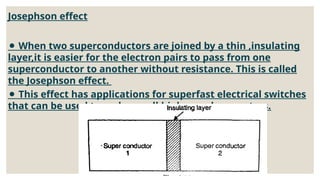
Josephson effect
⚫ Whentwo superconductors are joined by a thin ,insulating
layer,it is easier for the electron pairs to pass from one
superconductor to another without resistance. This is called
the Josephson effect.
⚫ This effect has applications for superfast electrical switches
that can be used to make small,high speed computers.
23.
Isotope Effect
◦It hasbeen observed that critical temperature
varies with isotopic mass..i.e.,critical temperature
is inversely proportional to the square root of
mass of the isotope.
Many elements having different no of Neutrons can have different mass.
He showed that Pb with an atomic mass 207 (from non radioactive ore)
& another Pb with M= 206( from Uranium ore) have different critical
temperature. This effect in superconductors can be summarized as
(M^p-T)= constant where p=1/2. But for some materials this value may
vary. The different values of P depend on vibration spectrum of real
crystal lattices.
24.
Applications of superconductors
SQUID(superconducting quantum interface device)
It is capable of sensing a very small change in the magnetic field
and is a very sensitive detector. Now, to make a study.. Into the
human body, some non-invasive means are to be used. When a
magnetic field derived from a strong superconductor is applied
across human body then hydrogen atoms in the water present in
human body and fat molecules are forced to accept magnetic
energy. When the magnetic field is switched off, the energy is
released. The frequency of the released energy can be detected
and displayed by a computer.
Such a technique is called magnetic resonance imaging (MRI).
25.
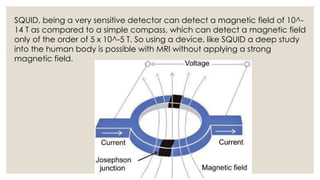
SQUID, being avery sensitive detector can detect a magnetic field of 10^-
14 T as compared to a simple compass, which can detect a magnetic field
only of the order of 5 x 10^-5 T. So using a device, like SQUID a deep study
into the human body is possible with MRI without applying a strong
magnetic field.
26.
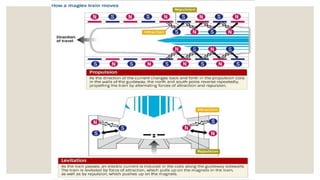
◦Magnetic levitation (MAGLEV):
Aswe know that a superconductor when
placed in a magnetic field repels the magnetic field. This
is because the material becomes a diamagnetic one
when placed in magnetic field. This phenomenon can be
observed experimentally when a light superconductor is
placed above a magnet. If the weight of the magnet is
less than force of repulsion then the magnet will be lifted
up. This is called magnetic levitation. Trains can virtually
be made to float on the superconducting magnets
eliminating the friction between the train and its track
which increase the speed of its journey.
28.
◦ The biggestproblem of the
superconductors is their “COOL” nature.
Creating a temperature near Ok is not a
easy job. Cooling arrangements involve a
huge cost.
SOLUTION
Scientists are
researching on how to create
superconductors at room temperature. So
they are basically dealing with high
temperature superconductors.
29.
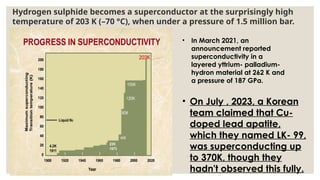
• In March2021, an
announcement reported
superconductivity in a
layered yttrium- palladium-
hydron material at 262 K and
a pressure of 187 GPa.
• On July , 2023, a Korean
team claimed that Cu-
doped lead apatite,
which they named LK- 99,
was superconducting up
to 370K, though they
hadn't observed this fully.
Hydrogen sulphide becomes a superconductor at the surprisingly high
temperature of 203 K (–70 °C), when under a pressure of 1.5 million bar.
 Most read
 Most read
 Most read