Superconductivity
IBRAHIM ABD ELHAMID AHMED
1
Main Items
 Introduction.
 Superconductivity.
 Meissner effect.
 Flux Quantization.
 Types of Superconductors.
 London Equations.
 BCS Theory.
 London Penetration Depth
 Applications of Super conductors.
14/02/2016
2
Introduction:
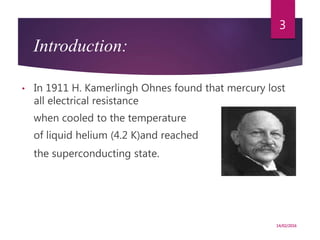
• In 1911 H. Kamerlingh Ohnes found that mercury lost
all electrical resistance
when cooled to the temperature
of liquid helium (4.2 K)and reached
the superconducting state.
14/02/2016
3
Superconductivity
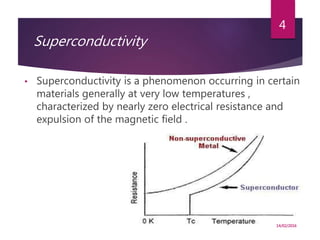
• Superconductivity is a phenomenon occurring in certain
materials generally at very low temperatures ,
characterized by nearly zero electrical resistance and
expulsion of the magnetic field .
14/02/2016
4
Response Of Magnetic Field
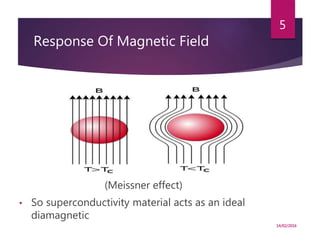
(Meissner effect)
• So superconductivity material acts as an ideal
diamagnetic
14/02/2016
5
Response Of Magnetic Field
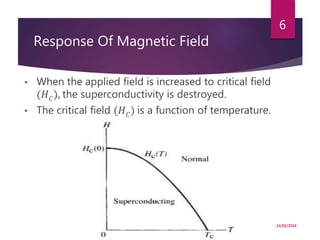
• When the applied field is increased to critical field
(𝐻 𝐶), the superconductivity is destroyed.
• The critical field (𝐻 𝐶) is a function of temperature.
14/02/2016
6
Response Of Magnetic Field
• This variation is empirically found to be represented by
the expression:
𝐻𝑐 𝑇 = 𝐻𝑐(0) 1 −
𝑇
𝑇𝑐
2
• Where 𝐻 𝐶(0) is the maximum value of the field
at 𝑇=0K. 𝐻 𝐶(0) And 𝑇𝑐 are constants of the material.
14/02/2016
7
Flux Quantization
• when a superconducting ring is placed in a magnetic
field and the field is removed, flux lines are trapped and
are maintained by a persistent current.
ɸ =
𝑛ℎ
2𝑒
= 𝑛ɸ0
14/02/2016
8
Types of Super conductors
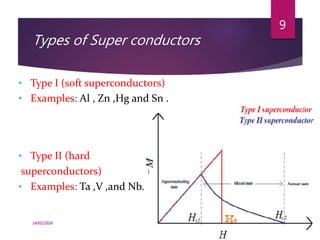
• Type I (soft superconductors)
• Examples: Al , Zn ,Hg and Sn .
• Type II (hard
superconductors)
• Examples: Ta ,V ,and Nb.
14/02/2016
9
London Equations
• Maxwell's equation:
𝛻 × 𝐸 =
−𝑑𝐵
𝑑𝑡
• The first London equation:
𝑑𝐽 𝑆
𝑑𝑡
=
𝑛 𝑠 𝑒2
𝑚
𝐸
• The second London equation:
𝛻 × 𝐽𝑠 = −
𝑛 𝑠 𝑒2
𝑚
𝐵
Where:
𝐽𝑠 : Current density of superelectron & 𝑛 𝑠: Superelectron
14/02/2016
10
Energy Gap
• The exponential behavior of the electronic specific heat
in superconducting state implies the presence of an
energy gap.
14/02/2016
11
BCS Theory
14/02/2016
12
London Penetration Depth
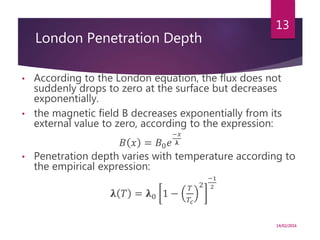
• According to the London equation, the flux does not
suddenly drops to zero at the surface but decreases
exponentially.
• the magnetic field B decreases exponentially from its
external value to zero, according to the expression:
𝐵 𝑥 = 𝐵0 𝑒
−𝑥
𝝺
• Penetration depth varies with temperature according to
the empirical expression:
𝛌 𝑇 = 𝛌0 1 −
𝑇
𝑇𝑐
2
−1
2
14/02/2016
13
London Penetration Depth
• λ increases with the increase of 𝑇 and becomes infinite
at T = 𝑇𝑐
• 𝑤 =
𝑛 𝑠
𝑛0
Where w is called
order parameter
14/02/2016
14
Applications of Superconductors
 SQUID:
• SQUID stands for Superconducting Quantum
Interference Device.
 MRI:
• MRI stands for magnetic resonance imaging.
 Maglev train
14/02/2016
15
Thank you
14/02/2016
16

Superconductivity

  • 1.
  • 2.
    Main Items  Introduction. Superconductivity.  Meissner effect.  Flux Quantization.  Types of Superconductors.  London Equations.  BCS Theory.  London Penetration Depth  Applications of Super conductors. 14/02/2016 2
  • 3.
    Introduction: • In 1911H. Kamerlingh Ohnes found that mercury lost all electrical resistance when cooled to the temperature of liquid helium (4.2 K)and reached the superconducting state. 14/02/2016 3
  • 4.
    Superconductivity • Superconductivity isa phenomenon occurring in certain materials generally at very low temperatures , characterized by nearly zero electrical resistance and expulsion of the magnetic field . 14/02/2016 4
  • 5.
    Response Of MagneticField (Meissner effect) • So superconductivity material acts as an ideal diamagnetic 14/02/2016 5
  • 6.
    Response Of MagneticField • When the applied field is increased to critical field (𝐻 𝐶), the superconductivity is destroyed. • The critical field (𝐻 𝐶) is a function of temperature. 14/02/2016 6
  • 7.
    Response Of MagneticField • This variation is empirically found to be represented by the expression: 𝐻𝑐 𝑇 = 𝐻𝑐(0) 1 − 𝑇 𝑇𝑐 2 • Where 𝐻 𝐶(0) is the maximum value of the field at 𝑇=0K. 𝐻 𝐶(0) And 𝑇𝑐 are constants of the material. 14/02/2016 7
  • 8.
    Flux Quantization • whena superconducting ring is placed in a magnetic field and the field is removed, flux lines are trapped and are maintained by a persistent current. ɸ = 𝑛ℎ 2𝑒 = 𝑛ɸ0 14/02/2016 8
  • 9.
    Types of Superconductors • Type I (soft superconductors) • Examples: Al , Zn ,Hg and Sn . • Type II (hard superconductors) • Examples: Ta ,V ,and Nb. 14/02/2016 9
  • 10.
    London Equations • Maxwell'sequation: 𝛻 × 𝐸 = −𝑑𝐵 𝑑𝑡 • The first London equation: 𝑑𝐽 𝑆 𝑑𝑡 = 𝑛 𝑠 𝑒2 𝑚 𝐸 • The second London equation: 𝛻 × 𝐽𝑠 = − 𝑛 𝑠 𝑒2 𝑚 𝐵 Where: 𝐽𝑠 : Current density of superelectron & 𝑛 𝑠: Superelectron 14/02/2016 10
  • 11.
    Energy Gap • Theexponential behavior of the electronic specific heat in superconducting state implies the presence of an energy gap. 14/02/2016 11
  • 12.
  • 13.
    London Penetration Depth •According to the London equation, the flux does not suddenly drops to zero at the surface but decreases exponentially. • the magnetic field B decreases exponentially from its external value to zero, according to the expression: 𝐵 𝑥 = 𝐵0 𝑒 −𝑥 𝝺 • Penetration depth varies with temperature according to the empirical expression: 𝛌 𝑇 = 𝛌0 1 − 𝑇 𝑇𝑐 2 −1 2 14/02/2016 13
  • 14.
    London Penetration Depth •λ increases with the increase of 𝑇 and becomes infinite at T = 𝑇𝑐 • 𝑤 = 𝑛 𝑠 𝑛0 Where w is called order parameter 14/02/2016 14
  • 15.
    Applications of Superconductors SQUID: • SQUID stands for Superconducting Quantum Interference Device.  MRI: • MRI stands for magnetic resonance imaging.  Maglev train 14/02/2016 15
  • 16.