SHANTILAL SHAH
ENGINEERING COLLEGE
(INSTRUMENTATION AND CONTROL
DEPARTMENT)
Roll no. Enrollment no. Name
3013 140430117015 GAMIT ANKITABEN ARVINDBHAI
3014 140430117016 GAMIT NAYANBHAI BABUBHAI
3015 140430117017 GAMIT SMITKUMAR KANTABHAI
3016 140430117018 ISHAN JATINKUMAR BHATT
3017 140430117019 JITIN J PILLAI
3018 140430117020 JOSHI MEETKUMAR DHARMENDRABHAI
Physics PPT
B.E. Sem-2 (I.C.) Batch-1 Group IC-3
APPLICATIONS
OF
SUPERCONDUCTIVITY
1. Low Temperature Liquid
Helium Superconductors Have
Been Used To Fabricate High
Field Magnets And Some
Electronic And Radio Frequency
Devices.
SUPERCONDUCTING MAGNETS
• We know that an electric current in a wire
creates a magnetic field around the wire.
The strength of the magnetic field
increases as the current in the wire
increases. Since SCs can carry large
currents without energy loss, they are well
suited for making strong magnets .
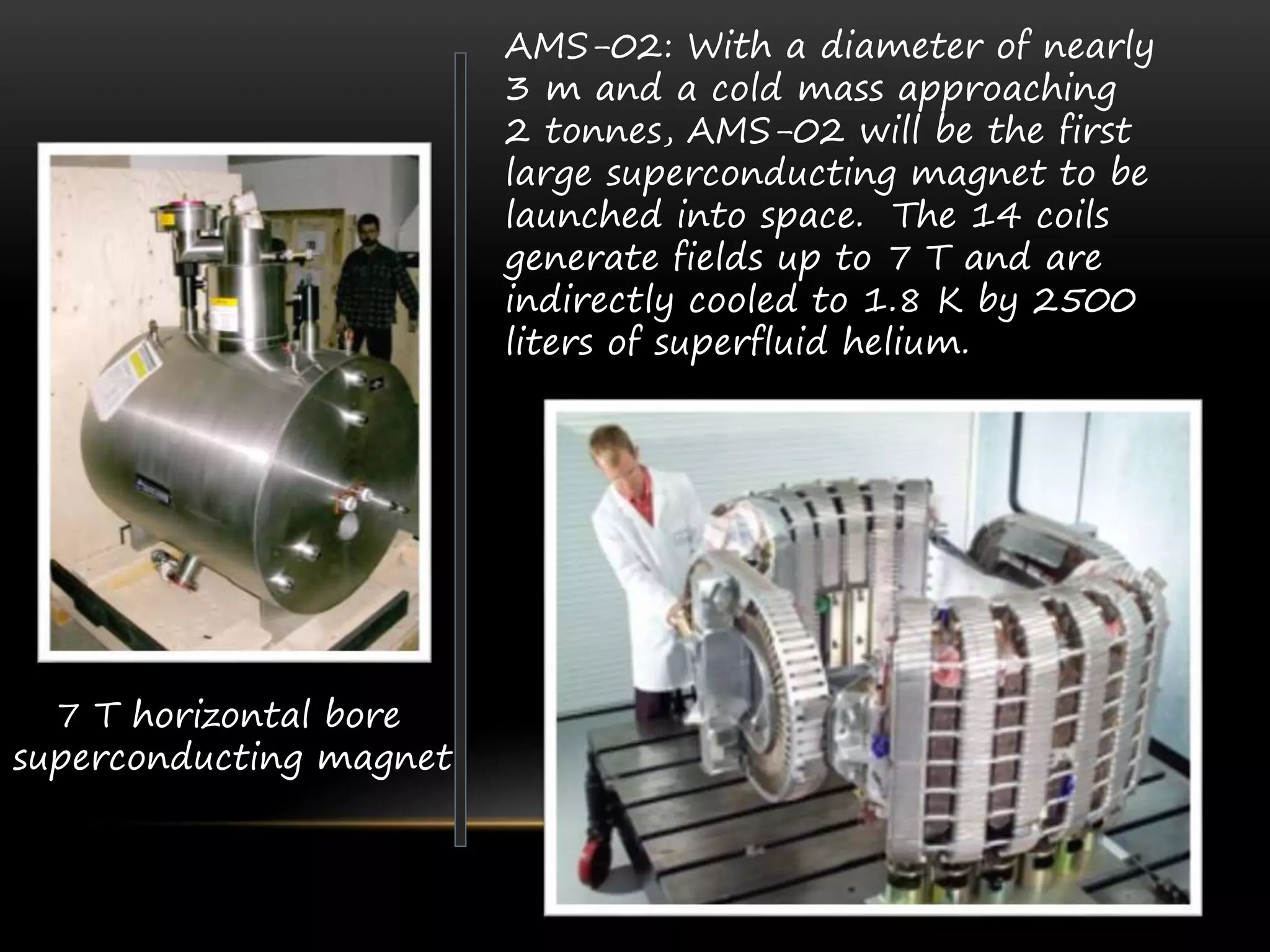
7 T horizontal bore
superconducting magnet
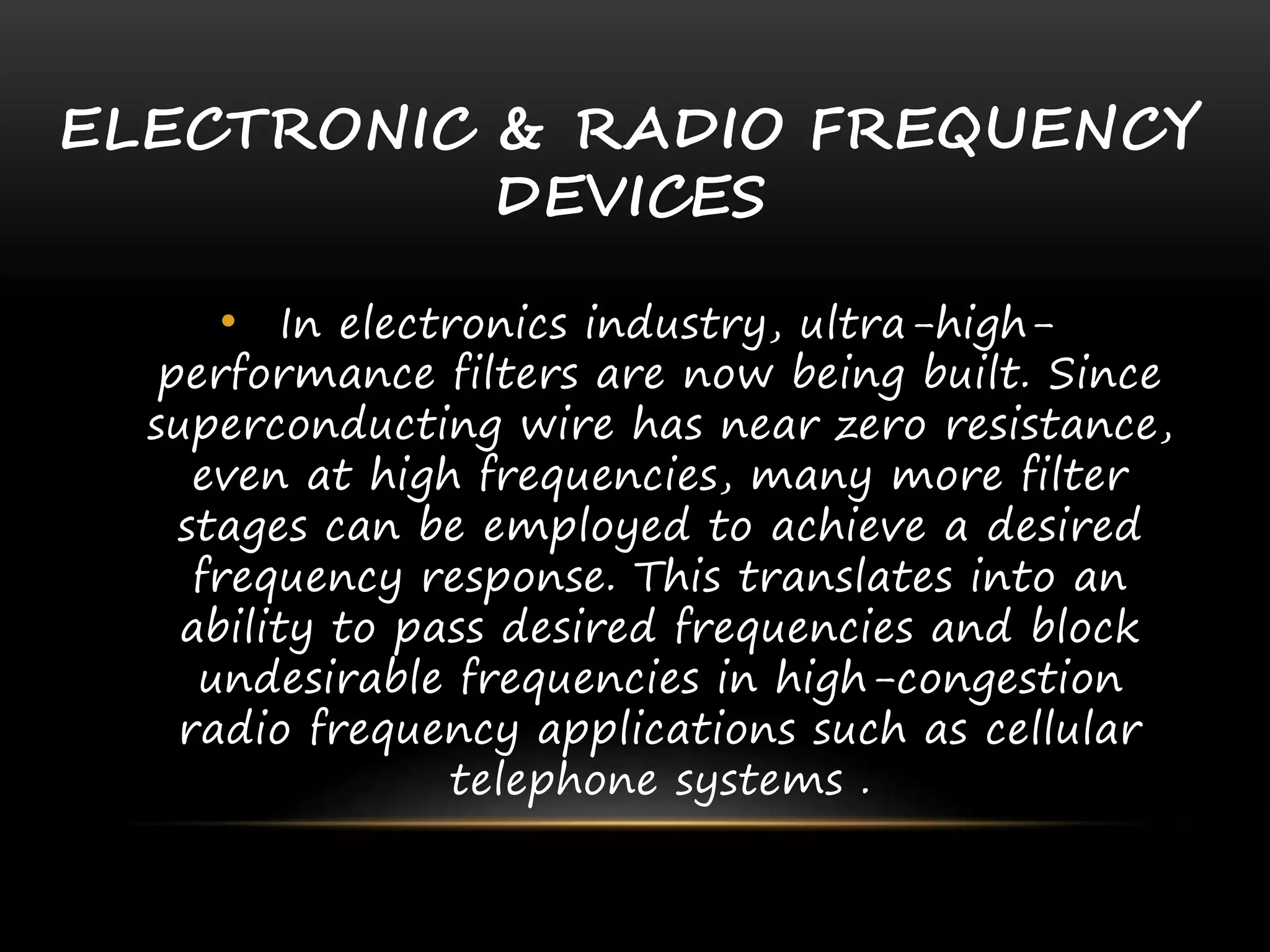
AMS-02: With a diameter of nearly
3 m and a cold mass approaching
2 tonnes, AMS-02 will be the first
large superconducting magnet to be
launched into space. The 14 coils
generate fields up to 7 T and are
indirectly cooled to 1.8 K by 2500
liters of superfluid helium.
ELECTRONIC & RADIO FREQUENCY
DEVICES
• In electronics industry, ultra-high-
performance filters are now being built. Since
superconducting wire has near zero resistance,
even at high frequencies, many more filter
stages can be employed to achieve a desired
frequency response. This translates into an
ability to pass desired frequencies and block
undesirable frequencies in high-congestion
radio frequency applications such as cellular
telephone systems .
2) The Superconducting Magnets
Have Been Employed In NMR
Spectrometers And NMR
Imaging Is Used In Medical
Diagnostics.
NUCLEAR MAGNETIC RESONANCE
(NMR) SPECTROMETERS
• NMR spectrometer technology uses
superconducting wires cooled with cryogens
(liquid helium & liquid nitrogen) to generate a
magnetic field. NMR spectrometers provide the
most homogenous magnetic fields and the
greatest spectral resolution. NMR spectroscopy
can be used for chemical analysis, reaction
monitoring, and quality assurance/quality
control experiments.
Higher-field instruments enable unparalleled
resolution for structure determination,
particularly for complex molecules.
NUCLEAR MAGNETIC
RESONANCE IMAGING (NMRI)
• On applying a strong superconductor derived
magnetic field into the body, hydrogen atoms that
exist in the body's water and fat molecules are
forced to accept energy from the magnetic field.
They then release this energy at a frequency that
can be detected and displayed graphically by a
computer.
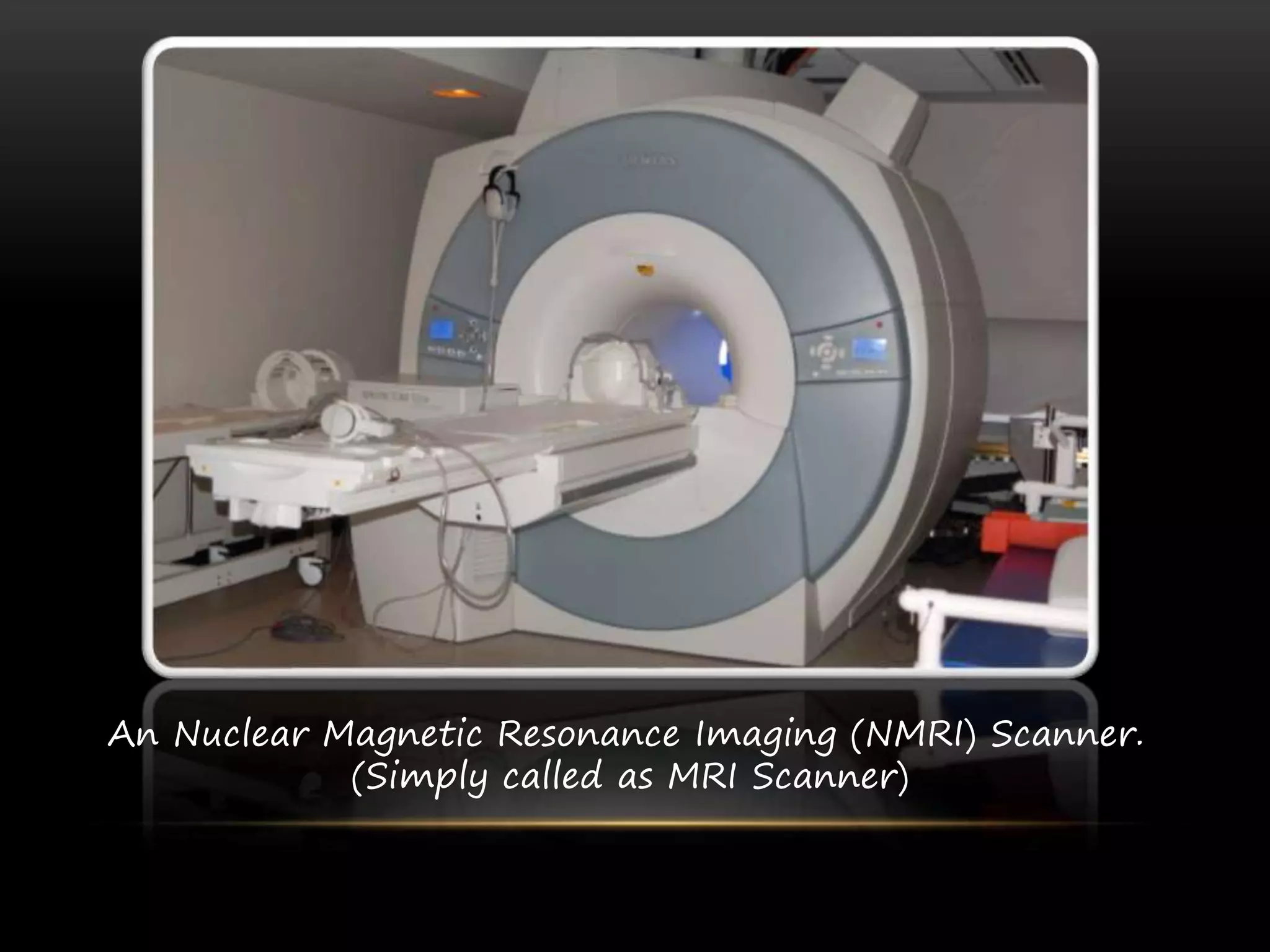
An Nuclear Magnetic Resonance Imaging (NMRI) Scanner.
(Simply called as MRI Scanner)
3) Superconductors Are Used For
Effective Magnetic Shielding.
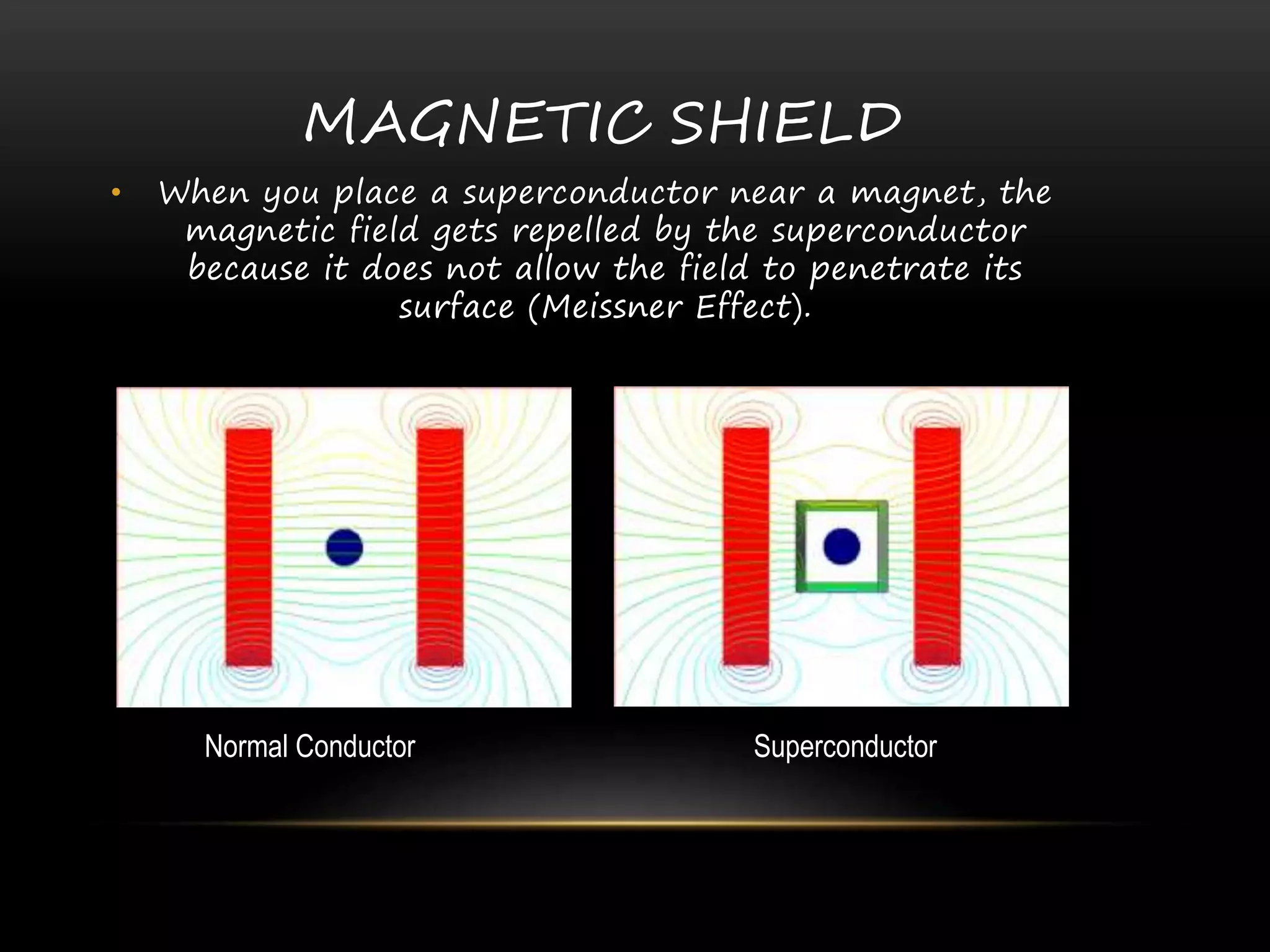
MAGNETIC SHIELD
• When you place a superconductor near a magnet, the
magnetic field gets repelled by the superconductor
because it does not allow the field to penetrate its
surface (Meissner Effect).
Normal Conductor Superconductor
4) Superconductors Are Used As
Magnetic Energy Storage.
SUPERCONDUCTING MAGNETIC
ENERGY STORAGE (SMES)
• SMES systems store energy in the magnetic field
created by the flow of direct current in
a superconducting coil.
• Once the superconducting coil is charged, the
current will not decay and the magnetic energy
can be stored indefinitely.
• The stored energy can be released back to the
network by discharging the coil.
• SMES loses the least amount of electricity in the
energy storage process compared to other methods
of storing energy. i.e. the SMES systems are highly
efficient; the round-trip efficiency is greater than
95%.
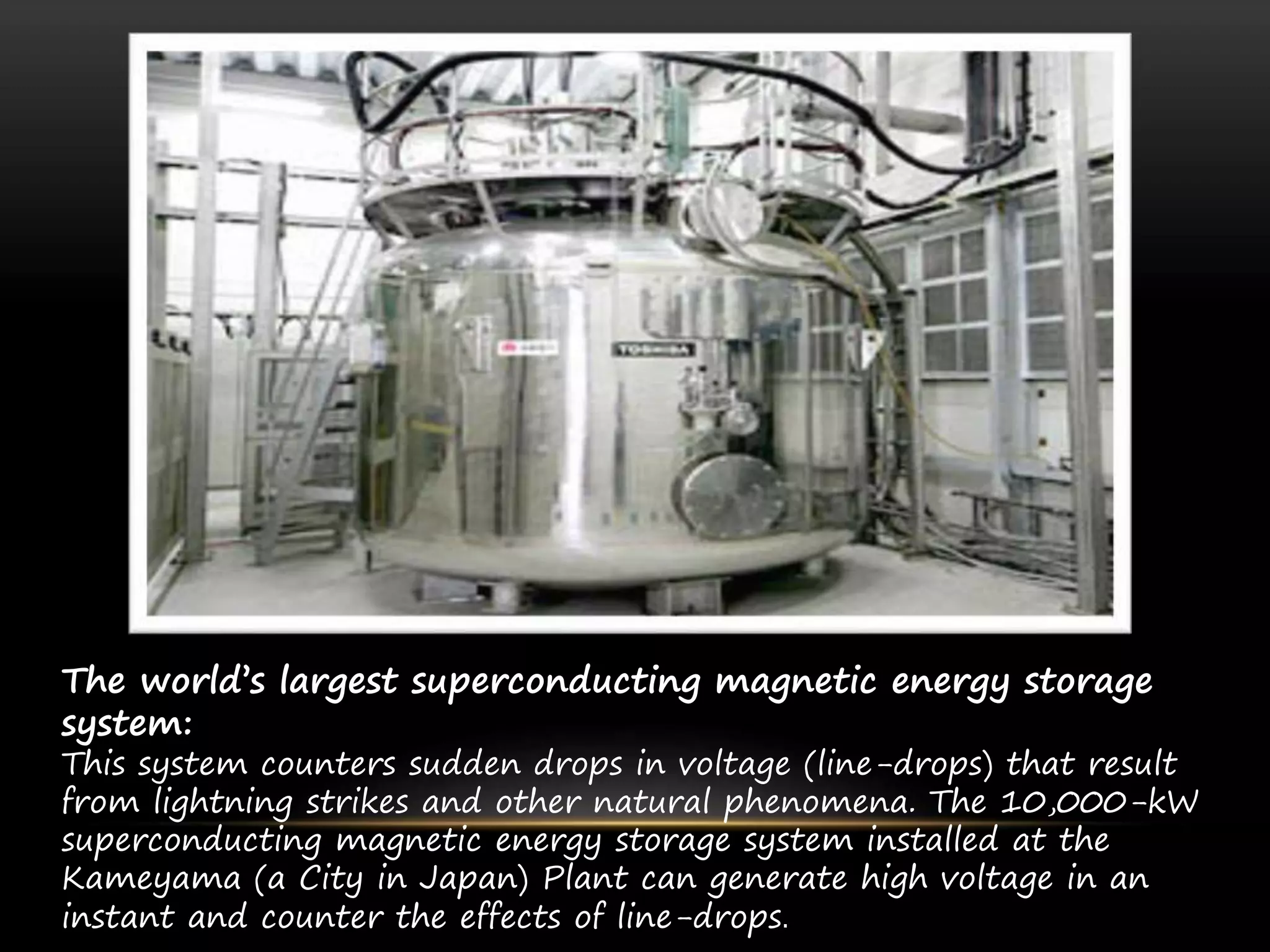
The world’s largest superconducting magnetic energy storage
system:
This system counters sudden drops in voltage (line-drops) that result
from lightning strikes and other natural phenomena. The 10,000-kW
superconducting magnetic energy storage system installed at the
Kameyama (a City in Japan) Plant can generate high voltage in an
instant and counter the effects of line-drops.
5) Superconductors Have Been
Used To Produce Various Devices
Based On Superconducting
Quantum Effects Such As
SQUIDS And Josephson Devices
SUPERCONDUCTING QUANTUM
INTERFERENCE DEVICE (SQUID)
• A SQUID is a very sensitive
magnetometer used to measure extreme
low magnetic fields.
• SQUIDs are sensitive enough to
measure fields as low as 5×10⁻¹⁸ T
(i.e. can detect a change of energy as much as
100 billion times weaker than the
electromagnetic energy that moves a compass
needle, such as subtle changes in the human
body's electromagnetic energy field)
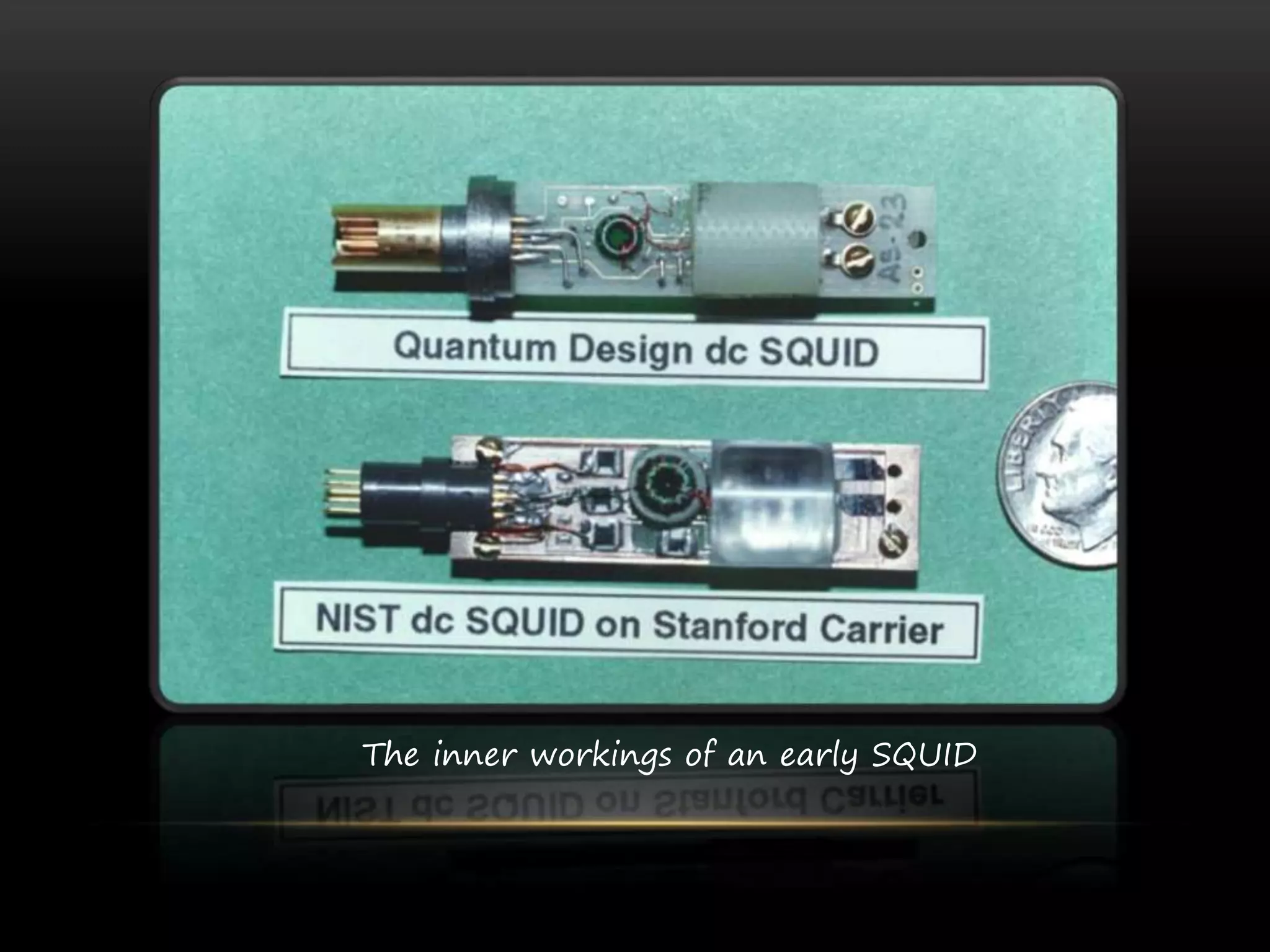
The inner workings of an early SQUID
JOSEPHSON DEVICES
• In 1962 Brian D. Josephson predicted that
electrical current would flow between two
superconducting materials, even when they are
separated by a non-superconductor or
insulator. His prediction was later confirmed
and won him a share of the 1973 Nobel Prize
in Physics. This tunneling phenomenon is today
known as the "Josephson effect“
• SQUIDs work based on the Josephson effect.
Devices that work based on the principle of
Josephson effect are called Josephson Devices.
6) For High Speed Magnetic
Trains And Ship Drive System
Superconductors Are Used.
MAGLEV TRAINS
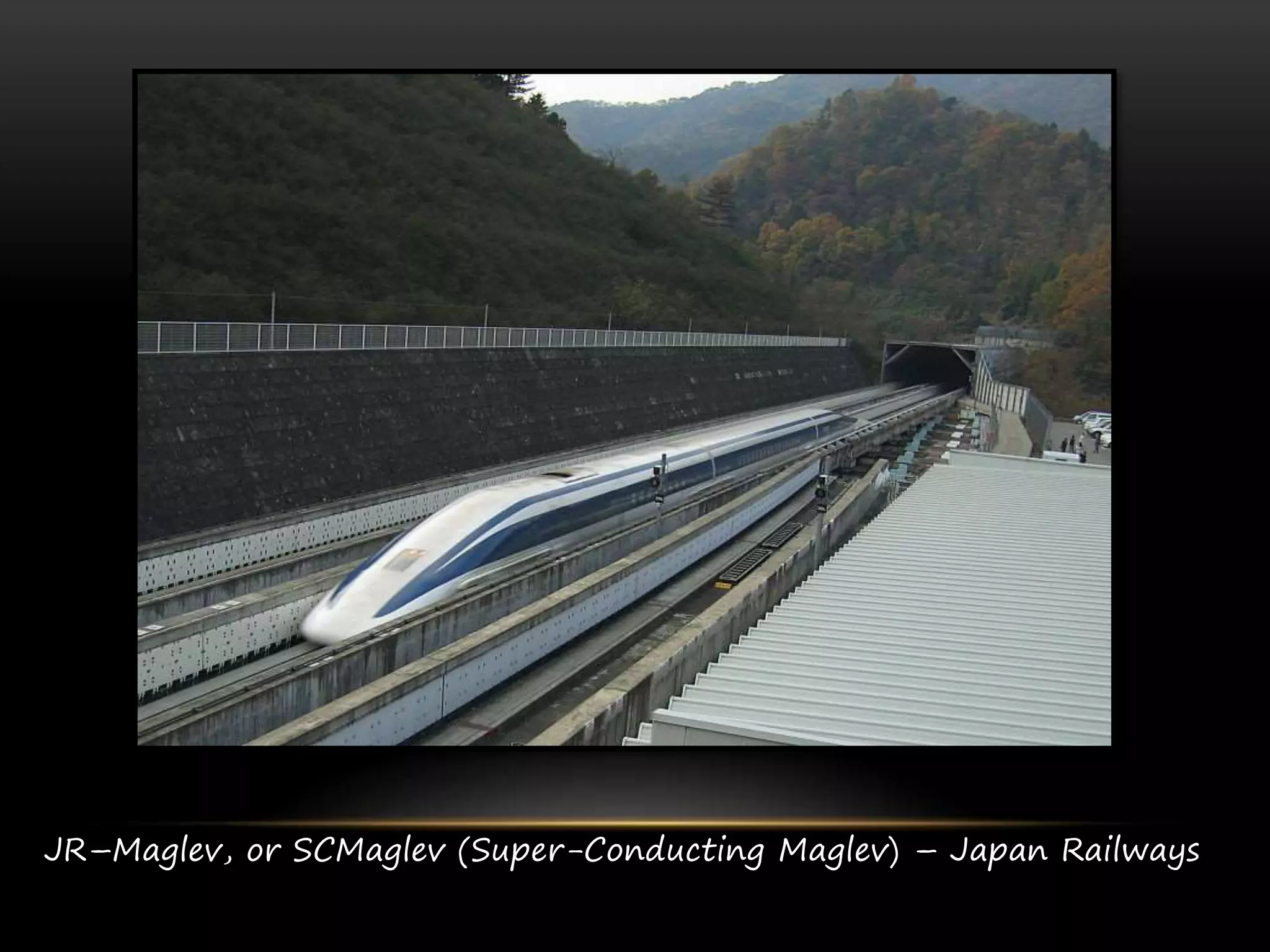
• The Maglev (derived from Magnetic
Levitation) train system works by utilizing
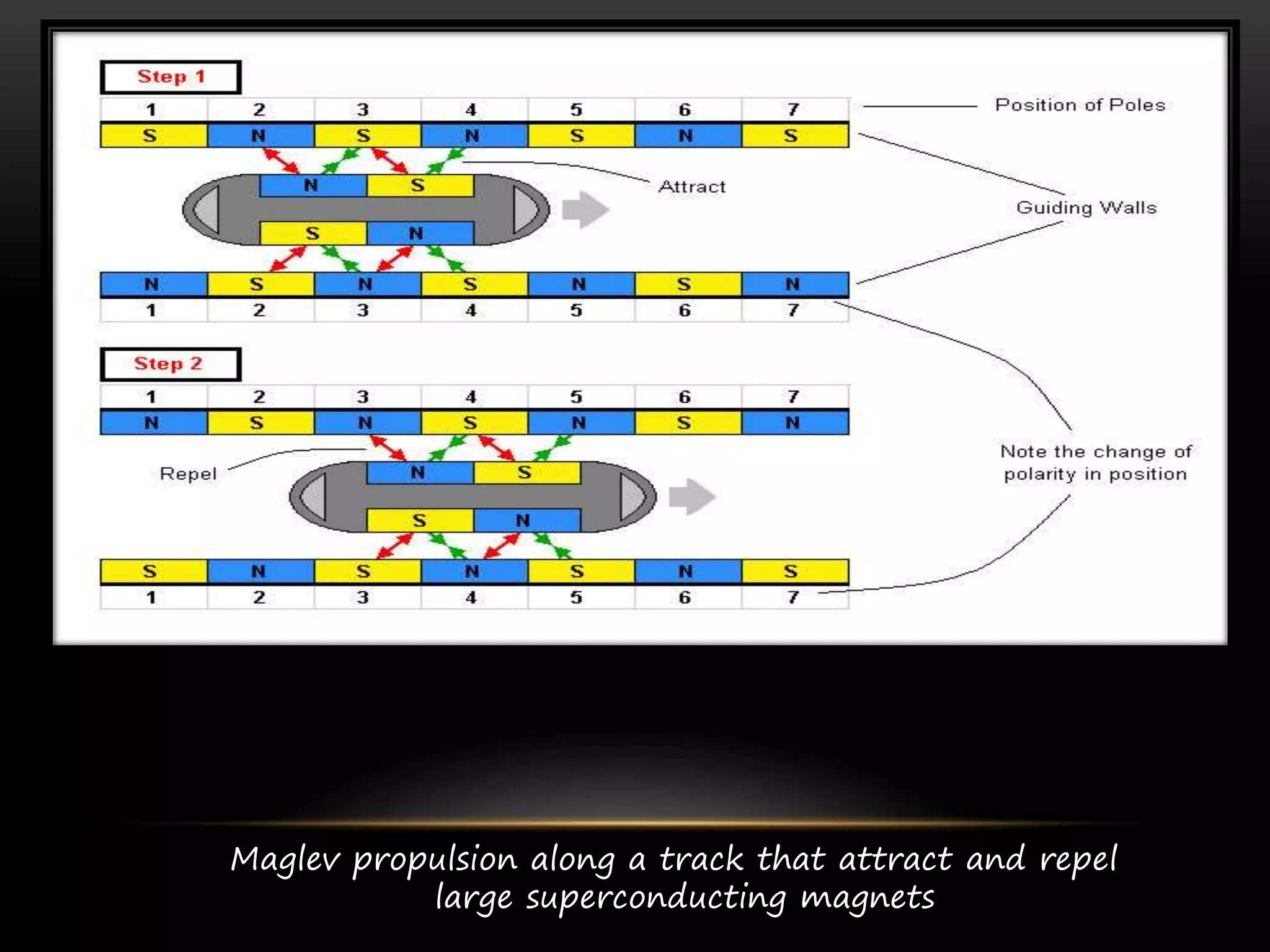
magnetized coils running along a track that
attract and repel large superconducting
magnets in the train’s undercarriage and
allow it to levitate almost 4 inches off the
ground. Power supplied to the coils in the
guideway then creates polarizing forces that
pull and push the train along. As the only
resistance is air,
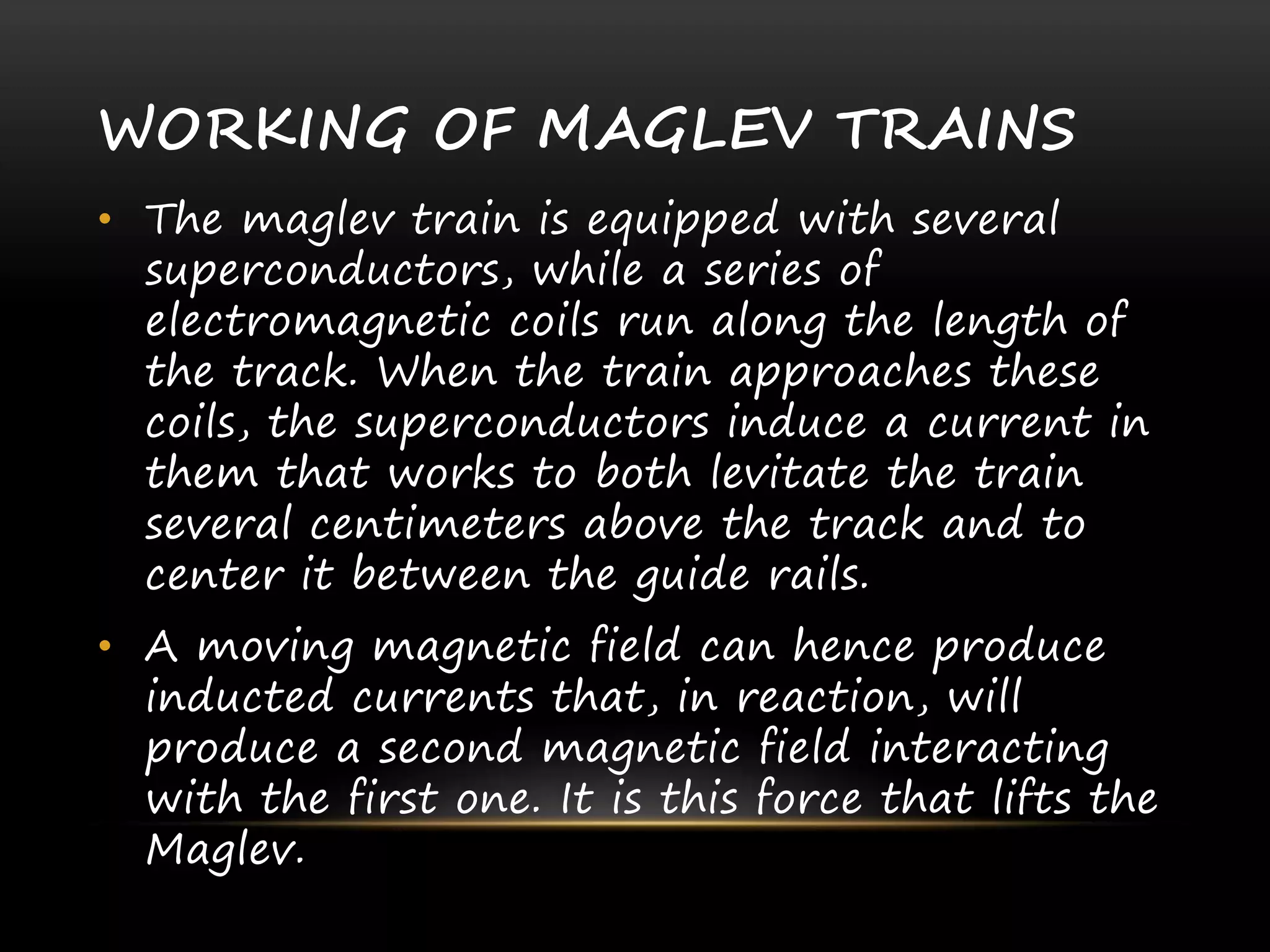
WORKING OF MAGLEV TRAINS
• The maglev train is equipped with several
superconductors, while a series of
electromagnetic coils run along the length of
the track. When the train approaches these
coils, the superconductors induce a current in
them that works to both levitate the train
several centimeters above the track and to
center it between the guide rails.
• A moving magnetic field can hence produce
inducted currents that, in reaction, will
produce a second magnetic field interacting
with the first one. It is this force that lifts the
Maglev.
Maglev propulsion along a track that attract and repel
large superconducting magnets
ADVANTAGES OF USING
SUPERCONDUCTORS IN MAGLEV
TRAINS
• Conventional electromagnets waste much of the
electrical energy as heat, they would have to be
physically much larger than superconducting
magnets.
• The beauty of maglevs is that they travel on air. The
consequent elimination of friction means much
greater efficiency: high speed (>500kmph) and less
wear and tear (i.e. less maintenance). Just as
electrons move more efficiently through a
superconducting wire because there is no resistance,
so, too, does a maglev travel more efficiently than a
regular train because there is no friction between
the wheels and the track, thanks to the Meissner
Effect.
JR–Maglev, or SCMaglev (Super-Conducting Maglev) – Japan Railways
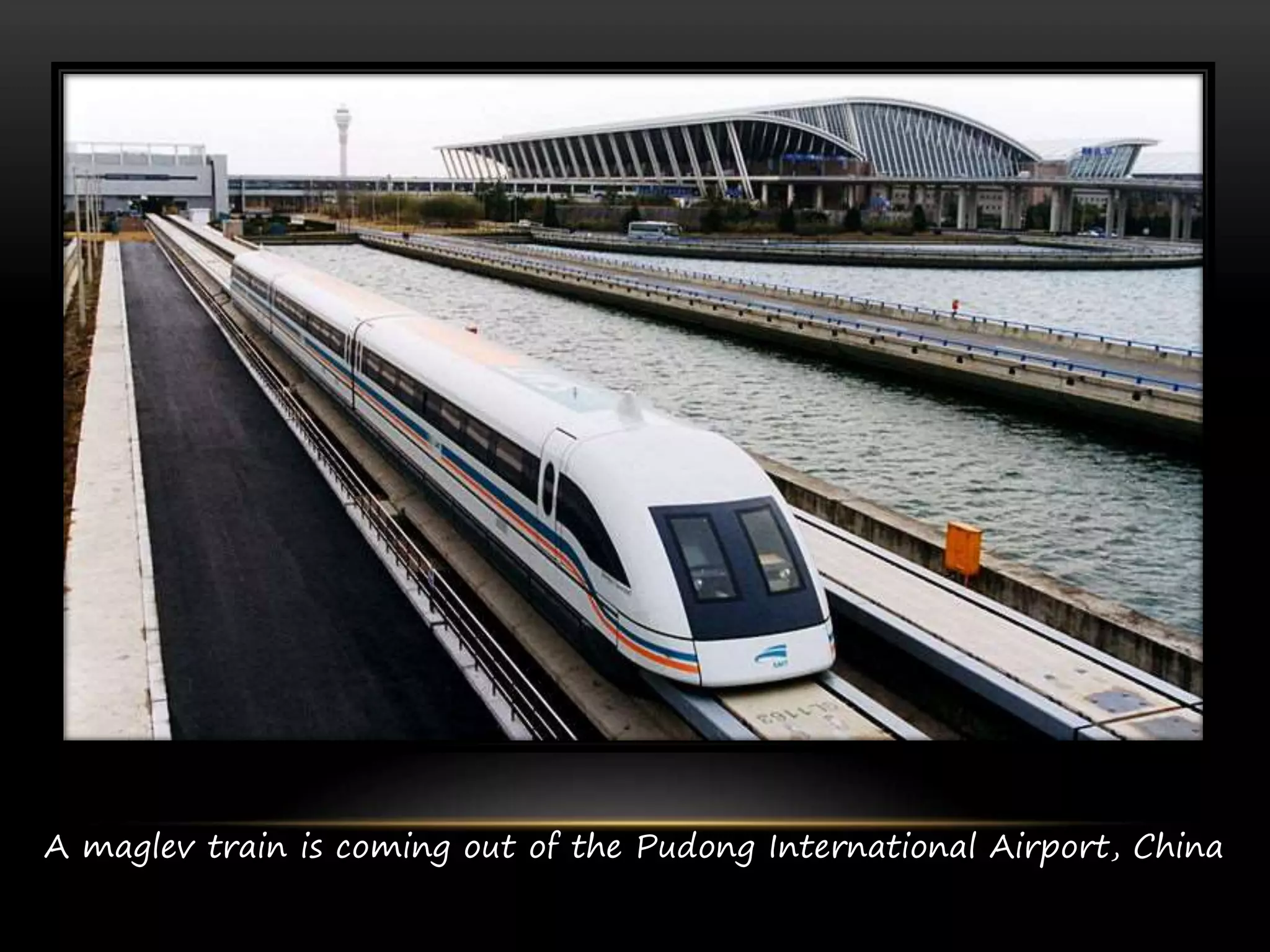
A maglev train is coming out of the Pudong International Airport, China
7) Superconductors Are Used In
Computers And Information
Processing.
COMPUTING AND
INFORMATION PROCESSING
• Superconductivity could even be used to build
a quantum computer, enabling massively parallel
processing (to reach speed at the rates of 100
GHz)
• Quantum computers are different from digital
computers based on transistors. Whereas digital
computers require data to be encoded into binary
digits (bits), quantum computation uses quantum
properties to represent data and
perform operations on these data.
• Quantum Processors make use of superconducting
qubit (Quantum Bits) architecture.
REFERENCES
• http://en.wikipedia.org/wiki/Superconducting_magnet
• hyperphysics.phy-astr.gsu.edu/hbase/solids/scapp.html
• snf.ieeecsc.org/sites/ieeecsc.org/files/BrayJ_4AP01.pdf
• Google image search/Applications of superconductivity
• http://www.intechopen.com/books/applications-of-high-tc-
superconductivity/overview-of-possible-applications-of-high-tc-
superconductors
• Engineering Physics by G Vijayakumari Vikas Publications
Sc applications

Sc applications

  • 1.
    SHANTILAL SHAH ENGINEERING COLLEGE (INSTRUMENTATIONAND CONTROL DEPARTMENT) Roll no. Enrollment no. Name 3013 140430117015 GAMIT ANKITABEN ARVINDBHAI 3014 140430117016 GAMIT NAYANBHAI BABUBHAI 3015 140430117017 GAMIT SMITKUMAR KANTABHAI 3016 140430117018 ISHAN JATINKUMAR BHATT 3017 140430117019 JITIN J PILLAI 3018 140430117020 JOSHI MEETKUMAR DHARMENDRABHAI Physics PPT B.E. Sem-2 (I.C.) Batch-1 Group IC-3
  • 2.
  • 3.
    1. Low TemperatureLiquid Helium Superconductors Have Been Used To Fabricate High Field Magnets And Some Electronic And Radio Frequency Devices.
  • 4.
    SUPERCONDUCTING MAGNETS • Weknow that an electric current in a wire creates a magnetic field around the wire. The strength of the magnetic field increases as the current in the wire increases. Since SCs can carry large currents without energy loss, they are well suited for making strong magnets .
  • 5.
    7 T horizontalbore superconducting magnet AMS-02: With a diameter of nearly 3 m and a cold mass approaching 2 tonnes, AMS-02 will be the first large superconducting magnet to be launched into space. The 14 coils generate fields up to 7 T and are indirectly cooled to 1.8 K by 2500 liters of superfluid helium.
  • 6.
    ELECTRONIC & RADIOFREQUENCY DEVICES • In electronics industry, ultra-high- performance filters are now being built. Since superconducting wire has near zero resistance, even at high frequencies, many more filter stages can be employed to achieve a desired frequency response. This translates into an ability to pass desired frequencies and block undesirable frequencies in high-congestion radio frequency applications such as cellular telephone systems .
  • 7.
    2) The SuperconductingMagnets Have Been Employed In NMR Spectrometers And NMR Imaging Is Used In Medical Diagnostics.
  • 8.
    NUCLEAR MAGNETIC RESONANCE (NMR)SPECTROMETERS • NMR spectrometer technology uses superconducting wires cooled with cryogens (liquid helium & liquid nitrogen) to generate a magnetic field. NMR spectrometers provide the most homogenous magnetic fields and the greatest spectral resolution. NMR spectroscopy can be used for chemical analysis, reaction monitoring, and quality assurance/quality control experiments. Higher-field instruments enable unparalleled resolution for structure determination, particularly for complex molecules.
  • 9.
    NUCLEAR MAGNETIC RESONANCE IMAGING(NMRI) • On applying a strong superconductor derived magnetic field into the body, hydrogen atoms that exist in the body's water and fat molecules are forced to accept energy from the magnetic field. They then release this energy at a frequency that can be detected and displayed graphically by a computer.
  • 10.
    An Nuclear MagneticResonance Imaging (NMRI) Scanner. (Simply called as MRI Scanner)
  • 11.
    3) Superconductors AreUsed For Effective Magnetic Shielding.
  • 12.
    MAGNETIC SHIELD • Whenyou place a superconductor near a magnet, the magnetic field gets repelled by the superconductor because it does not allow the field to penetrate its surface (Meissner Effect). Normal Conductor Superconductor
  • 13.
    4) Superconductors AreUsed As Magnetic Energy Storage.
  • 14.
    SUPERCONDUCTING MAGNETIC ENERGY STORAGE(SMES) • SMES systems store energy in the magnetic field created by the flow of direct current in a superconducting coil. • Once the superconducting coil is charged, the current will not decay and the magnetic energy can be stored indefinitely. • The stored energy can be released back to the network by discharging the coil. • SMES loses the least amount of electricity in the energy storage process compared to other methods of storing energy. i.e. the SMES systems are highly efficient; the round-trip efficiency is greater than 95%.
  • 15.
    The world’s largestsuperconducting magnetic energy storage system: This system counters sudden drops in voltage (line-drops) that result from lightning strikes and other natural phenomena. The 10,000-kW superconducting magnetic energy storage system installed at the Kameyama (a City in Japan) Plant can generate high voltage in an instant and counter the effects of line-drops.
  • 16.
    5) Superconductors HaveBeen Used To Produce Various Devices Based On Superconducting Quantum Effects Such As SQUIDS And Josephson Devices
  • 17.
    SUPERCONDUCTING QUANTUM INTERFERENCE DEVICE(SQUID) • A SQUID is a very sensitive magnetometer used to measure extreme low magnetic fields. • SQUIDs are sensitive enough to measure fields as low as 5×10⁻¹⁸ T (i.e. can detect a change of energy as much as 100 billion times weaker than the electromagnetic energy that moves a compass needle, such as subtle changes in the human body's electromagnetic energy field)
  • 18.
    The inner workingsof an early SQUID
  • 19.
    JOSEPHSON DEVICES • In1962 Brian D. Josephson predicted that electrical current would flow between two superconducting materials, even when they are separated by a non-superconductor or insulator. His prediction was later confirmed and won him a share of the 1973 Nobel Prize in Physics. This tunneling phenomenon is today known as the "Josephson effect“ • SQUIDs work based on the Josephson effect. Devices that work based on the principle of Josephson effect are called Josephson Devices.
  • 20.
    6) For HighSpeed Magnetic Trains And Ship Drive System Superconductors Are Used.
  • 21.
    MAGLEV TRAINS • TheMaglev (derived from Magnetic Levitation) train system works by utilizing magnetized coils running along a track that attract and repel large superconducting magnets in the train’s undercarriage and allow it to levitate almost 4 inches off the ground. Power supplied to the coils in the guideway then creates polarizing forces that pull and push the train along. As the only resistance is air,
  • 22.
    WORKING OF MAGLEVTRAINS • The maglev train is equipped with several superconductors, while a series of electromagnetic coils run along the length of the track. When the train approaches these coils, the superconductors induce a current in them that works to both levitate the train several centimeters above the track and to center it between the guide rails. • A moving magnetic field can hence produce inducted currents that, in reaction, will produce a second magnetic field interacting with the first one. It is this force that lifts the Maglev.
  • 23.
    Maglev propulsion alonga track that attract and repel large superconducting magnets
  • 24.
    ADVANTAGES OF USING SUPERCONDUCTORSIN MAGLEV TRAINS • Conventional electromagnets waste much of the electrical energy as heat, they would have to be physically much larger than superconducting magnets. • The beauty of maglevs is that they travel on air. The consequent elimination of friction means much greater efficiency: high speed (>500kmph) and less wear and tear (i.e. less maintenance). Just as electrons move more efficiently through a superconducting wire because there is no resistance, so, too, does a maglev travel more efficiently than a regular train because there is no friction between the wheels and the track, thanks to the Meissner Effect.
  • 25.
    JR–Maglev, or SCMaglev(Super-Conducting Maglev) – Japan Railways
  • 26.
    A maglev trainis coming out of the Pudong International Airport, China
  • 27.
    7) Superconductors AreUsed In Computers And Information Processing.
  • 28.
    COMPUTING AND INFORMATION PROCESSING •Superconductivity could even be used to build a quantum computer, enabling massively parallel processing (to reach speed at the rates of 100 GHz) • Quantum computers are different from digital computers based on transistors. Whereas digital computers require data to be encoded into binary digits (bits), quantum computation uses quantum properties to represent data and perform operations on these data. • Quantum Processors make use of superconducting qubit (Quantum Bits) architecture.
  • 29.
    REFERENCES • http://en.wikipedia.org/wiki/Superconducting_magnet • hyperphysics.phy-astr.gsu.edu/hbase/solids/scapp.html •snf.ieeecsc.org/sites/ieeecsc.org/files/BrayJ_4AP01.pdf • Google image search/Applications of superconductivity • http://www.intechopen.com/books/applications-of-high-tc- superconductivity/overview-of-possible-applications-of-high-tc- superconductors • Engineering Physics by G Vijayakumari Vikas Publications