General Microbiology notes on the Eukaryotic Microorganism: Algae
Subtopics included are: salient features, habitat, appearance, cell structure, economic importance
Eukaryotic Microorganisms: Algae
SALIENTFEATURES:
1. Algae are autotrophic organisms and they have chlorophyll.
2. They are O2 producing photosynthetic organisms.
3. In algae the plant body shows no differentiation into root, stem or leaf or true tissues.
Such a plant body is called thallus.
4. They do not have vascular tissues.
5. Embryo formation is absent.
Habitat:
1. Most of the algae are aquatic either fresh water or marine. Very few are terrestrial.
2. Some species of algae and fungi are found in association with each other and they are
called Lichens.
3. The free floating and free swimming minute algae are known as phytoplanktons.
4. Species that are found attached to the bottom of shallow water along the edges of
seas and lakes are called Benthic.
5. A few genera grow even in extreme condition like thermal springs (thermal algae),
glaciers and snow (cryophytes).
Appearance:
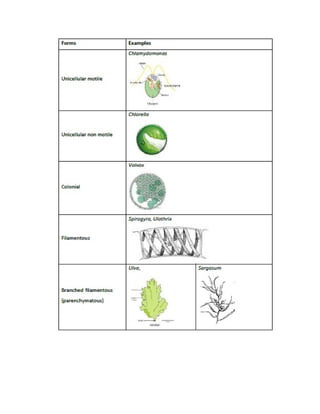
The thalli of algae exhibit a great range of variation in structure and organization.
It ranges from microscopic unicellular forms to giant seaweeds like Macrocystis
which measures up to 100 meters long.
3.
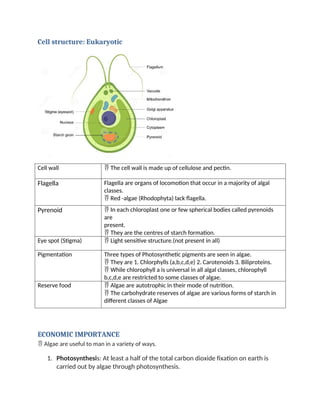
Cell structure: Eukaryotic
Cellwall The cell wall is made up of cellulose and pectin.
Flagella Flagella are organs of locomotion that occur in a majority of algal
classes.
Red -algae (Rhodophyta) lack flagella.
Pyrenoid In each chloroplast one or few spherical bodies called pyrenoids
are
present.
They are the centres of starch formation.
Eye spot (Stigma) Light sensitive structure.(not present in all)
Pigmentation Three types of Photosynthetic pigments are seen in algae.
They are 1. Chlorphylls (a,b,c,d,e) 2. Carotenoids 3. Biliproteins.
While chlorophyll a is universal in all algal classes, chlorophyll
b,c,d,e are restricted to some classes of algae.
Reserve food Algae are autotrophic in their mode of nutrition.
The carbohydrate reserves of algae are various forms of starch in
different classes of Algae
ECONOMIC IMPORTANCE
Algae are useful to man in a variety of ways.
1. Photosynthesis: At least a half of the total carbon dioxide fixation on earth is
carried out by algae through photosynthesis.
4.
2. Oxygen producer:Being photosynthetic they increase the level of dissolved
oxygen in their immediate environment.
3. Producer in food chain: They are of great importance as primary producers of
energy-rich compounds which form the basis of the food cycles of all aquatic
animals.
4. As a food: Many species of Porphyra, Laminaria and Sargassum are among the 70
species of marine algae used as food. Algae are a healthy source of
carbohydrates, fats, proteins, and vitamins A, B, C, and E as well as the minerals
like iron, potassium, magnesium, calcium, manganese, and zinc.
5. In industries: Agar, one of the commercial products obtained from Gelidium and
Gracilaria are used to grow microbes.
6. Algae in space travel: Chlorella and Spirullina are unicellular algae, rich in
proteins and are used as food supplements even by space travellers.
7. Binding agent: Soil can be held together by algae. In protecting against natural
processes such as erosion, the effectiveness of algae to help in healthy soil
formation is important.
8. Pisciculture: In fish farming, Algae plays a very important role because it helps in
the production process. Fish used plankton and zooplankton as food. It helps in
maintaining the health of the marine ecosystem because algae are naturally
absorbent of carbon dioxide and also provide oxygen to the water.
9. Biological indicator: Algae are very sensitive. If there is a slight change in the
environment their pigments changes or might get died. Water pollution is
checked with the help of Algae like Euglena and Chlorella.
10.Harmful algae: Algae and cyanobacteria can sometimes cause harm to people,
animals, and the environment. An accumulation of algae which may be harmful
to humans and animals is known as a harmful algal bloom. Harmful algae can be
found in both marine (salt water) and freshwater environments. Some types of
algae can cause irritation and allergic reactions on direct contact, while others
may also produce harmful toxins (poisons). Toxins produced by harmful algal
blooms in a marine or freshwater environment can impact human and animal
health. Seafood harvested from algae-affected water can also put our health at
risk. Harmful algal blooms will remain as long as there are favourable conditions –
including warmth, sunlight and low flow rates.


![Polymer [ बहुलक ] Chemistry Notes PDF - Irfanullah Mehar - JJ Sir Chemistry.pdf](https://cdn.slidesharecdn.com/ss_thumbnails/polymerchemistrynotespdf-irfanullahmehar-jjsirchemistry-260210172118-3f9b37f7-thumbnail.jpg?width=640&height=640&fit=bounds)


