B Thivya Priyaa
Telepathy ? 
• It’s the purported transmission of 
information from one person to 
another 
• without using any of our known 
sensory channels or physical 
interaction. 
• There is no scientific evidence 
that telepathy is a real 
phenomenon.
How will it be if you are going to have a 
real technology that will enable you to 
communicate just through thinking ?? 
Do you think so 
that it’s even 
possible ???
YES !!! It has become ALMOST possible 
Through ..... 
BRAIN TO BRAIN INTERFACE
Brain –Computer Interface 
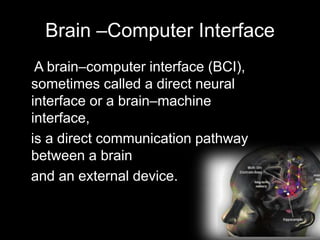
A brain–computer interface (BCI), 
sometimes called a direct neural 
interface or a brain–machine 
interface, 
is a direct communication pathway 
between a brain 
and an external device.
Types of BCI 
Invasive Brain Computer Interfaces 
-implanted directly into the brain and has the 
highest quality signals. 
-provide functionality to paralyzed people. 
Partially Invasive Brain Computer Interfaces 
-implanted inside the skull but outside the brain. 
Non Invasive Brain Computer Interfaces 
-Gives a patient the ability to move muscle 
implants and restore partial movement.
Invasive 
Partially Invasive 
Non Invasive
Shift from BCI to BBI 
• A BBI relies on two pillars: - 
 the capacity to read (or “decode”) useful 
information from neural activity 
 and the capacity to write (or “encode”) digital 
information back into neural activity. 
• In recent years, we have witnessed incredible 
progress in these two capabilities with the 
development of Brain-Computer Interfaces, or 
BCIs
Working of BBI 
• Electroencephalography, or EEG, is routinely 
used by clinicians and researchers to record 
brain activity noninvasively from the scalp. 
• The first human brain (the sender) is 
connected to a computer via an EEG-based 
BCI. The second human brain (the 
receiver) is connected to another computer 
via a Magstim transcranial magnetic 
stimulation (TMS)
The cycle of the experiment. Brain signals from the “Sender” are recorded. When the computer 
detects imagined hand movements, a “fire” command is transmitted over the Internet to the TMS 
machine, which causes an upward movement of the right hand of the “Receiver.” This usually 
results in the “fire” key being hit. (Credit: University of Washington)
Some experiments 
PLOS - ONE project
Applications 
• Criminal investigation 
• Communication 
• Aid for the differently-abled 
• Capturing memories ..etc
Future ...? 
• Great !! Instead of posting it in Facebook 
or in Twitter one can post a message 
directly into your brain ! Haha 
• Light weight EEG seems possible 
• Constant streaming of thoughts 
• Less bulkier BBI
Thank You =)
References 
• http://www.kurzweilai.net/researchers-demonstrate-direct- 
brain-to-brain-communication-in-human-subjects 
• http://www.extremetech.com/extreme/188883-the-first-human- 
brain-to-brain-interface-has-been-created-in-the- 
future-will-we-all-be-linked-telepathically 
• http://homes.cs.washington.edu/~rao/brain2brain/ 
• http://www.washington.edu/news/2013/08/27/research 
er-controls-colleagues-motions-in-1st-human-brain-to-brain- 
interface/ 
• Etc...

Brain to Brain Interface

  • 1.
  • 2.
    Telepathy ? •It’s the purported transmission of information from one person to another • without using any of our known sensory channels or physical interaction. • There is no scientific evidence that telepathy is a real phenomenon.
  • 3.
    How will itbe if you are going to have a real technology that will enable you to communicate just through thinking ?? Do you think so that it’s even possible ???
  • 4.
    YES !!! Ithas become ALMOST possible Through ..... BRAIN TO BRAIN INTERFACE
  • 5.
    Brain –Computer Interface A brain–computer interface (BCI), sometimes called a direct neural interface or a brain–machine interface, is a direct communication pathway between a brain and an external device.
  • 6.
    Types of BCI Invasive Brain Computer Interfaces -implanted directly into the brain and has the highest quality signals. -provide functionality to paralyzed people. Partially Invasive Brain Computer Interfaces -implanted inside the skull but outside the brain. Non Invasive Brain Computer Interfaces -Gives a patient the ability to move muscle implants and restore partial movement.
  • 7.
  • 8.
    Shift from BCIto BBI • A BBI relies on two pillars: -  the capacity to read (or “decode”) useful information from neural activity  and the capacity to write (or “encode”) digital information back into neural activity. • In recent years, we have witnessed incredible progress in these two capabilities with the development of Brain-Computer Interfaces, or BCIs
  • 9.
    Working of BBI • Electroencephalography, or EEG, is routinely used by clinicians and researchers to record brain activity noninvasively from the scalp. • The first human brain (the sender) is connected to a computer via an EEG-based BCI. The second human brain (the receiver) is connected to another computer via a Magstim transcranial magnetic stimulation (TMS)
  • 10.
    The cycle ofthe experiment. Brain signals from the “Sender” are recorded. When the computer detects imagined hand movements, a “fire” command is transmitted over the Internet to the TMS machine, which causes an upward movement of the right hand of the “Receiver.” This usually results in the “fire” key being hit. (Credit: University of Washington)
  • 11.
    Some experiments PLOS- ONE project
  • 12.
    Applications • Criminalinvestigation • Communication • Aid for the differently-abled • Capturing memories ..etc
  • 13.
    Future ...? •Great !! Instead of posting it in Facebook or in Twitter one can post a message directly into your brain ! Haha • Light weight EEG seems possible • Constant streaming of thoughts • Less bulkier BBI
  • 14.
  • 15.
    References • http://www.kurzweilai.net/researchers-demonstrate-direct- brain-to-brain-communication-in-human-subjects • http://www.extremetech.com/extreme/188883-the-first-human- brain-to-brain-interface-has-been-created-in-the- future-will-we-all-be-linked-telepathically • http://homes.cs.washington.edu/~rao/brain2brain/ • http://www.washington.edu/news/2013/08/27/research er-controls-colleagues-motions-in-1st-human-brain-to-brain- interface/ • Etc...

Editor's Notes

  • #11 The cycle of the experiment. Brain signals from the “Sender” are recorded. When the computer detects imagined hand movements, a “fire” command is transmitted over the Internet to the TMS machine, which causes an upward movement of the right hand of the “Receiver.” This usually results in the “fire” key being hit. (Credit: University of Washington)
  • #12 The words (“hola” and “ciao”) as binary strings and presented them as a series of cues on a computer monitor. They recorded the subject’s EEG signals as the subject was instructed to think about moving his feet (binary 0) or hands (binary 1). They then sent the recorded series of binary values in an email message to researchers in France, 5,000 miles away. MRI image showing location of TMS phosphene generator (credit: Carles Grau et al./PLoS ONE) There, the binary strings were converted into a series of transcranial magnetic stimulation (TMS) pulses applied to a hotspot location in the right visual occipital cortex that either produced a phosphene (perceived flash of light) or not.