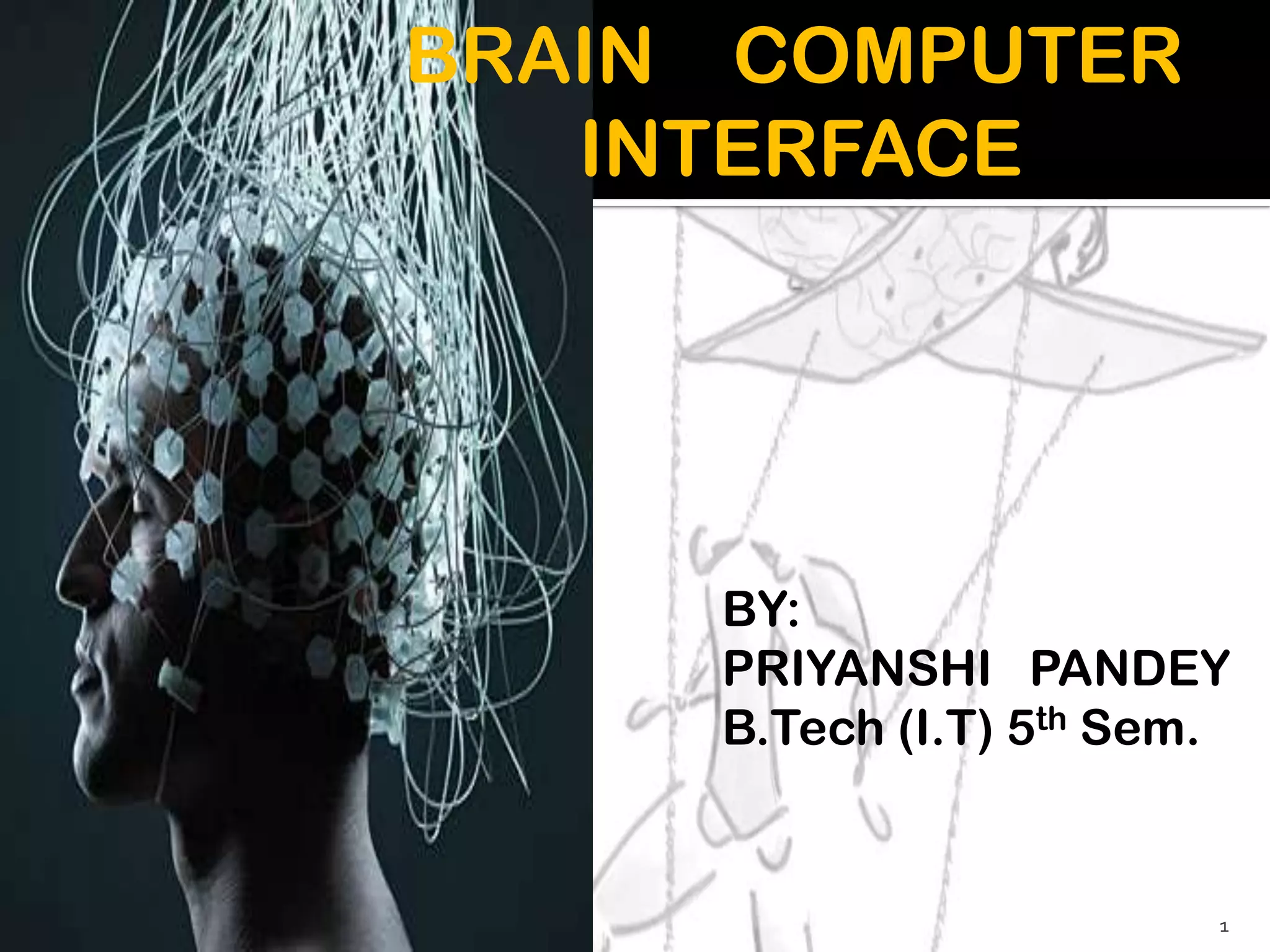
BRAIN COMPUTER
   INTERFACE


     BY:
     PRIYANSHI PANDEY
     B.Tech (I.T) 5th Sem.


                         1
    What is BCI?
   BCI approaches
   Implementation of BCI
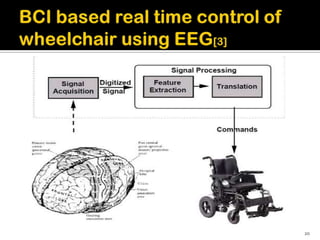
   BCI based real time control of wheelchair
    using EEG
   BCI in India
   BCI in the global market
   Conclusion
   References


                                                2
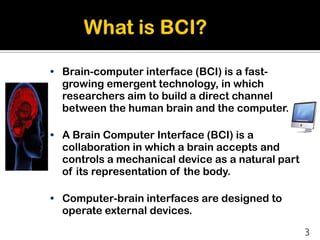
• Brain-computer interface (BCI) is a fast-
  growing emergent technology, in which
  researchers aim to build a direct channel
  between the human brain and the computer.

• A Brain Computer Interface (BCI) is a
  collaboration in which a brain accepts and
  controls a mechanical device as a natural part
  of its representation of the body.

• Computer-brain interfaces are designed to
  operate external devices.
                                                   3
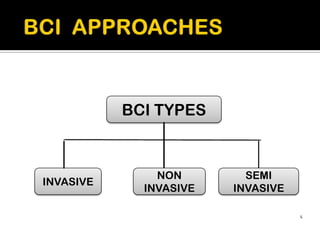
BCI TYPES


               NON        SEMI
INVASIVE
             INVASIVE   INVASIVE

                                   4
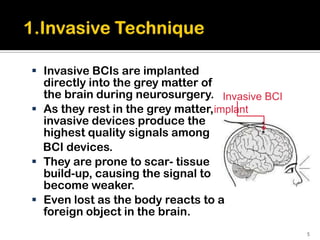
 Invasive BCIs are implanted
  directly into the grey matter of
  the brain during neurosurgery. Invasive BCI
 As they rest in the grey matter,implant
  invasive devices produce the
  highest quality signals among
  BCI devices.
 They are prone to scar- tissue
  build-up, causing the signal to
  become weaker.
 Even lost as the body reacts to a
  foreign object in the brain.
                                                5
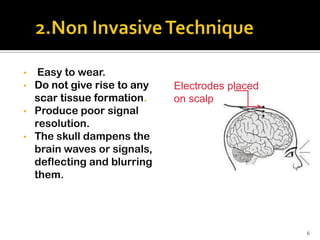
•  Easy to wear.
• Do not give rise to any   Electrodes placed
  scar tissue formation.    on scalp
• Produce poor signal
  resolution.
• The skull dampens the
  brain waves or signals,
  deflecting and blurring
  them.


                                                6
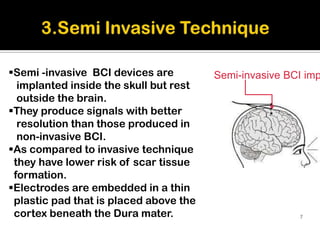
Semi -invasive BCI devices are         Semi-invasive BCI imp
  implanted inside the skull but rest
  outside the brain.
They produce signals with better
  resolution than those produced in
  non-invasive BCI.
As compared to invasive technique
 they have lower risk of scar tissue
 formation.
Electrodes are embedded in a thin
 plastic pad that is placed above the
 cortex beneath the Dura mater.                         7
   Over the years invasive technique has been
    implemented in the form of BCI device implanted in
    the brain of humans and animals.
   But the risk of scar tissue formation is always there.
   Besides the idea of implanting a device inside a
    normal brain is itself disturbing.
   Over the years there has been a shift in focus from
    invasive techniques to non-invasive techniques.
   With improvement in signal processing systems
    non-invasive techniques give better result.
   Nowadays most research work is in the field of non-
    invasive BCI implementation.
                                                             8
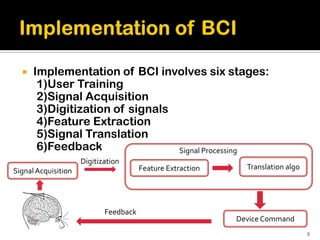
   Implementation of BCI involves six stages:
       1)User Training
       2)Signal Acquisition
       3)Digitization of signals
       4)Feature Extraction
       5)Signal Translation
       6)Feedback                Signal Processing
                     Digitization
                                       Feature Extraction     Translation algo
Signal Acquisition


                            Feedback
                                                            Device Command
                                                                                 9
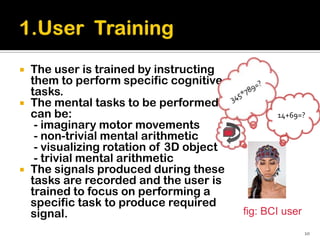
   The user is trained by instructing
    them to perform specific cognitive
    tasks.
   The mental tasks to be performed
    can be:                                       14+69=?
     - imaginary motor movements
     - non-trivial mental arithmetic
     - visualizing rotation of 3D object
     - trivial mental arithmetic
   The signals produced during these
    tasks are recorded and the user is
    trained to focus on performing a
    specific task to produce required
    signal.                                fig: BCI user
                                                           10
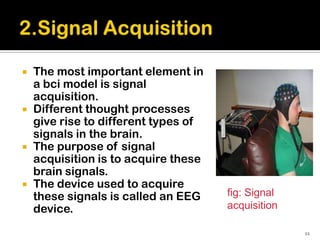
   The most important element in
    a bci model is signal
    acquisition.
   Different thought processes
    give rise to different types of
    signals in the brain.
   The purpose of signal
    acquisition is to acquire these
    brain signals.
   The device used to acquire
    these signals is called an EEG    fig: Signal
    device.                           acquisition

                                                    11
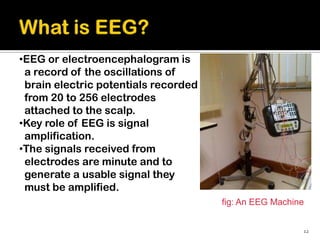
•EEG or electroencephalogram is
 a record of the oscillations of
 brain electric potentials recorded
 from 20 to 256 electrodes
 attached to the scalp.
•Key role of EEG is signal
 amplification.
•The signals received from
 electrodes are minute and to
 generate a usable signal they
 must be amplified.
                                      fig: An EEG Machine


                                                        12
 It uses an array of electrodes
  attached to the subject’s scalp.
 User’s scalp is first prepared with an
  abrasive paste to remove any dead
  skin and sweat which may interfere
  with the signal.                       fig: Conductive
 The electrodes used are either gold    paste
  or silver.
 Each electrode has a small amount
  of conductive paste applied to it ,
  which is then placed underneath a
  cap .

                                            fig: EEG cap
                                                           13
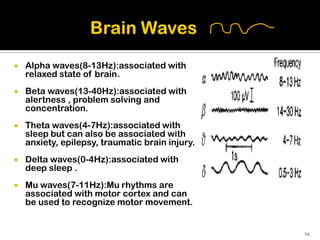
   Alpha waves(8-13Hz):associated with
    relaxed state of brain.
   Beta waves(13-40Hz):associated with
    alertness , problem solving and
    concentration.
   Theta waves(4-7Hz):associated with
    sleep but can also be associated with
    anxiety, epilepsy, traumatic brain injury.
   Delta waves(0-4Hz):associated with
    deep sleep .
   Mu waves(7-11Hz):Mu rhythms are
    associated with motor cortex and can
    be used to recognize motor movement.


                                                 14
   Mu and Beta rhythms
   Visual evoked potentials
   P300 evoked potentials
   EEG signal differences during
    different mental calculations


                                    15
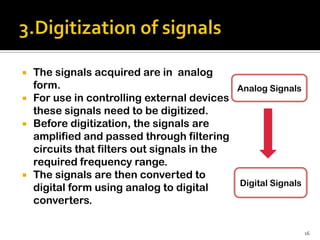
   The signals acquired are in analog
    form.                                    Analog Signals
   For use in controlling external devices
    these signals need to be digitized.
   Before digitization, the signals are
    amplified and passed through filtering
    circuits that filters out signals in the
    required frequency range.
   The signals are then converted to
                                             Digital Signals
    digital form using analog to digital
    converters.

                                                               16
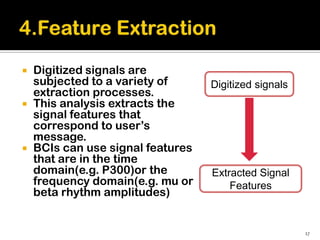
   Digitized signals are
    subjected to a variety of      Digitized signals
    extraction processes.
   This analysis extracts the
    signal features that
    correspond to user’s
    message.
   BCIs can use signal features
    that are in the time
    domain(e.g. P300)or the        Extracted Signal
    frequency domain(e.g. mu or        Features
    beta rhythm amplitudes)


                                                       17
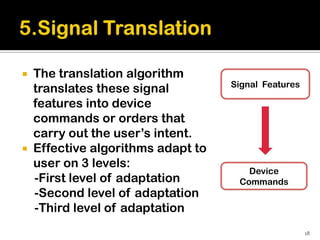
 The translation algorithm
                                  Signal Features
  translates these signal
  features into device
  commands or orders that
  carry out the user’s intent.
 Effective algorithms adapt to
  user on 3 levels:
                                     Device
  -First level of adaptation       Commands
  -Second level of adaptation
  -Third level of adaptation
                                                    18
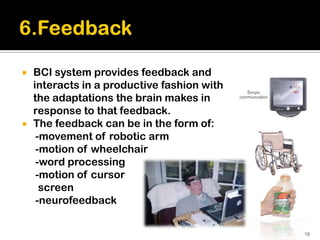
   BCI system provides feedback and
    interacts in a productive fashion with
    the adaptations the brain makes in
    response to that feedback.
   The feedback can be in the form of:
     -movement of robotic arm
     -motion of wheelchair
     -word processing
     -motion of cursor
      screen
     -neurofeedback

                                             19
20
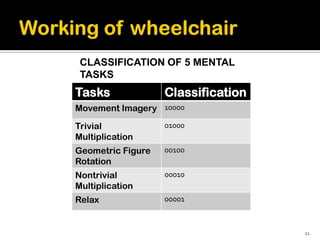
CLASSIFICATION OF 5 MENTAL
 TASKS
Tasks              Classification
Movement Imagery 10000

Trivial            01000
Multiplication
Geometric Figure   00100
Rotation
Nontrivial         00010
Multiplication
Relax              00001


                                    21
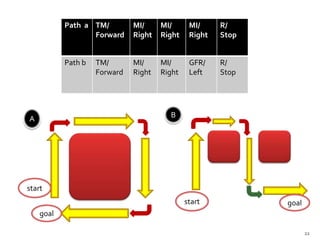
Path a TM/         MI/     MI/      MI/     R/
                  Forward     Right   Right    Right   Stop


           Path b   TM/       MI/     MI/      GFR/    R/
                    Forward   Right   Right    Left    Stop


                                        B
A


start
                                              start           goal
    goal

                                                                     22
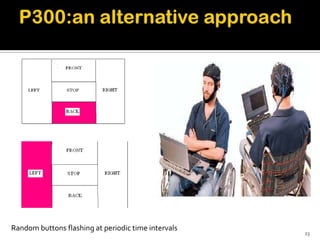
Random buttons flashing at periodic time intervals
                                                     23
   National Brain Research Centre
    Professor , Prof. Neeraj Jain has
    been doing research on BCI.
   A research project on developing
    a brain controlled robot, funded
    by DRDO has been taken up by        Prof. Neeraj
    NBRC.[1]                            Jain
   BCI developed by DAIICT
    Professor Mr. Suresh Ranjan has
    helped an IIM-A alumnus Mr.
    Suresh Karat who had been
    paralyzed for 13 years.[2]
                                        Mr. Suresh     24
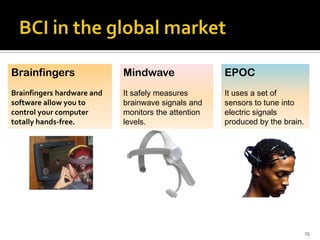
Brainfingers                Mindwave                 EPOC
Brainfingers hardware and   It safely measures       It uses a set of
software allow you to       brainwave signals and    sensors to tune into
control your computer       monitors the attention   electric signals
totally hands-free.         levels.                  produced by the brain.


                                                                              25
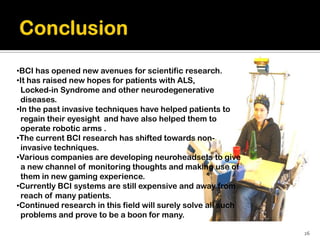
•BCI has opened new avenues for scientific research.
•It has raised new hopes for patients with ALS,
 Locked-in Syndrome and other neurodegenerative
 diseases.
•In the past invasive techniques have helped patients to
 regain their eyesight and have also helped them to
 operate robotic arms .
•The current BCI research has shifted towards non-
 invasive techniques.
•Various companies are developing neuroheadsets to give
 a new channel of monitoring thoughts and making use of
 them in new gaming experience.
•Currently BCI systems are still expensive and away from
 reach of many patients.
•Continued research in this field will surely solve all such
 problems and prove to be a boon for many.

                                                               26
[1]http://neurogadget.com/2011/03/23/indian-scientists-working-
  on-brain- controlled-robot-to-help-disabled-patients/1438
[2] http://articles.timesofindia.com/2012-04-
   07/news/31304725_1_device-iim-1- graduate-daiict
[3]http://www.jisce.org/attachments/File/Vol-1_Issue-
   5/E0143081511.pdf
•http://www.aksioma.org/brainloop/bci_dependent.html
•http://computer.howstuffworks.com/brain-computer-interface2.htm
•http://www.nbrc.ac.in/
•http://www.emotiv.com/
•http://store.neurosky.com
•http://mybrainnotes.com/memory-language-brain.html


                                                                   27
28
29

Seminar

  • 1.
    BRAIN COMPUTER INTERFACE BY: PRIYANSHI PANDEY B.Tech (I.T) 5th Sem. 1
  • 2.
    What is BCI?  BCI approaches  Implementation of BCI  BCI based real time control of wheelchair using EEG  BCI in India  BCI in the global market  Conclusion  References 2
  • 3.
    • Brain-computer interface(BCI) is a fast- growing emergent technology, in which researchers aim to build a direct channel between the human brain and the computer. • A Brain Computer Interface (BCI) is a collaboration in which a brain accepts and controls a mechanical device as a natural part of its representation of the body. • Computer-brain interfaces are designed to operate external devices. 3
  • 4.
    BCI TYPES NON SEMI INVASIVE INVASIVE INVASIVE 4
  • 5.
     Invasive BCIsare implanted directly into the grey matter of the brain during neurosurgery. Invasive BCI  As they rest in the grey matter,implant invasive devices produce the highest quality signals among BCI devices.  They are prone to scar- tissue build-up, causing the signal to become weaker.  Even lost as the body reacts to a foreign object in the brain. 5
  • 6.
    • Easyto wear. • Do not give rise to any Electrodes placed scar tissue formation. on scalp • Produce poor signal resolution. • The skull dampens the brain waves or signals, deflecting and blurring them. 6
  • 7.
    Semi -invasive BCIdevices are Semi-invasive BCI imp implanted inside the skull but rest outside the brain. They produce signals with better resolution than those produced in non-invasive BCI. As compared to invasive technique they have lower risk of scar tissue formation. Electrodes are embedded in a thin plastic pad that is placed above the cortex beneath the Dura mater. 7
  • 8.
    Over the years invasive technique has been implemented in the form of BCI device implanted in the brain of humans and animals.  But the risk of scar tissue formation is always there.  Besides the idea of implanting a device inside a normal brain is itself disturbing.  Over the years there has been a shift in focus from invasive techniques to non-invasive techniques.  With improvement in signal processing systems non-invasive techniques give better result.  Nowadays most research work is in the field of non- invasive BCI implementation. 8
  • 9.
    Implementation of BCI involves six stages: 1)User Training 2)Signal Acquisition 3)Digitization of signals 4)Feature Extraction 5)Signal Translation 6)Feedback Signal Processing Digitization Feature Extraction Translation algo Signal Acquisition Feedback Device Command 9
  • 10.
    The user is trained by instructing them to perform specific cognitive tasks.  The mental tasks to be performed can be: 14+69=? - imaginary motor movements - non-trivial mental arithmetic - visualizing rotation of 3D object - trivial mental arithmetic  The signals produced during these tasks are recorded and the user is trained to focus on performing a specific task to produce required signal. fig: BCI user 10
  • 11.
    The most important element in a bci model is signal acquisition.  Different thought processes give rise to different types of signals in the brain.  The purpose of signal acquisition is to acquire these brain signals.  The device used to acquire these signals is called an EEG fig: Signal device. acquisition 11
  • 12.
    •EEG or electroencephalogramis a record of the oscillations of brain electric potentials recorded from 20 to 256 electrodes attached to the scalp. •Key role of EEG is signal amplification. •The signals received from electrodes are minute and to generate a usable signal they must be amplified. fig: An EEG Machine 12
  • 13.
     It usesan array of electrodes attached to the subject’s scalp.  User’s scalp is first prepared with an abrasive paste to remove any dead skin and sweat which may interfere with the signal. fig: Conductive  The electrodes used are either gold paste or silver.  Each electrode has a small amount of conductive paste applied to it , which is then placed underneath a cap . fig: EEG cap 13
  • 14.
    Alpha waves(8-13Hz):associated with relaxed state of brain.  Beta waves(13-40Hz):associated with alertness , problem solving and concentration.  Theta waves(4-7Hz):associated with sleep but can also be associated with anxiety, epilepsy, traumatic brain injury.  Delta waves(0-4Hz):associated with deep sleep .  Mu waves(7-11Hz):Mu rhythms are associated with motor cortex and can be used to recognize motor movement. 14
  • 15.
    Mu and Beta rhythms  Visual evoked potentials  P300 evoked potentials  EEG signal differences during different mental calculations 15
  • 16.
    The signals acquired are in analog form. Analog Signals  For use in controlling external devices these signals need to be digitized.  Before digitization, the signals are amplified and passed through filtering circuits that filters out signals in the required frequency range.  The signals are then converted to Digital Signals digital form using analog to digital converters. 16
  • 17.
    Digitized signals are subjected to a variety of Digitized signals extraction processes.  This analysis extracts the signal features that correspond to user’s message.  BCIs can use signal features that are in the time domain(e.g. P300)or the Extracted Signal frequency domain(e.g. mu or Features beta rhythm amplitudes) 17
  • 18.
     The translationalgorithm Signal Features translates these signal features into device commands or orders that carry out the user’s intent.  Effective algorithms adapt to user on 3 levels: Device -First level of adaptation Commands -Second level of adaptation -Third level of adaptation 18
  • 19.
    BCI system provides feedback and interacts in a productive fashion with the adaptations the brain makes in response to that feedback.  The feedback can be in the form of: -movement of robotic arm -motion of wheelchair -word processing -motion of cursor screen -neurofeedback 19
  • 20.
  • 21.
    CLASSIFICATION OF 5MENTAL TASKS Tasks Classification Movement Imagery 10000 Trivial 01000 Multiplication Geometric Figure 00100 Rotation Nontrivial 00010 Multiplication Relax 00001 21
  • 22.
    Path a TM/ MI/ MI/ MI/ R/ Forward Right Right Right Stop Path b TM/ MI/ MI/ GFR/ R/ Forward Right Right Left Stop B A start start goal goal 22
  • 23.
    Random buttons flashingat periodic time intervals 23
  • 24.
    National Brain Research Centre Professor , Prof. Neeraj Jain has been doing research on BCI.  A research project on developing a brain controlled robot, funded by DRDO has been taken up by Prof. Neeraj NBRC.[1] Jain  BCI developed by DAIICT Professor Mr. Suresh Ranjan has helped an IIM-A alumnus Mr. Suresh Karat who had been paralyzed for 13 years.[2] Mr. Suresh 24
  • 25.
    Brainfingers Mindwave EPOC Brainfingers hardware and It safely measures It uses a set of software allow you to brainwave signals and sensors to tune into control your computer monitors the attention electric signals totally hands-free. levels. produced by the brain. 25
  • 26.
    •BCI has openednew avenues for scientific research. •It has raised new hopes for patients with ALS, Locked-in Syndrome and other neurodegenerative diseases. •In the past invasive techniques have helped patients to regain their eyesight and have also helped them to operate robotic arms . •The current BCI research has shifted towards non- invasive techniques. •Various companies are developing neuroheadsets to give a new channel of monitoring thoughts and making use of them in new gaming experience. •Currently BCI systems are still expensive and away from reach of many patients. •Continued research in this field will surely solve all such problems and prove to be a boon for many. 26
  • 27.
    [1]http://neurogadget.com/2011/03/23/indian-scientists-working- on-brain-controlled-robot-to-help-disabled-patients/1438 [2] http://articles.timesofindia.com/2012-04- 07/news/31304725_1_device-iim-1- graduate-daiict [3]http://www.jisce.org/attachments/File/Vol-1_Issue- 5/E0143081511.pdf •http://www.aksioma.org/brainloop/bci_dependent.html •http://computer.howstuffworks.com/brain-computer-interface2.htm •http://www.nbrc.ac.in/ •http://www.emotiv.com/ •http://store.neurosky.com •http://mybrainnotes.com/memory-language-brain.html 27
  • 28.
  • 29.