BOTANICAL INSECTICIDES FOR
VEGETABLE PRODUCTION
ORGANIC IPM – PART 1
By
Ayanava Majumdar
Ext. Entomologist
251-331-8416
William East
Regional Extension Agent
Neil Kelly
Regional Extension Agent
What are BOTANICAL insecticides?
Insect toxins derived from certain plants.
Quick action on target pests.
Broad spectrum action (non-selective).
Do not persist in the environment.
2
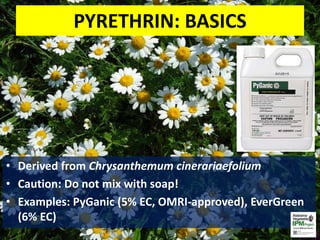
PYRETHRIN: BASICS
• Derived from Chrysanthemum cinerariaefolium
• Caution: Do not mix with soap!
• Examples: PyGanic (5% EC, OMRI-approved), EverGreen
(6% EC)
3
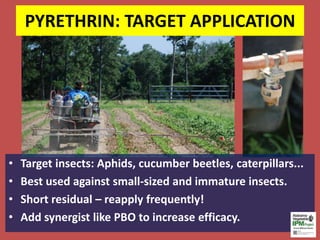
PYRETHRIN: TARGET APPLICATION
• Target insects: Aphids, cucumber beetles, caterpillars...
• Best used against small-sized and immature insects.
• Short residual – reapply frequently!
• Add synergist like PBO to increase efficacy.
4
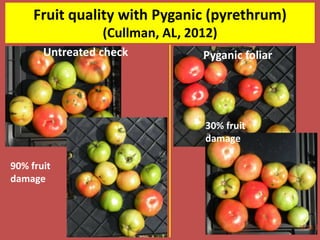
Fruit quality with Pyganic (pyrethrum)
(Cullman, AL, 2012)
Untreated check Pyganic foliar
90% fruit
damage
30% fruit
damage
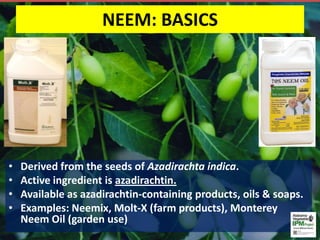
NEEM: BASICS
• Derived from the seeds of Azadirachta indica.
• Active ingredient is azadirachtin.
• Available as azadirachtin-containing products, oils & soaps.
• Examples: Neemix, Molt-X (farm products), Monterey
Neem Oil (garden use)
6
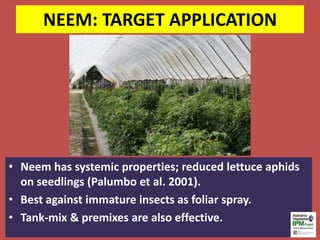
NEEM: TARGET APPLICATION
• Neem has systemic properties; reduced lettuce aphids
on seedlings (Palumbo et al. 2001).
• Best against immature insects as foliar spray.
• Tank-mix & premixes are also effective.
7
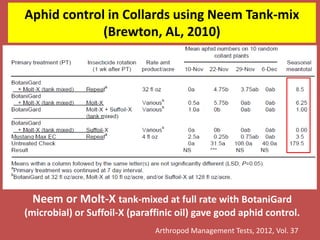
Aphid control in Collards using Neem Tank-mix
(Brewton, AL, 2010)
Arthropod Management Tests, 2012, Vol. 37
Neem or Molt-X tank-mixed at full rate with BotaniGard
(microbial) or Suffoil-X (paraffinic oil) gave good aphid control.
ROTENONE: BASICS
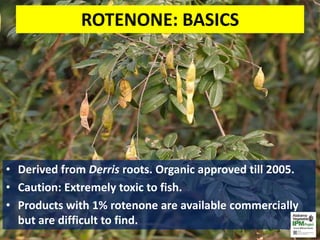
• Derived from Derris roots. Organic approved till 2005.
• Caution: Extremely toxic to fish.
• Products with 1% rotenone are available commercially
but are difficult to find.
9
SABADILLA
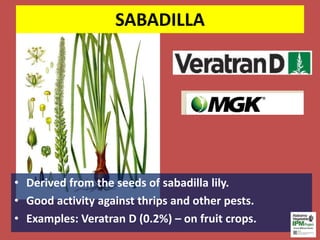
• Derived from the seeds of sabadilla lily.
• Good activity against thrips and other pests.
• Examples: Veratran D (0.2%) – on fruit crops.
10
11
OTHER BOTANICAL PESTICIDES
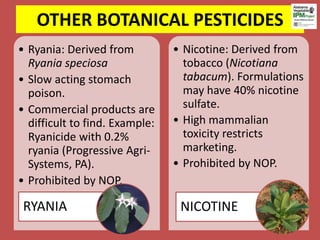
• Ryania: Derived from
Ryania speciosa
• Slow acting stomach
poison.
• Commercial products are
difficult to find. Example:
Ryanicide with 0.2%
ryania (Progressive Agri-
Systems, PA).
• Prohibited by NOP.
RYANIA
• Nicotine: Derived from
tobacco (Nicotiana
tabacum). Formulations
may have 40% nicotine
sulfate.
• High mammalian
toxicity restricts
marketing.
• Prohibited by NOP.
NICOTINE
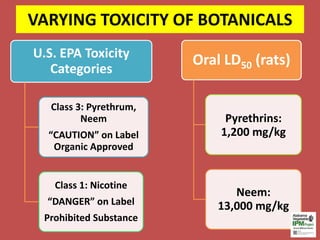
VARYING TOXICITY OF BOTANICALS
12
U.S. EPA Toxicity
Categories
Class 3: Pyrethrum,
Neem
“CAUTION” on Label
Organic Approved
Class 1: Nicotine
“DANGER” on Label
Prohibited Substance
Oral LD50 (rats)
Pyrethrins:
1,200 mg/kg
Neem:
13,000 mg/kg
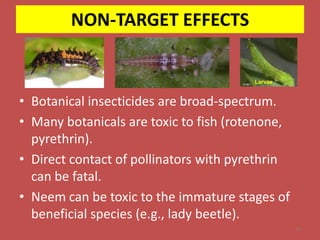
• Botanical insecticides are broad-spectrum.
• Many botanicals are toxic to fish (rotenone,
pyrethrin).
• Direct contact of pollinators with pyrethrin
can be fatal.
• Neem can be toxic to the immature stages of
beneficial species (e.g., lady beetle).
13
NON-TARGET EFFECTS
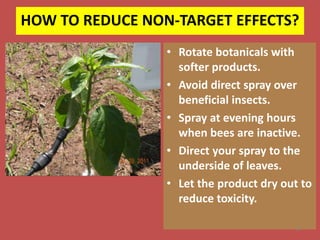
• Rotate botanicals with
softer products.
• Avoid direct spray over
beneficial insects.
• Spray at evening hours
when bees are inactive.
• Direct your spray to the
underside of leaves.
• Let the product dry out to
reduce toxicity.
14
HOW TO REDUCE NON-TARGET EFFECTS?
• Insecticides for Organic Commercial and
Backyard Vegetable Production, ANR-
1428. [Online]
http://www.aces.edu/pubs/docs/A/ANR
-1428/ANR-1428.pdf
• Pest Management in High Tunnel Crop
Production, ANR-1432. [Online]
http://www.aces.edu/pubs/docs/A/ANR
-1432/ANR-1432.pdf
• Consult a Regional Extension Agent for
designing an optimal trap cropping
system with accurate pest insect
identification.
Additional Publications
Acknowledgment
• Commercial Horticulture IPM Team: Mike
Reeves, James Miles, Doug Chapman, Neil
Kelly, Chip East, Bethany O’Rear, Gary Gray
• Home Ground IPM Team: Chris Becker, Willie
Datcher, Mike McQueen, Sallie Lee, Ellen
Huckabay
FUNDING AGENCIES

Botanical Insecticides (version 2013)

  • 1.
    BOTANICAL INSECTICIDES FOR VEGETABLEPRODUCTION ORGANIC IPM – PART 1 By Ayanava Majumdar Ext. Entomologist 251-331-8416 William East Regional Extension Agent Neil Kelly Regional Extension Agent
  • 2.
    What are BOTANICALinsecticides? Insect toxins derived from certain plants. Quick action on target pests. Broad spectrum action (non-selective). Do not persist in the environment. 2
  • 3.
    PYRETHRIN: BASICS • Derivedfrom Chrysanthemum cinerariaefolium • Caution: Do not mix with soap! • Examples: PyGanic (5% EC, OMRI-approved), EverGreen (6% EC) 3
  • 4.
    PYRETHRIN: TARGET APPLICATION •Target insects: Aphids, cucumber beetles, caterpillars... • Best used against small-sized and immature insects. • Short residual – reapply frequently! • Add synergist like PBO to increase efficacy. 4
  • 5.
    Fruit quality withPyganic (pyrethrum) (Cullman, AL, 2012) Untreated check Pyganic foliar 90% fruit damage 30% fruit damage
  • 6.
    NEEM: BASICS • Derivedfrom the seeds of Azadirachta indica. • Active ingredient is azadirachtin. • Available as azadirachtin-containing products, oils & soaps. • Examples: Neemix, Molt-X (farm products), Monterey Neem Oil (garden use) 6
  • 7.
    NEEM: TARGET APPLICATION •Neem has systemic properties; reduced lettuce aphids on seedlings (Palumbo et al. 2001). • Best against immature insects as foliar spray. • Tank-mix & premixes are also effective. 7
  • 8.
    Aphid control inCollards using Neem Tank-mix (Brewton, AL, 2010) Arthropod Management Tests, 2012, Vol. 37 Neem or Molt-X tank-mixed at full rate with BotaniGard (microbial) or Suffoil-X (paraffinic oil) gave good aphid control.
  • 9.
    ROTENONE: BASICS • Derivedfrom Derris roots. Organic approved till 2005. • Caution: Extremely toxic to fish. • Products with 1% rotenone are available commercially but are difficult to find. 9
  • 10.
    SABADILLA • Derived fromthe seeds of sabadilla lily. • Good activity against thrips and other pests. • Examples: Veratran D (0.2%) – on fruit crops. 10
  • 11.
    11 OTHER BOTANICAL PESTICIDES •Ryania: Derived from Ryania speciosa • Slow acting stomach poison. • Commercial products are difficult to find. Example: Ryanicide with 0.2% ryania (Progressive Agri- Systems, PA). • Prohibited by NOP. RYANIA • Nicotine: Derived from tobacco (Nicotiana tabacum). Formulations may have 40% nicotine sulfate. • High mammalian toxicity restricts marketing. • Prohibited by NOP. NICOTINE
  • 12.
    VARYING TOXICITY OFBOTANICALS 12 U.S. EPA Toxicity Categories Class 3: Pyrethrum, Neem “CAUTION” on Label Organic Approved Class 1: Nicotine “DANGER” on Label Prohibited Substance Oral LD50 (rats) Pyrethrins: 1,200 mg/kg Neem: 13,000 mg/kg
  • 13.
    • Botanical insecticidesare broad-spectrum. • Many botanicals are toxic to fish (rotenone, pyrethrin). • Direct contact of pollinators with pyrethrin can be fatal. • Neem can be toxic to the immature stages of beneficial species (e.g., lady beetle). 13 NON-TARGET EFFECTS
  • 14.
    • Rotate botanicalswith softer products. • Avoid direct spray over beneficial insects. • Spray at evening hours when bees are inactive. • Direct your spray to the underside of leaves. • Let the product dry out to reduce toxicity. 14 HOW TO REDUCE NON-TARGET EFFECTS?
  • 15.
    • Insecticides forOrganic Commercial and Backyard Vegetable Production, ANR- 1428. [Online] http://www.aces.edu/pubs/docs/A/ANR -1428/ANR-1428.pdf • Pest Management in High Tunnel Crop Production, ANR-1432. [Online] http://www.aces.edu/pubs/docs/A/ANR -1432/ANR-1432.pdf • Consult a Regional Extension Agent for designing an optimal trap cropping system with accurate pest insect identification. Additional Publications
  • 16.
    Acknowledgment • Commercial HorticultureIPM Team: Mike Reeves, James Miles, Doug Chapman, Neil Kelly, Chip East, Bethany O’Rear, Gary Gray • Home Ground IPM Team: Chris Becker, Willie Datcher, Mike McQueen, Sallie Lee, Ellen Huckabay
  • 17.