




Bioinsecticides 101
Dr. Ayanava Majumdar (Dr. A)
Extension Professor &
State SARE Coordinator
Auburn, AL 36849
Tel: (251) 331-8416
bugdoctor@auburn.edu
www.alabamabeginningfarmer.com
Disclaimer!!
• Handouts may be slightly different. Email
bugdoctor@auburn.edu if you are
concerned!
• Initial research is done in controlled
environments – then evaluated by
farmers.
• Name of products does not mean
endorsement.
• Adapt or develop pest management
strategies as needed – ‘site-specific IPM’ is
the goal!
• Keep record of what works for you
• Contact your county Extension office for
updates.
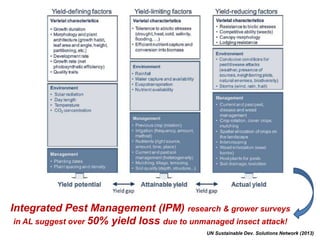
UN Sustainable Dev. Solutions Network (2013)
Integrated Pest Management (IPM) research & grower surveys
in AL suggest over 50% yield loss due to unmanaged insect attack!
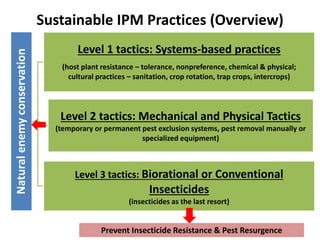
Sustainable IPM Practices (Overview)Naturalenemyconservation
Level 1 tactics: Systems-based practices
(host plant resistance – tolerance, nonpreference, chemical & physical;
cultural practices – sanitation, crop rotation, trap crops, intercrops)
Level 2 tactics: Mechanical and Physical Tactics
(temporary or permanent pest exclusion systems, pest removal manually or
specialized equipment)
Level 3 tactics: Biorational or Conventional
Insecticides
(insecticides as the last resort)
Prevent Insecticide Resistance & Pest Resurgence
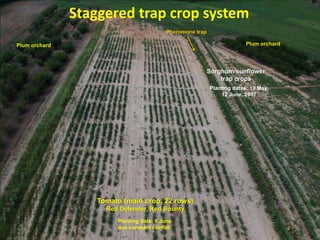
Staggered trap crop system
Tomato (main crop, 22 rows)
Red Defender, Red Bounty
Sorghum/sunflower
trap crops
Plum orchard Plum orchard
Planting dates: 19 May,
12 June, 2017
Planting date: 9 June
due constant rainfall
Pheromone trap
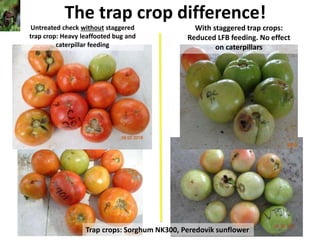
The trap crop difference!
Untreated check without staggered
trap crop: Heavy leaffooted bug and
caterpillar feeding
Trap crops: Sorghum NK300, Peredovik sunflower
With staggered trap crops:
Reduced LFB feeding. No effect
on caterpillars
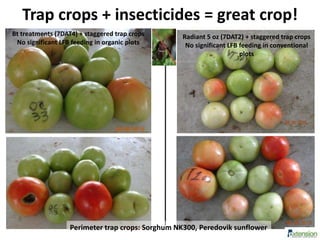
Trap crops + insecticides = great crop!
Radiant 5 oz (7DAT2) + staggered trap crops
No significant LFB feeding in conventional
plots
Perimeter trap crops: Sorghum NK300, Peredovik sunflower
Bt treatments (7DAT4) + staggered trap crops
No significant LFB feeding in organic plots
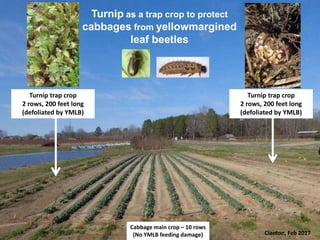
Clanton, Feb 2017
Turnip trap crop
2 rows, 200 feet long
(defoliated by YMLB)
Turnip trap crop
2 rows, 200 feet long
(defoliated by YMLB)
Turnip as a trap crop to protect
cabbages from yellowmargined
leaf beetles
Cabbage main crop – 10 rows
(No YMLB feeding damage)
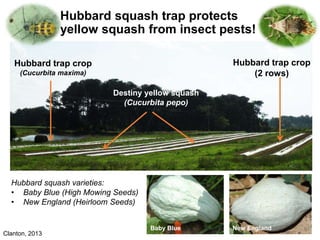
Hubbard squash trap protects
yellow squash from insect pests!
Hubbard trap crop
(Cucurbita maxima)
Hubbard trap crop
(2 rows)
Destiny yellow squash
(Cucurbita pepo)
Hubbard squash varieties:
• Baby Blue (High Mowing Seeds)
• New England (Heirloom Seeds)
Baby Blue New England
Clanton, 2013
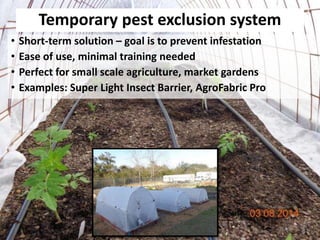
Temporary pest exclusion system
• Short-term solution – goal is to prevent infestation
• Ease of use, minimal training needed
• Perfect for small scale agriculture, market gardens
• Examples: Super Light Insect Barrier, AgroFabric Pro
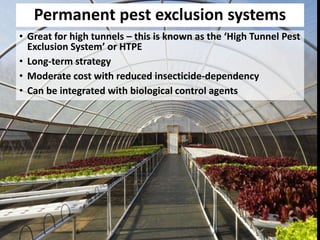
Permanent pest exclusion systems
• Great for high tunnels – this is known as the ‘High Tunnel Pest
Exclusion System’ or HTPE
• Long-term strategy
• Moderate cost with reduced insecticide-dependency
• Can be integrated with biological control agents
Insect Pest Activity Updates
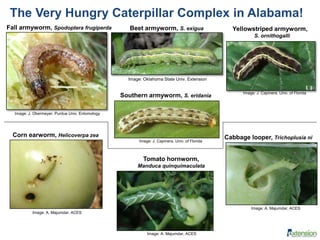
Fall armyworm, Spodoptera frugiperda
Image: J. Obermeyer, Purdue Univ. Entomology
Beet armyworm, S. exigua
Image: Oklahoma State Univ. Extension
Image: J. Capinera, Univ. of Florida
Yellowstriped armyworm,
S. ornithogalli
Southern armyworm, S. eridania
Image: J. Capinera, Univ. of Florida
Corn earworm, Helicoverpa zea
Image: A. Majumdar, ACES
Tomato hornworm,
Manduca quinquimaculata
Image: A. Majumdar, ACES
Cabbage looper, Trichoplusia ni
Image: A. Majumdar, ACES
The Very Hungry Caterpillar Complex in Alabama!
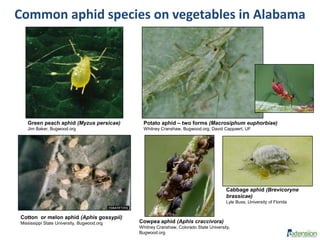
Common aphid species on vegetables in Alabama
Green peach aphid (Myzus persicae)
Jim Baker, Bugwood.org
Potato aphid – two forms (Macrosiphum euphorbiae)
Whitney Cranshaw, Bugwood.org; David Cappaert, UF
Cotton or melon aphid (Aphis gossypii)
Mississippi State University, Bugwood.org Cowpea aphid (Aphis craccivora)
Whitney Cranshaw, Colorado State University,
Bugwood.org
Cabbage aphid (Brevicoryne
brassicae)
Lyle Buss, University of Florida
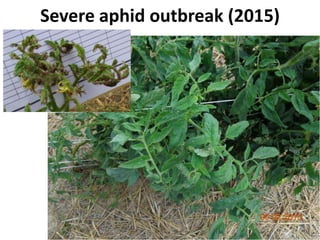
Severe aphid outbreak (2015)
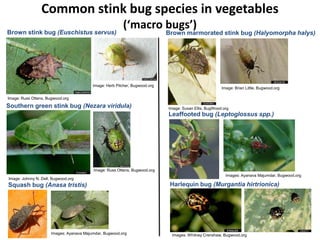
Common stink bug species in vegetables
(‘macro bugs’)Brown stink bug (Euschistus servus)
Image: Russ Ottens, Bugwood.org
Image: Herb Pilcher, Bugwood.org
Southern green stink bug (Nezara viridula)
Image: Russ Ottens, Bugwood.org
Image: Johnny N. Dell, Bugwood.org
Brown marmorated stink bug (Halyomorpha halys)
Image: Susan Ellis, BugWood.org
Image: Brian Little, Bugwood.org
Leaffooted bug (Leptoglossus spp.)
Images: Ayanava Majumdar, Bugwood.org
Squash bug (Anasa tristis)
Images: Ayanava Majumdar, Bugwood.org
Harlequin bug (Murgantia hirtrionica)
Images: Whitney Crenshaw, Bugwood.org
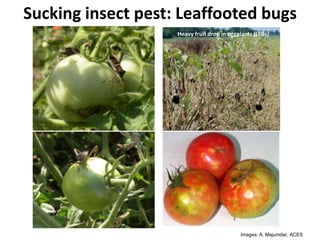
Sucking insect pest: Leaffooted bugs
Images: A. Majumdar, ACES
Heavy fruit drop in eggplants (LFBs)
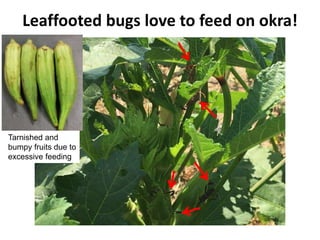
Leaffooted bugs love to feed on okra!
Tarnished and
bumpy fruits due to
excessive feeding
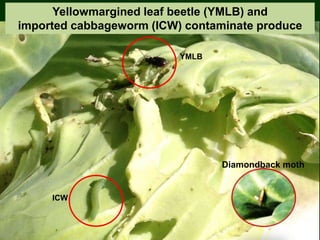
Yellowmargined leaf beetle (YMLB) and
imported cabbageworm (ICW) contaminate produce
Diamondback moth
YMLB
ICW
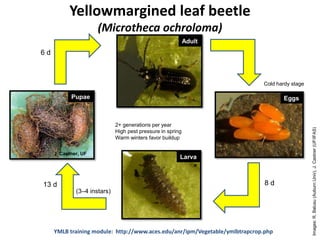
J. Castner, UF
8 d13 d
(3–4 instars)
6 d
Yellowmargined leaf beetle
(Microtheca ochroloma)
Adult
Eggs
Larva
Pupae
Cold hardy stage
2+ generations per year
High pest pressure in spring
Warm winters favor buildup
Images:R.Balusu(AuburnUniv),J.Castner(UF/IFAS)
YMLB training module: http://www.aces.edu/anr/ipm/Vegetable/ymlbtrapcrop.php
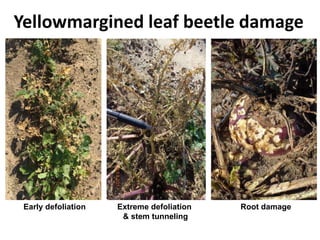
Yellowmargined leaf beetle damage
Early defoliation Extreme defoliation
& stem tunneling
Root damage
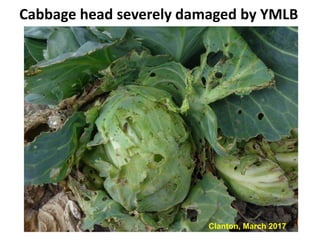
Cabbage head severely damaged by YMLB
Clanton, March 2017
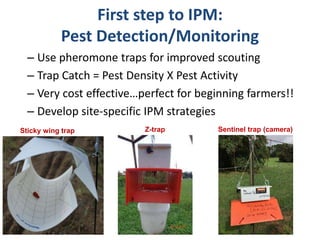
First step to IPM:
Pest Detection/Monitoring
– Use pheromone traps for improved scouting
– Trap Catch = Pest Density X Pest Activity
– Very cost effective…perfect for beginning farmers!!
– Develop site-specific IPM strategies
Sticky wing trap Z-trap Sentinel trap (camera)
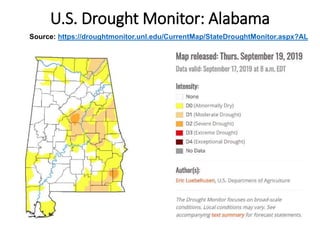
U.S. Drought Monitor: Alabama
Source: https://droughtmonitor.unl.edu/CurrentMap/StateDroughtMonitor.aspx?AL
5.2 1.7 3.9 4.6 5.1 4.5 4.1 4.7 0 5.6 2.6 5.6
48
61 58 66 76 80 83 84 83 71
54 54
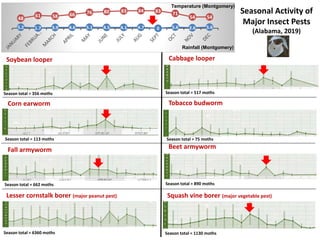
Seasonal Activity of
Major Insect Pests
(Alabama, 2019)
Soybean looper Cabbage looper
Tobacco budworm
Fall armyworm Beet armyworm
Lesser cornstalk borer (major peanut pest) Squash vine borer (major vegetable pest)
Corn earworm
Season total = 890 moths
Rainfall (Montgomery)
Temperature (Montgomery)
Season total = 517 moths
Season total = 113 moths
Season total = 662 moths
Season total = 6360 moths
Season total = 356 moths
Season total = 1130 moths
Season total = 75 moths
Level 3.
Organic Insecticides
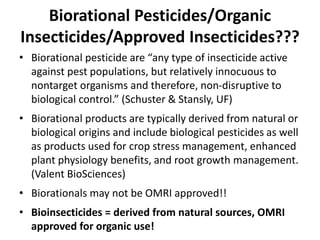
Biorational Pesticides/Organic
Insecticides/Approved Insecticides???
• Biorational pesticide are “any type of insecticide active
against pest populations, but relatively innocuous to
nontarget organisms and therefore, non-disruptive to
biological control.” (Schuster & Stansly, UF)
• Biorational products are typically derived from natural or
biological origins and include biological pesticides as well
as products used for crop stress management, enhanced
plant physiology benefits, and root growth management.
(Valent BioSciences)
• Biorationals may not be OMRI approved!!
• Bioinsecticides = derived from natural sources, OMRI
approved for organic use!
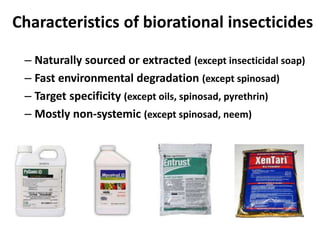
Characteristics of biorational insecticides
– Naturally sourced or extracted (except insecticidal soap)
– Fast environmental degradation (except spinosad)
– Target specificity (except oils, spinosad, pyrethrin)
– Mostly non-systemic (except spinosad, neem)
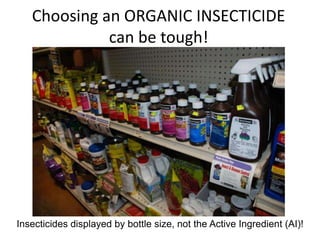
Insecticides displayed by bottle size, not the Active Ingredient (AI)!
Choosing an ORGANIC INSECTICIDE
can be tough!
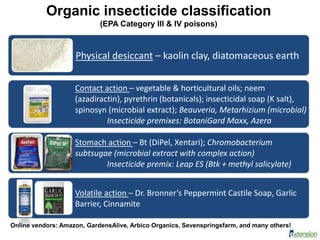
Physical desiccant – kaolin clay, diatomaceous earth
Contact action – vegetable & horticultural oils; neem
(azadiractin), pyrethrin (botanicals); insecticidal soap (K salt),
spinosyn (microbial extract); Beauveria, Metarhizium (microbial)
Insecticide premixes: BotaniGard Maxx, Azera
Stomach action – Bt (DiPel, Xentari); Chromobacterium
subtsugae (microbial extract with complex action)
Insecticide premix: Leap ES (Btk + methyl salicylate)
Volatile action – Dr. Bronner’s Peppermint Castile Soap, Garlic
Barrier, Cinnamite
Organic insecticide classification
(EPA Category III & IV poisons)
Online vendors: Amazon, GardensAlive, Arbico Organics, Sevenspringsfarm, and many others!
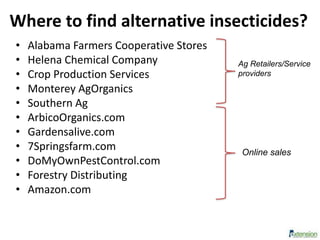
Where to find alternative insecticides?
• Alabama Farmers Cooperative Stores
• Helena Chemical Company
• Crop Production Services
• Monterey AgOrganics
• Southern Ag
• ArbicoOrganics.com
• Gardensalive.com
• 7Springsfarm.com
• DoMyOwnPestControl.com
• Forestry Distributing
• Amazon.com
Ag Retailers/Service
providers
Online sales
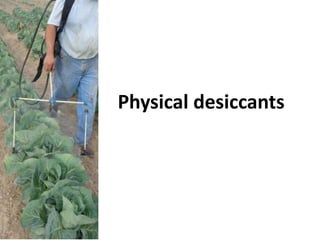
Physical desiccants
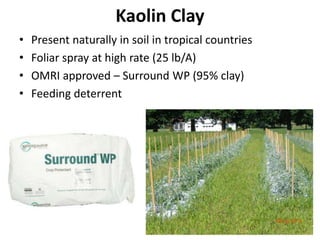
Kaolin Clay
• Present naturally in soil in tropical countries
• Foliar spray at high rate (25 lb/A)
• OMRI approved – Surround WP (95% clay)
• Feeding deterrent
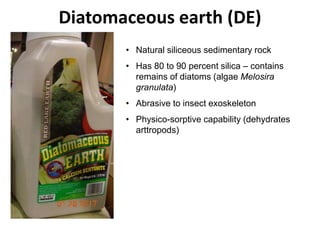
Diatomaceous earth (DE)
• Natural siliceous sedimentary rock
• Has 80 to 90 percent silica – contains
remains of diatoms (algae Melosira
granulata)
• Abrasive to insect exoskeleton
• Physico-sorptive capability (dehydrates
arttropods)
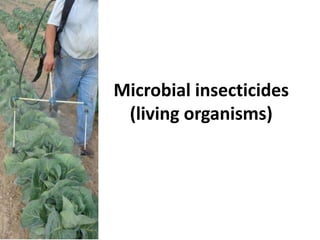
Microbial insecticides
(living organisms)
Bacillus thuringiensis (Bt)
• IRAC Class 11 (disrupts midguts)
• Four generations:
- Bt kurstaki (DiPel, Javelin, CoStar, Deliver) or
Bt aizawai (Xentari, Agree)
- 2 species premix – not available commercially
- Pseudomonas-based systems: MVP
- Recombinant DNA (Btk+Bta): Crymax – GM
product…not organic approved
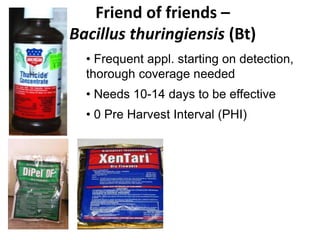
Friend of friends –
Bacillus thuringiensis (Bt)
• Frequent appl. starting on detection,
thorough coverage needed
• Needs 10-14 days to be effective
• 0 Pre Harvest Interval (PHI)
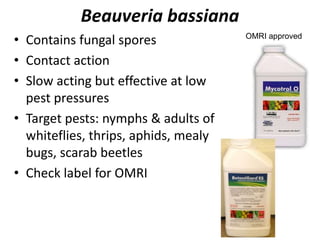
Beauveria bassiana
• Contains fungal spores
• Contact action
• Slow acting but effective at low
pest pressures
• Target pests: nymphs & adults of
whiteflies, thrips, aphids, mealy
bugs, scarab beetles
• Check label for OMRI
OMRI approved
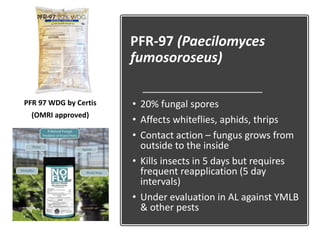
PFR-97 (Paecilomyces
fumosoroseus)
• 20% fungal spores
• Affects whiteflies, aphids, thrips
• Contact action – fungus grows from
outside to the inside
• Kills insects in 5 days but requires
frequent reapplication (5 day
intervals)
• Under evaluation in AL against YMLB
& other pests
PFR 97 WDG by Certis
(OMRI approved)
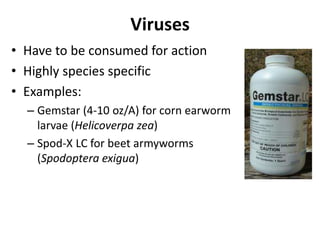
Viruses
• Have to be consumed for action
• Highly species specific
• Examples:
– Gemstar (4-10 oz/A) for corn earworm
larvae (Helicoverpa zea)
– Spod-X LC for beet armyworms
(Spodoptera exigua)
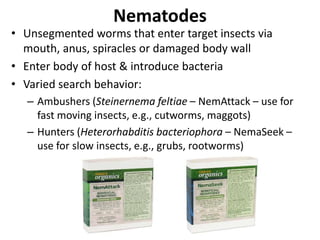
Nematodes
• Unsegmented worms that enter target insects via
mouth, anus, spiracles or damaged body wall
• Enter body of host & introduce bacteria
• Varied search behavior:
– Ambushers (Steinernema feltiae – NemAttack – use for
fast moving insects, e.g., cutworms, maggots)
– Hunters (Heterorhabditis bacteriophora – NemaSeek –
use for slow insects, e.g., grubs, rootworms)
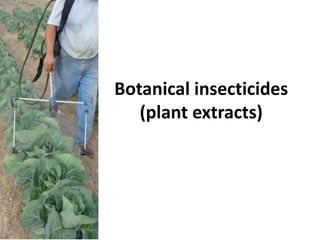
Botanical insecticides
(plant extracts)
What are botanical insecticides?
Insect toxins derived from certain plants.
Quick action on target pests.
Broad spectrum action (non-selective).
Do not persist in the environment.
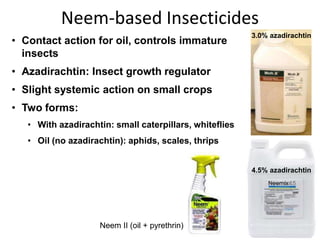
Neem-based Insecticides
Neem II (oil + pyrethrin)
• Contact action for oil, controls immature
insects
• Azadirachtin: Insect growth regulator
• Slight systemic action on small crops
• Two forms:
• With azadirachtin: small caterpillars, whiteflies
• Oil (no azadirachtin): aphids, scales, thrips
4.5% azadirachtin
3.0% azadirachtin
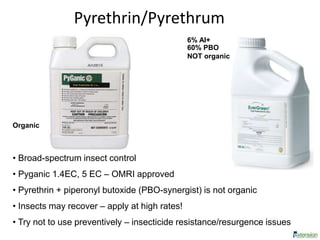
Pyrethrin/Pyrethrum
• Broad-spectrum insect control
• Pyganic 1.4EC, 5 EC – OMRI approved
• Pyrethrin + piperonyl butoxide (PBO-synergist) is not organic
• Insects may recover – apply at high rates!
• Try not to use preventively – insecticide resistance/resurgence issues
6% AI+
60% PBO
NOT organic
Organic
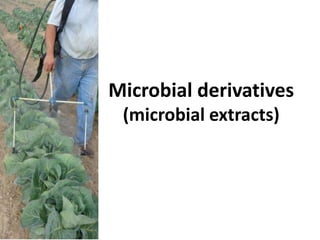
Microbial derivatives
(microbial extracts)
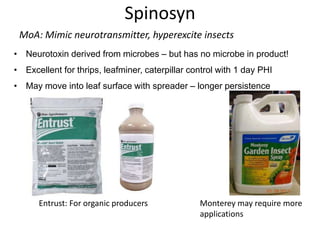
MoA: Mimic neurotransmitter, hyperexcite insects
Entrust: For organic producers
Spinosyn
• Neurotoxin derived from microbes – but has no microbe in product!
• Excellent for thrips, leafminer, caterpillar control with 1 day PHI
• May move into leaf surface with spreader – longer persistence
Monterey may require more
applications
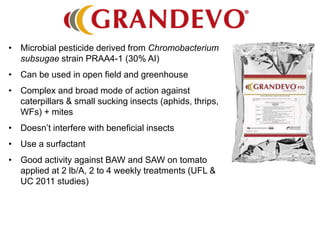
• Microbial pesticide derived from Chromobacterium
subsugae strain PRAA4-1 (30% AI)
• Can be used in open field and greenhouse
• Complex and broad mode of action against
caterpillars & small sucking insects (aphids, thrips,
WFs) + mites
• Doesn’t interfere with beneficial insects
• Use a surfactant
• Good activity against BAW and SAW on tomato
applied at 2 lb/A, 2 to 4 weekly treatments (UFL &
UC 2011 studies)
Venerate for caterpillar control
• Heat-killed Burkholderia spp. Strain A396 (Proteobacteria)
• Kills insects by enzymatic degradation of exoskeleton
• Interferes with molting (contact action)
• Controls or suppresses…aphids, whiteflies, spider mites,
caterpillars
• Avoid application during adult stages of insects
• Can be used in open field or greenhouses – cucurbits,
fruiting vegetables, cole crops, bulb vegetables, herbs, leafy
vegetables etc.
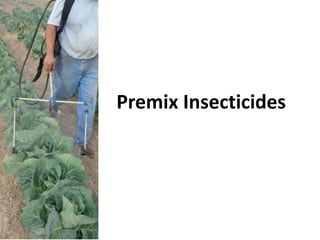
Premix Insecticides
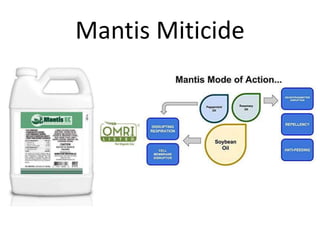
Mantis Miticide
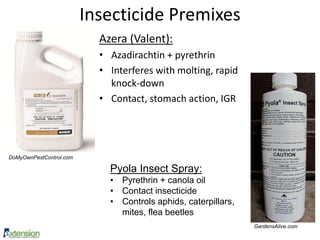
Insecticide Premixes
Azera (Valent):
• Azadirachtin + pyrethrin
• Interferes with molting, rapid
knock-down
• Contact, stomach action, IGR
Pyola Insect Spray:
• Pyrethrin + canola oil
• Contact insecticide
• Controls aphids, caterpillars,
mites, flea beetles
GardensAlive.com
DoMyOwnPestControl.com
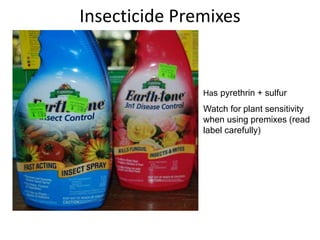
Insecticide Premixes
Has pyrethrin + sulfur
Watch for plant sensitivity
when using premixes (read
label carefully)
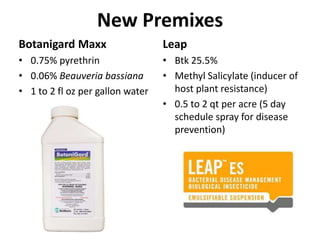
New Premixes
Botanigard Maxx
• 0.75% pyrethrin
• 0.06% Beauveria bassiana
• 1 to 2 fl oz per gallon water
Leap
• Btk 25.5%
• Methyl Salicylate (inducer of
host plant resistance)
• 0.5 to 2 qt per acre (5 day
schedule spray for disease
prevention)
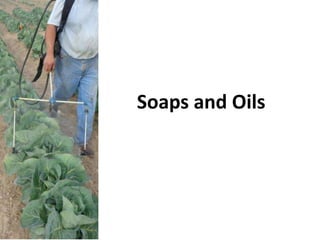
Soaps and Oils
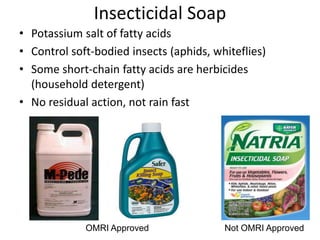
Insecticidal Soap
• Potassium salt of fatty acids
• Control soft-bodied insects (aphids, whiteflies)
• Some short-chain fatty acids are herbicides
(household detergent)
• No residual action, not rain fast
OMRI Approved Not OMRI Approved
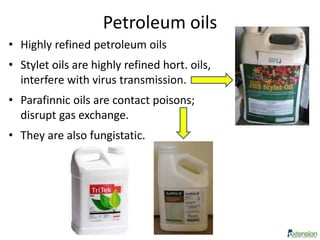
Petroleum oils
• Highly refined petroleum oils
• Stylet oils are highly refined hort. oils,
interfere with virus transmission.
• Parafinnic oils are contact poisons;
disrupt gas exchange.
• They are also fungistatic.
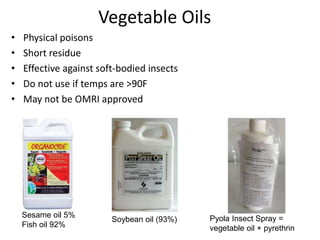
Vegetable Oils
• Physical poisons
• Short residue
• Effective against soft-bodied insects
• Do not use if temps are >90F
• May not be OMRI approved
Soybean oil (93%)
Sesame oil 5%
Fish oil 92%
Pyola Insect Spray =
vegetable oil + pyrethrin
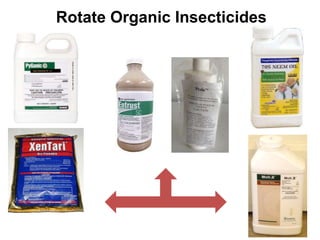
Rotate Organic Insecticides
Efficacy data (field trials)
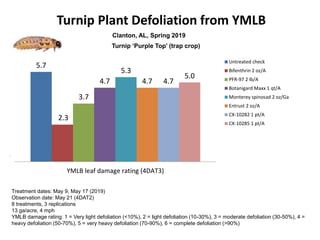
Turnip Plant Defoliation from YMLB
0.0 0.0 0.0 0.0 0.0 0.0 0.0 0.0
YMLB leaf damage rating (3DAT3)
Untreated check
Bifenthrin 2 oz/A (3 weekly appl)
PFR-97 2 lb/A (3 weekly appl)
Botanigard Maxx 1 qt/A (3 weekly appl)
Pyganic 16 ozA, Leap 2 qt/A, Pyganic 16 oz/A
Azera 32 oz/A, Xentari 1.5 lb/A, Azera 32 oz/A
Monterey spinosad 2 oz/Ga (3 weekly application)
Entrust 1 oz/A (3 weekly appl)
Clanton, AL, Spring 2019
Turnip ‘Purple Top’ (trap crop)
a b b b b b b b
5.7
2.3
3.7
4.7
5.3
4.7 4.7
5.0
YMLB leaf damage rating (4DAT3)
Untreated check
Bifenthrin 2 oz/A
PFR-97 2 lb/A
Botanigard Maxx 1 qt/A
Monterey spinosad 2 oz/Ga
Entrust 2 oz/A
CX-10282 1 pt/A
CX-10285 1 pt/A
Treatment dates: May 9, May 17 (2019)
Observation date: May 21 (4DAT2)
8 treatments, 3 replications
13 ga/acre, 4 mph
YMLB damage rating: 1 = Very light defoliation (<10%), 2 = light defoliation (10-30%), 3 = moderate defoliation (30-50%), 4 =
heavy defoliation (50-70%), 5 = very heavy defoliation (70-90%), 6 = complete defoliation (>90%)
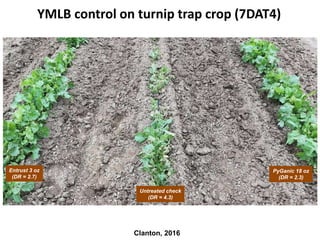
Clanton, 2016
YMLB control on turnip trap crop (7DAT4)
Entrust 3 oz
(DR = 2.7)
Untreated check
(DR = 4.3)
PyGanic 18 oz
(DR = 2.3)
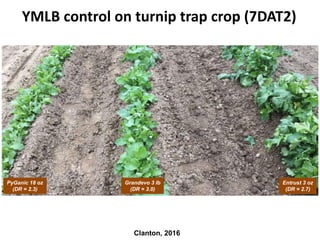
Clanton, 2016
YMLB control on turnip trap crop (7DAT2)
PyGanic 18 oz
(DR = 2.3)
Grandevo 3 lb
(DR = 3.0)
Entrust 3 oz
(DR = 2.7)
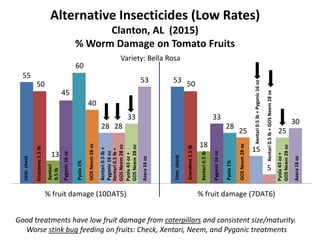
Alternative Insecticides (Low Rates)
Clanton, AL (2015)
% Worm Damage on Tomato Fruits
55
53
50 50
13
18
45
33
60
28
40
25
28
15
28
5
33
25
53
30
% fruit damage (10DAT5) % fruit damage (7DAT6)
Untr.check
Grandevo1.5lb
Xentari
0.5lb
GOSNeem28oz
Pyola1%
Untr.check
Grandevo1.5lb
Pyganic16oz
Variety: Bella Rosa
Xentari0.5lb
Pyganic16oz
GOSNeem28oz
Pyola1%
Xentari0.5lb+Pyganic16oz
Xentari0.5lb+
Pyganic16oz
Xentari0.5lb+
GOSNeem28oz
Xentari0.5lb+GOSNeem28oz
Pyola43oz+
GOSNeem28oz
Pyola43oz+
GOSNeem28oz
Azera16oz
Azera16oz
Good treatments have low fruit damage from caterpillars and consistent size/maturity.
Worse stink bug feeding on fruits: Check, Xentari, Neem, and Pyganic treatments
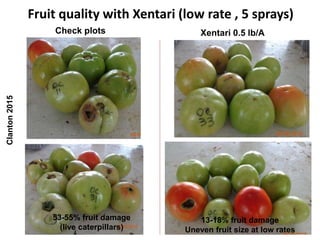
Fruit quality with Xentari (low rate , 5 sprays)
Check plots Xentari 0.5 lb/A
13-18% fruit damage
Uneven fruit size at low rates
Clanton2015
53-55% fruit damage
(live caterpillars)
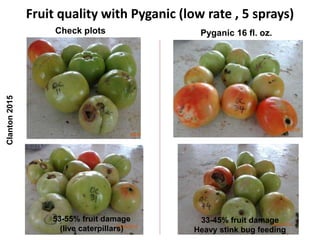
Fruit quality with Pyganic (low rate , 5 sprays)
Check plots Pyganic 16 fl. oz.
33-45% fruit damage
Heavy stink bug feeding
Clanton2015
53-55% fruit damage
(live caterpillars)
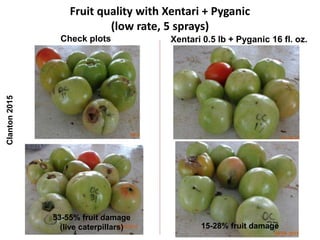
Fruit quality with Xentari + Pyganic
(low rate, 5 sprays)
Check plots Xentari 0.5 lb + Pyganic 16 fl. oz.
Clanton2015
53-55% fruit damage
(live caterpillars) 15-28% fruit damage
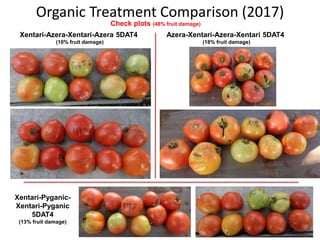
Organic Treatment Comparison (2017)
Check plots (48% fruit damage)
Xentari-Azera-Xentari-Azera 5DAT4
(10% fruit damage)
Azera-Xentari-Azera-Xentari 5DAT4
(18% fruit damage)
Xentari-Pyganic-
Xentari-Pyganic
5DAT4
(13% fruit damage)
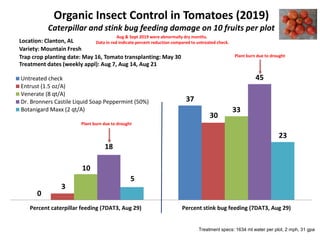
Organic Insect Control in Tomatoes (2019)
Caterpillar and stink bug feeding damage on 10 fruits per plot
0
37
3
30
10
33
18
45
5
23
Percent caterpillar feeding (7DAT3, Aug 29) Percent stink bug feeding (7DAT3, Aug 29)
Untreated check
Entrust (1.5 oz/A)
Venerate (8 qt/A)
Dr. Bronners Castile Liquid Soap Peppermint (50%)
Botanigard Maxx (2 qt/A)
Location: Clanton, AL
Variety: Mountain Fresh
Treatment dates (weekly appl): Aug 7, Aug 14, Aug 21
Treatment specs: 1634 ml water per plot, 2 mph, 31 gpa
Plant burn due to drought
Aug & Sept 2019 were abnormally dry months.
Data in red indicate percent reduction compared to untreated check.
Plant burn due to droughtTrap crop planting date: May 16, Tomato transplanting: May 30
Ant management options
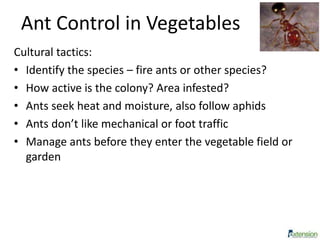
Ant Control in Vegetables
Cultural tactics:
• Identify the species – fire ants or other species?
• How active is the colony? Area infested?
• Ants seek heat and moisture, also follow aphids
• Ants don’t like mechanical or foot traffic
• Manage ants before they enter the vegetable field or
garden
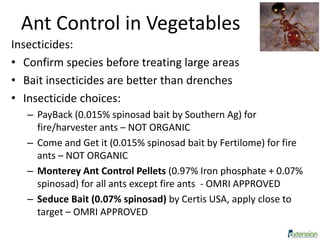
Ant Control in Vegetables
Insecticides:
• Confirm species before treating large areas
• Bait insecticides are better than drenches
• Insecticide choices:
– PayBack (0.015% spinosad bait by Southern Ag) for
fire/harvester ants – NOT ORGANIC
– Come and Get it (0.015% spinosad bait by Fertilome) for fire
ants – NOT ORGANIC
– Monterey Ant Control Pellets (0.97% Iron phosphate + 0.07%
spinosad) for all ants except fire ants - OMRI APPROVED
– Seduce Bait (0.07% spinosad) by Certis USA, apply close to
target – OMRI APPROVED
Organic Spreaders/Sticker
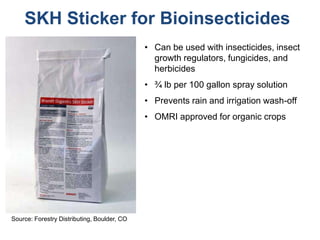
SKH Sticker for Bioinsecticides
• Can be used with insecticides, insect
growth regulators, fungicides, and
herbicides
• ¾ lb per 100 gallon spray solution
• Prevents rain and irrigation wash-off
• OMRI approved for organic crops
Source: Forestry Distributing, Boulder, CO
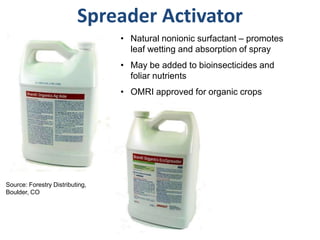
Spreader Activator
Source: Forestry Distributing,
Boulder, CO
• Natural nonionic surfactant – promotes
leaf wetting and absorption of spray
• May be added to bioinsecticides and
foliar nutrients
• OMRI approved for organic crops
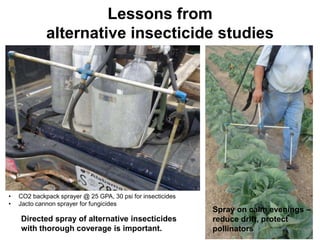
Lessons from
alternative insecticide studies
Directed spray of alternative insecticides
with thorough coverage is important.
Spray on calm evenings –
reduce drift, protect
pollinators
• CO2 backpack sprayer @ 25 GPA, 30 psi for insecticides
• Jacto cannon sprayer for fungicides
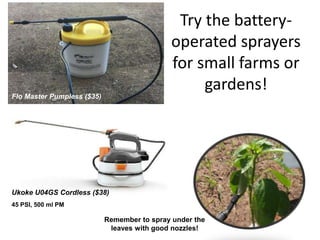
Try the battery-
operated sprayers
for small farms or
gardens!
Remember to spray under the
leaves with good nozzles!
Flo Master Pumpless ($35)
Ukoke U04GS Cordless ($38)
45 PSI, 500 ml PM
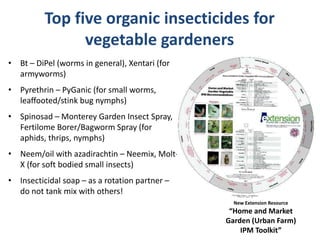
Top five organic insecticides for
vegetable gardeners
• Bt – DiPel (worms in general), Xentari (for
armyworms)
• Pyrethrin – PyGanic (for small worms,
leaffooted/stink bug nymphs)
• Spinosad – Monterey Garden Insect Spray,
Fertilome Borer/Bagworm Spray (for
aphids, thrips, nymphs)
• Neem/oil with azadirachtin – Neemix, Molt-
X (for soft bodied small insects)
• Insecticidal soap – as a rotation partner –
do not tank mix with others!
New Extension Resource
“Home and Market
Garden (Urban Farm)
IPM Toolkit”
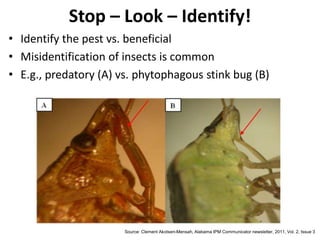
Stop – Look – Identify!
• Identify the pest vs. beneficial
• Misidentification of insects is common
• E.g., predatory (A) vs. phytophagous stink bug (B)
Source: Clement Akotsen-Mensah, Alabama IPM Communicator newsletter, 2011, Vol. 2, Issue 3
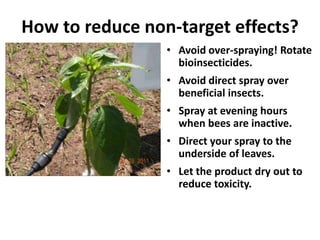
• Avoid over-spraying! Rotate
bioinsecticides.
• Avoid direct spray over
beneficial insects.
• Spray at evening hours
when bees are inactive.
• Direct your spray to the
underside of leaves.
• Let the product dry out to
reduce toxicity.
How to reduce non-target effects?
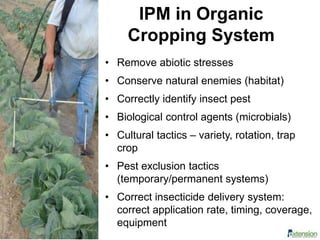
IPM in Organic
Cropping System
• Remove abiotic stresses
• Conserve natural enemies (habitat)
• Correctly identify insect pest
• Biological control agents (microbials)
• Cultural tactics – variety, rotation, trap
crop
• Pest exclusion tactics
(temporary/permanent systems)
• Correct insecticide delivery system:
correct application rate, timing, coverage,
equipment
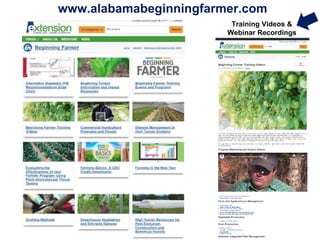
Educational Resources
Training Videos &
Webinar Recordings
www.alabamabeginningfarmer.com
Scan code below to…
Great source of crop
production and IPM info
Mobile-friendly website
www.aces.edu/ipmcommunicator
Alabama IPM Communicator Newsletter
Thank you!
Dr. Ayanava Majumdar (Dr. A)
Extension Professor &
State SARE Coordinator
Auburn, AL 36849
Tel: (251) 331-8416
bugdoctor@auburn.edu
www.alabamabeginningfarmer.com
Questions?

Bioinsecticide basics

  • 1.
    Bioinsecticides 101 Dr. AyanavaMajumdar (Dr. A) Extension Professor & State SARE Coordinator Auburn, AL 36849 Tel: (251) 331-8416 bugdoctor@auburn.edu www.alabamabeginningfarmer.com
  • 3.
    Disclaimer!! • Handouts maybe slightly different. Email bugdoctor@auburn.edu if you are concerned! • Initial research is done in controlled environments – then evaluated by farmers. • Name of products does not mean endorsement. • Adapt or develop pest management strategies as needed – ‘site-specific IPM’ is the goal! • Keep record of what works for you • Contact your county Extension office for updates.
  • 4.
    UN Sustainable Dev.Solutions Network (2013) Integrated Pest Management (IPM) research & grower surveys in AL suggest over 50% yield loss due to unmanaged insect attack!
  • 5.
    Sustainable IPM Practices(Overview)Naturalenemyconservation Level 1 tactics: Systems-based practices (host plant resistance – tolerance, nonpreference, chemical & physical; cultural practices – sanitation, crop rotation, trap crops, intercrops) Level 2 tactics: Mechanical and Physical Tactics (temporary or permanent pest exclusion systems, pest removal manually or specialized equipment) Level 3 tactics: Biorational or Conventional Insecticides (insecticides as the last resort) Prevent Insecticide Resistance & Pest Resurgence
  • 6.
    Staggered trap cropsystem Tomato (main crop, 22 rows) Red Defender, Red Bounty Sorghum/sunflower trap crops Plum orchard Plum orchard Planting dates: 19 May, 12 June, 2017 Planting date: 9 June due constant rainfall Pheromone trap
  • 7.
    The trap cropdifference! Untreated check without staggered trap crop: Heavy leaffooted bug and caterpillar feeding Trap crops: Sorghum NK300, Peredovik sunflower With staggered trap crops: Reduced LFB feeding. No effect on caterpillars
  • 8.
    Trap crops +insecticides = great crop! Radiant 5 oz (7DAT2) + staggered trap crops No significant LFB feeding in conventional plots Perimeter trap crops: Sorghum NK300, Peredovik sunflower Bt treatments (7DAT4) + staggered trap crops No significant LFB feeding in organic plots
  • 9.
    Clanton, Feb 2017 Turniptrap crop 2 rows, 200 feet long (defoliated by YMLB) Turnip trap crop 2 rows, 200 feet long (defoliated by YMLB) Turnip as a trap crop to protect cabbages from yellowmargined leaf beetles Cabbage main crop – 10 rows (No YMLB feeding damage)
  • 10.
    Hubbard squash trapprotects yellow squash from insect pests! Hubbard trap crop (Cucurbita maxima) Hubbard trap crop (2 rows) Destiny yellow squash (Cucurbita pepo) Hubbard squash varieties: • Baby Blue (High Mowing Seeds) • New England (Heirloom Seeds) Baby Blue New England Clanton, 2013
  • 11.
    Temporary pest exclusionsystem • Short-term solution – goal is to prevent infestation • Ease of use, minimal training needed • Perfect for small scale agriculture, market gardens • Examples: Super Light Insect Barrier, AgroFabric Pro
  • 12.
    Permanent pest exclusionsystems • Great for high tunnels – this is known as the ‘High Tunnel Pest Exclusion System’ or HTPE • Long-term strategy • Moderate cost with reduced insecticide-dependency • Can be integrated with biological control agents
  • 13.
  • 14.
    Fall armyworm, Spodopterafrugiperda Image: J. Obermeyer, Purdue Univ. Entomology Beet armyworm, S. exigua Image: Oklahoma State Univ. Extension Image: J. Capinera, Univ. of Florida Yellowstriped armyworm, S. ornithogalli Southern armyworm, S. eridania Image: J. Capinera, Univ. of Florida Corn earworm, Helicoverpa zea Image: A. Majumdar, ACES Tomato hornworm, Manduca quinquimaculata Image: A. Majumdar, ACES Cabbage looper, Trichoplusia ni Image: A. Majumdar, ACES The Very Hungry Caterpillar Complex in Alabama!
  • 15.
    Common aphid specieson vegetables in Alabama Green peach aphid (Myzus persicae) Jim Baker, Bugwood.org Potato aphid – two forms (Macrosiphum euphorbiae) Whitney Cranshaw, Bugwood.org; David Cappaert, UF Cotton or melon aphid (Aphis gossypii) Mississippi State University, Bugwood.org Cowpea aphid (Aphis craccivora) Whitney Cranshaw, Colorado State University, Bugwood.org Cabbage aphid (Brevicoryne brassicae) Lyle Buss, University of Florida
  • 16.
  • 17.
    Common stink bugspecies in vegetables (‘macro bugs’)Brown stink bug (Euschistus servus) Image: Russ Ottens, Bugwood.org Image: Herb Pilcher, Bugwood.org Southern green stink bug (Nezara viridula) Image: Russ Ottens, Bugwood.org Image: Johnny N. Dell, Bugwood.org Brown marmorated stink bug (Halyomorpha halys) Image: Susan Ellis, BugWood.org Image: Brian Little, Bugwood.org Leaffooted bug (Leptoglossus spp.) Images: Ayanava Majumdar, Bugwood.org Squash bug (Anasa tristis) Images: Ayanava Majumdar, Bugwood.org Harlequin bug (Murgantia hirtrionica) Images: Whitney Crenshaw, Bugwood.org
  • 18.
    Sucking insect pest:Leaffooted bugs Images: A. Majumdar, ACES Heavy fruit drop in eggplants (LFBs)
  • 19.
    Leaffooted bugs loveto feed on okra! Tarnished and bumpy fruits due to excessive feeding
  • 20.
    Yellowmargined leaf beetle(YMLB) and imported cabbageworm (ICW) contaminate produce Diamondback moth YMLB ICW
  • 21.
    J. Castner, UF 8d13 d (3–4 instars) 6 d Yellowmargined leaf beetle (Microtheca ochroloma) Adult Eggs Larva Pupae Cold hardy stage 2+ generations per year High pest pressure in spring Warm winters favor buildup Images:R.Balusu(AuburnUniv),J.Castner(UF/IFAS) YMLB training module: http://www.aces.edu/anr/ipm/Vegetable/ymlbtrapcrop.php
  • 22.
    Yellowmargined leaf beetledamage Early defoliation Extreme defoliation & stem tunneling Root damage
  • 23.
    Cabbage head severelydamaged by YMLB Clanton, March 2017
  • 24.
    First step toIPM: Pest Detection/Monitoring – Use pheromone traps for improved scouting – Trap Catch = Pest Density X Pest Activity – Very cost effective…perfect for beginning farmers!! – Develop site-specific IPM strategies Sticky wing trap Z-trap Sentinel trap (camera)
  • 25.
    U.S. Drought Monitor:Alabama Source: https://droughtmonitor.unl.edu/CurrentMap/StateDroughtMonitor.aspx?AL
  • 26.
    5.2 1.7 3.94.6 5.1 4.5 4.1 4.7 0 5.6 2.6 5.6 48 61 58 66 76 80 83 84 83 71 54 54 Seasonal Activity of Major Insect Pests (Alabama, 2019) Soybean looper Cabbage looper Tobacco budworm Fall armyworm Beet armyworm Lesser cornstalk borer (major peanut pest) Squash vine borer (major vegetable pest) Corn earworm Season total = 890 moths Rainfall (Montgomery) Temperature (Montgomery) Season total = 517 moths Season total = 113 moths Season total = 662 moths Season total = 6360 moths Season total = 356 moths Season total = 1130 moths Season total = 75 moths
  • 27.
  • 28.
    Biorational Pesticides/Organic Insecticides/Approved Insecticides??? •Biorational pesticide are “any type of insecticide active against pest populations, but relatively innocuous to nontarget organisms and therefore, non-disruptive to biological control.” (Schuster & Stansly, UF) • Biorational products are typically derived from natural or biological origins and include biological pesticides as well as products used for crop stress management, enhanced plant physiology benefits, and root growth management. (Valent BioSciences) • Biorationals may not be OMRI approved!! • Bioinsecticides = derived from natural sources, OMRI approved for organic use!
  • 29.
    Characteristics of biorationalinsecticides – Naturally sourced or extracted (except insecticidal soap) – Fast environmental degradation (except spinosad) – Target specificity (except oils, spinosad, pyrethrin) – Mostly non-systemic (except spinosad, neem)
  • 30.
    Insecticides displayed bybottle size, not the Active Ingredient (AI)! Choosing an ORGANIC INSECTICIDE can be tough!
  • 31.
    Physical desiccant –kaolin clay, diatomaceous earth Contact action – vegetable & horticultural oils; neem (azadiractin), pyrethrin (botanicals); insecticidal soap (K salt), spinosyn (microbial extract); Beauveria, Metarhizium (microbial) Insecticide premixes: BotaniGard Maxx, Azera Stomach action – Bt (DiPel, Xentari); Chromobacterium subtsugae (microbial extract with complex action) Insecticide premix: Leap ES (Btk + methyl salicylate) Volatile action – Dr. Bronner’s Peppermint Castile Soap, Garlic Barrier, Cinnamite Organic insecticide classification (EPA Category III & IV poisons) Online vendors: Amazon, GardensAlive, Arbico Organics, Sevenspringsfarm, and many others!
  • 32.
    Where to findalternative insecticides? • Alabama Farmers Cooperative Stores • Helena Chemical Company • Crop Production Services • Monterey AgOrganics • Southern Ag • ArbicoOrganics.com • Gardensalive.com • 7Springsfarm.com • DoMyOwnPestControl.com • Forestry Distributing • Amazon.com Ag Retailers/Service providers Online sales
  • 33.
  • 34.
    Kaolin Clay • Presentnaturally in soil in tropical countries • Foliar spray at high rate (25 lb/A) • OMRI approved – Surround WP (95% clay) • Feeding deterrent
  • 35.
    Diatomaceous earth (DE) •Natural siliceous sedimentary rock • Has 80 to 90 percent silica – contains remains of diatoms (algae Melosira granulata) • Abrasive to insect exoskeleton • Physico-sorptive capability (dehydrates arttropods)
  • 36.
  • 37.
    Bacillus thuringiensis (Bt) •IRAC Class 11 (disrupts midguts) • Four generations: - Bt kurstaki (DiPel, Javelin, CoStar, Deliver) or Bt aizawai (Xentari, Agree) - 2 species premix – not available commercially - Pseudomonas-based systems: MVP - Recombinant DNA (Btk+Bta): Crymax – GM product…not organic approved
  • 38.
    Friend of friends– Bacillus thuringiensis (Bt) • Frequent appl. starting on detection, thorough coverage needed • Needs 10-14 days to be effective • 0 Pre Harvest Interval (PHI)
  • 39.
    Beauveria bassiana • Containsfungal spores • Contact action • Slow acting but effective at low pest pressures • Target pests: nymphs & adults of whiteflies, thrips, aphids, mealy bugs, scarab beetles • Check label for OMRI OMRI approved
  • 40.
    PFR-97 (Paecilomyces fumosoroseus) • 20%fungal spores • Affects whiteflies, aphids, thrips • Contact action – fungus grows from outside to the inside • Kills insects in 5 days but requires frequent reapplication (5 day intervals) • Under evaluation in AL against YMLB & other pests PFR 97 WDG by Certis (OMRI approved)
  • 41.
    Viruses • Have tobe consumed for action • Highly species specific • Examples: – Gemstar (4-10 oz/A) for corn earworm larvae (Helicoverpa zea) – Spod-X LC for beet armyworms (Spodoptera exigua)
  • 42.
    Nematodes • Unsegmented wormsthat enter target insects via mouth, anus, spiracles or damaged body wall • Enter body of host & introduce bacteria • Varied search behavior: – Ambushers (Steinernema feltiae – NemAttack – use for fast moving insects, e.g., cutworms, maggots) – Hunters (Heterorhabditis bacteriophora – NemaSeek – use for slow insects, e.g., grubs, rootworms)
  • 43.
  • 44.
    What are botanicalinsecticides? Insect toxins derived from certain plants. Quick action on target pests. Broad spectrum action (non-selective). Do not persist in the environment.
  • 45.
    Neem-based Insecticides Neem II(oil + pyrethrin) • Contact action for oil, controls immature insects • Azadirachtin: Insect growth regulator • Slight systemic action on small crops • Two forms: • With azadirachtin: small caterpillars, whiteflies • Oil (no azadirachtin): aphids, scales, thrips 4.5% azadirachtin 3.0% azadirachtin
  • 46.
    Pyrethrin/Pyrethrum • Broad-spectrum insectcontrol • Pyganic 1.4EC, 5 EC – OMRI approved • Pyrethrin + piperonyl butoxide (PBO-synergist) is not organic • Insects may recover – apply at high rates! • Try not to use preventively – insecticide resistance/resurgence issues 6% AI+ 60% PBO NOT organic Organic
  • 47.
  • 48.
    MoA: Mimic neurotransmitter,hyperexcite insects Entrust: For organic producers Spinosyn • Neurotoxin derived from microbes – but has no microbe in product! • Excellent for thrips, leafminer, caterpillar control with 1 day PHI • May move into leaf surface with spreader – longer persistence Monterey may require more applications
  • 49.
    • Microbial pesticidederived from Chromobacterium subsugae strain PRAA4-1 (30% AI) • Can be used in open field and greenhouse • Complex and broad mode of action against caterpillars & small sucking insects (aphids, thrips, WFs) + mites • Doesn’t interfere with beneficial insects • Use a surfactant • Good activity against BAW and SAW on tomato applied at 2 lb/A, 2 to 4 weekly treatments (UFL & UC 2011 studies)
  • 50.
    Venerate for caterpillarcontrol • Heat-killed Burkholderia spp. Strain A396 (Proteobacteria) • Kills insects by enzymatic degradation of exoskeleton • Interferes with molting (contact action) • Controls or suppresses…aphids, whiteflies, spider mites, caterpillars • Avoid application during adult stages of insects • Can be used in open field or greenhouses – cucurbits, fruiting vegetables, cole crops, bulb vegetables, herbs, leafy vegetables etc.
  • 51.
  • 52.
  • 53.
    Insecticide Premixes Azera (Valent): •Azadirachtin + pyrethrin • Interferes with molting, rapid knock-down • Contact, stomach action, IGR Pyola Insect Spray: • Pyrethrin + canola oil • Contact insecticide • Controls aphids, caterpillars, mites, flea beetles GardensAlive.com DoMyOwnPestControl.com
  • 54.
    Insecticide Premixes Has pyrethrin+ sulfur Watch for plant sensitivity when using premixes (read label carefully)
  • 55.
    New Premixes Botanigard Maxx •0.75% pyrethrin • 0.06% Beauveria bassiana • 1 to 2 fl oz per gallon water Leap • Btk 25.5% • Methyl Salicylate (inducer of host plant resistance) • 0.5 to 2 qt per acre (5 day schedule spray for disease prevention)
  • 56.
  • 57.
    Insecticidal Soap • Potassiumsalt of fatty acids • Control soft-bodied insects (aphids, whiteflies) • Some short-chain fatty acids are herbicides (household detergent) • No residual action, not rain fast OMRI Approved Not OMRI Approved
  • 58.
    Petroleum oils • Highlyrefined petroleum oils • Stylet oils are highly refined hort. oils, interfere with virus transmission. • Parafinnic oils are contact poisons; disrupt gas exchange. • They are also fungistatic.
  • 59.
    Vegetable Oils • Physicalpoisons • Short residue • Effective against soft-bodied insects • Do not use if temps are >90F • May not be OMRI approved Soybean oil (93%) Sesame oil 5% Fish oil 92% Pyola Insect Spray = vegetable oil + pyrethrin
  • 60.
  • 61.
  • 62.
    Turnip Plant Defoliationfrom YMLB 0.0 0.0 0.0 0.0 0.0 0.0 0.0 0.0 YMLB leaf damage rating (3DAT3) Untreated check Bifenthrin 2 oz/A (3 weekly appl) PFR-97 2 lb/A (3 weekly appl) Botanigard Maxx 1 qt/A (3 weekly appl) Pyganic 16 ozA, Leap 2 qt/A, Pyganic 16 oz/A Azera 32 oz/A, Xentari 1.5 lb/A, Azera 32 oz/A Monterey spinosad 2 oz/Ga (3 weekly application) Entrust 1 oz/A (3 weekly appl) Clanton, AL, Spring 2019 Turnip ‘Purple Top’ (trap crop) a b b b b b b b 5.7 2.3 3.7 4.7 5.3 4.7 4.7 5.0 YMLB leaf damage rating (4DAT3) Untreated check Bifenthrin 2 oz/A PFR-97 2 lb/A Botanigard Maxx 1 qt/A Monterey spinosad 2 oz/Ga Entrust 2 oz/A CX-10282 1 pt/A CX-10285 1 pt/A Treatment dates: May 9, May 17 (2019) Observation date: May 21 (4DAT2) 8 treatments, 3 replications 13 ga/acre, 4 mph YMLB damage rating: 1 = Very light defoliation (<10%), 2 = light defoliation (10-30%), 3 = moderate defoliation (30-50%), 4 = heavy defoliation (50-70%), 5 = very heavy defoliation (70-90%), 6 = complete defoliation (>90%)
  • 63.
    Clanton, 2016 YMLB controlon turnip trap crop (7DAT4) Entrust 3 oz (DR = 2.7) Untreated check (DR = 4.3) PyGanic 18 oz (DR = 2.3)
  • 64.
    Clanton, 2016 YMLB controlon turnip trap crop (7DAT2) PyGanic 18 oz (DR = 2.3) Grandevo 3 lb (DR = 3.0) Entrust 3 oz (DR = 2.7)
  • 65.
    Alternative Insecticides (LowRates) Clanton, AL (2015) % Worm Damage on Tomato Fruits 55 53 50 50 13 18 45 33 60 28 40 25 28 15 28 5 33 25 53 30 % fruit damage (10DAT5) % fruit damage (7DAT6) Untr.check Grandevo1.5lb Xentari 0.5lb GOSNeem28oz Pyola1% Untr.check Grandevo1.5lb Pyganic16oz Variety: Bella Rosa Xentari0.5lb Pyganic16oz GOSNeem28oz Pyola1% Xentari0.5lb+Pyganic16oz Xentari0.5lb+ Pyganic16oz Xentari0.5lb+ GOSNeem28oz Xentari0.5lb+GOSNeem28oz Pyola43oz+ GOSNeem28oz Pyola43oz+ GOSNeem28oz Azera16oz Azera16oz Good treatments have low fruit damage from caterpillars and consistent size/maturity. Worse stink bug feeding on fruits: Check, Xentari, Neem, and Pyganic treatments
  • 66.
    Fruit quality withXentari (low rate , 5 sprays) Check plots Xentari 0.5 lb/A 13-18% fruit damage Uneven fruit size at low rates Clanton2015 53-55% fruit damage (live caterpillars)
  • 67.
    Fruit quality withPyganic (low rate , 5 sprays) Check plots Pyganic 16 fl. oz. 33-45% fruit damage Heavy stink bug feeding Clanton2015 53-55% fruit damage (live caterpillars)
  • 68.
    Fruit quality withXentari + Pyganic (low rate, 5 sprays) Check plots Xentari 0.5 lb + Pyganic 16 fl. oz. Clanton2015 53-55% fruit damage (live caterpillars) 15-28% fruit damage
  • 69.
    Organic Treatment Comparison(2017) Check plots (48% fruit damage) Xentari-Azera-Xentari-Azera 5DAT4 (10% fruit damage) Azera-Xentari-Azera-Xentari 5DAT4 (18% fruit damage) Xentari-Pyganic- Xentari-Pyganic 5DAT4 (13% fruit damage)
  • 70.
    Organic Insect Controlin Tomatoes (2019) Caterpillar and stink bug feeding damage on 10 fruits per plot 0 37 3 30 10 33 18 45 5 23 Percent caterpillar feeding (7DAT3, Aug 29) Percent stink bug feeding (7DAT3, Aug 29) Untreated check Entrust (1.5 oz/A) Venerate (8 qt/A) Dr. Bronners Castile Liquid Soap Peppermint (50%) Botanigard Maxx (2 qt/A) Location: Clanton, AL Variety: Mountain Fresh Treatment dates (weekly appl): Aug 7, Aug 14, Aug 21 Treatment specs: 1634 ml water per plot, 2 mph, 31 gpa Plant burn due to drought Aug & Sept 2019 were abnormally dry months. Data in red indicate percent reduction compared to untreated check. Plant burn due to droughtTrap crop planting date: May 16, Tomato transplanting: May 30
  • 71.
  • 72.
    Ant Control inVegetables Cultural tactics: • Identify the species – fire ants or other species? • How active is the colony? Area infested? • Ants seek heat and moisture, also follow aphids • Ants don’t like mechanical or foot traffic • Manage ants before they enter the vegetable field or garden
  • 73.
    Ant Control inVegetables Insecticides: • Confirm species before treating large areas • Bait insecticides are better than drenches • Insecticide choices: – PayBack (0.015% spinosad bait by Southern Ag) for fire/harvester ants – NOT ORGANIC – Come and Get it (0.015% spinosad bait by Fertilome) for fire ants – NOT ORGANIC – Monterey Ant Control Pellets (0.97% Iron phosphate + 0.07% spinosad) for all ants except fire ants - OMRI APPROVED – Seduce Bait (0.07% spinosad) by Certis USA, apply close to target – OMRI APPROVED
  • 74.
  • 75.
    SKH Sticker forBioinsecticides • Can be used with insecticides, insect growth regulators, fungicides, and herbicides • ¾ lb per 100 gallon spray solution • Prevents rain and irrigation wash-off • OMRI approved for organic crops Source: Forestry Distributing, Boulder, CO
  • 76.
    Spreader Activator Source: ForestryDistributing, Boulder, CO • Natural nonionic surfactant – promotes leaf wetting and absorption of spray • May be added to bioinsecticides and foliar nutrients • OMRI approved for organic crops
  • 77.
    Lessons from alternative insecticidestudies Directed spray of alternative insecticides with thorough coverage is important. Spray on calm evenings – reduce drift, protect pollinators • CO2 backpack sprayer @ 25 GPA, 30 psi for insecticides • Jacto cannon sprayer for fungicides
  • 78.
    Try the battery- operatedsprayers for small farms or gardens! Remember to spray under the leaves with good nozzles! Flo Master Pumpless ($35) Ukoke U04GS Cordless ($38) 45 PSI, 500 ml PM
  • 79.
    Top five organicinsecticides for vegetable gardeners • Bt – DiPel (worms in general), Xentari (for armyworms) • Pyrethrin – PyGanic (for small worms, leaffooted/stink bug nymphs) • Spinosad – Monterey Garden Insect Spray, Fertilome Borer/Bagworm Spray (for aphids, thrips, nymphs) • Neem/oil with azadirachtin – Neemix, Molt- X (for soft bodied small insects) • Insecticidal soap – as a rotation partner – do not tank mix with others! New Extension Resource “Home and Market Garden (Urban Farm) IPM Toolkit”
  • 80.
    Stop – Look– Identify! • Identify the pest vs. beneficial • Misidentification of insects is common • E.g., predatory (A) vs. phytophagous stink bug (B) Source: Clement Akotsen-Mensah, Alabama IPM Communicator newsletter, 2011, Vol. 2, Issue 3
  • 81.
    • Avoid over-spraying!Rotate bioinsecticides. • Avoid direct spray over beneficial insects. • Spray at evening hours when bees are inactive. • Direct your spray to the underside of leaves. • Let the product dry out to reduce toxicity. How to reduce non-target effects?
  • 82.
    IPM in Organic CroppingSystem • Remove abiotic stresses • Conserve natural enemies (habitat) • Correctly identify insect pest • Biological control agents (microbials) • Cultural tactics – variety, rotation, trap crop • Pest exclusion tactics (temporary/permanent systems) • Correct insecticide delivery system: correct application rate, timing, coverage, equipment
  • 83.
  • 84.
    Training Videos & WebinarRecordings www.alabamabeginningfarmer.com
  • 85.
  • 86.
    Great source ofcrop production and IPM info Mobile-friendly website www.aces.edu/ipmcommunicator Alabama IPM Communicator Newsletter
  • 87.
    Thank you! Dr. AyanavaMajumdar (Dr. A) Extension Professor & State SARE Coordinator Auburn, AL 36849 Tel: (251) 331-8416 bugdoctor@auburn.edu www.alabamabeginningfarmer.com Questions?