Seed Treatment
Seed can harbor pathogens on the
seed coat or within the seed
• Fungi
• Bacteria
• Viruses
Soil, unless fumigated or sterilized,
also contains:
• Fungi
• Bacteria
• Insects
• other organisms that can attack seed and
seedlings
Treating seed with pesticides can
• Improve stand quality
• Increase yields
• Increase return on investment
Treated seed is defined as seed that is:
• Given an application of a pesticide or
subjected to a process designed to
reduce, control, repel disease
organisms, insects, or other pests that
attack seed or seedlings.
• This includes control of pests while seed is
in storage and after planting.
The terms “grain” and “seed” have
distinct legal meanings
• “Grain” refers to food and feed grains as grain if
it can be legally marketed as such (fit for
human and animal consumption).
• “Grain” becomes “seed” when a seed treatment
pesticide is applied to it (unfit for human or
animal consumption).
• Use of grain treated with protectants (malathion,
Reldan, etc.) is not considered seed because it
can still be used for human and animal
consumption.
Seed pests
• Fungi and bacteria that cause seed rots and
decays, seedling blights, and smuts.
• Soil insects, such as seed corn maggot and
wire worms
• Storage insects, including weevils, moth
larvae, and beetles.
• Birds and rodents that eat stored or planted
seed and young seedlings
Seeds commonly treated
• Corn
• Small grains – barley, oats, rice, rye, wheat
• Cotton
• Forage grasses
• Sorghum
• Soybeans
• Vegetables
Ideal chemical seed treatment
• Harmless to seed (no phytotoxicity)
• Stable for relatively long periods of time before
planting
• Provide an even coating to seed
• Adhere well without giving a dull or unattractive
appearance
• Does not impair seed flow in planting equipment
• Inexpensive
• Registered for its intended use
Pests and principles of management
• Control of a particular pest is considered
only when economic damage will occur.
• Economic damage is the amount of loss in
yield or quality justifies the cost of
control.
• Seed treatment is used in anticipation of
economic damage.
Pests and principles of management
(continued)
• Pesticides are applied to protect against
pathogens and pests that impair stands,
reduce yields, and/or lower food or feed
quality.
• Effective seed pest management should not
rely on any one method of control.
• Use coordinated use of multiple tactics - IPM
(time of planting, cultivar selection, etc.).
Decision making process
• Analyze why you need to treat your seed.
What are your objectives; what
disease(s) or insect(s) do you want to
manage?
• Be familiar with pesticide(s) you are using.
Know spectrum of control; toxicity
classification (LD50); physical hazards,
etc. (LD= 50% Lethal Dose)
Decision making process
(continued)
• Understand the basic working principle of
your seed-treating equipment. Know
how to calibrate, maintain, and clean it.
• Know and understand laws and regulations
related to chemical seed treatment (using
machinery, disposing of wastes, labeling
treated seed).
Decision making process
(continued)
• Seed is grown for seed production.
• Good quality seed with lower % fungal
infection may be produced when seed is
treated with a fungicide.
• Planting is to precise populations.
• Germination may be delayed by
unfavorable soil or weather conditions.
Types of fungicidal seed treatments
• Seed disinfestation - killing of spores,
mycelia, or microorganisms on seed surface.
• Seed disinfection – elimination of pathogen
that has penetrated into living cells of seed
(e.g. smut or bunt).
• Seed protection – application to protect seed from
pathogens in the soil (damping-off). A
systemic fungicide may provide post-
emergence protection (powdery mildew).
Common seed treatment fungicides
Captan
• Heterocylic compound with broad spectrum
protective activity
• Inhibit essential compounds containing
–NH2 and –SH (sulfhydryl) group
(amino compounds and enzymes)
• Controls seed rots and damping-off
• (A ring of atoms of more than one kind; especially a ring of carbon
atoms containing at least one atom that is not carbon)
Common seed treatment fungicides
Thiram
• Dithiocarbamate compound that is
metabolized in to the isothiocyanate
radical ( -N=C=S) which inactivates
sulfhydral groups (-SH) in amino acids
and enzymes – broad spectrum activity
• Controls seed rots, damping-off, covered
smut of wheat, Helminthosporium stripe
rust of barley
Common seed treatment fungicides
Carboxin
• Oxanthiin compound that was the first
systemic fungicides to be discovered (1966)
– Sold as Vitavax
• Inhibits succinic acid hydrogenase (mitochondrial
respiration)
• A protective contact-systemic fungicide that
controls embryo-borne loose smut of wheat
and barley, seed rotting and seedling blight
fungi (Rhizoctonia solani, Helminthosporium
spp.)
Difenoconazole and Tebuconazole
• Triazole compounds with systemic and
curative activity (Dividend and Raxil)
• Inhibits ergosterol biosynthesis (interferes
with cell membrane development)
• Controls smuts, certain seedborne and
soilborne pathogens in cereal grains
• Weak suppressive activity on powdery
mildew
Common seed treatment fungicides
Triadimenol
• Triazole compound with systemic and
curative activity (Baytan)
• Inhibits ergosterol biosynthesis (interferes
with cell membrane development)
• Controls smuts, certain seedborne and
soilborne pathogens in cereal grains
• Excellent activity on fall powdery
mildew infections
Common seed treatment fungicides
Fludioxonil
• Contact fungicide active against Fusarium,
Rhizoctonia, Helminthosporium,
Aspergillus, and Penicillium spp.
• Used primarily on corn, sweet corn, and
sorghum. Sold as Maxim. Often used
in combination with metalaxyl or
mefenoxam
Common seed treatment fungicides
Metalaxyl and mefenoxam
• Acylalanine compounds that are systemic
and specific for seed rot and damping-
off caused by water molds (Pythium
and Phytopthora species)
• Sold under trade names Apron or
Allegiance (metalaxyl) and Apron XL
(mefenoxam)
Common seed treatment fungicides
pentachloronitrobenzene (PCNB)
• An aromatic compound that is a long lasting
soil fungicide
• Active against seed rots and damping-off
caused by Rhizoctonia spp.
• Inhibits production of compounds with
-NH2 and –SH groups (amino acids and
enzymes)
• No activity on Pythium spp.
Labeling treated seed
• Federal and state seed regulations require
special labeling for treated seed
• Instruction for proper handling and storage
• Ensure that “leftover” seed is not used for
any unintended purpose
• OSHA requires information for worker
safety
• (Occupational Safety and Health Administration)
Federal Seed Act Requires:
• Statement that seed is treated with a
pesticide
• Name of pesticide(s); common and trade
names
• Labeling must include health hazards of the
pesticide(s) and if it is a skin irritant, a
carcinogen, or able to cause eye damage
• Name, address, phone number of pesticide
manufacturer and seed treater
Federal Seed Act Requires:
Precautionary statements
• Seed treated with highly toxic pesticides (LD50
less than 50 ppm) requires a label bearing a
Skull-and-Crossbones and a statement “THIS
SEED IS TREATED WITH POISON”
• Seed treated with toxic pesticides (LD50 greater
than 50 ppm) requires a label with a statement
like “DO NOT USE FOR FOOD, FEED, OR
OIL PURPOSES”.
Treated seed disposal
• Leftover seed must be stored separately from
grain and labeled
• Leftover seed intended for planting the following
year should be stored in a dry, well-ventilated
location
• Percentage germination must be checked before
use
• Treated seed and sweepings must be handled as
excess pesticide
Application equipment
• Seed treatment equipment is designed to
apply precisely measured quantities of
pesticide to a given volume of seed
• Seed treaters consist of three componants: a
mixing tank, a treater head, and a coating
chamber
Application equipment
Mixing tank (premix tank)
• Flowables, water dispersible granules,
wettable powders, true liquids, or
emulsifiable concentrate formulations may
be mixed with water in this tank
• Tanks are equipped with an agitation device
• Tanks are equipped with pump to
recirculate and transport to treater header
Application equipment
Treater head
• Chamber where the seed is treated with the pesticide
• Seed measurement is controlled by a weigh pan, a flow
gate, and a counterweight
• Proper settings for flow gate and counterweights results
in a constant dump weight
• Each time weigh pan trips, seed flows through treater
head and activates a cup of slurry to the seed as it enters
the coating chamber
Application equipment
Coating chamber
• Coating chambers are designed to handle seed
gently while uniformly coating with pesticide
formulation
• Augar-type or revolving drum mixer where
pesticide formulation and seed come together
• Precision application is essential (check
calibration regularly)
Future Trends
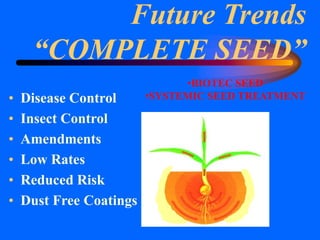
“COMPLETE SEED”
• Disease Control
• Insect Control
• Amendments
• Low Rates
• Reduced Risk
• Dust Free Coatings
•BIOTEC SEED
•SYSTEMIC SEED TREATMENT

Seed treatment

  • 1.
  • 2.
    Seed can harborpathogens on the seed coat or within the seed • Fungi • Bacteria • Viruses
  • 3.
    Soil, unless fumigatedor sterilized, also contains: • Fungi • Bacteria • Insects • other organisms that can attack seed and seedlings
  • 4.
    Treating seed withpesticides can • Improve stand quality • Increase yields • Increase return on investment
  • 5.
    Treated seed isdefined as seed that is: • Given an application of a pesticide or subjected to a process designed to reduce, control, repel disease organisms, insects, or other pests that attack seed or seedlings. • This includes control of pests while seed is in storage and after planting.
  • 6.
    The terms “grain”and “seed” have distinct legal meanings • “Grain” refers to food and feed grains as grain if it can be legally marketed as such (fit for human and animal consumption). • “Grain” becomes “seed” when a seed treatment pesticide is applied to it (unfit for human or animal consumption). • Use of grain treated with protectants (malathion, Reldan, etc.) is not considered seed because it can still be used for human and animal consumption.
  • 7.
    Seed pests • Fungiand bacteria that cause seed rots and decays, seedling blights, and smuts. • Soil insects, such as seed corn maggot and wire worms • Storage insects, including weevils, moth larvae, and beetles. • Birds and rodents that eat stored or planted seed and young seedlings
  • 8.
    Seeds commonly treated •Corn • Small grains – barley, oats, rice, rye, wheat • Cotton • Forage grasses • Sorghum • Soybeans • Vegetables
  • 9.
    Ideal chemical seedtreatment • Harmless to seed (no phytotoxicity) • Stable for relatively long periods of time before planting • Provide an even coating to seed • Adhere well without giving a dull or unattractive appearance • Does not impair seed flow in planting equipment • Inexpensive • Registered for its intended use
  • 10.
    Pests and principlesof management • Control of a particular pest is considered only when economic damage will occur. • Economic damage is the amount of loss in yield or quality justifies the cost of control. • Seed treatment is used in anticipation of economic damage.
  • 11.
    Pests and principlesof management (continued) • Pesticides are applied to protect against pathogens and pests that impair stands, reduce yields, and/or lower food or feed quality. • Effective seed pest management should not rely on any one method of control. • Use coordinated use of multiple tactics - IPM (time of planting, cultivar selection, etc.).
  • 12.
    Decision making process •Analyze why you need to treat your seed. What are your objectives; what disease(s) or insect(s) do you want to manage? • Be familiar with pesticide(s) you are using. Know spectrum of control; toxicity classification (LD50); physical hazards, etc. (LD= 50% Lethal Dose)
  • 13.
    Decision making process (continued) •Understand the basic working principle of your seed-treating equipment. Know how to calibrate, maintain, and clean it. • Know and understand laws and regulations related to chemical seed treatment (using machinery, disposing of wastes, labeling treated seed).
  • 14.
    Decision making process (continued) •Seed is grown for seed production. • Good quality seed with lower % fungal infection may be produced when seed is treated with a fungicide. • Planting is to precise populations. • Germination may be delayed by unfavorable soil or weather conditions.
  • 15.
    Types of fungicidalseed treatments • Seed disinfestation - killing of spores, mycelia, or microorganisms on seed surface. • Seed disinfection – elimination of pathogen that has penetrated into living cells of seed (e.g. smut or bunt). • Seed protection – application to protect seed from pathogens in the soil (damping-off). A systemic fungicide may provide post- emergence protection (powdery mildew).
  • 16.
    Common seed treatmentfungicides Captan • Heterocylic compound with broad spectrum protective activity • Inhibit essential compounds containing –NH2 and –SH (sulfhydryl) group (amino compounds and enzymes) • Controls seed rots and damping-off • (A ring of atoms of more than one kind; especially a ring of carbon atoms containing at least one atom that is not carbon)
  • 17.
    Common seed treatmentfungicides Thiram • Dithiocarbamate compound that is metabolized in to the isothiocyanate radical ( -N=C=S) which inactivates sulfhydral groups (-SH) in amino acids and enzymes – broad spectrum activity • Controls seed rots, damping-off, covered smut of wheat, Helminthosporium stripe rust of barley
  • 18.
    Common seed treatmentfungicides Carboxin • Oxanthiin compound that was the first systemic fungicides to be discovered (1966) – Sold as Vitavax • Inhibits succinic acid hydrogenase (mitochondrial respiration) • A protective contact-systemic fungicide that controls embryo-borne loose smut of wheat and barley, seed rotting and seedling blight fungi (Rhizoctonia solani, Helminthosporium spp.)
  • 19.
    Difenoconazole and Tebuconazole •Triazole compounds with systemic and curative activity (Dividend and Raxil) • Inhibits ergosterol biosynthesis (interferes with cell membrane development) • Controls smuts, certain seedborne and soilborne pathogens in cereal grains • Weak suppressive activity on powdery mildew Common seed treatment fungicides
  • 20.
    Triadimenol • Triazole compoundwith systemic and curative activity (Baytan) • Inhibits ergosterol biosynthesis (interferes with cell membrane development) • Controls smuts, certain seedborne and soilborne pathogens in cereal grains • Excellent activity on fall powdery mildew infections Common seed treatment fungicides
  • 21.
    Fludioxonil • Contact fungicideactive against Fusarium, Rhizoctonia, Helminthosporium, Aspergillus, and Penicillium spp. • Used primarily on corn, sweet corn, and sorghum. Sold as Maxim. Often used in combination with metalaxyl or mefenoxam Common seed treatment fungicides
  • 22.
    Metalaxyl and mefenoxam •Acylalanine compounds that are systemic and specific for seed rot and damping- off caused by water molds (Pythium and Phytopthora species) • Sold under trade names Apron or Allegiance (metalaxyl) and Apron XL (mefenoxam) Common seed treatment fungicides
  • 23.
    Common seed treatmentfungicides pentachloronitrobenzene (PCNB) • An aromatic compound that is a long lasting soil fungicide • Active against seed rots and damping-off caused by Rhizoctonia spp. • Inhibits production of compounds with -NH2 and –SH groups (amino acids and enzymes) • No activity on Pythium spp.
  • 24.
    Labeling treated seed •Federal and state seed regulations require special labeling for treated seed • Instruction for proper handling and storage • Ensure that “leftover” seed is not used for any unintended purpose • OSHA requires information for worker safety • (Occupational Safety and Health Administration)
  • 25.
    Federal Seed ActRequires: • Statement that seed is treated with a pesticide • Name of pesticide(s); common and trade names • Labeling must include health hazards of the pesticide(s) and if it is a skin irritant, a carcinogen, or able to cause eye damage • Name, address, phone number of pesticide manufacturer and seed treater
  • 26.
    Federal Seed ActRequires: Precautionary statements • Seed treated with highly toxic pesticides (LD50 less than 50 ppm) requires a label bearing a Skull-and-Crossbones and a statement “THIS SEED IS TREATED WITH POISON” • Seed treated with toxic pesticides (LD50 greater than 50 ppm) requires a label with a statement like “DO NOT USE FOR FOOD, FEED, OR OIL PURPOSES”.
  • 27.
    Treated seed disposal •Leftover seed must be stored separately from grain and labeled • Leftover seed intended for planting the following year should be stored in a dry, well-ventilated location • Percentage germination must be checked before use • Treated seed and sweepings must be handled as excess pesticide
  • 28.
    Application equipment • Seedtreatment equipment is designed to apply precisely measured quantities of pesticide to a given volume of seed • Seed treaters consist of three componants: a mixing tank, a treater head, and a coating chamber
  • 29.
    Application equipment Mixing tank(premix tank) • Flowables, water dispersible granules, wettable powders, true liquids, or emulsifiable concentrate formulations may be mixed with water in this tank • Tanks are equipped with an agitation device • Tanks are equipped with pump to recirculate and transport to treater header
  • 30.
    Application equipment Treater head •Chamber where the seed is treated with the pesticide • Seed measurement is controlled by a weigh pan, a flow gate, and a counterweight • Proper settings for flow gate and counterweights results in a constant dump weight • Each time weigh pan trips, seed flows through treater head and activates a cup of slurry to the seed as it enters the coating chamber
  • 31.
    Application equipment Coating chamber •Coating chambers are designed to handle seed gently while uniformly coating with pesticide formulation • Augar-type or revolving drum mixer where pesticide formulation and seed come together • Precision application is essential (check calibration regularly)
  • 32.
    Future Trends “COMPLETE SEED” •Disease Control • Insect Control • Amendments • Low Rates • Reduced Risk • Dust Free Coatings •BIOTEC SEED •SYSTEMIC SEED TREATMENT