


Insect Management in
 Tomatoes & Peppers


        Dr. Ayanava Majumdar
Extension Entomologist (Peanuts, Vegetables)
     State SARE Coordinator (Auburn U)
   Alabama Cooperative Extension System
          Cell phone: 251-331-8416
        Email: bugdoctor@auburn.edu

             AFVG Conf., February 11, 2012
What is it?
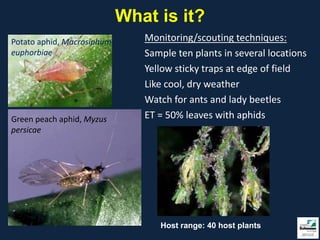
Potato aphid, Macrosiphum      Monitoring/scouting techniques:
euphorbiae                     Sample ten plants in several locations
                               Yellow sticky traps at edge of field
                               Like cool, dry weather
                               Watch for ants and lady beetles
Green peach aphid, Myzus       ET = 50% leaves with aphids
persicae


                                  Host range: 40 host plants
What is it?
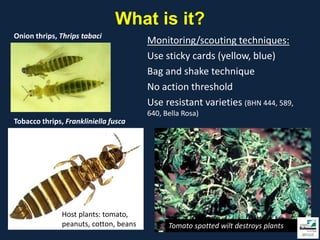
Onion thrips, Thrips tabaci
                                        Monitoring/scouting techniques:
                                        Use sticky cards (yellow, blue)
                                        Bag and shake technique
                                        No action threshold
                                        Use resistant varieties (BHN 444, 589,
                                        640, Bella Rosa)
Tobacco thrips, Frankliniella fusca


               Host plants: tomato,
               peanuts, cotton, beans         Tomato spotted wilt destroys plants
What is it?
                              Monitoring/scouting techniques:
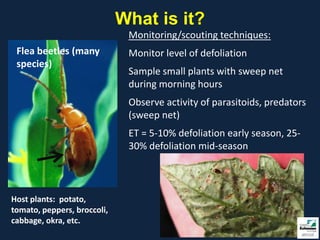
 Flea beetles (many           Monitor level of defoliation
 species)
                              Sample small plants with sweep net
                              during morning hours
                              Observe activity of parasitoids, predators
                              (sweep net)
                              ET = 5-10% defoliation early season, 25-
                              30% defoliation mid-season


Host plants: potato,
tomato, peppers, broccoli,
cabbage, okra, etc.
What is it?
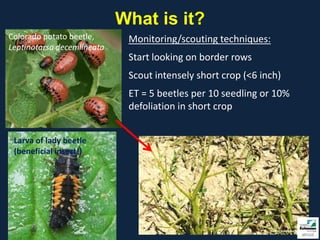
Colorado potato beetle,      Monitoring/scouting techniques:
Leptinotarsa decemlineata
                             Start looking on border rows
                             Scout intensely short crop (<6 inch)
                             ET = 5 beetles per 10 seedling or 10%
                             defoliation in short crop


 Larva of lady beetle
 (beneficial insect!)
What is it?
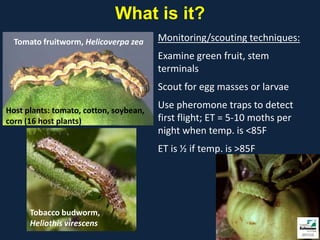
  Tomato fruitworm, Helicoverpa zea     Monitoring/scouting techniques:
                                        Examine green fruit, stem
                                        terminals
                                        Scout for egg masses or larvae

Host plants: tomato, cotton, soybean,
                                        Use pheromone traps to detect
corn (16 host plants)                   first flight; ET = 5-10 moths per
                                        night when temp. is <85F
                                        ET is ½ if temp. is >85F


      Tobacco budworm,
      Heliothis virescens
What is it?
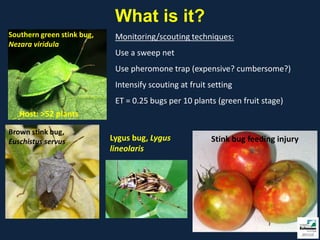
Southern green stink bug,    Monitoring/scouting techniques:
Nezara viridula
                             Use a sweep net
                             Use pheromone trap (expensive? cumbersome?)
                             Intensify scouting at fruit setting
                             ET = 0.25 bugs per 10 plants (green fruit stage)
   Host: >52 plants
Brown stink bug,
Euschistus servus           Lygus bug, Lygus             Stink bug feeding injury
                            lineolaris
What is it?


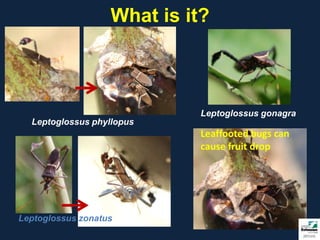
                             Leptoglossus gonagra
  Leptoglossus phyllopus
                             Leaffooted bugs can
                             cause fruit drop


Leptoglossus zonatus
What is it?
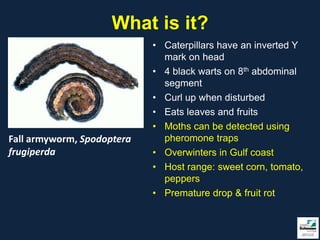
                            • Caterpillars have an inverted Y
                              mark on head
                            • 4 black warts on 8th abdominal
                              segment
                            • Curl up when disturbed
                            • Eats leaves and fruits
                            • Moths can be detected using
Fall armyworm, Spodoptera     pheromone traps
frugiperda                  • Overwinters in Gulf coast
                            • Host range: sweet corn, tomato,
                              peppers
                            • Premature drop & fruit rot
What is it?
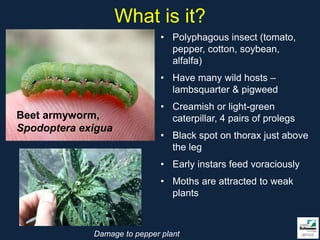
                              • Polyphagous insect (tomato,
                                pepper, cotton, soybean,
                                alfalfa)
                              • Have many wild hosts –
                                lambsquarter & pigweed
                              • Creamish or light-green
Beet armyworm,                  caterpillar, 4 pairs of prolegs
Spodoptera exigua
                              • Black spot on thorax just above
                                the leg
                              • Early instars feed voraciously
                              • Moths are attracted to weak
                                plants


             Damage to pepper plant
What is it?
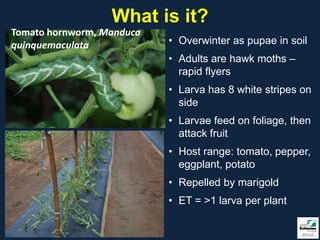
Tomato hornworm, Manduca
quinquemaculata            • Overwinter as pupae in soil
                           • Adults are hawk moths –
                             rapid flyers
                           • Larva has 8 white stripes on
                             side
                           • Larvae feed on foliage, then
                             attack fruit
                           • Host range: tomato, pepper,
                             eggplant, potato
                           • Repelled by marigold
                           • ET = >1 larva per plant
What is it?
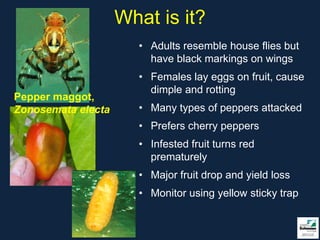
                      • Adults resemble house flies but
                        have black markings on wings
                      • Females lay eggs on fruit, cause
                        dimple and rotting
Pepper maggot,
Zonosemata electa     • Many types of peppers attacked
                      • Prefers cherry peppers
                      • Infested fruit turns red
                        prematurely
                      • Major fruit drop and yield loss
                      • Monitor using yellow sticky trap
What is it?
                                    Monitoring/scouting techniques:
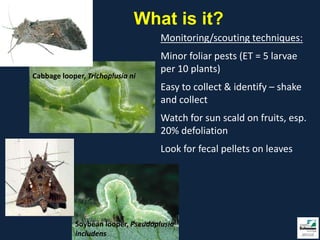
                                    Minor foliar pests (ET = 5 larvae
                                    per 10 plants)
Cabbage looper, Trichoplusia ni
                                    Easy to collect & identify – shake
                                    and collect
                                    Watch for sun scald on fruits, esp.
                                    20% defoliation
                                    Look for fecal pellets on leaves


            Soybean looper, Pseudoplusia
            includens
VEGETABLE INSECTICIDES

CAUTION:
Use of product names does not mean endorsement by university!
Use cultural, mechanical, and other pest management tactics first
Insecticide use should be last resort!
Read pesticide labels – LABEL IS THE LAW.
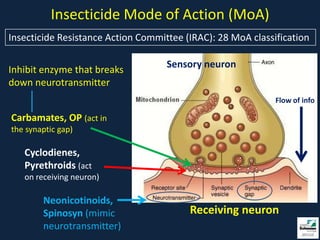
Insecticide Mode of Action (MoA)
Insecticide Resistance Action Committee (IRAC): 28 MoA classification

                                    Sensory neuron
Inhibit enzyme that breaks
down neurotransmitter
                                                             Flow of info

Carbamates, OP (act in
the synaptic gap)

   Cyclodienes,
   Pyrethroids (act
   on receiving neuron)

        Neonicotinoids,
        Spinosyn (mimic                  Receiving neuron
        neurotransmitter)
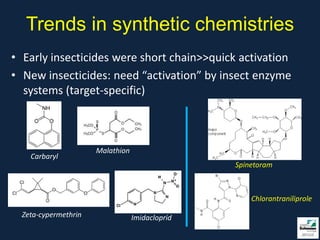
Trends in synthetic chemistries
• Early insecticides were short chain>>quick activation
• New insecticides: need “activation” by insect enzyme
  systems (target-specific)


                      Malathion
    Carbaryl
                                                 Spinetoram


                                                     Chlorantraniliprole

  Zeta-cypermethrin               Imidacloprid
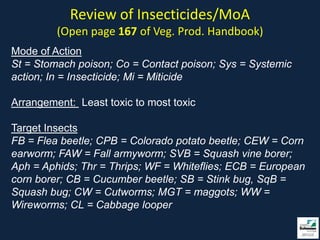
Review of Insecticides/MoA
         (Open page 167 of Veg. Prod. Handbook)
Mode of Action
St = Stomach poison; Co = Contact poison; Sys = Systemic
action; In = Insecticide; Mi = Miticide

Arrangement: Least toxic to most toxic

Target Insects
FB = Flea beetle; CPB = Colorado potato beetle; CEW = Corn
earworm; FAW = Fall armyworm; SVB = Squash vine borer;
Aph = Aphids; Thr = Thrips; WF = Whiteflies; ECB = European
corn borer; CB = Cucumber beetle; SB = Stink bug, SqB =
Squash bug; CW = Cutworms; MGT = maggots; WW =
Wireworms; CL = Cabbage looper
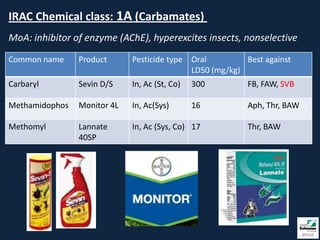
IRAC Chemical class: 1A (Carbamates)
MoA: inhibitor of enzyme (AChE), hyperexcites insects, nonselective
Common name     Product      Pesticide type Oral         Best against
                                            LD50 (mg/kg)
Carbaryl        Sevin D/S    In, Ac (St, Co)   300        FB, FAW, SVB

Methamidophos   Monitor 4L   In, Ac(Sys)       16         Aph, Thr, BAW

Methomyl        Lannate      In, Ac (Sys, Co) 17          Thr, BAW
                40SP
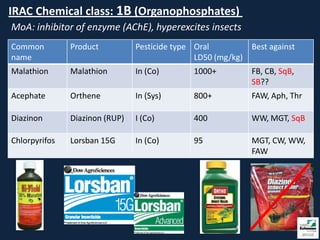
IRAC Chemical class: 1B (Organophosphates)
MoA: inhibitor of enzyme (AChE), hyperexcites insects
Common         Product          Pesticide type Oral         Best against
name                                           LD50 (mg/kg)
Malathion      Malathion        In (Co)       1000+          FB, CB, SqB,
                                                             SB??
Acephate       Orthene          In (Sys)      800+           FAW, Aph, Thr

Diazinon       Diazinon (RUP)   I (Co)        400            WW, MGT, SqB

Chlorpyrifos   Lorsban 15G      In (Co)       95             MGT, CW, WW,
                                                             FAW
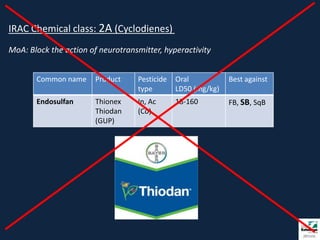
IRAC Chemical class: 2A (Cyclodienes)
MoA: Block the action of neurotransmitter, hyperactivity


       Common name      Product    Pesticide   Oral           Best against
                                   type        LD50 (mg/kg)
       Endosulfan       Thionex    In, Ac      18-160         FB, SB, SqB
                        Thiodan    (Co)
                        (GUP)
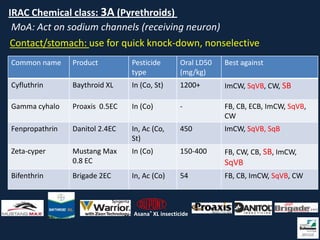
IRAC Chemical class: 3A (Pyrethroids)
 MoA: Act on sodium channels (receiving neuron)
Contact/stomach: use for quick knock-down, nonselective
Common name     Product         Pesticide        Oral LD50   Best against
                                type             (mg/kg)
Cyfluthrin      Baythroid XL    In (Co, St)      1200+       ImCW, SqVB, CW, SB

Gamma cyhalo    Proaxis 0.5EC   In (Co)          -           FB, CB, ECB, ImCW, SqVB,
                                                             CW
Fenpropathrin   Danitol 2.4EC   In, Ac (Co,      450         ImCW, SqVB, SqB
                                St)
Zeta-cyper      Mustang Max     In (Co)          150-400     FB, CW, CB, SB, ImCW,
                0.8 EC                                       SqVB
Bifenthrin      Brigade 2EC     In, Ac (Co)      54          FB, CB, ImCW, SqVB, CW


                                Asana® XL insecticide
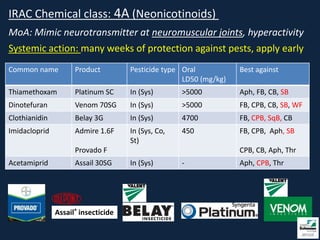
IRAC Chemical class: 4A (Neonicotinoids)
MoA: Mimic neurotransmitter at neuromuscular joints, hyperactivity
Systemic action: many weeks of protection against pests, apply early
Common name          Product         Pesticide type Oral           Best against
                                                    LD50 (mg/kg)
Thiamethoxam         Platinum SC     In (Sys)       >5000          Aph, FB, CB, SB
Dinotefuran          Venom 70SG      In (Sys)       >5000          FB, CPB, CB, SB, WF
Clothianidin         Belay 3G        In (Sys)       4700           FB, CPB, SqB, CB
Imidacloprid         Admire 1.6F     In (Sys, Co,   450            FB, CPB, Aph, SB
                                     St)
                     Provado F                                     CPB, CB, Aph, Thr
Acetamiprid          Assail 30SG     In (Sys)       -              Aph, CPB, Thr


               Assail® insecticide
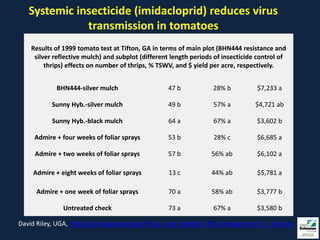
Systemic insecticide (imidacloprid) reduces virus
              transmission in tomatoes
    Results of 1999 tomato test at Tifton, GA in terms of main plot (BHN444 resistance and
     silver reflective mulch) and subplot (different length periods of insecticide control of
         thrips) effects on number of thrips, % TSWV, and $ yield per acre, respectively.


            BHN444-silver mulch                    47 b            28% b          $7,233 a

           Sunny Hyb.-silver mulch                 49 b            57% a          $4,721 ab

           Sunny Hyb.-black mulch                  64 a            67% a          $3,602 b

     Admire + four weeks of foliar sprays          53 b            28% c          $6,685 a

     Admire + two weeks of foliar sprays           57 b           56% ab          $6,102 a

    Admire + eight weeks of foliar sprays           13 c          44% ab          $5,781 a

     Admire + one week of foliar sprays            70 a           58% ab          $3,777 b

               Untreated check                     73 a            67% a          $3,580 b

David Riley, UGA, http://wiki.bugwood.org/Thrips_and_Spotted_Wilt_Management_in_Tomato
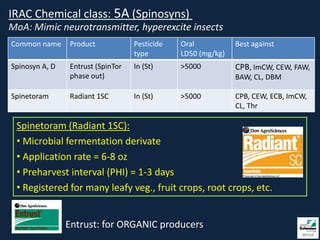
IRAC Chemical class: 5A (Spinosyns)
MoA: Mimic neurotransmitter, hyperexcite insects
Common name     Product            Pesticide   Oral           Best against
                                   type        LD50 (mg/kg)
Spinosyn A, D   Entrust (SpinTor   In (St)     >5000          CPB, ImCW, CEW, FAW,
                phase out)                                    BAW, CL, DBM

Spinetoram      Radiant 1SC        In (St)     >5000          CPB, CEW, ECB, ImCW,
                                                              CL, Thr

 Spinetoram (Radiant 1SC):
 • Microbial fermentation derivate
 • Application rate = 6-8 oz
 • Preharvest interval (PHI) = 1-3 days
 • Registered for many leafy veg., fruit crops, root crops, etc.


                Entrust: for ORGANIC producers
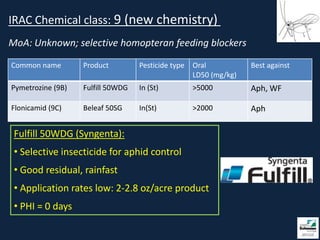
IRAC Chemical class: 9 (new chemistry)
MoA: Unknown; selective homopteran feeding blockers

Common name        Product         Pesticide type   Oral           Best against
                                                    LD50 (mg/kg)
Pymetrozine (9B)   Fulfill 50WDG   In (St)          >5000          Aph, WF

Flonicamid (9C)    Beleaf 50SG     In(St)           >2000          Aph

 Fulfill 50WDG (Syngenta):
 • Selective insecticide for aphid control
 • Good residual, rainfast
 • Application rates low: 2-2.8 oz/acre product
 • PHI = 0 days
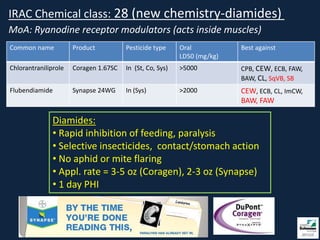
IRAC Chemical class: 28 (new chemistry-diamides)
MoA: Ryanodine receptor modulators (acts inside muscles)
Common name           Product          Pesticide type     Oral           Best against
                                                          LD50 (mg/kg)
Chlorantraniliprole   Coragen 1.67SC   In (St, Co, Sys)   >5000          CPB, CEW, ECB, FAW,
                                                                         BAW, CL, SqVB, SB
Flubendiamide         Synapse 24WG     In (Sys)           >2000          CEW, ECB, CL, ImCW,
                                                                         BAW, FAW

               Diamides:
               • Rapid inhibition of feeding, paralysis
               • Selective insecticides, contact/stomach action
               • No aphid or mite flaring
               • Appl. rate = 3-5 oz (Coragen), 2-3 oz (Synapse)
               • 1 day PHI
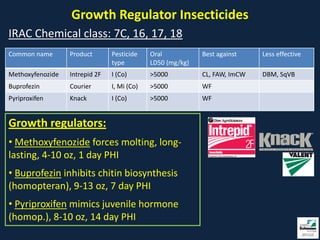
Growth Regulator Insecticides
IRAC Chemical class: 7C, 16, 17, 18
Common name       Product       Pesticide    Oral           Best against    Less effective
                                type         LD50 (mg/kg)
Methoxyfenozide   Intrepid 2F   I (Co)       >5000          CL, FAW, ImCW   DBM, SqVB
Buprofezin        Courier       I, Mi (Co)   >5000          WF
Pyriproxifen      Knack         I (Co)       >5000          WF


Growth regulators:
• Methoxyfenozide forces molting, long-
lasting, 4-10 oz, 1 day PHI
• Buprofezin inhibits chitin biosynthesis
(homopteran), 9-13 oz, 7 day PHI
• Pyriproxifen mimics juvenile hormone
(homop.), 8-10 oz, 14 day PHI
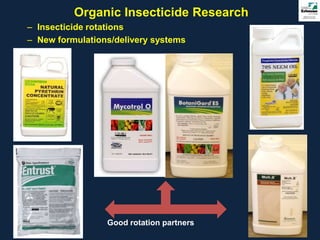
Organic Insecticide Research
– Insecticide rotations
– New formulations/delivery systems


                 Good rotation partners
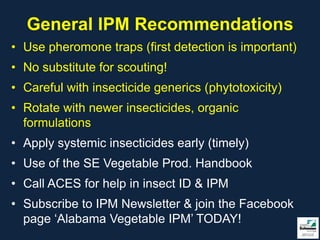
General IPM Recommendations
• Use pheromone traps (first detection is important)
• No substitute for scouting!
• Careful with insecticide generics (phytotoxicity)
• Rotate with newer insecticides, organic
  formulations
• Apply systemic insecticides early (timely)
• Use of the SE Vegetable Prod. Handbook
• Call ACES for help in insect ID & IPM
• Subscribe to IPM Newsletter & join the Facebook
  page ‘Alabama Vegetable IPM’ TODAY!
Alabama SARE Website
Join Vegetable IPM on Facebook!


Advantages: Live updates, chat with researchers,
        videos and photos, IPM contest
The IPM Communicator
   (A FREE electronic newsletter)


To signup: Email bugdoctor@auburn.edu
Or sign up today on the sheet provided!
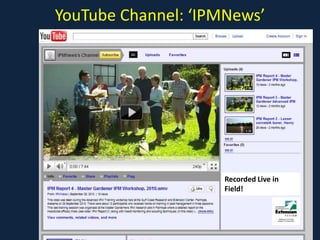
YouTube Channel: ‘IPMNews’


                    Recorded Live in
                    Field!
ACES Website (publications)
Insect Management in
 Tomatoes & Peppers


 Questions for Dr. A?

       AFVG Conf., February 11, 2012

Ayanava tomato pepper pests 2012

  • 1.
    Insect Management in Tomatoes & Peppers Dr. Ayanava Majumdar Extension Entomologist (Peanuts, Vegetables) State SARE Coordinator (Auburn U) Alabama Cooperative Extension System Cell phone: 251-331-8416 Email: bugdoctor@auburn.edu AFVG Conf., February 11, 2012
  • 2.
    What is it? Potatoaphid, Macrosiphum Monitoring/scouting techniques: euphorbiae Sample ten plants in several locations Yellow sticky traps at edge of field Like cool, dry weather Watch for ants and lady beetles Green peach aphid, Myzus ET = 50% leaves with aphids persicae Host range: 40 host plants
  • 3.
    What is it? Onionthrips, Thrips tabaci Monitoring/scouting techniques: Use sticky cards (yellow, blue) Bag and shake technique No action threshold Use resistant varieties (BHN 444, 589, 640, Bella Rosa) Tobacco thrips, Frankliniella fusca Host plants: tomato, peanuts, cotton, beans Tomato spotted wilt destroys plants
  • 4.
    What is it? Monitoring/scouting techniques: Flea beetles (many Monitor level of defoliation species) Sample small plants with sweep net during morning hours Observe activity of parasitoids, predators (sweep net) ET = 5-10% defoliation early season, 25- 30% defoliation mid-season Host plants: potato, tomato, peppers, broccoli, cabbage, okra, etc.
  • 5.
    What is it? Coloradopotato beetle, Monitoring/scouting techniques: Leptinotarsa decemlineata Start looking on border rows Scout intensely short crop (<6 inch) ET = 5 beetles per 10 seedling or 10% defoliation in short crop Larva of lady beetle (beneficial insect!)
  • 6.
    What is it? Tomato fruitworm, Helicoverpa zea Monitoring/scouting techniques: Examine green fruit, stem terminals Scout for egg masses or larvae Host plants: tomato, cotton, soybean, Use pheromone traps to detect corn (16 host plants) first flight; ET = 5-10 moths per night when temp. is <85F ET is ½ if temp. is >85F Tobacco budworm, Heliothis virescens
  • 7.
    What is it? Southerngreen stink bug, Monitoring/scouting techniques: Nezara viridula Use a sweep net Use pheromone trap (expensive? cumbersome?) Intensify scouting at fruit setting ET = 0.25 bugs per 10 plants (green fruit stage) Host: >52 plants Brown stink bug, Euschistus servus Lygus bug, Lygus Stink bug feeding injury lineolaris
  • 8.
    What is it? Leptoglossus gonagra Leptoglossus phyllopus Leaffooted bugs can cause fruit drop Leptoglossus zonatus
  • 9.
    What is it? • Caterpillars have an inverted Y mark on head • 4 black warts on 8th abdominal segment • Curl up when disturbed • Eats leaves and fruits • Moths can be detected using Fall armyworm, Spodoptera pheromone traps frugiperda • Overwinters in Gulf coast • Host range: sweet corn, tomato, peppers • Premature drop & fruit rot
  • 10.
    What is it? • Polyphagous insect (tomato, pepper, cotton, soybean, alfalfa) • Have many wild hosts – lambsquarter & pigweed • Creamish or light-green Beet armyworm, caterpillar, 4 pairs of prolegs Spodoptera exigua • Black spot on thorax just above the leg • Early instars feed voraciously • Moths are attracted to weak plants Damage to pepper plant
  • 11.
    What is it? Tomatohornworm, Manduca quinquemaculata • Overwinter as pupae in soil • Adults are hawk moths – rapid flyers • Larva has 8 white stripes on side • Larvae feed on foliage, then attack fruit • Host range: tomato, pepper, eggplant, potato • Repelled by marigold • ET = >1 larva per plant
  • 12.
    What is it? • Adults resemble house flies but have black markings on wings • Females lay eggs on fruit, cause dimple and rotting Pepper maggot, Zonosemata electa • Many types of peppers attacked • Prefers cherry peppers • Infested fruit turns red prematurely • Major fruit drop and yield loss • Monitor using yellow sticky trap
  • 13.
    What is it? Monitoring/scouting techniques: Minor foliar pests (ET = 5 larvae per 10 plants) Cabbage looper, Trichoplusia ni Easy to collect & identify – shake and collect Watch for sun scald on fruits, esp. 20% defoliation Look for fecal pellets on leaves Soybean looper, Pseudoplusia includens
  • 14.
    VEGETABLE INSECTICIDES CAUTION: Use ofproduct names does not mean endorsement by university! Use cultural, mechanical, and other pest management tactics first Insecticide use should be last resort! Read pesticide labels – LABEL IS THE LAW.
  • 15.
    Insecticide Mode ofAction (MoA) Insecticide Resistance Action Committee (IRAC): 28 MoA classification Sensory neuron Inhibit enzyme that breaks down neurotransmitter Flow of info Carbamates, OP (act in the synaptic gap) Cyclodienes, Pyrethroids (act on receiving neuron) Neonicotinoids, Spinosyn (mimic Receiving neuron neurotransmitter)
  • 16.
    Trends in syntheticchemistries • Early insecticides were short chain>>quick activation • New insecticides: need “activation” by insect enzyme systems (target-specific) Malathion Carbaryl Spinetoram Chlorantraniliprole Zeta-cypermethrin Imidacloprid
  • 17.
    Review of Insecticides/MoA (Open page 167 of Veg. Prod. Handbook) Mode of Action St = Stomach poison; Co = Contact poison; Sys = Systemic action; In = Insecticide; Mi = Miticide Arrangement: Least toxic to most toxic Target Insects FB = Flea beetle; CPB = Colorado potato beetle; CEW = Corn earworm; FAW = Fall armyworm; SVB = Squash vine borer; Aph = Aphids; Thr = Thrips; WF = Whiteflies; ECB = European corn borer; CB = Cucumber beetle; SB = Stink bug, SqB = Squash bug; CW = Cutworms; MGT = maggots; WW = Wireworms; CL = Cabbage looper
  • 18.
    IRAC Chemical class:1A (Carbamates) MoA: inhibitor of enzyme (AChE), hyperexcites insects, nonselective Common name Product Pesticide type Oral Best against LD50 (mg/kg) Carbaryl Sevin D/S In, Ac (St, Co) 300 FB, FAW, SVB Methamidophos Monitor 4L In, Ac(Sys) 16 Aph, Thr, BAW Methomyl Lannate In, Ac (Sys, Co) 17 Thr, BAW 40SP
  • 19.
    IRAC Chemical class:1B (Organophosphates) MoA: inhibitor of enzyme (AChE), hyperexcites insects Common Product Pesticide type Oral Best against name LD50 (mg/kg) Malathion Malathion In (Co) 1000+ FB, CB, SqB, SB?? Acephate Orthene In (Sys) 800+ FAW, Aph, Thr Diazinon Diazinon (RUP) I (Co) 400 WW, MGT, SqB Chlorpyrifos Lorsban 15G In (Co) 95 MGT, CW, WW, FAW
  • 20.
    IRAC Chemical class:2A (Cyclodienes) MoA: Block the action of neurotransmitter, hyperactivity Common name Product Pesticide Oral Best against type LD50 (mg/kg) Endosulfan Thionex In, Ac 18-160 FB, SB, SqB Thiodan (Co) (GUP)
  • 21.
    IRAC Chemical class:3A (Pyrethroids) MoA: Act on sodium channels (receiving neuron) Contact/stomach: use for quick knock-down, nonselective Common name Product Pesticide Oral LD50 Best against type (mg/kg) Cyfluthrin Baythroid XL In (Co, St) 1200+ ImCW, SqVB, CW, SB Gamma cyhalo Proaxis 0.5EC In (Co) - FB, CB, ECB, ImCW, SqVB, CW Fenpropathrin Danitol 2.4EC In, Ac (Co, 450 ImCW, SqVB, SqB St) Zeta-cyper Mustang Max In (Co) 150-400 FB, CW, CB, SB, ImCW, 0.8 EC SqVB Bifenthrin Brigade 2EC In, Ac (Co) 54 FB, CB, ImCW, SqVB, CW Asana® XL insecticide
  • 22.
    IRAC Chemical class:4A (Neonicotinoids) MoA: Mimic neurotransmitter at neuromuscular joints, hyperactivity Systemic action: many weeks of protection against pests, apply early Common name Product Pesticide type Oral Best against LD50 (mg/kg) Thiamethoxam Platinum SC In (Sys) >5000 Aph, FB, CB, SB Dinotefuran Venom 70SG In (Sys) >5000 FB, CPB, CB, SB, WF Clothianidin Belay 3G In (Sys) 4700 FB, CPB, SqB, CB Imidacloprid Admire 1.6F In (Sys, Co, 450 FB, CPB, Aph, SB St) Provado F CPB, CB, Aph, Thr Acetamiprid Assail 30SG In (Sys) - Aph, CPB, Thr Assail® insecticide
  • 23.
    Systemic insecticide (imidacloprid)reduces virus transmission in tomatoes Results of 1999 tomato test at Tifton, GA in terms of main plot (BHN444 resistance and silver reflective mulch) and subplot (different length periods of insecticide control of thrips) effects on number of thrips, % TSWV, and $ yield per acre, respectively. BHN444-silver mulch 47 b 28% b $7,233 a Sunny Hyb.-silver mulch 49 b 57% a $4,721 ab Sunny Hyb.-black mulch 64 a 67% a $3,602 b Admire + four weeks of foliar sprays 53 b 28% c $6,685 a Admire + two weeks of foliar sprays 57 b 56% ab $6,102 a Admire + eight weeks of foliar sprays 13 c 44% ab $5,781 a Admire + one week of foliar sprays 70 a 58% ab $3,777 b Untreated check 73 a 67% a $3,580 b David Riley, UGA, http://wiki.bugwood.org/Thrips_and_Spotted_Wilt_Management_in_Tomato
  • 24.
    IRAC Chemical class:5A (Spinosyns) MoA: Mimic neurotransmitter, hyperexcite insects Common name Product Pesticide Oral Best against type LD50 (mg/kg) Spinosyn A, D Entrust (SpinTor In (St) >5000 CPB, ImCW, CEW, FAW, phase out) BAW, CL, DBM Spinetoram Radiant 1SC In (St) >5000 CPB, CEW, ECB, ImCW, CL, Thr Spinetoram (Radiant 1SC): • Microbial fermentation derivate • Application rate = 6-8 oz • Preharvest interval (PHI) = 1-3 days • Registered for many leafy veg., fruit crops, root crops, etc. Entrust: for ORGANIC producers
  • 25.
    IRAC Chemical class:9 (new chemistry) MoA: Unknown; selective homopteran feeding blockers Common name Product Pesticide type Oral Best against LD50 (mg/kg) Pymetrozine (9B) Fulfill 50WDG In (St) >5000 Aph, WF Flonicamid (9C) Beleaf 50SG In(St) >2000 Aph Fulfill 50WDG (Syngenta): • Selective insecticide for aphid control • Good residual, rainfast • Application rates low: 2-2.8 oz/acre product • PHI = 0 days
  • 26.
    IRAC Chemical class:28 (new chemistry-diamides) MoA: Ryanodine receptor modulators (acts inside muscles) Common name Product Pesticide type Oral Best against LD50 (mg/kg) Chlorantraniliprole Coragen 1.67SC In (St, Co, Sys) >5000 CPB, CEW, ECB, FAW, BAW, CL, SqVB, SB Flubendiamide Synapse 24WG In (Sys) >2000 CEW, ECB, CL, ImCW, BAW, FAW Diamides: • Rapid inhibition of feeding, paralysis • Selective insecticides, contact/stomach action • No aphid or mite flaring • Appl. rate = 3-5 oz (Coragen), 2-3 oz (Synapse) • 1 day PHI
  • 27.
    Growth Regulator Insecticides IRACChemical class: 7C, 16, 17, 18 Common name Product Pesticide Oral Best against Less effective type LD50 (mg/kg) Methoxyfenozide Intrepid 2F I (Co) >5000 CL, FAW, ImCW DBM, SqVB Buprofezin Courier I, Mi (Co) >5000 WF Pyriproxifen Knack I (Co) >5000 WF Growth regulators: • Methoxyfenozide forces molting, long- lasting, 4-10 oz, 1 day PHI • Buprofezin inhibits chitin biosynthesis (homopteran), 9-13 oz, 7 day PHI • Pyriproxifen mimics juvenile hormone (homop.), 8-10 oz, 14 day PHI
  • 28.
    Organic Insecticide Research –Insecticide rotations – New formulations/delivery systems Good rotation partners
  • 29.
    General IPM Recommendations •Use pheromone traps (first detection is important) • No substitute for scouting! • Careful with insecticide generics (phytotoxicity) • Rotate with newer insecticides, organic formulations • Apply systemic insecticides early (timely) • Use of the SE Vegetable Prod. Handbook • Call ACES for help in insect ID & IPM • Subscribe to IPM Newsletter & join the Facebook page ‘Alabama Vegetable IPM’ TODAY!
  • 30.
  • 31.
    Join Vegetable IPMon Facebook! Advantages: Live updates, chat with researchers, videos and photos, IPM contest
  • 32.
    The IPM Communicator (A FREE electronic newsletter) To signup: Email bugdoctor@auburn.edu Or sign up today on the sheet provided!
  • 33.
    YouTube Channel: ‘IPMNews’ Recorded Live in Field!
  • 34.
  • 35.
    Insect Management in Tomatoes & Peppers Questions for Dr. A? AFVG Conf., February 11, 2012

Editor's Notes

  • #21 Methyl parathion use cancelled in May 2010 and existing stocks can be used till 2013. In May 2010, cucurbit yellow vine decline (caused by Serratiamarcescens, transmitted by squash bugs) was found in AL – symptoms look like bacterial wilt. Endosulfan (Gr 2 insecticide) was cancelled by EPA in June 2010. Temik was cancelled by EPA in August 2010 and all use must cease after December 31, 2010.