
Spider Mite Control in Vegetables


      Dr. Ayanava Majumdar (Dr. A)
             Ext. Entomologist
            115 Extension Hall
             Auburn, AL 36849
            Tel: (251) 331-8416
          bugdoctor@auburn.edu
            AFVGA Conference, Feb. 9, 2013
References
• Jon Traunfeld. 2013. Top Vegetable pests – spider mite. Univ. of Maryland
  Extension.
• Godfrey, L. D. 2011. Spider mites. University of California – Statewide IPM
  Program, Pubication 7405.
• Fasulo, T. R. 2009. Twospotted spider mites. Univ. of Florida – IFAS Publication
  EENY-150. http://entnemdept.ufl.edu/creatures/orn/twospotted_mite.htm
• Zalom et al. 2011. UC IPM Pest Management Guidelines: Tomato. University
  of California ANR Publication 3470.
  http://www.ipm.ucdavis.edu/PMG/r783400111.html
• Schuster, D. Tomato russet mite. Univ. of Florida – IFAS Publication.
  http://ipm.ifas.ufl.edu/resources/success_stories/T&PGuide/pdfs/Chapter4/
  Russet_Mite.pdf
• Peter Jentsch. Mite Management Using Reduced Risk Pest Management
  Programs and Biological Control. Cornell University.
  http://hudsonvf.cce.cornell.edu/scouting%20reports/scouting%20data/Mite
  %20Management%20Using%20Reduced%20Risk%20Pest%20Management%2
  0Programs%20and%20Biological%20Control.pdf
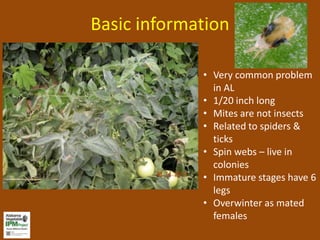
Basic information

             • Very common problem
               in AL
             • 1/20 inch long
             • Mites are not insects
             • Related to spiders &
               ticks
             • Spin webs – live in
               colonies
             • Immature stages have 6
               legs
             • Overwinter as mated
               females
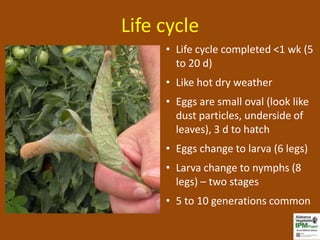
Life cycle
     • Life cycle completed <1 wk (5
       to 20 d)
     • Like hot dry weather
     • Eggs are small oval (look like
       dust particles, underside of
       leaves), 3 d to hatch
     • Eggs change to larva (6 legs)
     • Larva change to nymphs (8
       legs) – two stages
     • 5 to 10 generations common
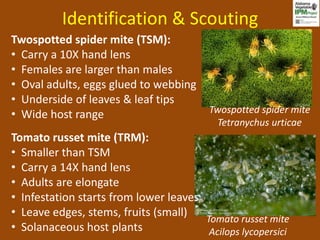
Identification & Scouting
Twospotted spider mite (TSM):
• Carry a 10X hand lens
• Females are larger than males
• Oval adults, eggs glued to webbing
• Underside of leaves & leaf tips
• Wide host range                        Twospotted spider mite
                                          Tetranychus urticae
Tomato russet mite (TRM):
• Smaller than TSM
• Carry a 14X hand lens
• Adults are elongate
• Infestation starts from lower leaves
• Leave edges, stems, fruits (small)
                                       Tomato russet mite
• Solanaceous host plants               Acilops lycopersici
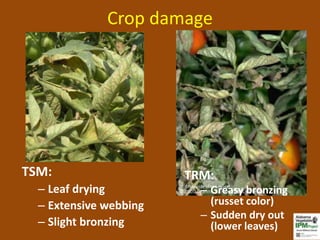
Crop damage


TSM:                    TRM:
  – Leaf drying           – Greasy bronzing
  – Extensive webbing       (russet color)
                          – Sudden dry out
  – Slight bronzing         (lower leaves)
Spider mite management
CULTURAL PRACTICES:
• Start clean: Get healthy transplants
• Avoid planting in hot dry conditions
• Avoid mowing or blowing dust on to crops
• Avoid water stress on plants
Spider mite management
ALTERNATIVE MITICIDES:
• Layton et al. (2011): 2 applications of insecticidal oil,
  insecticidal soap or neem oil provided good TSM
  control
• OMRI approved: Grandevo (extracted from
  Chromobacterium subtsugae) – 2 treatments on
  strawberry provided 63 to 80% mite suppression
Spider mite management
CAUTION: Many synthetic pyrethroids can flare up spider mites by
removing predatory mites and other beneficial insects.


 Abamectin (AgriMek, 8-16 fl oz/acre):
 • Good rescue insecticide.
 • Contains synthetic abamectin and provides long-term
   residual control of TSM.
 • Do not apply more than two sequential applications of
   abamectin.
 • PHI on tomatoes is 7 days.
Spider mite management
Bifenazate (Acramite, 0.75-1 lb/acre):
• MOA: GABA agonist
• Contact poison against motile stage of TSM
• Has some ovicidal action (kills eggs)
• Reduced toxicity to predaceous mites and
  beneficial arthropods.
• Do not make more than one application per
  season.
• PHI on tomatoes is 3 days.
Spider mite management
Fenpyroximate (Portal, 2 pts/acre):
• Mitochondrial electron transport inhibitor
  (METI), blocking cellular respiration
• Stops mite feeding & egg laying, 7 day to kill
• Good late season rescue insecticide
• Limit to one application per year
• Softer on predatory mites
• Complete coverage essential
Spider mite management
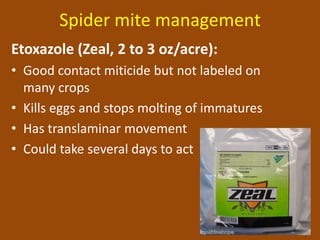
Etoxazole (Zeal, 2 to 3 oz/acre):
• Good contact miticide but not labeled on
  many crops
• Kills eggs and stops molting of immatures
• Has translaminar movement
• Could take several days to act
Spider mite management
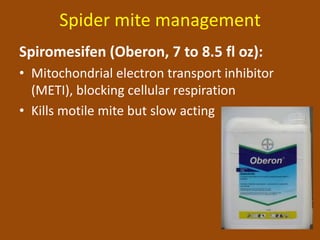
Spiromesifen (Oberon, 7 to 8.5 fl oz):
• Mitochondrial electron transport inhibitor
  (METI), blocking cellular respiration
• Kills motile mite but slow acting
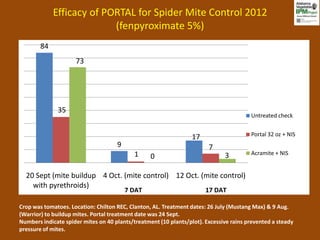
Efficacy of PORTAL for Spider Mite Control 2012
                           (fenpyroximate 5%)
        84
                     73


              35
                                                                                        Untreated check


                                                                  17                    Portal 32 oz + NIS
                                     9                                  7
                                            1                                 3         Acramite + NIS
                                                  0

  20 Sept (mite buildup 4 Oct. (mite control) 12 Oct. (mite control)
    with pyrethroids)
                                         7 DAT                         17 DAT

Crop was tomatoes. Location: Chilton REC, Clanton, AL. Treatment dates: 26 July (Mustang Max) & 9 Aug.
(Warrior) to buildup mites. Portal treatment date was 24 Sept.
Numbers indicate spider mites on 40 plants/treatment (10 plants/plot). Excessive rains prevented a steady
pressure of mites.
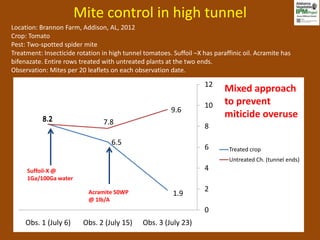
Mite control in high tunnel
Location: Brannon Farm, Addison, AL, 2012
Crop: Tomato
Pest: Two-spotted spider mite
Treatment: Insecticide rotation in high tunnel tomatoes. Suffoil –X has paraffinic oil. Acramite has
bifenazate. Entire rows treated with untreated plants at the two ends.
Observation: Mites per 20 leaflets on each observation date.

                                                                     12
                                                                            Mixed approach
                                                                     10     to prevent
                                                         9.6
           8.2
                                                                            miticide overuse
                                 7.8
                                                                     8

                                   6.5
                                                                     6        Treated crop
                                                                              Untreated Ch. (tunnel ends)
     Suffoil-X @                                                     4
     1Ga/100Ga water

                           Acramite 50WP                             2
                                                         1.9
                           @ 1lb/A
                                                                     0
     Obs. 1 (July 6)     Obs. 2 (July 15)      Obs. 3 (July 23)
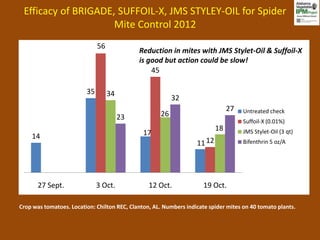
Efficacy of BRIGADE, SUFFOIL-X, JMS STYLEY-OIL for Spider
                     Mite Control 2012
                              56
                                             Reduction in mites with JMS Stylet-Oil & Suffoil-X
                                             is good but action could be slow!
                                                 45

                         35        34
                                                          32
                                                                                27   Untreated check
                                        23           26
                                                                                     Suffoil-X (0.01%)
                                                                           18        JMS Stylet-Oil (3 qt)
    14                                         17
                                                                   11 12             Bifenthrin 5 oz/A


       27 Sept.               3 Oct.             12 Oct.              19 Oct.

Crop was tomatoes. Location: Chilton REC, Clanton, AL. Numbers indicate spider mites on 40 tomato plants.
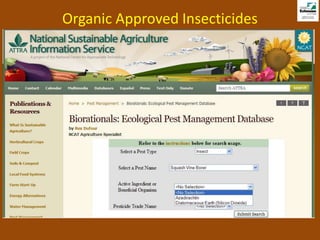
Organic Approved Insecticides
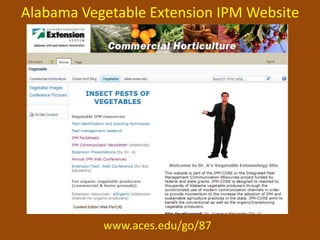
Alabama Vegetable Extension IPM Website


           www.aces.edu/go/87
Join Vegetable IPM on Facebook!


    Advantages: Live updates, interact with
 researchers, videos and photos, IPM contest
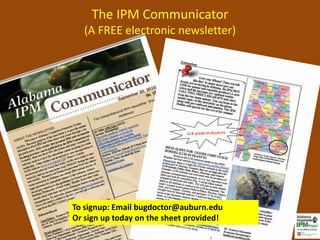
The IPM Communicator
   (A FREE electronic newsletter)


To signup: Email bugdoctor@auburn.edu
Or sign up today on the sheet provided!
References used
• Jon Traunfeld. 2013. Top Vegetable pests – spider mite. Univ. of Maryland
  Extension.
• Godfrey, L. D. 2011. Spider mites. University of California – Statewide IPM
  Program, Pubication 7405.
• Fasulo, T. R. 2009. Twospotted spider mites. Univ. of Florida – IFAS Publication
  EENY-150. http://entnemdept.ufl.edu/creatures/orn/twospotted_mite.htm
• Zalom et al. 2011. UC IPM Pest Management Guidelines: Tomato. University
  of California ANR Publication 3470.
  http://www.ipm.ucdavis.edu/PMG/r783400111.html
• Schuster, D. Tomato russet mite. Univ. of Florida – IFAS Publication.
  http://ipm.ifas.ufl.edu/resources/success_stories/T&PGuide/pdfs/Chapter4/
  Russet_Mite.pdf
• Peter Jentsch. Mite Management Using Reduced Risk Pest Management
  Programs and Biological Control. Cornell University.
  http://hudsonvf.cce.cornell.edu/scouting%20reports/scouting%20data/Mite
  %20Management%20Using%20Reduced%20Risk%20Pest%20Management%2
  0Programs%20and%20Biological%20Control.pdf

Spider mite control in vegetables 2013

  • 1.
    Spider Mite Controlin Vegetables Dr. Ayanava Majumdar (Dr. A) Ext. Entomologist 115 Extension Hall Auburn, AL 36849 Tel: (251) 331-8416 bugdoctor@auburn.edu AFVGA Conference, Feb. 9, 2013
  • 2.
    References • Jon Traunfeld.2013. Top Vegetable pests – spider mite. Univ. of Maryland Extension. • Godfrey, L. D. 2011. Spider mites. University of California – Statewide IPM Program, Pubication 7405. • Fasulo, T. R. 2009. Twospotted spider mites. Univ. of Florida – IFAS Publication EENY-150. http://entnemdept.ufl.edu/creatures/orn/twospotted_mite.htm • Zalom et al. 2011. UC IPM Pest Management Guidelines: Tomato. University of California ANR Publication 3470. http://www.ipm.ucdavis.edu/PMG/r783400111.html • Schuster, D. Tomato russet mite. Univ. of Florida – IFAS Publication. http://ipm.ifas.ufl.edu/resources/success_stories/T&PGuide/pdfs/Chapter4/ Russet_Mite.pdf • Peter Jentsch. Mite Management Using Reduced Risk Pest Management Programs and Biological Control. Cornell University. http://hudsonvf.cce.cornell.edu/scouting%20reports/scouting%20data/Mite %20Management%20Using%20Reduced%20Risk%20Pest%20Management%2 0Programs%20and%20Biological%20Control.pdf
  • 3.
    Basic information • Very common problem in AL • 1/20 inch long • Mites are not insects • Related to spiders & ticks • Spin webs – live in colonies • Immature stages have 6 legs • Overwinter as mated females
  • 4.
    Life cycle • Life cycle completed <1 wk (5 to 20 d) • Like hot dry weather • Eggs are small oval (look like dust particles, underside of leaves), 3 d to hatch • Eggs change to larva (6 legs) • Larva change to nymphs (8 legs) – two stages • 5 to 10 generations common
  • 5.
    Identification & Scouting Twospottedspider mite (TSM): • Carry a 10X hand lens • Females are larger than males • Oval adults, eggs glued to webbing • Underside of leaves & leaf tips • Wide host range Twospotted spider mite Tetranychus urticae Tomato russet mite (TRM): • Smaller than TSM • Carry a 14X hand lens • Adults are elongate • Infestation starts from lower leaves • Leave edges, stems, fruits (small) Tomato russet mite • Solanaceous host plants Acilops lycopersici
  • 6.
    Crop damage TSM: TRM: – Leaf drying – Greasy bronzing – Extensive webbing (russet color) – Sudden dry out – Slight bronzing (lower leaves)
  • 7.
    Spider mite management CULTURALPRACTICES: • Start clean: Get healthy transplants • Avoid planting in hot dry conditions • Avoid mowing or blowing dust on to crops • Avoid water stress on plants
  • 8.
    Spider mite management ALTERNATIVEMITICIDES: • Layton et al. (2011): 2 applications of insecticidal oil, insecticidal soap or neem oil provided good TSM control • OMRI approved: Grandevo (extracted from Chromobacterium subtsugae) – 2 treatments on strawberry provided 63 to 80% mite suppression
  • 9.
    Spider mite management CAUTION:Many synthetic pyrethroids can flare up spider mites by removing predatory mites and other beneficial insects. Abamectin (AgriMek, 8-16 fl oz/acre): • Good rescue insecticide. • Contains synthetic abamectin and provides long-term residual control of TSM. • Do not apply more than two sequential applications of abamectin. • PHI on tomatoes is 7 days.
  • 10.
    Spider mite management Bifenazate(Acramite, 0.75-1 lb/acre): • MOA: GABA agonist • Contact poison against motile stage of TSM • Has some ovicidal action (kills eggs) • Reduced toxicity to predaceous mites and beneficial arthropods. • Do not make more than one application per season. • PHI on tomatoes is 3 days.
  • 11.
    Spider mite management Fenpyroximate(Portal, 2 pts/acre): • Mitochondrial electron transport inhibitor (METI), blocking cellular respiration • Stops mite feeding & egg laying, 7 day to kill • Good late season rescue insecticide • Limit to one application per year • Softer on predatory mites • Complete coverage essential
  • 12.
    Spider mite management Etoxazole(Zeal, 2 to 3 oz/acre): • Good contact miticide but not labeled on many crops • Kills eggs and stops molting of immatures • Has translaminar movement • Could take several days to act
  • 13.
    Spider mite management Spiromesifen(Oberon, 7 to 8.5 fl oz): • Mitochondrial electron transport inhibitor (METI), blocking cellular respiration • Kills motile mite but slow acting
  • 14.
    Efficacy of PORTALfor Spider Mite Control 2012 (fenpyroximate 5%) 84 73 35 Untreated check 17 Portal 32 oz + NIS 9 7 1 3 Acramite + NIS 0 20 Sept (mite buildup 4 Oct. (mite control) 12 Oct. (mite control) with pyrethroids) 7 DAT 17 DAT Crop was tomatoes. Location: Chilton REC, Clanton, AL. Treatment dates: 26 July (Mustang Max) & 9 Aug. (Warrior) to buildup mites. Portal treatment date was 24 Sept. Numbers indicate spider mites on 40 plants/treatment (10 plants/plot). Excessive rains prevented a steady pressure of mites.
  • 15.
    Mite control inhigh tunnel Location: Brannon Farm, Addison, AL, 2012 Crop: Tomato Pest: Two-spotted spider mite Treatment: Insecticide rotation in high tunnel tomatoes. Suffoil –X has paraffinic oil. Acramite has bifenazate. Entire rows treated with untreated plants at the two ends. Observation: Mites per 20 leaflets on each observation date. 12 Mixed approach 10 to prevent 9.6 8.2 miticide overuse 7.8 8 6.5 6 Treated crop Untreated Ch. (tunnel ends) Suffoil-X @ 4 1Ga/100Ga water Acramite 50WP 2 1.9 @ 1lb/A 0 Obs. 1 (July 6) Obs. 2 (July 15) Obs. 3 (July 23)
  • 16.
    Efficacy of BRIGADE,SUFFOIL-X, JMS STYLEY-OIL for Spider Mite Control 2012 56 Reduction in mites with JMS Stylet-Oil & Suffoil-X is good but action could be slow! 45 35 34 32 27 Untreated check 23 26 Suffoil-X (0.01%) 18 JMS Stylet-Oil (3 qt) 14 17 11 12 Bifenthrin 5 oz/A 27 Sept. 3 Oct. 12 Oct. 19 Oct. Crop was tomatoes. Location: Chilton REC, Clanton, AL. Numbers indicate spider mites on 40 tomato plants.
  • 17.
  • 18.
    Alabama Vegetable ExtensionIPM Website www.aces.edu/go/87
  • 19.
    Join Vegetable IPMon Facebook! Advantages: Live updates, interact with researchers, videos and photos, IPM contest
  • 20.
    The IPM Communicator (A FREE electronic newsletter) To signup: Email bugdoctor@auburn.edu Or sign up today on the sheet provided!
  • 21.
    References used • JonTraunfeld. 2013. Top Vegetable pests – spider mite. Univ. of Maryland Extension. • Godfrey, L. D. 2011. Spider mites. University of California – Statewide IPM Program, Pubication 7405. • Fasulo, T. R. 2009. Twospotted spider mites. Univ. of Florida – IFAS Publication EENY-150. http://entnemdept.ufl.edu/creatures/orn/twospotted_mite.htm • Zalom et al. 2011. UC IPM Pest Management Guidelines: Tomato. University of California ANR Publication 3470. http://www.ipm.ucdavis.edu/PMG/r783400111.html • Schuster, D. Tomato russet mite. Univ. of Florida – IFAS Publication. http://ipm.ifas.ufl.edu/resources/success_stories/T&PGuide/pdfs/Chapter4/ Russet_Mite.pdf • Peter Jentsch. Mite Management Using Reduced Risk Pest Management Programs and Biological Control. Cornell University. http://hudsonvf.cce.cornell.edu/scouting%20reports/scouting%20data/Mite %20Management%20Using%20Reduced%20Risk%20Pest%20Management%2 0Programs%20and%20Biological%20Control.pdf