PROTECTED CULTIVATION
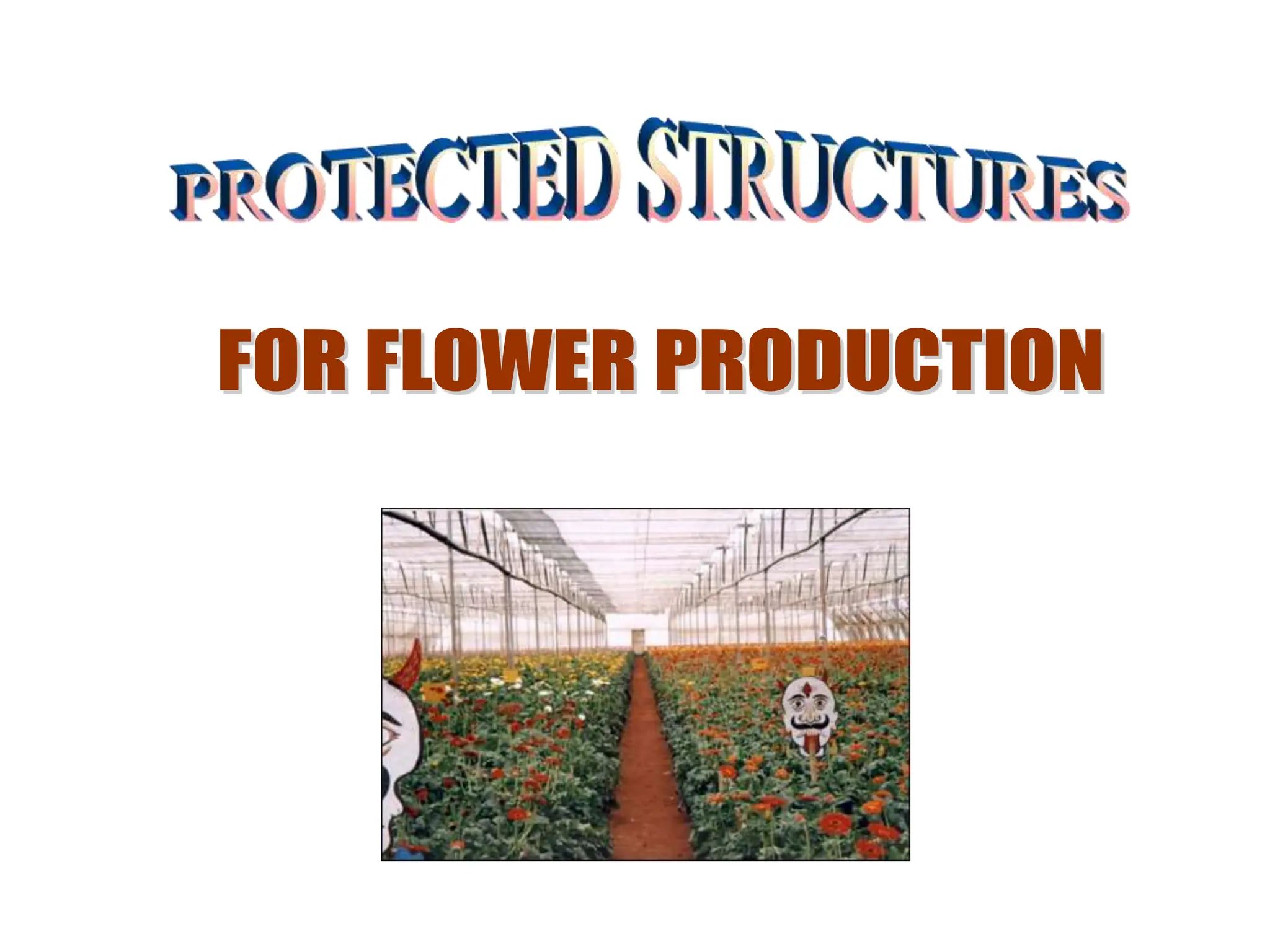
the cultivation of flowers under controlled atmosphere
PROTECTED STRUCTURE
framed structure with cladding material used to grow plants under
controlled environment to maximise productivity
ADVANTAGES
 Productivity is high
 High quality of the produce
 Control of pest and disease is easier
 Production during off-season
 Effective and intensive propagation of high value ornamental crops is easier
 Less water requirement due to less evaporation losses
Effective use of land resources
Lucrative for youth
HISTORY
Existed even in Roman times (daily cucumber production
for emperor)
First modern green house in Italy during 13th century
(to conserve explored plants)
First modern practical green house – ‘Holland’
to grow tropical medicinal plants
Better designs during 17th century due to building technology
(better glass etc.)
Largest green houses in 19th century –
conservatory of Kew garden of England
Use of polyethylene based materials – 21st century
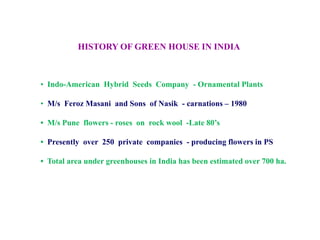
HISTORY OF GREEN HOUSE IN INDIA
• Indo-American Hybrid Seeds Company - Ornamental Plants
• M/s Feroz Masani and Sons of Nasik - carnations – 1980
• M/s Pune flowers - roses on rock wool -Late 80’s
• Presently over 250 private companies - producing flowers in PS
• Total area under greenhouses in India has been estimated over 700 ha.
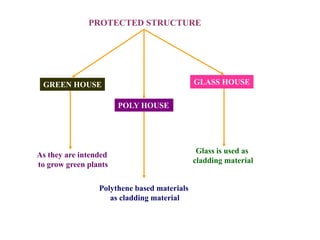
PROTECTED STRUCTURE
GREEN HOUSE GLASS HOUSE
POLY HOUSE
As they are intended
to grow green plants
Polythene based materials
as cladding material
Glass is used as
cladding material
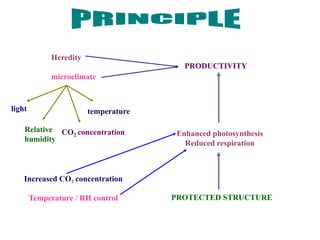
PRODUCTIVITY
Heredity
microclimate
light
Relative
humidity
CO2 concentration
temperature
PROTECTED STRUCTURE
Enhanced photosynthesis
Reduced respiration
Increased CO2 concentration
Temperature / RH control
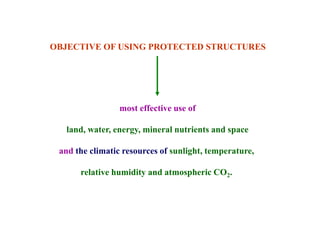
most effective use of
land, water, energy, mineral nutrients and space
and the climatic resources of sunlight, temperature,
relative humidity and atmospheric CO2.
OBJECTIVE OF USING PROTECTED STRUCTURES
Green House
Shade net House
Plastic tunnel
Walk in tunnel
Plant protection nets
PROTECTED STUCTURES
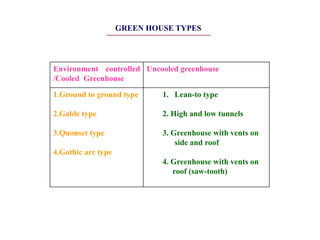
GREEN HOUSE TYPES
Environment controlled
/Cooled Greenhouse
Uncooled greenhouse
1.Ground to ground type
2.Gable type
3.Quonset type
4.Gothic arc type
1. Lean-to type
2. High and low tunnels
3. Greenhouse with vents on
side and roof
4. Greenhouse with vents on
roof (saw-tooth)
---------------------------------------
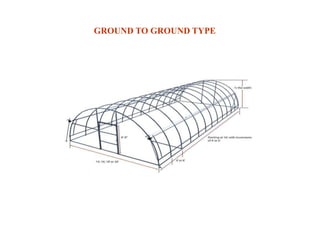
GROUND TO GROUND TYPE
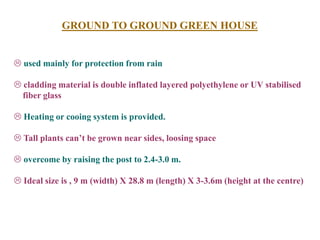
 used mainly for protection from rain
 cladding material is double inflated layered polyethylene or UV stabilised
fiber glass
 Heating or cooing system is provided.
 Tall plants can’t be grown near sides, loosing space
 overcome by raising the post to 2.4-3.0 m.
 Ideal size is , 9 m (width) X 28.8 m (length) X 3-3.6m (height at the centre)
GROUND TO GROUND GREEN HOUSE
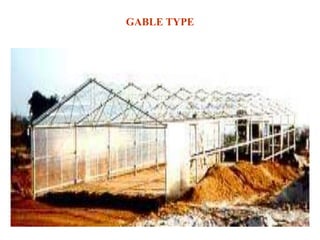
GABLE TYPE
 large conventional commercial greenhouses
 sides and top are covered with fiberglass / polycarbonate / polysheets.
 ideal for temperate regions where snow fall is a problem
 suited for foliage, flowering and high value crops
 can be gutter connected and made multi-span
 Ideal size is , 8.7m X 28.8-36m X 3.6-4.24 m and 2.4-3.0m height of posts.
GABLE TYPE GREEN HOUSE
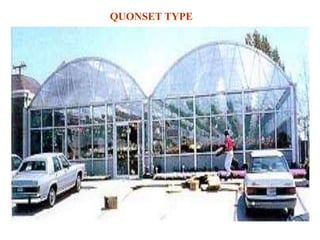
QUONSET TYPE
* The roof is semi-round
* Roof and sides and covered with polyethylene / fiber glass / polycarbonate
* has minimum roof covering and is very energy efficient
* It is very simple to expand this type by connecting through gutters
* Ideal size is, 8.7m X 28.8-36m X 3.6-4.24 m and 2.4-3.0m height of posts.
QUONSET TYPE
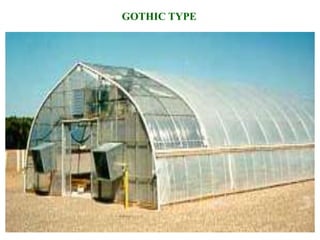
GOTHIC TYPE
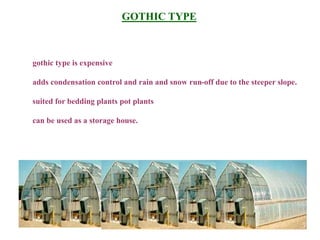
GOTHIC TYPE
gothic type is expensive
adds condensation control and rain and snow run-off due to the steeper slope.
suited for bedding plants pot plants
can be used as a storage house.
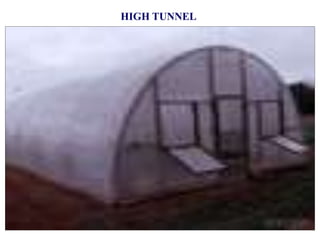
HIGH TUNNEL
 unheated plastic covered structures
 provides an intermediate level of environmental protection and control
compared to open field conditions and heated greenhouses.
 they are covered with a single layer of plastic
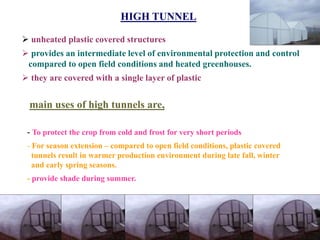
HIGH TUNNEL
main uses of high tunnels are,
- To protect the crop from cold and frost for very short periods
- For season extension – compared to open field conditions, plastic covered
tunnels result in warmer production environment during late fall, winter
and early spring seasons.
- provide shade during summer.
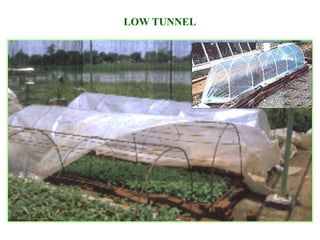
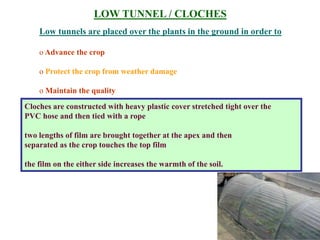
LOW TUNNEL
Low tunnels are placed over the plants in the ground in order to
o Advance the crop
o Protect the crop from weather damage
o Maintain the quality
LOW TUNNEL / CLOCHES
Cloches are constructed with heavy plastic cover stretched tight over the
PVC hose and then tied with a rope
two lengths of film are brought together at the apex and then
separated as the crop touches the top film
the film on the either side increases the warmth of the soil.
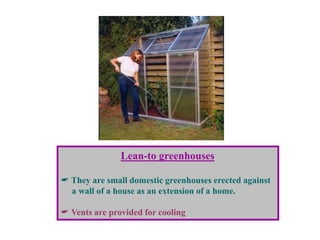
Lean-to greenhouses
 They are small domestic greenhouses erected against
a wall of a house as an extension of a home.
 Vents are provided for cooling
CONSTRAINTS
HIGH INITIAL INVESTMENT
LA CK OF INDIGENOUS TECHNICAL KNOW HOW
LACK OF TRAINED TECHNICAL MAN POWER
SITE SELECTION
Elevated place to avoid water stagnation
Assured year round quality water supply
Away from tall buildings and trees
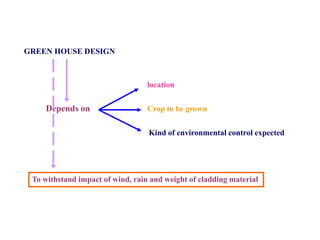
GREEN HOUSE DESIGN
Depends on
location
Crop to be grown
Kind of environmental control expected
To withstand impact of wind, rain and weight of cladding material
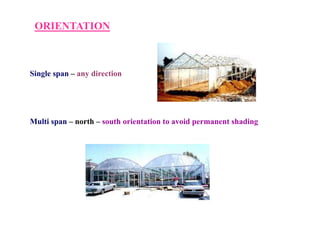
ORIENTATION
Single span – any direction
Multi span – north – south orientation to avoid permanent shading
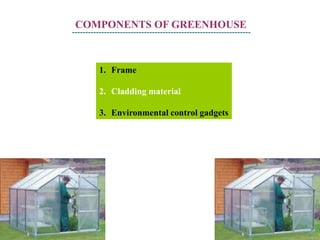
COMPONENTS OF GREENHOUSE
-------------------------------------------------------------------
1. Frame
2. Cladding material
3. Environmental control gadgets
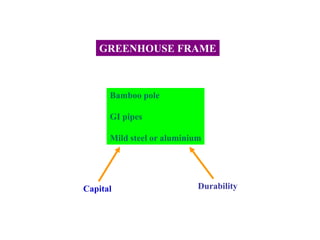
GREENHOUSE FRAME
Bamboo pole
GI pipes
Mild steel or aluminium
Capital Durability
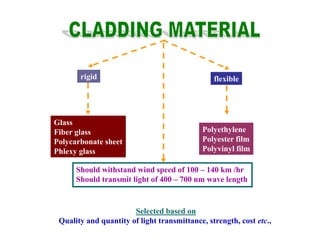
rigid flexible
Glass
Fiber glass
Polycarbonate sheet
Phlexy glass
Polyethylene
Polyester film
Polyvinyl film
Should withstand wind speed of 100 – 140 km /hr
Should transmit light of 400 – 700 nm wave length
Selected based on
Quality and quantity of light transmittance, strength, cost etc.,
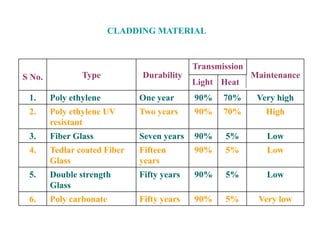
S No. Type Durability
Transmission
Maintenance
Light Heat
1. Poly ethylene One year 90% 70% Very high
2. Poly ethylene UV
resistant
Two years 90% 70% High
3. Fiber Glass Seven years 90% 5% Low
4. Tedlar coated Fiber
Glass
Fifteen
years
90% 5% Low
5. Double strength
Glass
Fifty years 90% 5% Low
6. Poly carbonate Fifty years 90% 5% Very low
CLADDING MATERIAL
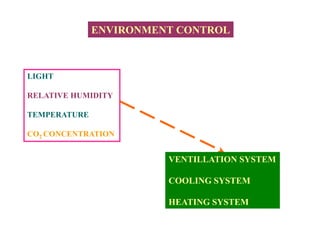
ENVIRONMENT CONTROL
LIGHT
RELATIVE HUMIDITY
TEMPERATURE
CO2 CONCENTRATION
VENTILLATION SYSTEM
COOLING SYSTEM
HEATING SYSTEM
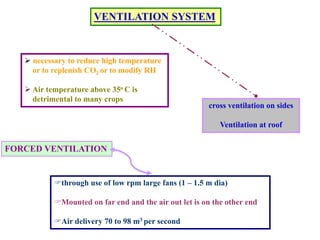
VENTILATION SYSTEM
 necessary to reduce high temperature
or to replenish CO2 or to modify RH
 Air temperature above 35o C is
detrimental to many crops
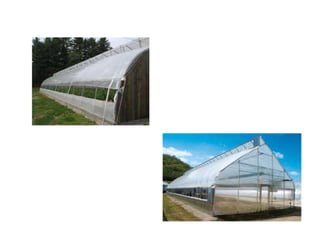
cross ventilation on sides
Ventilation at roof
FORCED VENTILATION
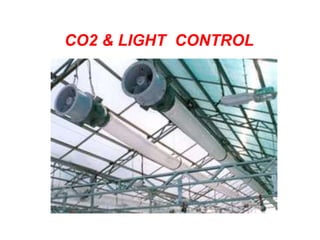
through use of low rpm large fans (1 – 1.5 m dia)
Mounted on far end and the air out let is on the other end
Air delivery 70 to 98 m3 per second
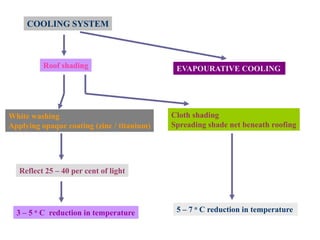
COOLING SYSTEM
Roof shading
White washing
Applying opaque coating (zinc / titanium)
Reflect 25 – 40 per cent of light
3 – 5 o C reduction in temperature
Cloth shading
Spreading shade net beneath roofing
5 – 7 o C reduction in temperature
EVAPOURATIVE COOLING
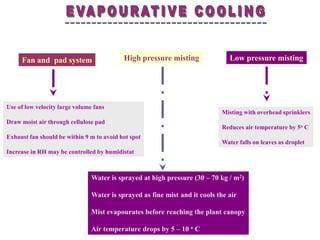
Fan and pad system High pressure misting Low pressure misting
Use of low velocity large volume fans
Draw moist air through cellulose pad
Exhaust fan should be within 9 m to avoid hot spot
Increase in RH may be controlled by humidistat
Misting with overhead sprinklers
Reduces air temperature by 5o C
Water falls on leaves as droplet
--------------------------------------
Water is sprayed at high pressure (30 – 70 kg / m2)
Water is sprayed as fine mist and it cools the air
Mist evapourates before reaching the plant canopy
Air temperature drops by 5 – 10 o C
CO2 & LIGHT CONTROL
Required in temperate climate
Heated by hot water system running through metal pipes

Protected Structures.ppt

  • 2.
    PROTECTED CULTIVATION the cultivationof flowers under controlled atmosphere PROTECTED STRUCTURE framed structure with cladding material used to grow plants under controlled environment to maximise productivity
  • 3.
    ADVANTAGES  Productivity ishigh  High quality of the produce  Control of pest and disease is easier  Production during off-season  Effective and intensive propagation of high value ornamental crops is easier  Less water requirement due to less evaporation losses Effective use of land resources Lucrative for youth
  • 4.
    HISTORY Existed even inRoman times (daily cucumber production for emperor) First modern green house in Italy during 13th century (to conserve explored plants) First modern practical green house – ‘Holland’ to grow tropical medicinal plants Better designs during 17th century due to building technology (better glass etc.) Largest green houses in 19th century – conservatory of Kew garden of England Use of polyethylene based materials – 21st century
  • 5.
    HISTORY OF GREENHOUSE IN INDIA • Indo-American Hybrid Seeds Company - Ornamental Plants • M/s Feroz Masani and Sons of Nasik - carnations – 1980 • M/s Pune flowers - roses on rock wool -Late 80’s • Presently over 250 private companies - producing flowers in PS • Total area under greenhouses in India has been estimated over 700 ha.
  • 6.
    PROTECTED STRUCTURE GREEN HOUSEGLASS HOUSE POLY HOUSE As they are intended to grow green plants Polythene based materials as cladding material Glass is used as cladding material
  • 7.
    PRODUCTIVITY Heredity microclimate light Relative humidity CO2 concentration temperature PROTECTED STRUCTURE Enhancedphotosynthesis Reduced respiration Increased CO2 concentration Temperature / RH control
  • 8.
    most effective useof land, water, energy, mineral nutrients and space and the climatic resources of sunlight, temperature, relative humidity and atmospheric CO2. OBJECTIVE OF USING PROTECTED STRUCTURES
  • 9.
    Green House Shade netHouse Plastic tunnel Walk in tunnel Plant protection nets PROTECTED STUCTURES
  • 10.
    GREEN HOUSE TYPES Environmentcontrolled /Cooled Greenhouse Uncooled greenhouse 1.Ground to ground type 2.Gable type 3.Quonset type 4.Gothic arc type 1. Lean-to type 2. High and low tunnels 3. Greenhouse with vents on side and roof 4. Greenhouse with vents on roof (saw-tooth) ---------------------------------------
  • 11.
  • 12.
     used mainlyfor protection from rain  cladding material is double inflated layered polyethylene or UV stabilised fiber glass  Heating or cooing system is provided.  Tall plants can’t be grown near sides, loosing space  overcome by raising the post to 2.4-3.0 m.  Ideal size is , 9 m (width) X 28.8 m (length) X 3-3.6m (height at the centre) GROUND TO GROUND GREEN HOUSE
  • 13.
  • 14.
     large conventionalcommercial greenhouses  sides and top are covered with fiberglass / polycarbonate / polysheets.  ideal for temperate regions where snow fall is a problem  suited for foliage, flowering and high value crops  can be gutter connected and made multi-span  Ideal size is , 8.7m X 28.8-36m X 3.6-4.24 m and 2.4-3.0m height of posts. GABLE TYPE GREEN HOUSE
  • 15.
  • 16.
    * The roofis semi-round * Roof and sides and covered with polyethylene / fiber glass / polycarbonate * has minimum roof covering and is very energy efficient * It is very simple to expand this type by connecting through gutters * Ideal size is, 8.7m X 28.8-36m X 3.6-4.24 m and 2.4-3.0m height of posts. QUONSET TYPE
  • 17.
  • 18.
    GOTHIC TYPE gothic typeis expensive adds condensation control and rain and snow run-off due to the steeper slope. suited for bedding plants pot plants can be used as a storage house.
  • 19.
  • 20.
     unheated plasticcovered structures  provides an intermediate level of environmental protection and control compared to open field conditions and heated greenhouses.  they are covered with a single layer of plastic HIGH TUNNEL main uses of high tunnels are, - To protect the crop from cold and frost for very short periods - For season extension – compared to open field conditions, plastic covered tunnels result in warmer production environment during late fall, winter and early spring seasons. - provide shade during summer.
  • 21.
  • 22.
    Low tunnels areplaced over the plants in the ground in order to o Advance the crop o Protect the crop from weather damage o Maintain the quality LOW TUNNEL / CLOCHES Cloches are constructed with heavy plastic cover stretched tight over the PVC hose and then tied with a rope two lengths of film are brought together at the apex and then separated as the crop touches the top film the film on the either side increases the warmth of the soil.
  • 23.
    Lean-to greenhouses  Theyare small domestic greenhouses erected against a wall of a house as an extension of a home.  Vents are provided for cooling
  • 24.
    CONSTRAINTS HIGH INITIAL INVESTMENT LACK OF INDIGENOUS TECHNICAL KNOW HOW LACK OF TRAINED TECHNICAL MAN POWER
  • 25.
    SITE SELECTION Elevated placeto avoid water stagnation Assured year round quality water supply Away from tall buildings and trees
  • 26.
    GREEN HOUSE DESIGN Dependson location Crop to be grown Kind of environmental control expected To withstand impact of wind, rain and weight of cladding material
  • 27.
    ORIENTATION Single span –any direction Multi span – north – south orientation to avoid permanent shading
  • 28.
  • 29.
    GREENHOUSE FRAME Bamboo pole GIpipes Mild steel or aluminium Capital Durability
  • 30.
    rigid flexible Glass Fiber glass Polycarbonatesheet Phlexy glass Polyethylene Polyester film Polyvinyl film Should withstand wind speed of 100 – 140 km /hr Should transmit light of 400 – 700 nm wave length Selected based on Quality and quantity of light transmittance, strength, cost etc.,
  • 31.
    S No. TypeDurability Transmission Maintenance Light Heat 1. Poly ethylene One year 90% 70% Very high 2. Poly ethylene UV resistant Two years 90% 70% High 3. Fiber Glass Seven years 90% 5% Low 4. Tedlar coated Fiber Glass Fifteen years 90% 5% Low 5. Double strength Glass Fifty years 90% 5% Low 6. Poly carbonate Fifty years 90% 5% Very low CLADDING MATERIAL
  • 32.
    ENVIRONMENT CONTROL LIGHT RELATIVE HUMIDITY TEMPERATURE CO2CONCENTRATION VENTILLATION SYSTEM COOLING SYSTEM HEATING SYSTEM
  • 33.
    VENTILATION SYSTEM  necessaryto reduce high temperature or to replenish CO2 or to modify RH  Air temperature above 35o C is detrimental to many crops cross ventilation on sides Ventilation at roof FORCED VENTILATION through use of low rpm large fans (1 – 1.5 m dia) Mounted on far end and the air out let is on the other end Air delivery 70 to 98 m3 per second
  • 35.
    COOLING SYSTEM Roof shading Whitewashing Applying opaque coating (zinc / titanium) Reflect 25 – 40 per cent of light 3 – 5 o C reduction in temperature Cloth shading Spreading shade net beneath roofing 5 – 7 o C reduction in temperature EVAPOURATIVE COOLING
  • 36.
    Fan and padsystem High pressure misting Low pressure misting Use of low velocity large volume fans Draw moist air through cellulose pad Exhaust fan should be within 9 m to avoid hot spot Increase in RH may be controlled by humidistat Misting with overhead sprinklers Reduces air temperature by 5o C Water falls on leaves as droplet -------------------------------------- Water is sprayed at high pressure (30 – 70 kg / m2) Water is sprayed as fine mist and it cools the air Mist evapourates before reaching the plant canopy Air temperature drops by 5 – 10 o C
  • 37.
    CO2 & LIGHTCONTROL
  • 39.
    Required in temperateclimate Heated by hot water system running through metal pipes