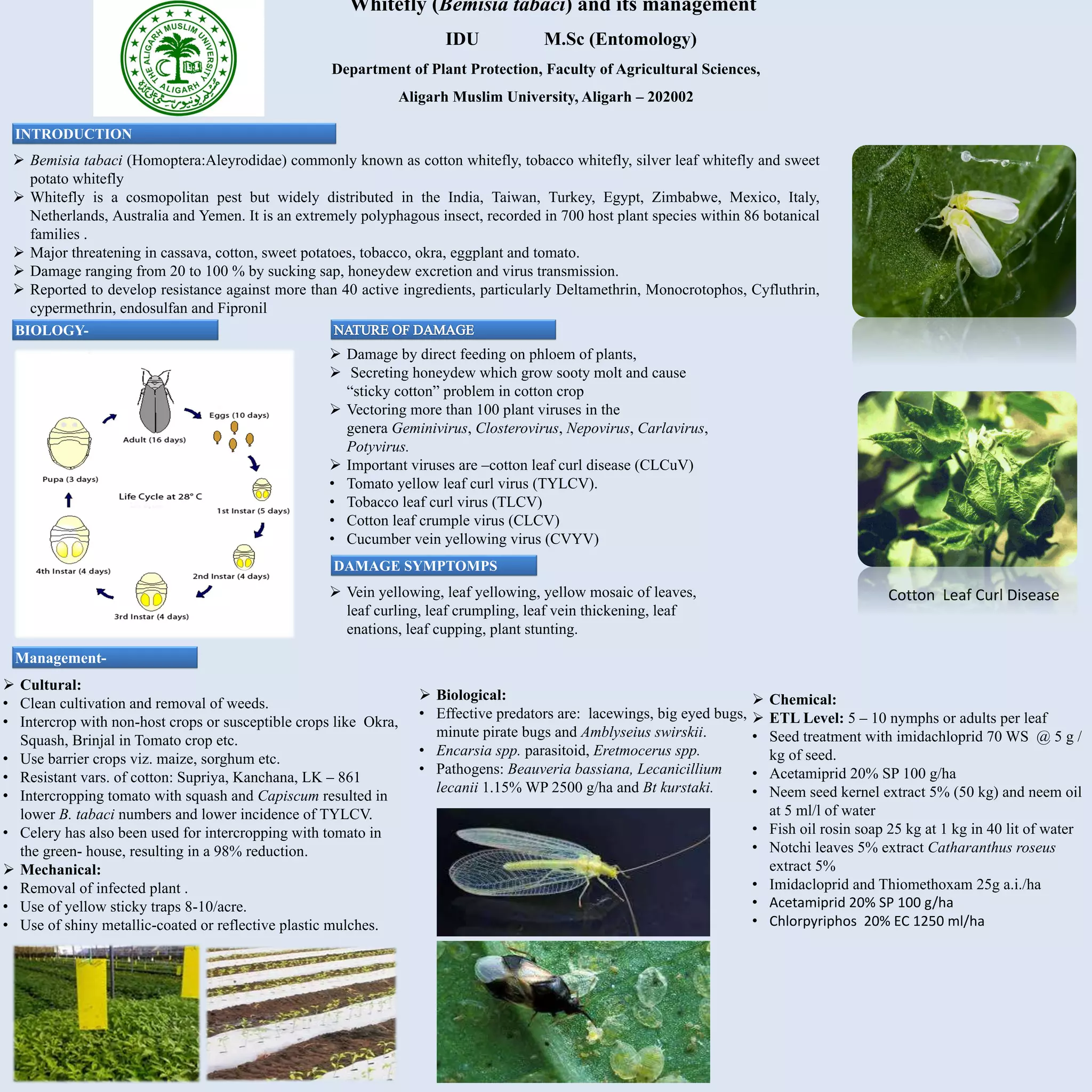
Whitefly (Bemisia tabaci) and its management
IDU M.Sc (Entomology)
Department of Plant Protection, Faculty of Agricultural Sciences,
Aligarh Muslim University, Aligarh – 202002
INTRODUCTION
 Bemisia tabaci (Homoptera:Aleyrodidae) commonly known as cotton whitefly, tobacco whitefly, silver leaf whitefly and sweet
potato whitefly
 Whitefly is a cosmopolitan pest but widely distributed in the India, Taiwan, Turkey, Egypt, Zimbabwe, Mexico, Italy,
Netherlands, Australia and Yemen. It is an extremely polyphagous insect, recorded in 700 host plant species within 86 botanical
families .
 Major threatening in cassava, cotton, sweet potatoes, tobacco, okra, eggplant and tomato.
 Damage ranging from 20 to 100 % by sucking sap, honeydew excretion and virus transmission.
 Reported to develop resistance against more than 40 active ingredients, particularly Deltamethrin, Monocrotophos, Cyfluthrin,
cypermethrin, endosulfan and Fipronil
BIOLOGY-
Management-
 Damage by direct feeding on phloem of plants,
 Secreting honeydew which grow sooty molt and cause
“sticky cotton” problem in cotton crop
 Vectoring more than 100 plant viruses in the
genera Geminivirus, Closterovirus, Nepovirus, Carlavirus,
Potyvirus.
 Important viruses are –cotton leaf curl disease (CLCuV)
• Tomato yellow leaf curl virus (TYLCV).
• Tobacco leaf curl virus (TLCV)
• Cotton leaf crumple virus (CLCV)
• Cucumber vein yellowing virus (CVYV)
 Cultural:
• Clean cultivation and removal of weeds.
• Intercrop with non-host crops or susceptible crops like Okra,
Squash, Brinjal in Tomato crop etc.
• Use barrier crops viz. maize, sorghum etc.
• Resistant vars. of cotton: Supriya, Kanchana, LK – 861
• Intercropping tomato with squash and Capiscum resulted in
lower B. tabaci numbers and lower incidence of TYLCV.
• Celery has also been used for intercropping with tomato in
the green- house, resulting in a 98% reduction.
 Mechanical:
• Removal of infected plant .
• Use of yellow sticky traps 8-10/acre.
• Use of shiny metallic-coated or reflective plastic mulches.
DAMAGE SYMPTOMPS
 Vein yellowing, leaf yellowing, yellow mosaic of leaves,
leaf curling, leaf crumpling, leaf vein thickening, leaf
enations, leaf cupping, plant stunting.
 Biological:
• Effective predators are: lacewings, big eyed bugs,
minute pirate bugs and Amblyseius swirskii.
• Encarsia spp. parasitoid, Eretmocerus spp.
• Pathogens: Beauveria bassiana, Lecanicillium
lecanii 1.15% WP 2500 g/ha and Bt kurstaki.
 Chemical:
 ETL Level: 5 – 10 nymphs or adults per leaf
• Seed treatment with imidachloprid 70 WS @ 5 g /
kg of seed.
• Acetamiprid 20% SP 100 g/ha
• Neem seed kernel extract 5% (50 kg) and neem oil
at 5 ml/l of water
• Fish oil rosin soap 25 kg at 1 kg in 40 lit of water
• Notchi leaves 5% extract Catharanthus roseus
extract 5%
• Imidacloprid and Thiomethoxam 25g a.i./ha
• Acetamiprid 20% SP 100 g/ha
• Chlorpyriphos 20% EC 1250 ml/ha
Cotton Leaf Curl Disease

WHITEFLY MANAGEMENT

  • 1.
    Whitefly (Bemisia tabaci)and its management IDU M.Sc (Entomology) Department of Plant Protection, Faculty of Agricultural Sciences, Aligarh Muslim University, Aligarh – 202002 INTRODUCTION  Bemisia tabaci (Homoptera:Aleyrodidae) commonly known as cotton whitefly, tobacco whitefly, silver leaf whitefly and sweet potato whitefly  Whitefly is a cosmopolitan pest but widely distributed in the India, Taiwan, Turkey, Egypt, Zimbabwe, Mexico, Italy, Netherlands, Australia and Yemen. It is an extremely polyphagous insect, recorded in 700 host plant species within 86 botanical families .  Major threatening in cassava, cotton, sweet potatoes, tobacco, okra, eggplant and tomato.  Damage ranging from 20 to 100 % by sucking sap, honeydew excretion and virus transmission.  Reported to develop resistance against more than 40 active ingredients, particularly Deltamethrin, Monocrotophos, Cyfluthrin, cypermethrin, endosulfan and Fipronil BIOLOGY- Management-  Damage by direct feeding on phloem of plants,  Secreting honeydew which grow sooty molt and cause “sticky cotton” problem in cotton crop  Vectoring more than 100 plant viruses in the genera Geminivirus, Closterovirus, Nepovirus, Carlavirus, Potyvirus.  Important viruses are –cotton leaf curl disease (CLCuV) • Tomato yellow leaf curl virus (TYLCV). • Tobacco leaf curl virus (TLCV) • Cotton leaf crumple virus (CLCV) • Cucumber vein yellowing virus (CVYV)  Cultural: • Clean cultivation and removal of weeds. • Intercrop with non-host crops or susceptible crops like Okra, Squash, Brinjal in Tomato crop etc. • Use barrier crops viz. maize, sorghum etc. • Resistant vars. of cotton: Supriya, Kanchana, LK – 861 • Intercropping tomato with squash and Capiscum resulted in lower B. tabaci numbers and lower incidence of TYLCV. • Celery has also been used for intercropping with tomato in the green- house, resulting in a 98% reduction.  Mechanical: • Removal of infected plant . • Use of yellow sticky traps 8-10/acre. • Use of shiny metallic-coated or reflective plastic mulches. DAMAGE SYMPTOMPS  Vein yellowing, leaf yellowing, yellow mosaic of leaves, leaf curling, leaf crumpling, leaf vein thickening, leaf enations, leaf cupping, plant stunting.  Biological: • Effective predators are: lacewings, big eyed bugs, minute pirate bugs and Amblyseius swirskii. • Encarsia spp. parasitoid, Eretmocerus spp. • Pathogens: Beauveria bassiana, Lecanicillium lecanii 1.15% WP 2500 g/ha and Bt kurstaki.  Chemical:  ETL Level: 5 – 10 nymphs or adults per leaf • Seed treatment with imidachloprid 70 WS @ 5 g / kg of seed. • Acetamiprid 20% SP 100 g/ha • Neem seed kernel extract 5% (50 kg) and neem oil at 5 ml/l of water • Fish oil rosin soap 25 kg at 1 kg in 40 lit of water • Notchi leaves 5% extract Catharanthus roseus extract 5% • Imidacloprid and Thiomethoxam 25g a.i./ha • Acetamiprid 20% SP 100 g/ha • Chlorpyriphos 20% EC 1250 ml/ha Cotton Leaf Curl Disease