WELCOME
CREDIT SEMINAR
ON
CHILLI THRIPS
Presented By,
RAKESH KR. MEENA
SAM HIGGINBOTTOM INSTITUTE OF
AGRICULTURE, TECHNOLOGY & SCIENCES
(Deemed to be University)
ALLAHABAD-211007,U.P., INDIA
Scientific name : Scirtothrips dorsalis
Order : Thysanoptera
Family : Thripidae
1. Introduction
2. Economic Important
3. Host range
4. Area and Distribution
5. Yield loss
6. ETL
7. Scientific Classification
8. Marks of Identification
9. Life cycle
10. Nature of damage
11. Vector
12. Management
 Thrips cause serious economic losses in many agricultural
systems each year including vegetables and ornamentals.
 Chilli thrips is a polyphagous pest.
 Chilli thrips is a very small 0.5 to 1.2 mm.
 Chilli thrips life cycle 4 stages-eggs, larvae, pupa, adult.
 pale yellow-colored thrips that can be found feeding on
leaves, flowers and fruits.
 Both the adults and nymphs feed on leaf tissue
and suck the sap.
 Thrips usually feed on the lower surface of leaves.
 They are serious pest of chilli and can reduce
yield by 30-50%.
 They are responsible for transmitting leaf curl
disease on chilli.
Economic Important
 Chilli thrips is a polyphagous species.
 It is a significant pest of chilli pepper, tomato,
mango, citrus, castor, bean, cotton, onion, and
other crops in tropical and subtropical regions of
Asia, Africa and Japan.
Minor Host - Okra, Cucumber, Water melon,
Pumpkin, Soybean, Bean, Mung bean, Brinjal.
 Asia : Bangladesh, China, India, Indonesia, Japan,
Malasia, Myanmar, Pakistan, Phillippines,
Sri Lanka, and Thailand.
 Africa : South Africa.
 North America : United States.
 Oceania : Australia, Islands.
FIGURE - Worldwide distribution of chilli thrips,
Scirtothrips dorsalis Hood, as of September 2009.
 Yield losses attributable to Scirtothrips dorsalis in
chilli have ranged from 20% to nearly 50%.
 3 Nymphs or adult per leaf.
 ETL : (Economic threshold level)
 The level at which control measure should be
undertaken otherwise it will cause significant
economic loss.
 Kingdom : Animalia
 Phylum : Arthropoda
 Class : Insecta
 Order : Thysanoptera
 Family : Thripidae
 Genus : Scirtothrips
 Species : dorsalis
 Eggs: Typically oval, whitish to
yellowish coloured.
 Eggs are about 0.075mm long
and 0.070 mm wide, and are
inserted inside plant tissue.
 Larvae : Two larval stages (first and second
instar) 6 to 7 days. The larvae are off-white in
colour.
First instar : transparent, body short, legs
longer, antennae short and seven segmented,
and cylindrical.
 Second instar : Antennae longer, cylindrical,
seven-segmented, mouth longer.
 Pre-pupae : Yellowish, antennae short, two pair
of external wing.
 The pre-pupal period is short(24 hours).
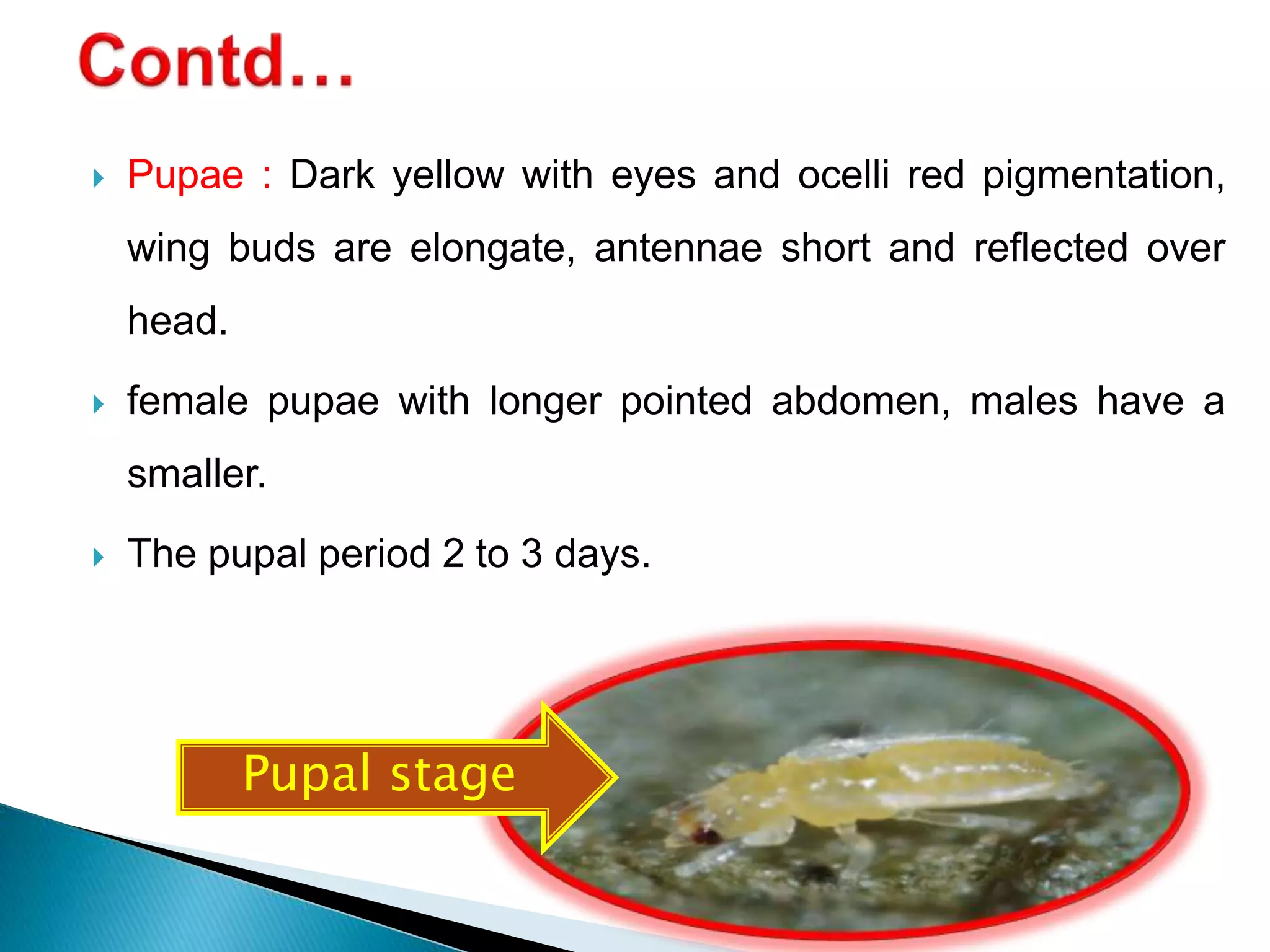
 Pupae : Dark yellow with eyes and ocelli red pigmentation,
wing buds are elongate, antennae short and reflected over
head.
 female pupae with longer pointed abdomen, males have a
smaller.
 The pupal period 2 to 3 days.
Pupal stage
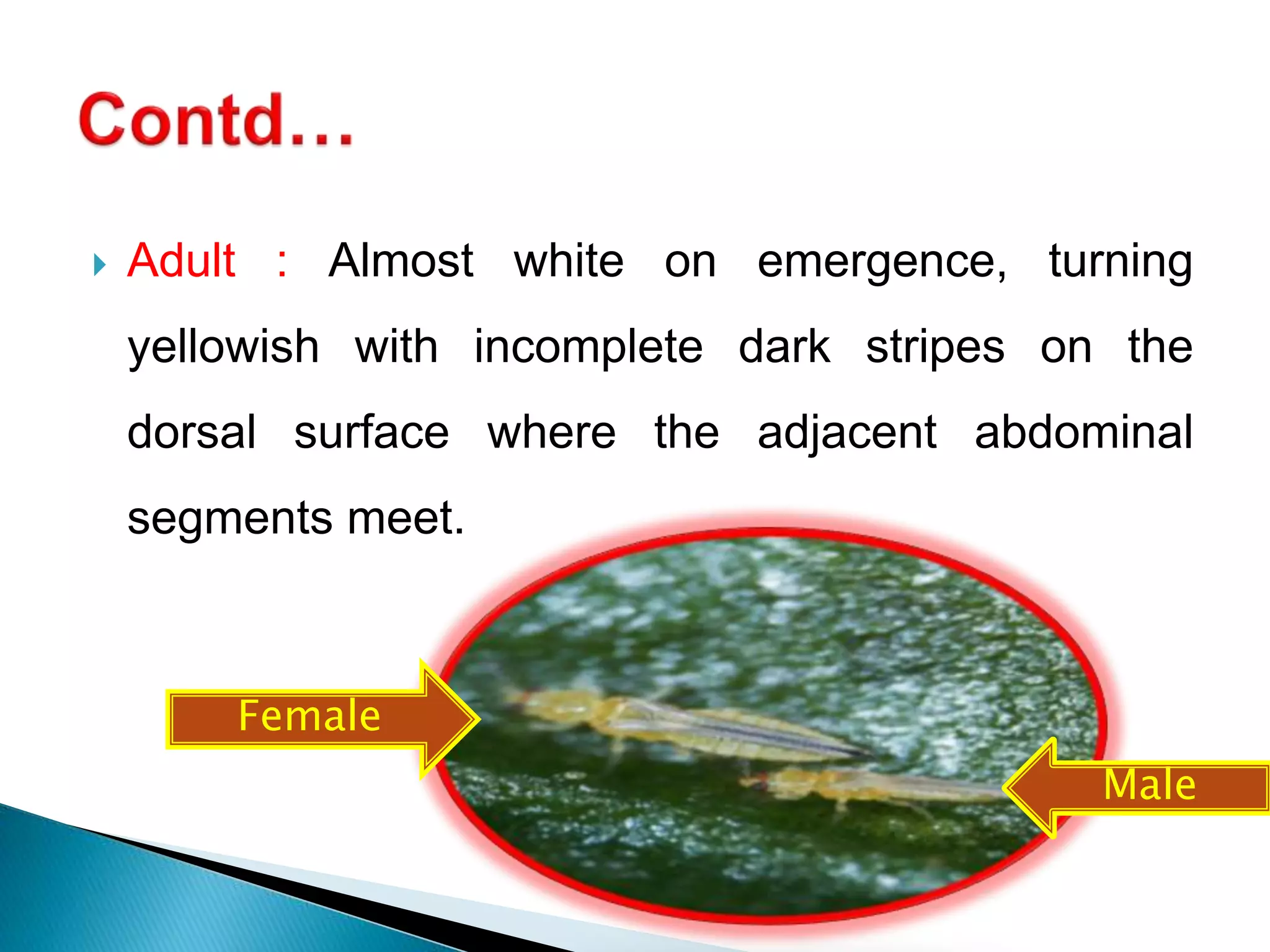
 Adult : Almost white on emergence, turning
yellowish with incomplete dark stripes on the
dorsal surface where the adjacent abdominal
segments meet.
Female
Male
1st Instar
2nd Inster
Adult
 The pest is active during the monsoon season.
 A female lay about 45 to 50 eggs inside the
tissues of the leaves and shoots. eggs hatch in 4-
9 days.
 The larvae start feeding and larval period 4-6
days.
 Pupate at the depth of soil 25 mm. pupal stage 3-6
days.
 complete life cycle in 15-40 days.
 It has many generations in a year.
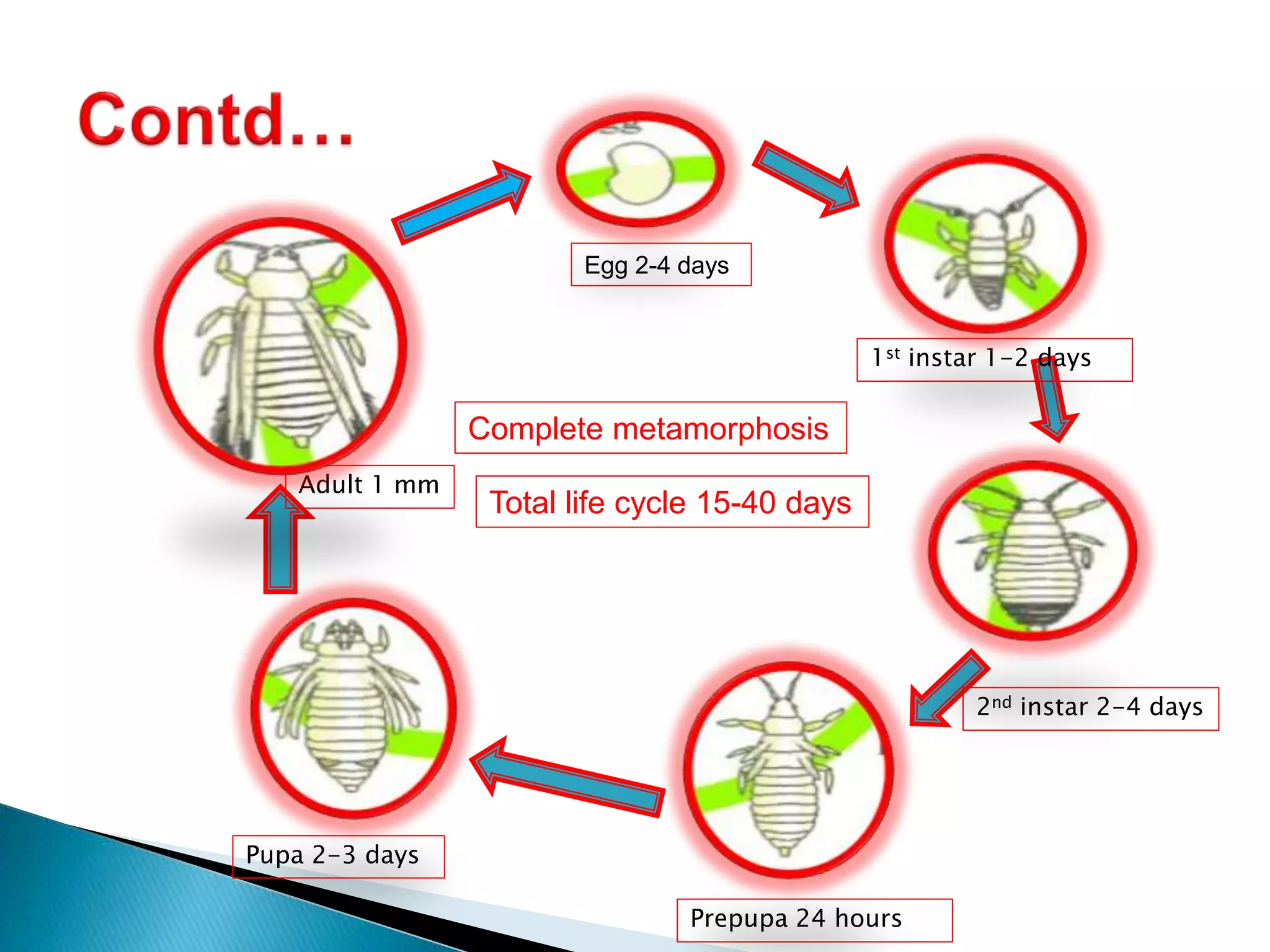
Egg 2-4 days
1st instar 1-2 days
2nd instar 2-4 days
Prepupa 24 hours
Pupa 2-3 days
Adult 1 mm
Total life cycle 15-40 days
Complete metamorphosis
 Chilli thrips attacks all the above ground parts of its host
plants.
 Adult and nymphs of suck the cell sap of leaves buds and
fruits.
 Thrips piercing and sucking mouthparts.
 Chilli thrips create damaging feeding-
 deformed pepper fruits.
 Softening of fruits.
 discolorations of buds.
 rolling of the leaf upward.
 leaf size reduction.
 chilli leaf curl.
Deformed pepper fruit
Pepper leaf curl
Scars on pepper
Premature falling of fruits (softening)
 This species transmits Chilli leaf curl virus (CLCV)
 Tobacco streak virus (TSV) in groundnut crops.
 Watermelon silver mottle virus (WsMoV)
 Melon yellow spot virus (MYSV)
 Capsicum chlorosis virus (CaCV) in field crops.
1) Cultural Method :
 Deep ploughing to expose the pupa from soil.
 Summer soil solarization.
 Use nylon net in nursery to protect seedling from thrips
infestation and reduce leaf curl incidence.
2) Biological control :
 Predatory thrips : Scirtothrips indicus, pirate bugs.
3) Chemical control :
 Melathion 50EC @ 500ml/ha.
 Imidacloprid 17SL @ 6ml/ha.
 Spinosad 45 SC @ 0.015
“Field efficacy of certain botanicals and chemical
insecticides against Chilli thrips on Chilli It was
concluded that among all the treatment Spinosad
0.015% also effective in managing chilli thrips
reduction. Recommended dose of chemicals and
botanicals may be useful in devising proper
integrated pest management against chilli thrips”.
 Amin, B. W. (1979) Leaf fall disease of chilly and pepper in
Maharashtra, India. Pans, 25: 131-134.
 Amin, P. W., Reddy, D. V. R., Ghanekar, A. M. (1981). Transmission of
tomato spotted wilt virus, the causal agent of bud necrosis of peanut, by
Scirtothrips dorsalis and Frankliniella schultzei. Plant Disease 65: 663-
665.
 Ananthakrishnan TN. (1993). Bionomics of thrips. Annual Review of
Entomology 38: 71-92.
 Sanap, M. M. and R. N. Nawale. (1987). Chemical control of chilli
thrips, Scirtothrips dorsalis Hood (Thysanoptera: Thripidae). Vegetable
Science 14(2): 195-199.
THANK YOU

Chilli thrips(RAKESH)

  • 1.
  • 2.
    CREDIT SEMINAR ON CHILLI THRIPS PresentedBy, RAKESH KR. MEENA SAM HIGGINBOTTOM INSTITUTE OF AGRICULTURE, TECHNOLOGY & SCIENCES (Deemed to be University) ALLAHABAD-211007,U.P., INDIA
  • 3.
    Scientific name :Scirtothrips dorsalis Order : Thysanoptera Family : Thripidae
  • 4.
    1. Introduction 2. EconomicImportant 3. Host range 4. Area and Distribution 5. Yield loss 6. ETL 7. Scientific Classification 8. Marks of Identification 9. Life cycle 10. Nature of damage 11. Vector 12. Management
  • 5.
     Thrips causeserious economic losses in many agricultural systems each year including vegetables and ornamentals.  Chilli thrips is a polyphagous pest.  Chilli thrips is a very small 0.5 to 1.2 mm.  Chilli thrips life cycle 4 stages-eggs, larvae, pupa, adult.  pale yellow-colored thrips that can be found feeding on leaves, flowers and fruits.
  • 6.
     Both theadults and nymphs feed on leaf tissue and suck the sap.  Thrips usually feed on the lower surface of leaves.  They are serious pest of chilli and can reduce yield by 30-50%.  They are responsible for transmitting leaf curl disease on chilli. Economic Important
  • 7.
     Chilli thripsis a polyphagous species.  It is a significant pest of chilli pepper, tomato, mango, citrus, castor, bean, cotton, onion, and other crops in tropical and subtropical regions of Asia, Africa and Japan. Minor Host - Okra, Cucumber, Water melon, Pumpkin, Soybean, Bean, Mung bean, Brinjal.
  • 8.
     Asia :Bangladesh, China, India, Indonesia, Japan, Malasia, Myanmar, Pakistan, Phillippines, Sri Lanka, and Thailand.  Africa : South Africa.  North America : United States.  Oceania : Australia, Islands.
  • 9.
    FIGURE - Worldwidedistribution of chilli thrips, Scirtothrips dorsalis Hood, as of September 2009.
  • 10.
     Yield lossesattributable to Scirtothrips dorsalis in chilli have ranged from 20% to nearly 50%.
  • 11.
     3 Nymphsor adult per leaf.  ETL : (Economic threshold level)  The level at which control measure should be undertaken otherwise it will cause significant economic loss.
  • 12.
     Kingdom :Animalia  Phylum : Arthropoda  Class : Insecta  Order : Thysanoptera  Family : Thripidae  Genus : Scirtothrips  Species : dorsalis
  • 13.
     Eggs: Typicallyoval, whitish to yellowish coloured.  Eggs are about 0.075mm long and 0.070 mm wide, and are inserted inside plant tissue.
  • 14.
     Larvae :Two larval stages (first and second instar) 6 to 7 days. The larvae are off-white in colour.
  • 15.
    First instar :transparent, body short, legs longer, antennae short and seven segmented, and cylindrical.
  • 16.
     Second instar: Antennae longer, cylindrical, seven-segmented, mouth longer.
  • 17.
     Pre-pupae :Yellowish, antennae short, two pair of external wing.  The pre-pupal period is short(24 hours).
  • 18.
     Pupae :Dark yellow with eyes and ocelli red pigmentation, wing buds are elongate, antennae short and reflected over head.  female pupae with longer pointed abdomen, males have a smaller.  The pupal period 2 to 3 days. Pupal stage
  • 19.
     Adult :Almost white on emergence, turning yellowish with incomplete dark stripes on the dorsal surface where the adjacent abdominal segments meet. Female Male
  • 20.
  • 21.
     The pestis active during the monsoon season.  A female lay about 45 to 50 eggs inside the tissues of the leaves and shoots. eggs hatch in 4- 9 days.  The larvae start feeding and larval period 4-6 days.  Pupate at the depth of soil 25 mm. pupal stage 3-6 days.  complete life cycle in 15-40 days.  It has many generations in a year.
  • 22.
    Egg 2-4 days 1stinstar 1-2 days 2nd instar 2-4 days Prepupa 24 hours Pupa 2-3 days Adult 1 mm Total life cycle 15-40 days Complete metamorphosis
  • 23.
     Chilli thripsattacks all the above ground parts of its host plants.  Adult and nymphs of suck the cell sap of leaves buds and fruits.  Thrips piercing and sucking mouthparts.  Chilli thrips create damaging feeding-  deformed pepper fruits.  Softening of fruits.  discolorations of buds.  rolling of the leaf upward.  leaf size reduction.  chilli leaf curl.
  • 24.
    Deformed pepper fruit Pepperleaf curl Scars on pepper Premature falling of fruits (softening)
  • 25.
     This speciestransmits Chilli leaf curl virus (CLCV)  Tobacco streak virus (TSV) in groundnut crops.  Watermelon silver mottle virus (WsMoV)  Melon yellow spot virus (MYSV)  Capsicum chlorosis virus (CaCV) in field crops.
  • 26.
    1) Cultural Method:  Deep ploughing to expose the pupa from soil.  Summer soil solarization.  Use nylon net in nursery to protect seedling from thrips infestation and reduce leaf curl incidence. 2) Biological control :  Predatory thrips : Scirtothrips indicus, pirate bugs. 3) Chemical control :  Melathion 50EC @ 500ml/ha.  Imidacloprid 17SL @ 6ml/ha.  Spinosad 45 SC @ 0.015
  • 27.
    “Field efficacy ofcertain botanicals and chemical insecticides against Chilli thrips on Chilli It was concluded that among all the treatment Spinosad 0.015% also effective in managing chilli thrips reduction. Recommended dose of chemicals and botanicals may be useful in devising proper integrated pest management against chilli thrips”.
  • 28.
     Amin, B.W. (1979) Leaf fall disease of chilly and pepper in Maharashtra, India. Pans, 25: 131-134.  Amin, P. W., Reddy, D. V. R., Ghanekar, A. M. (1981). Transmission of tomato spotted wilt virus, the causal agent of bud necrosis of peanut, by Scirtothrips dorsalis and Frankliniella schultzei. Plant Disease 65: 663- 665.  Ananthakrishnan TN. (1993). Bionomics of thrips. Annual Review of Entomology 38: 71-92.  Sanap, M. M. and R. N. Nawale. (1987). Chemical control of chilli thrips, Scirtothrips dorsalis Hood (Thysanoptera: Thripidae). Vegetable Science 14(2): 195-199.
  • 29.