





New Restricted Use Insecticide Choices 
in 
Peanuts, Vegetables 
Dr. Ayanava Majumdar (Dr. A) 
Ext. Entomologist & 
State SARE Coordinator 
Auburn, AL 36849 
Tel: (251) 331-8416 
bugdoctor@auburn.edu 
Pesticide Dealer Meetings, Nov 2014
What is IPM? 
• “Integrated pest management (IPM) is a threshold 
based decision management system which leads to 
judicious use of multiple pest control tactics.” 
• IPM is currently insecticide-intensive… 
• Major losses occur due to: 
• Lack of early detection of insects 
• Insecticide resistance by misuse 
• Loss of natural control with insecticides
Decision making in IPM… 
• Insect detection & monitoring 
• Insect identification 
• Population pressure 
• Economic threshold 
• Make treatment decision 
• Choosing right insecticide
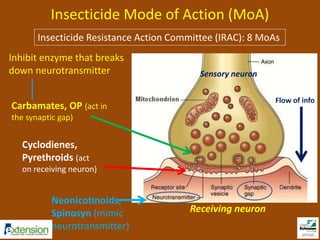
Insecticide Mode of Action (MoA) 
Insecticide Resistance Action Committee (IRAC): 8 MoAs 
Sensory neuron 
Receiving neuron 
Inhibit enzyme that breaks 
down neurotransmitter 
Carbamates, OP (act in 
the synaptic gap) 
Cyclodienes, 
Pyrethroids (act 
on receiving neuron) 
Neonicotinoids, 
Spinosyn (mimic 
neurotransmitter) 
Flow of info
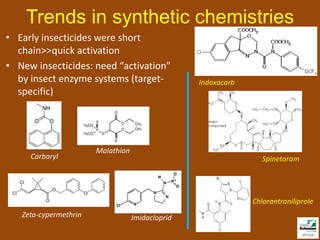
Trends in synthetic chemistries 
• Early insecticides were short 
chain>>quick activation 
• New insecticides: need “activation” 
by insect enzyme systems (target-specific) 
Carbaryl 
Malathion 
Zeta-cypermethrin Imidacloprid 
Spinetoram 
Chlorantraniliprole 
Indoxacarb
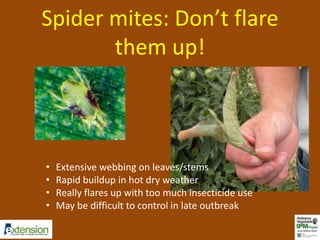
Spider mites: Don’t flare 
them up! 
• Extensive webbing on leaves/stems 
• Rapid buildup in hot dry weather 
• Really flares up with too much insecticide use 
• May be difficult to control in late outbreak
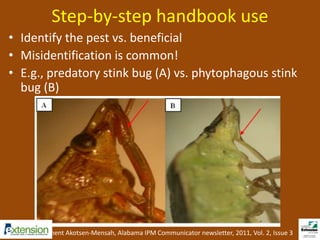
Step-by-step handbook use 
• Identify the pest vs. beneficial 
• Misidentification is common! 
• E.g., predatory stink bug (A) vs. phytophagous stink 
bug (B) 
Source: Clement Akotsen-Mensah, Alabama IPM Communicator newsletter, 2011, Vol. 2, Issue 3
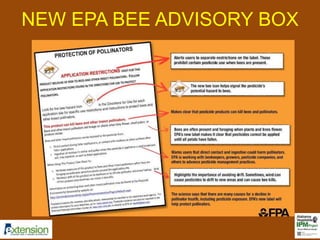
NEW EPA BEE ADVISORY BOX
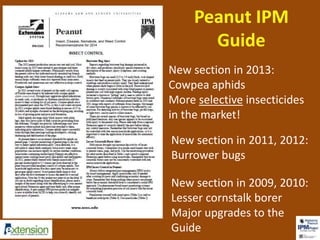
Peanut IPM 
Guide 
New section in 2013: 
Cowpea aphids 
More selective insecticides 
in the market! 
New section in 2011, 2012: 
Burrower bugs 
New section in 2009, 2010: 
Lesser cornstalk borer 
Major upgrades to the 
Guide
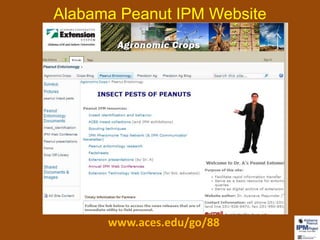
Alabama Peanut IPM Website 
www.aces.edu/go/88
LIKE ‘Peanut IPM’ on Facebook! 
Advantages: Live updates, chat with researchers, 
videos and photos, IPM contest
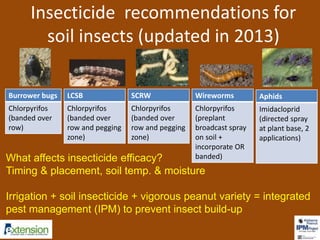
Insecticide recommendations for 
soil insects (updated in 2013) 
LCSB 
Chlorpyrifos 
(banded over 
row and pegging 
zone) 
SCRW 
Chlorpyrifos 
(banded over 
row and pegging 
zone) 
Wireworms 
Chlorpyrifos 
(preplant 
broadcast spray 
on soil + 
incorporate OR 
Burrower bugs 
Chlorpyrifos 
(banded over 
row) 
What affects insecticide efficacy? banded) 
Timing & placement, soil temp. & moisture 
Aphids 
Imidacloprid 
(directed spray 
at plant base, 2 
applications) 
Irrigation + soil insecticide + vigorous peanut variety = integrated 
pest management (IPM) to prevent insect build-up
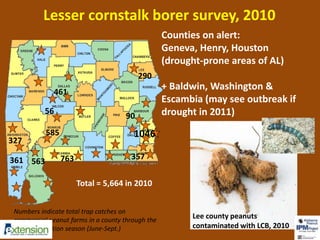
Lesser cornstalk borer survey, 2010 
Counties on alert: 
Geneva, Henry, Houston 
(drought-prone areas of AL) 
+ Baldwin, Washington & 
Escambia (may see outbreak if 
drought in 2011) 
461 
56 
327 
585 
361 563 763 
290 
90 
1046 
357 
Total = 5,664 in 2010 
Numbers indicate total trap catches on 
commercial peanut farms in a county through the 
entire production season (June-Sept.) 
Lee county peanuts 
contaminated with LCB, 2010
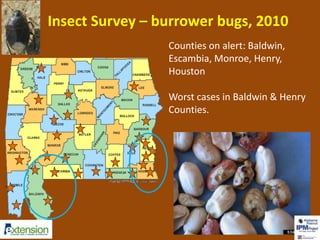
Insect Survey – burrower bugs, 2010 
Counties on alert: Baldwin, 
Escambia, Monroe, Henry, 
Houston 
Worst cases in Baldwin & Henry 
Counties.
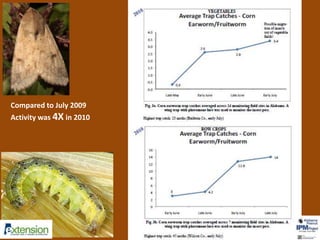
Compared to July 2009 
Activity was 4X in 2010
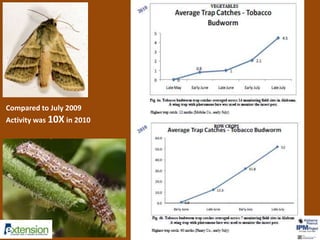
Compared to July 2009 
Activity was 10X in 2010
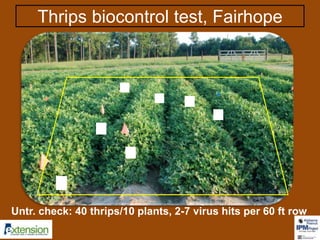
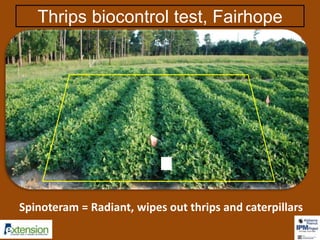
Thrips biocontrol test, Fairhope 
1 
2 
3 
4 
5 
6 
7 
Untr. check: 40 thrips/10 plants, 2-7 virus hits per 60 ft row
Thrips biocontrol test, Fairhope 
1 
Spinoteram = Radiant, wipes out thrips and caterpillars
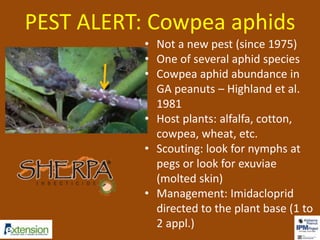
PEST ALERT: Cowpea aphids 
• Not a new pest (since 1975) 
• One of several aphid species 
• Cowpea aphid abundance in 
GA peanuts – Highland et al. 
1981 
• Host plants: alfalfa, cotton, 
cowpea, wheat, etc. 
• Scouting: look for nymphs at 
pegs or look for exuviae 
(molted skin) 
• Management: Imidacloprid 
directed to the plant base (1 to 
2 appl.)
Reference for this talk: 
2013 SE Vegetable Production Handbook 
Download at 
http://www.thegrower.com/so 
uth-east-vegetable-guide/
New Extension Resources 
Coming in print in November 2014
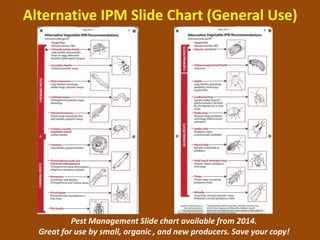
Alternative IPM Slide Chart (General Use) 
Pest Management Slide chart available from 2014. 
Great for use by small, organic , and new producers. Save your copy!
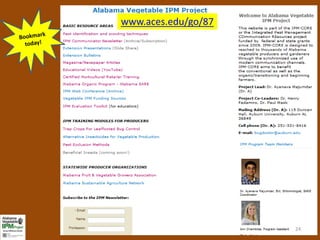
www.aces.edu/go/87 
24
Join Vegetable IPM on Facebook! 
Advantages: Rapid pest alerts, interactive, insect ID 
photos and videos, success stories, IPM contest
The Alabama IPM Communicator Newsletter 
Online edition or Printable file 
TO SUBSCRIBE VISIT WWW.ACES.EDU/IPMCOMMUNICATOR AND 
CLICK ON SUBSCRIBE TAB.
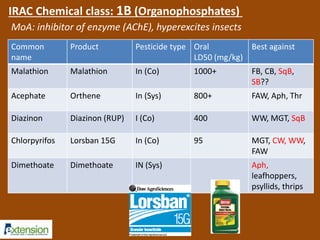
Common 
name 
Product Pesticide type Oral 
LD50 (mg/kg) 
Best against 
Malathion Malathion In (Co) 1000+ FB, CB, SqB, 
SB?? 
Acephate Orthene In (Sys) 800+ FAW, Aph, Thr 
Diazinon Diazinon (RUP) I (Co) 400 WW, MGT, SqB 
Chlorpyrifos Lorsban 15G In (Co) 95 MGT, CW, WW, 
FAW 
Dimethoate Dimethoate IN (Sys) Aph, 
leafhoppers, 
psyllids, thrips 
IRAC Chemical class: 1B (Organophosphates) 
MoA: inhibitor of enzyme (AChE), hyperexcites insects
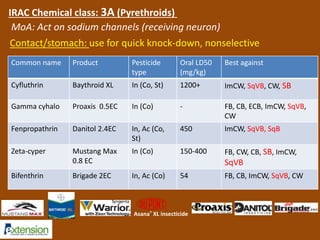
IRAC Chemical class: 3A (Pyrethroids) 
MoA: Act on sodium channels (receiving neuron) 
Contact/stomach: use for quick knock-down, nonselective 
Common name Product Pesticide 
type 
Oral LD50 
(mg/kg) 
Best against 
Cyfluthrin Baythroid XL In (Co, St) 1200+ ImCW, SqVB, CW, SB 
Gamma cyhalo Proaxis 0.5EC In (Co) - FB, CB, ECB, ImCW, SqVB, 
CW 
Fenpropathrin Danitol 2.4EC In, Ac (Co, 
St) 
450 ImCW, SqVB, SqB 
Zeta-cyper Mustang Max 
0.8 EC 
In (Co) 150-400 FB, CW, CB, SB, ImCW, 
SqVB 
Bifenthrin Brigade 2EC In, Ac (Co) 54 FB, CB, ImCW, SqVB, CW 
Asana® XL insecticide
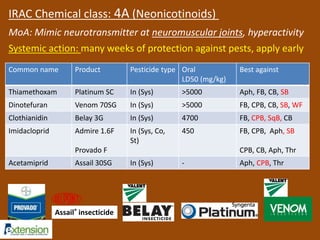
IRAC Chemical class: 4A (Neonicotinoids) 
MoA: Mimic neurotransmitter at neuromuscular joints, hyperactivity 
Systemic action: many weeks of protection against pests, apply early 
Common name Product Pesticide type Oral 
LD50 (mg/kg) 
Best against 
Thiamethoxam Platinum SC In (Sys) >5000 Aph, FB, CB, SB 
Dinotefuran Venom 70SG In (Sys) >5000 FB, CPB, CB, SB, WF 
Clothianidin Belay 3G In (Sys) 4700 FB, CPB, SqB, CB 
Imidacloprid Admire 1.6F 
Provado F 
In (Sys, Co, 
St) 
450 FB, CPB, Aph, SB 
CPB, CB, Aph, Thr 
Acetamiprid Assail 30SG In (Sys) - Aph, CPB, Thr 
Assail® insecticide
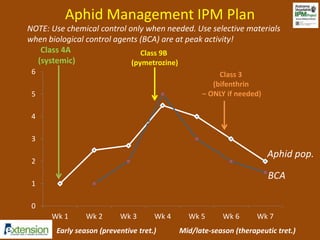
Aphid Management IPM Plan 
NOTE: Use chemical control only when needed. Use selective materials 
when biological control agents (BCA) are at peak activity! 
6 
5 
4 
3 
2 
1 
0 
Class 4A 
(systemic) 
Aphid pop. 
Wk 1 Wk 2 Wk 3 Wk 4 Wk 5 Wk 6 Wk 7 
Early season (preventive tret.) 
Mid/late-season (therapeutic tret.) 
Class 9B 
(pymetrozine) 
Class 3 
(bifenthrin 
– ONLY if needed) 
BCA
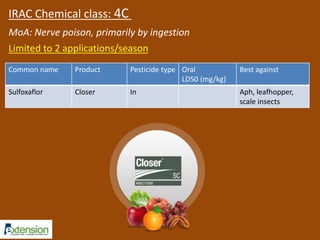
Common name Product Pesticide type Oral 
LD50 (mg/kg) 
Best against 
Sulfoxaflor Closer In Aph, leafhopper, 
scale insects 
IRAC Chemical class: 4C 
MoA: Nerve poison, primarily by ingestion 
Limited to 2 applications/season
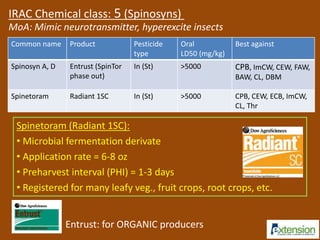
Common name Product Pesticide 
type 
Oral 
LD50 (mg/kg) 
Best against 
Spinosyn A, D Entrust (SpinTor 
phase out) 
In (St) >5000 CPB, ImCW, CEW, FAW, 
BAW, CL, DBM 
Spinetoram Radiant 1SC In (St) >5000 CPB, CEW, ECB, ImCW, 
CL, Thr 
IRAC Chemical class: 5 (Spinosyns) 
MoA: Mimic neurotransmitter, hyperexcite insects 
Spinetoram (Radiant 1SC): 
• Microbial fermentation derivate 
• Application rate = 6-8 oz 
• Preharvest interval (PHI) = 1-3 days 
• Registered for many leafy veg., fruit crops, root crops, etc. 
Entrust: for ORGANIC producers
Growth Regulator Insecticides 
IRAC Chemical class: 7C, 16, 17, 18 
Common name Product Pesticide 
type 
Oral 
LD50 (mg/kg) 
Best against Less effective 
Methoxyfenozide Intrepid 2F I (Co) >5000 CL, FAW, ImCW DBM, SqVB 
Buprofezin Courier I, Mi (Co) >5000 WF 
Pyriproxifen Knack I (Co) >5000 WF 
Growth regulators: 
• Methoxyfenozide forces molting, long-lasting, 
4-10 oz, 1 day PHI 
• Buprofezin inhibits chitin biosynthesis 
(homopteran), 9-13 oz, 7 day PHI 
• Pyriproxifen mimics juvenile hormone 
(homop.), 8-10 oz, 14 day PHI
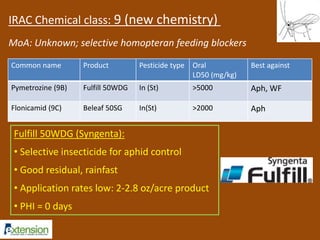
IRAC Chemical class: 9 (new chemistry) 
MoA: Unknown; selective homopteran feeding blockers 
Common name Product Pesticide type Oral 
LD50 (mg/kg) 
Best against 
Pymetrozine (9B) Fulfill 50WDG In (St) >5000 Aph, WF 
Flonicamid (9C) Beleaf 50SG In(St) >2000 Aph 
Fulfill 50WDG (Syngenta): 
• Selective insecticide for aphid control 
• Good residual, rainfast 
• Application rates low: 2-2.8 oz/acre product 
• PHI = 0 days
Novaluron (IGR, Chitin Inhibitor) 
• Group 15 insecticide 
• Application rate: 9 to 12 fl oz/A 
• Stops chitin production in caterpillar pests 
• Has ovi-larvicidal action 
• 1 d PHI in tomato, okra, sweetpotato, potato
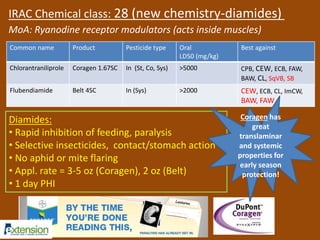
IRAC Chemical class: 28 (new chemistry-diamides) 
MoA: Ryanodine receptor modulators (acts inside muscles) 
Common name Product Pesticide type Oral 
LD50 (mg/kg) 
Best against 
Chlorantraniliprole Coragen 1.67SC In (St, Co, Sys) >5000 CPB, CEW, ECB, FAW, 
BAW, CL, SqVB, SB 
Flubendiamide Belt 4SC In (Sys) >2000 CEW, ECB, CL, ImCW, 
BAW, FAW 
Diamides: 
• Rapid inhibition of feeding, paralysis 
• Selective insecticides, contact/stomach action 
• No aphid or mite flaring 
• Appl. rate = 3-5 oz (Coragen), 2 oz (Belt) 
• 1 day PHI 
Coragen has 
great 
translaminar 
and systemic 
properties for 
early season 
protection!
Spider mite management 
CAUTION: Many synthetic pyrethroids can flare up spider mites by 
removing predatory mites and other beneficial insects. 
Abamectin (AgriMek, 8-16 fl oz/acre): 
• Good rescue insecticide (may get some thrips) 
• Contains synthetic abamectin and provides long-term 
residual control of TSM. 
• Do not apply more than two sequential applications of 
abamectin. 
• PHI on tomatoes is 7 days.
Spider mite management 
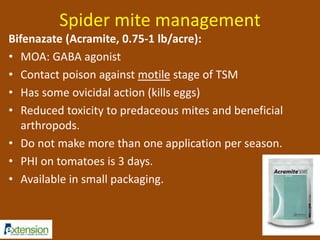
Bifenazate (Acramite, 0.75-1 lb/acre): 
• MOA: GABA agonist 
• Contact poison against motile stage of TSM 
• Has some ovicidal action (kills eggs) 
• Reduced toxicity to predaceous mites and beneficial 
arthropods. 
• Do not make more than one application per season. 
• PHI on tomatoes is 3 days. 
• Available in small packaging.
Spider mite management 
Fenpyroximate (Portal, 2 pts/acre): 
• Mitochondrial electron transport inhibitor 
(METI), blocking cellular respiration 
• Stops mite feeding & egg laying, 7 days to kill 
• Good late season rescue insecticide 
• Limit to one application per year 
• Softer on predatory mites 
• Complete coverage essential
Spider mite management 
Etoxazole (Zeal, 2 to 3 oz/acre): 
• Good contact miticide but not labeled on 
many crops 
• Kills eggs and stops molting of immatures 
• Sterilize adults 
• Has translaminar movement 
• Could take several days to act
(Boring?) 
Data Slides 
But pictures 
can make it 
interesting!!
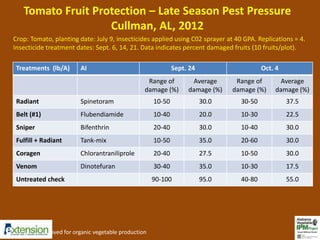
Tomato Fruit Protection – Late Season Pest Pressure 
Cullman, AL, 2012 
Crop: Tomato, planting date: July 9, insecticides applied using C02 sprayer at 40 GPA. Replications = 4. 
Insecticide treatment dates: Sept. 6, 14, 21. Data indicates percent damaged fruits (10 fruits/plot). 
Treatments (lb/A) AI Sept. 24 Oct. 4 
Range of 
damage (%) 
Average 
damage (%) 
Range of 
damage (%) 
Average 
damage (%) 
Radiant Spinetoram 10-50 30.0 30-50 37.5 
Belt (#1) Flubendiamide 10-40 20.0 10-30 22.5 
Sniper Bifenthrin 20-40 30.0 10-40 30.0 
Fulfill + Radiant Tank-mix 10-50 35.0 20-60 30.0 
Coragen Chlorantraniliprole 20-40 27.5 10-50 30.0 
Venom Dinotefuran 30-40 35.0 10-30 17.5 
Untreated check 90-100 95.0 40-80 55.0 
*OMRI-approved for organic vegetable production
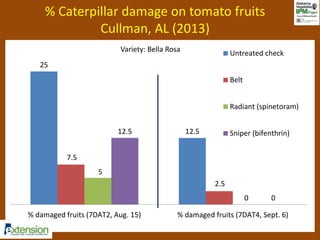
% Caterpillar damage on tomato fruits 
Cullman, AL (2013) 
25 
12.5 
7.5 
2.5 
5 
Untreated check 
Radiant (spinetoram) 
Sniper (bifenthrin) 
0 
Variety: Bella Rosa 
12.5 
0 
Belt 
% damaged fruits (7DAT2, Aug. 15) % damaged fruits (7DAT4, Sept. 6)
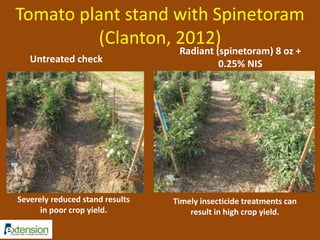
Tomato plant stand with Spinetoram 
(Clanton, 2012) 
Untreated check 
Radiant (spinetoram) 8 oz + 
0.25% NIS 
Severely reduced stand results 
in poor crop yield. 
Timely insecticide treatments can 
result in high crop yield.
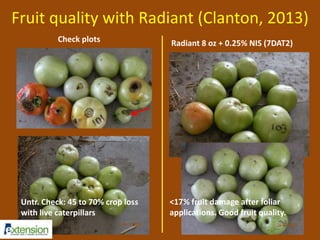
Fruit quality with Radiant (Clanton, 2013) 
Check plots Radiant 8 oz + 0.25% NIS (7DAT2) 
Untr. Check: 45 to 70% crop loss 
with live caterpillars 
<17% fruit damage after foliar 
applications. Good fruit quality.
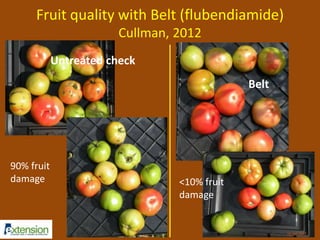
Fruit quality with Belt (flubendiamide) 
Cullman, 2012 
Untreated check 
Belt 
90% fruit 
damage <10% fruit 
damage
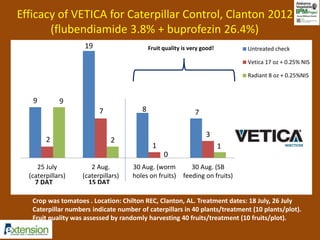
Efficacy of VETICA for Caterpillar Control, Clanton 2012 
(flubendiamide 3.8% + buprofezin 26.4%) 
9 
19 
8 7 
2 
7 
1 
3 
9 
2 
0 
1 
25 July 
(caterpillars) 
2 Aug. 
(caterpillars) 
30 Aug. (worm 
holes on fruits) 
30 Aug. (SB 
feeding on fruits) 
Untreated check 
Vetica 17 oz + 0.25% NIS 
Radiant 8 oz + 0.25%NIS 
7 DAT 15 DAT 
Fruit quality is very good! 
Crop was tomatoes . Location: Chilton REC, Clanton, AL. Treatment dates: 18 July, 26 July 
Caterpillar numbers indicate number of caterpillars in 40 plants/treatment (10 plants/plot). 
Fruit quality was assessed by randomly harvesting 40 fruits/treatment (10 fruits/plot).
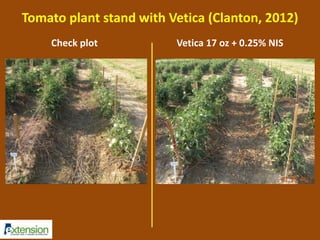
Tomato plant stand with Vetica (Clanton, 2012) 
Check plot Vetica 17 oz + 0.25% NIS
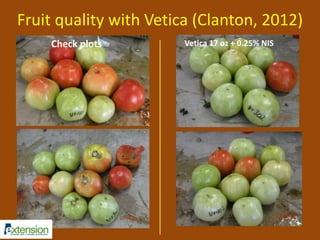
Fruit quality with Vetica (Clanton, 2012) 
Check plots Vetica 17 oz + 0.25% NIS
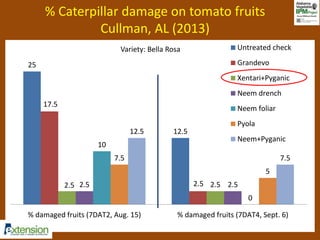
% Caterpillar damage on tomato fruits 
Cullman, AL (2013) 
25 
Variety: Bella Rosa 
12.5 
17.5 
10 
Untreated check 
Grandevo 
Xentari+Pyganic 
Neem drench 
Neem foliar 
Pyola 
Neem+Pyganic 
2.5 2.5 2.5 2.5 2.5 
0 
7.5 
5 
12.5 
7.5 
% damaged fruits (7DAT2, Aug. 15) % damaged fruits (7DAT4, Sept. 6)
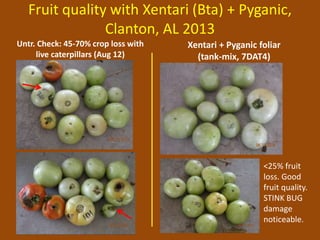
Fruit quality with Xentari (Bta) + Pyganic, 
Clanton, AL 2013 
Xentari + Pyganic foliar 
(tank-mix, 7DAT4) 
Untr. Check: 45-70% crop loss with 
live caterpillars (Aug 12) 
<25% fruit 
loss. Good 
fruit quality. 
STINK BUG 
damage 
noticeable.
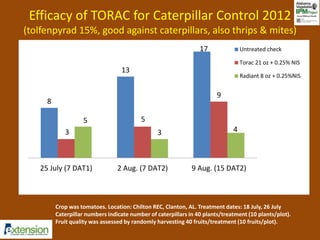
Efficacy of TORAC for Caterpillar Control 2012 
(tolfenpyrad 15%, good against caterpillars, also thrips & mites) 
8 
13 
17 
3 
5 
9 
5 
3 4 
Untreated check 
Torac 21 oz + 0.25% NIS 
Radiant 8 oz + 0.25%NIS 
25 July (7 DAT1) 2 Aug. (7 DAT2) 9 Aug. (15 DAT2) 
Crop was tomatoes. Location: Chilton REC, Clanton, AL. Treatment dates: 18 July, 26 July 
Caterpillar numbers indicate number of caterpillars in 40 plants/treatment (10 plants/plot). 
Fruit quality was assessed by randomly harvesting 40 fruits/treatment (10 fruits/plot).

Restricted Use Insecticides in Peanuts and Vegetables

  • 1.
    New Restricted UseInsecticide Choices in Peanuts, Vegetables Dr. Ayanava Majumdar (Dr. A) Ext. Entomologist & State SARE Coordinator Auburn, AL 36849 Tel: (251) 331-8416 bugdoctor@auburn.edu Pesticide Dealer Meetings, Nov 2014
  • 2.
    What is IPM? • “Integrated pest management (IPM) is a threshold based decision management system which leads to judicious use of multiple pest control tactics.” • IPM is currently insecticide-intensive… • Major losses occur due to: • Lack of early detection of insects • Insecticide resistance by misuse • Loss of natural control with insecticides
  • 3.
    Decision making inIPM… • Insect detection & monitoring • Insect identification • Population pressure • Economic threshold • Make treatment decision • Choosing right insecticide
  • 4.
    Insecticide Mode ofAction (MoA) Insecticide Resistance Action Committee (IRAC): 8 MoAs Sensory neuron Receiving neuron Inhibit enzyme that breaks down neurotransmitter Carbamates, OP (act in the synaptic gap) Cyclodienes, Pyrethroids (act on receiving neuron) Neonicotinoids, Spinosyn (mimic neurotransmitter) Flow of info
  • 5.
    Trends in syntheticchemistries • Early insecticides were short chain>>quick activation • New insecticides: need “activation” by insect enzyme systems (target-specific) Carbaryl Malathion Zeta-cypermethrin Imidacloprid Spinetoram Chlorantraniliprole Indoxacarb
  • 6.
    Spider mites: Don’tflare them up! • Extensive webbing on leaves/stems • Rapid buildup in hot dry weather • Really flares up with too much insecticide use • May be difficult to control in late outbreak
  • 7.
    Step-by-step handbook use • Identify the pest vs. beneficial • Misidentification is common! • E.g., predatory stink bug (A) vs. phytophagous stink bug (B) Source: Clement Akotsen-Mensah, Alabama IPM Communicator newsletter, 2011, Vol. 2, Issue 3
  • 8.
    NEW EPA BEEADVISORY BOX
  • 9.
    Peanut IPM Guide New section in 2013: Cowpea aphids More selective insecticides in the market! New section in 2011, 2012: Burrower bugs New section in 2009, 2010: Lesser cornstalk borer Major upgrades to the Guide
  • 10.
    Alabama Peanut IPMWebsite www.aces.edu/go/88
  • 12.
    LIKE ‘Peanut IPM’on Facebook! Advantages: Live updates, chat with researchers, videos and photos, IPM contest
  • 13.
    Insecticide recommendations for soil insects (updated in 2013) LCSB Chlorpyrifos (banded over row and pegging zone) SCRW Chlorpyrifos (banded over row and pegging zone) Wireworms Chlorpyrifos (preplant broadcast spray on soil + incorporate OR Burrower bugs Chlorpyrifos (banded over row) What affects insecticide efficacy? banded) Timing & placement, soil temp. & moisture Aphids Imidacloprid (directed spray at plant base, 2 applications) Irrigation + soil insecticide + vigorous peanut variety = integrated pest management (IPM) to prevent insect build-up
  • 14.
    Lesser cornstalk borersurvey, 2010 Counties on alert: Geneva, Henry, Houston (drought-prone areas of AL) + Baldwin, Washington & Escambia (may see outbreak if drought in 2011) 461 56 327 585 361 563 763 290 90 1046 357 Total = 5,664 in 2010 Numbers indicate total trap catches on commercial peanut farms in a county through the entire production season (June-Sept.) Lee county peanuts contaminated with LCB, 2010
  • 15.
    Insect Survey –burrower bugs, 2010 Counties on alert: Baldwin, Escambia, Monroe, Henry, Houston Worst cases in Baldwin & Henry Counties.
  • 16.
    Compared to July2009 Activity was 4X in 2010
  • 17.
    Compared to July2009 Activity was 10X in 2010
  • 18.
    Thrips biocontrol test,Fairhope 1 2 3 4 5 6 7 Untr. check: 40 thrips/10 plants, 2-7 virus hits per 60 ft row
  • 19.
    Thrips biocontrol test,Fairhope 1 Spinoteram = Radiant, wipes out thrips and caterpillars
  • 20.
    PEST ALERT: Cowpeaaphids • Not a new pest (since 1975) • One of several aphid species • Cowpea aphid abundance in GA peanuts – Highland et al. 1981 • Host plants: alfalfa, cotton, cowpea, wheat, etc. • Scouting: look for nymphs at pegs or look for exuviae (molted skin) • Management: Imidacloprid directed to the plant base (1 to 2 appl.)
  • 21.
    Reference for thistalk: 2013 SE Vegetable Production Handbook Download at http://www.thegrower.com/so uth-east-vegetable-guide/
  • 22.
    New Extension Resources Coming in print in November 2014
  • 23.
    Alternative IPM SlideChart (General Use) Pest Management Slide chart available from 2014. Great for use by small, organic , and new producers. Save your copy!
  • 24.
  • 25.
    Join Vegetable IPMon Facebook! Advantages: Rapid pest alerts, interactive, insect ID photos and videos, success stories, IPM contest
  • 26.
    The Alabama IPMCommunicator Newsletter Online edition or Printable file TO SUBSCRIBE VISIT WWW.ACES.EDU/IPMCOMMUNICATOR AND CLICK ON SUBSCRIBE TAB.
  • 27.
    Common name ProductPesticide type Oral LD50 (mg/kg) Best against Malathion Malathion In (Co) 1000+ FB, CB, SqB, SB?? Acephate Orthene In (Sys) 800+ FAW, Aph, Thr Diazinon Diazinon (RUP) I (Co) 400 WW, MGT, SqB Chlorpyrifos Lorsban 15G In (Co) 95 MGT, CW, WW, FAW Dimethoate Dimethoate IN (Sys) Aph, leafhoppers, psyllids, thrips IRAC Chemical class: 1B (Organophosphates) MoA: inhibitor of enzyme (AChE), hyperexcites insects
  • 28.
    IRAC Chemical class:3A (Pyrethroids) MoA: Act on sodium channels (receiving neuron) Contact/stomach: use for quick knock-down, nonselective Common name Product Pesticide type Oral LD50 (mg/kg) Best against Cyfluthrin Baythroid XL In (Co, St) 1200+ ImCW, SqVB, CW, SB Gamma cyhalo Proaxis 0.5EC In (Co) - FB, CB, ECB, ImCW, SqVB, CW Fenpropathrin Danitol 2.4EC In, Ac (Co, St) 450 ImCW, SqVB, SqB Zeta-cyper Mustang Max 0.8 EC In (Co) 150-400 FB, CW, CB, SB, ImCW, SqVB Bifenthrin Brigade 2EC In, Ac (Co) 54 FB, CB, ImCW, SqVB, CW Asana® XL insecticide
  • 29.
    IRAC Chemical class:4A (Neonicotinoids) MoA: Mimic neurotransmitter at neuromuscular joints, hyperactivity Systemic action: many weeks of protection against pests, apply early Common name Product Pesticide type Oral LD50 (mg/kg) Best against Thiamethoxam Platinum SC In (Sys) >5000 Aph, FB, CB, SB Dinotefuran Venom 70SG In (Sys) >5000 FB, CPB, CB, SB, WF Clothianidin Belay 3G In (Sys) 4700 FB, CPB, SqB, CB Imidacloprid Admire 1.6F Provado F In (Sys, Co, St) 450 FB, CPB, Aph, SB CPB, CB, Aph, Thr Acetamiprid Assail 30SG In (Sys) - Aph, CPB, Thr Assail® insecticide
  • 30.
    Aphid Management IPMPlan NOTE: Use chemical control only when needed. Use selective materials when biological control agents (BCA) are at peak activity! 6 5 4 3 2 1 0 Class 4A (systemic) Aphid pop. Wk 1 Wk 2 Wk 3 Wk 4 Wk 5 Wk 6 Wk 7 Early season (preventive tret.) Mid/late-season (therapeutic tret.) Class 9B (pymetrozine) Class 3 (bifenthrin – ONLY if needed) BCA
  • 31.
    Common name ProductPesticide type Oral LD50 (mg/kg) Best against Sulfoxaflor Closer In Aph, leafhopper, scale insects IRAC Chemical class: 4C MoA: Nerve poison, primarily by ingestion Limited to 2 applications/season
  • 32.
    Common name ProductPesticide type Oral LD50 (mg/kg) Best against Spinosyn A, D Entrust (SpinTor phase out) In (St) >5000 CPB, ImCW, CEW, FAW, BAW, CL, DBM Spinetoram Radiant 1SC In (St) >5000 CPB, CEW, ECB, ImCW, CL, Thr IRAC Chemical class: 5 (Spinosyns) MoA: Mimic neurotransmitter, hyperexcite insects Spinetoram (Radiant 1SC): • Microbial fermentation derivate • Application rate = 6-8 oz • Preharvest interval (PHI) = 1-3 days • Registered for many leafy veg., fruit crops, root crops, etc. Entrust: for ORGANIC producers
  • 33.
    Growth Regulator Insecticides IRAC Chemical class: 7C, 16, 17, 18 Common name Product Pesticide type Oral LD50 (mg/kg) Best against Less effective Methoxyfenozide Intrepid 2F I (Co) >5000 CL, FAW, ImCW DBM, SqVB Buprofezin Courier I, Mi (Co) >5000 WF Pyriproxifen Knack I (Co) >5000 WF Growth regulators: • Methoxyfenozide forces molting, long-lasting, 4-10 oz, 1 day PHI • Buprofezin inhibits chitin biosynthesis (homopteran), 9-13 oz, 7 day PHI • Pyriproxifen mimics juvenile hormone (homop.), 8-10 oz, 14 day PHI
  • 34.
    IRAC Chemical class:9 (new chemistry) MoA: Unknown; selective homopteran feeding blockers Common name Product Pesticide type Oral LD50 (mg/kg) Best against Pymetrozine (9B) Fulfill 50WDG In (St) >5000 Aph, WF Flonicamid (9C) Beleaf 50SG In(St) >2000 Aph Fulfill 50WDG (Syngenta): • Selective insecticide for aphid control • Good residual, rainfast • Application rates low: 2-2.8 oz/acre product • PHI = 0 days
  • 35.
    Novaluron (IGR, ChitinInhibitor) • Group 15 insecticide • Application rate: 9 to 12 fl oz/A • Stops chitin production in caterpillar pests • Has ovi-larvicidal action • 1 d PHI in tomato, okra, sweetpotato, potato
  • 36.
    IRAC Chemical class:28 (new chemistry-diamides) MoA: Ryanodine receptor modulators (acts inside muscles) Common name Product Pesticide type Oral LD50 (mg/kg) Best against Chlorantraniliprole Coragen 1.67SC In (St, Co, Sys) >5000 CPB, CEW, ECB, FAW, BAW, CL, SqVB, SB Flubendiamide Belt 4SC In (Sys) >2000 CEW, ECB, CL, ImCW, BAW, FAW Diamides: • Rapid inhibition of feeding, paralysis • Selective insecticides, contact/stomach action • No aphid or mite flaring • Appl. rate = 3-5 oz (Coragen), 2 oz (Belt) • 1 day PHI Coragen has great translaminar and systemic properties for early season protection!
  • 37.
    Spider mite management CAUTION: Many synthetic pyrethroids can flare up spider mites by removing predatory mites and other beneficial insects. Abamectin (AgriMek, 8-16 fl oz/acre): • Good rescue insecticide (may get some thrips) • Contains synthetic abamectin and provides long-term residual control of TSM. • Do not apply more than two sequential applications of abamectin. • PHI on tomatoes is 7 days.
  • 38.
    Spider mite management Bifenazate (Acramite, 0.75-1 lb/acre): • MOA: GABA agonist • Contact poison against motile stage of TSM • Has some ovicidal action (kills eggs) • Reduced toxicity to predaceous mites and beneficial arthropods. • Do not make more than one application per season. • PHI on tomatoes is 3 days. • Available in small packaging.
  • 39.
    Spider mite management Fenpyroximate (Portal, 2 pts/acre): • Mitochondrial electron transport inhibitor (METI), blocking cellular respiration • Stops mite feeding & egg laying, 7 days to kill • Good late season rescue insecticide • Limit to one application per year • Softer on predatory mites • Complete coverage essential
  • 40.
    Spider mite management Etoxazole (Zeal, 2 to 3 oz/acre): • Good contact miticide but not labeled on many crops • Kills eggs and stops molting of immatures • Sterilize adults • Has translaminar movement • Could take several days to act
  • 41.
    (Boring?) Data Slides But pictures can make it interesting!!
  • 42.
    Tomato Fruit Protection– Late Season Pest Pressure Cullman, AL, 2012 Crop: Tomato, planting date: July 9, insecticides applied using C02 sprayer at 40 GPA. Replications = 4. Insecticide treatment dates: Sept. 6, 14, 21. Data indicates percent damaged fruits (10 fruits/plot). Treatments (lb/A) AI Sept. 24 Oct. 4 Range of damage (%) Average damage (%) Range of damage (%) Average damage (%) Radiant Spinetoram 10-50 30.0 30-50 37.5 Belt (#1) Flubendiamide 10-40 20.0 10-30 22.5 Sniper Bifenthrin 20-40 30.0 10-40 30.0 Fulfill + Radiant Tank-mix 10-50 35.0 20-60 30.0 Coragen Chlorantraniliprole 20-40 27.5 10-50 30.0 Venom Dinotefuran 30-40 35.0 10-30 17.5 Untreated check 90-100 95.0 40-80 55.0 *OMRI-approved for organic vegetable production
  • 43.
    % Caterpillar damageon tomato fruits Cullman, AL (2013) 25 12.5 7.5 2.5 5 Untreated check Radiant (spinetoram) Sniper (bifenthrin) 0 Variety: Bella Rosa 12.5 0 Belt % damaged fruits (7DAT2, Aug. 15) % damaged fruits (7DAT4, Sept. 6)
  • 44.
    Tomato plant standwith Spinetoram (Clanton, 2012) Untreated check Radiant (spinetoram) 8 oz + 0.25% NIS Severely reduced stand results in poor crop yield. Timely insecticide treatments can result in high crop yield.
  • 45.
    Fruit quality withRadiant (Clanton, 2013) Check plots Radiant 8 oz + 0.25% NIS (7DAT2) Untr. Check: 45 to 70% crop loss with live caterpillars <17% fruit damage after foliar applications. Good fruit quality.
  • 46.
    Fruit quality withBelt (flubendiamide) Cullman, 2012 Untreated check Belt 90% fruit damage <10% fruit damage
  • 47.
    Efficacy of VETICAfor Caterpillar Control, Clanton 2012 (flubendiamide 3.8% + buprofezin 26.4%) 9 19 8 7 2 7 1 3 9 2 0 1 25 July (caterpillars) 2 Aug. (caterpillars) 30 Aug. (worm holes on fruits) 30 Aug. (SB feeding on fruits) Untreated check Vetica 17 oz + 0.25% NIS Radiant 8 oz + 0.25%NIS 7 DAT 15 DAT Fruit quality is very good! Crop was tomatoes . Location: Chilton REC, Clanton, AL. Treatment dates: 18 July, 26 July Caterpillar numbers indicate number of caterpillars in 40 plants/treatment (10 plants/plot). Fruit quality was assessed by randomly harvesting 40 fruits/treatment (10 fruits/plot).
  • 48.
    Tomato plant standwith Vetica (Clanton, 2012) Check plot Vetica 17 oz + 0.25% NIS
  • 49.
    Fruit quality withVetica (Clanton, 2012) Check plots Vetica 17 oz + 0.25% NIS
  • 50.
    % Caterpillar damageon tomato fruits Cullman, AL (2013) 25 Variety: Bella Rosa 12.5 17.5 10 Untreated check Grandevo Xentari+Pyganic Neem drench Neem foliar Pyola Neem+Pyganic 2.5 2.5 2.5 2.5 2.5 0 7.5 5 12.5 7.5 % damaged fruits (7DAT2, Aug. 15) % damaged fruits (7DAT4, Sept. 6)
  • 51.
    Fruit quality withXentari (Bta) + Pyganic, Clanton, AL 2013 Xentari + Pyganic foliar (tank-mix, 7DAT4) Untr. Check: 45-70% crop loss with live caterpillars (Aug 12) <25% fruit loss. Good fruit quality. STINK BUG damage noticeable.
  • 52.
    Efficacy of TORACfor Caterpillar Control 2012 (tolfenpyrad 15%, good against caterpillars, also thrips & mites) 8 13 17 3 5 9 5 3 4 Untreated check Torac 21 oz + 0.25% NIS Radiant 8 oz + 0.25%NIS 25 July (7 DAT1) 2 Aug. (7 DAT2) 9 Aug. (15 DAT2) Crop was tomatoes. Location: Chilton REC, Clanton, AL. Treatment dates: 18 July, 26 July Caterpillar numbers indicate number of caterpillars in 40 plants/treatment (10 plants/plot). Fruit quality was assessed by randomly harvesting 40 fruits/treatment (10 fruits/plot).