INTRODUCTION
2
Spice and Vegetable.
Tropical and subtropical
Centre of Origin : Mexico
Sec.Centre of Origin : Guatemala and Bulgaria
Capsicum, Paprika, Pimento, hot pepper, red pepper,
bird pepper, Chilli, Chile pepper.
Capsicum species are diploids, with most having 24
chromosomes (n = x = 12), but with several
wild species having 26 chromosomes (n = x = 13)
Global
 India contributes for around 25% of world chilli
production
 Other major producer are China, Pakistan, Morocco,
Mexico, Spain and Turkey
 Chilli contributes for 22% of world spices trade in
terms of volume.
 Globally China is emerging as major threat for India
 Asian countries consumes chillies directly while USA
and EU imports mainly for its oleoresin requirement
3
India
 Major Producer, consumer & exporter in
the world
 Chilli accounts for 20-30% of total Indian
spices exports valuing approx 400-500 crore
 Practically all the states in India grows chilli
resulting in arrivals round the year.
4
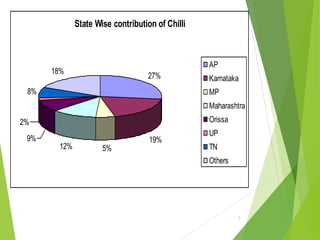
State Wise contribution of Chilli
27%
19%
5%12%
9%
2%
8%
18%
AP
Karnataka
MP
Maharashtra
Orissa
UP
TN
Others
5
Origin
 Chilies and their various cultivars
originate in South and Central America
and are cultivated around the world as
spices, vegetables and healing plants.
 Chili peppers and their products have
several medicinal functions as
decongestants and pain killers, they are
rich source of vitamin C and have
antibacterial properties.
 Chili is also used in pepper sprays and
organic pesticides!
6
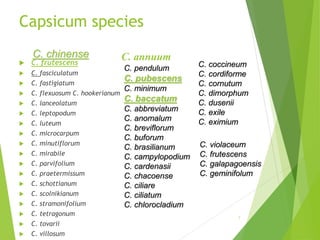
Capsicum species
 C. frutescens
 C. fasciculatum
 C. fastigiatum
 C. flexuosum C. hookerianum
 C. lanceolatum
 C. leptopodum
 C. luteum
 C. microcarpum
 C. minutiflorum
 C. mirabile
 C. parvifolium
 C. praetermissum
 C. schottianum
 C. scolnikianum
 C. stramonifolium
 C. tetragonum
 C. tovarii
 C. villosum
7
C. pendulum
C. pubescens
C. minimum
C. baccatum
C. abbreviatum
C. anomalum
C. breviflorum
C. buforum
C. brasilianum
C. campylopodium
C. cardenasii
C. chacoense
C. ciliare
C. ciliatum
C. chlorocladium
C. coccineum
C. cordiforme
C. cornutum
C. dimorphum
C. dusenii
C. exile
C. eximium
C. violaceum
C. frutescens
C. galapagoensis
C. geminifolum
C. chinense C. annuum
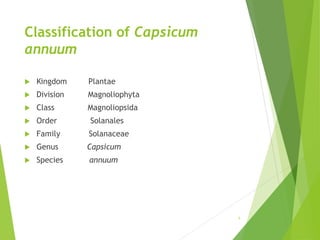
Classification of Capsicum
annuum
 Kingdom Plantae
 Division Magnoliophyta
 Class Magnoliopsida
 Order Solanales
 Family Solanaceae
 Genus Capsicum
 Species annuum
8
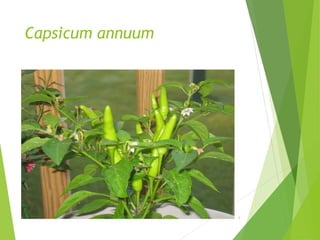
Capsicum annuum
9
C. chinense
10
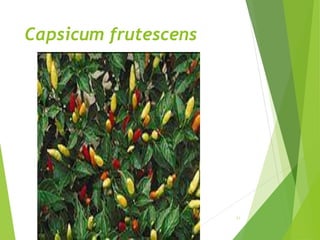
Capsicum frutescens
11
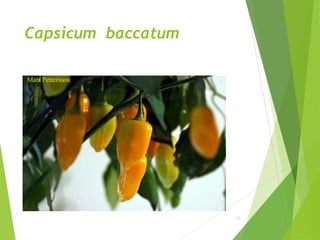
Capsicum baccatum
12
13
FLOWER
 Capsicum annuum starts flowering at the axil of
the first branching node, with subsequent
flowers forming at each additional node
 Usually C. annuum has a solitary flower at the
axil
 The flowers are complete, with calyx, corolla,
and male and female sex organs.
14
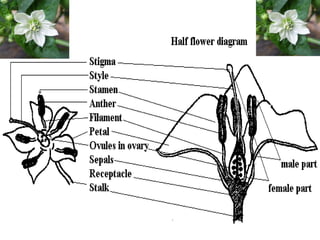
Capsicum flower is bisexual, hypogynous and usually
pentamerous
 The Capsicum calyx is broadly campanulate,
ribbed, about 2 mm long, and truncate or undulate
to weakly or prominently dentate with 5-7 teeth.
 with usually 5 but sometimes 6-7 (-8) petals in
some species.
 Typically the flowers have 5 stamens The pistil
comprises an ovary of 2-3 carpels that is 2-5 mm
long and 1.5-5 mm in diameter,
 a style 3.5-6.5 mm long, and a capitate stigma
slightly wider than the style.
15
16
The nectary appears as swellings on the basal part of
the ovary. The nectariferous cells are smaller and
denser than the neighbouring parenchyma. Stomata are
present in the nectary epidermis, but do not appear on
the other parts of the ovary epidermis.
Anthesis
 The daily start of anthesis apparently is controlled
by daylength
 The corolla typically opens within the first 3 hours
after sunrise, and the petals remain open for less
than a day; there also can be a smaller peak of
anthesis in the afternoon. the anthers
 To occur late in the morning, between 10 am and
noon. Depending on the environmental conditions
and variety, the period of receptivity of the stigma
is
 5-8 days, from several days before anthesis to
fewer days afterwards, with maximum fertility on
the day of
 anthesis
17
Pollen and fertilisation
 The pollen grains of chili pepper are medium
to light yellow, subspheroidal, pitted, and
tricolporate with longitudinal grooves.
 The plant has about 1-1.5 mg of pollen per
flower with 11,000-18,000 pollen grains in a
single anther.
 Pollen tube growth from the stigma to the egg
has been reported to take 6 to 42hrs.
18
 Male-sterility in peppers (Capsicum annuum
L.) was first documented in the 1950’s. Since
then considerable
knowledge has been accumulated on the
nature of the trait, the means of its
identification and induction, inheritance of
both genic and cytoplasmic genic male-
sterility, its line maintenance, and the
potential for breeding hybrid cultivars.
Today, several internationally known seed
companies use the genic mechanism msms on
a large scale for producing hybrids, whereas
the cytoplasmic genic source is used mainly
for breeding pungent (S) Rf rf hybrids
19
 CGMS- reported by Peterson (1958)
Hirose and Takashima (1963), Anikeenko (1973)
 Not exploited by public and private sector
Reasons-
 Hand emasculation and pollination is practicable and
feasible
 large no. of seeds set/fruit/crossing
 CMS-limit no. of lines if they are not complete
restorers
 Non-CMS based hybrids ensure greater genetic
diversity
 -stable and sustainable production
 CMS- only ease emasculation
20
Fruit
 There is extensive diversity in fruit
shape, size, wall thickness and
fleshiness colour and pungency
 blocky bell-shaped, globose, oblong
(sausage-shaped), ovoid, conical,
cylindrical, banana like (curved); and
smooth, grooved, lumpy or wrinkled..
Morphologically the Capsicum fruit is a
berry
 Green stage- 35-50 days after the
flower is pollinated.
21
Chilli thrips
22
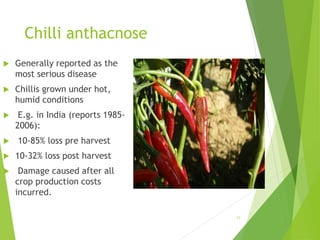
Chilli anthacnose
 Generally reported as the
most serious disease
 Chillis grown under hot,
humid conditions
 E.g. in India (reports 1985-
2006):
 10-85% loss pre harvest
 10-32% loss post harvest
 Damage caused after all
crop production costs
incurred.
23
Chilli wilt
24
25

Chilli capsicum sp..

  • 2.
    INTRODUCTION 2 Spice and Vegetable. Tropicaland subtropical Centre of Origin : Mexico Sec.Centre of Origin : Guatemala and Bulgaria Capsicum, Paprika, Pimento, hot pepper, red pepper, bird pepper, Chilli, Chile pepper. Capsicum species are diploids, with most having 24 chromosomes (n = x = 12), but with several wild species having 26 chromosomes (n = x = 13)
  • 3.
    Global  India contributesfor around 25% of world chilli production  Other major producer are China, Pakistan, Morocco, Mexico, Spain and Turkey  Chilli contributes for 22% of world spices trade in terms of volume.  Globally China is emerging as major threat for India  Asian countries consumes chillies directly while USA and EU imports mainly for its oleoresin requirement 3
  • 4.
    India  Major Producer,consumer & exporter in the world  Chilli accounts for 20-30% of total Indian spices exports valuing approx 400-500 crore  Practically all the states in India grows chilli resulting in arrivals round the year. 4
  • 5.
    State Wise contributionof Chilli 27% 19% 5%12% 9% 2% 8% 18% AP Karnataka MP Maharashtra Orissa UP TN Others 5
  • 6.
    Origin  Chilies andtheir various cultivars originate in South and Central America and are cultivated around the world as spices, vegetables and healing plants.  Chili peppers and their products have several medicinal functions as decongestants and pain killers, they are rich source of vitamin C and have antibacterial properties.  Chili is also used in pepper sprays and organic pesticides! 6
  • 7.
    Capsicum species  C.frutescens  C. fasciculatum  C. fastigiatum  C. flexuosum C. hookerianum  C. lanceolatum  C. leptopodum  C. luteum  C. microcarpum  C. minutiflorum  C. mirabile  C. parvifolium  C. praetermissum  C. schottianum  C. scolnikianum  C. stramonifolium  C. tetragonum  C. tovarii  C. villosum 7 C. pendulum C. pubescens C. minimum C. baccatum C. abbreviatum C. anomalum C. breviflorum C. buforum C. brasilianum C. campylopodium C. cardenasii C. chacoense C. ciliare C. ciliatum C. chlorocladium C. coccineum C. cordiforme C. cornutum C. dimorphum C. dusenii C. exile C. eximium C. violaceum C. frutescens C. galapagoensis C. geminifolum C. chinense C. annuum
  • 8.
    Classification of Capsicum annuum Kingdom Plantae  Division Magnoliophyta  Class Magnoliopsida  Order Solanales  Family Solanaceae  Genus Capsicum  Species annuum 8
  • 9.
  • 10.
  • 11.
  • 12.
  • 13.
  • 14.
    FLOWER  Capsicum annuumstarts flowering at the axil of the first branching node, with subsequent flowers forming at each additional node  Usually C. annuum has a solitary flower at the axil  The flowers are complete, with calyx, corolla, and male and female sex organs. 14 Capsicum flower is bisexual, hypogynous and usually pentamerous
  • 15.
     The Capsicumcalyx is broadly campanulate, ribbed, about 2 mm long, and truncate or undulate to weakly or prominently dentate with 5-7 teeth.  with usually 5 but sometimes 6-7 (-8) petals in some species.  Typically the flowers have 5 stamens The pistil comprises an ovary of 2-3 carpels that is 2-5 mm long and 1.5-5 mm in diameter,  a style 3.5-6.5 mm long, and a capitate stigma slightly wider than the style. 15
  • 16.
    16 The nectary appearsas swellings on the basal part of the ovary. The nectariferous cells are smaller and denser than the neighbouring parenchyma. Stomata are present in the nectary epidermis, but do not appear on the other parts of the ovary epidermis.
  • 17.
    Anthesis  The dailystart of anthesis apparently is controlled by daylength  The corolla typically opens within the first 3 hours after sunrise, and the petals remain open for less than a day; there also can be a smaller peak of anthesis in the afternoon. the anthers  To occur late in the morning, between 10 am and noon. Depending on the environmental conditions and variety, the period of receptivity of the stigma is  5-8 days, from several days before anthesis to fewer days afterwards, with maximum fertility on the day of  anthesis 17
  • 18.
    Pollen and fertilisation The pollen grains of chili pepper are medium to light yellow, subspheroidal, pitted, and tricolporate with longitudinal grooves.  The plant has about 1-1.5 mg of pollen per flower with 11,000-18,000 pollen grains in a single anther.  Pollen tube growth from the stigma to the egg has been reported to take 6 to 42hrs. 18
  • 19.
     Male-sterility inpeppers (Capsicum annuum L.) was first documented in the 1950’s. Since then considerable knowledge has been accumulated on the nature of the trait, the means of its identification and induction, inheritance of both genic and cytoplasmic genic male- sterility, its line maintenance, and the potential for breeding hybrid cultivars. Today, several internationally known seed companies use the genic mechanism msms on a large scale for producing hybrids, whereas the cytoplasmic genic source is used mainly for breeding pungent (S) Rf rf hybrids 19
  • 20.
     CGMS- reportedby Peterson (1958) Hirose and Takashima (1963), Anikeenko (1973)  Not exploited by public and private sector Reasons-  Hand emasculation and pollination is practicable and feasible  large no. of seeds set/fruit/crossing  CMS-limit no. of lines if they are not complete restorers  Non-CMS based hybrids ensure greater genetic diversity  -stable and sustainable production  CMS- only ease emasculation 20
  • 21.
    Fruit  There isextensive diversity in fruit shape, size, wall thickness and fleshiness colour and pungency  blocky bell-shaped, globose, oblong (sausage-shaped), ovoid, conical, cylindrical, banana like (curved); and smooth, grooved, lumpy or wrinkled.. Morphologically the Capsicum fruit is a berry  Green stage- 35-50 days after the flower is pollinated. 21
  • 22.
  • 23.
    Chilli anthacnose  Generallyreported as the most serious disease  Chillis grown under hot, humid conditions  E.g. in India (reports 1985- 2006):  10-85% loss pre harvest  10-32% loss post harvest  Damage caused after all crop production costs incurred. 23
  • 24.
  • 25.