Body MovementsBody Movements
Muscles and Body MovementsMuscles and Body Movements
►Movement results when a muscle moves anMovement results when a muscle moves an
attached boneattached bone
►Muscles are attached to at least two pointsMuscles are attached to at least two points
 OriginOrigin
► Attachment to a immoveable boneAttachment to a immoveable bone
 InsertionInsertion
► Attachment to an movable boneAttachment to an movable bone
Muscles and Body MovementsMuscles and Body Movements
Types of Ordinary BodyTypes of Ordinary Body
MovementsMovements
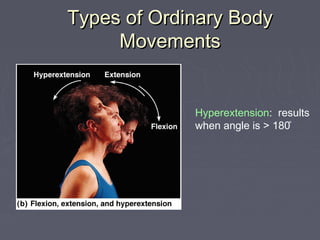
►FlexionFlexion
 Decreases the angle of the jointDecreases the angle of the joint
 Brings two bones closer togetherBrings two bones closer together
 Typical of hinge joints like knee and elbowTypical of hinge joints like knee and elbow
►ExtensionExtension
 Opposite of flexionOpposite of flexion
 Increases angle between two bonesIncreases angle between two bones
Types of Ordinary BodyTypes of Ordinary Body
MovementsMovements
Types of Ordinary BodyTypes of Ordinary Body
MovementsMovements
Hyperextension: results
when angle is > 180 ̊
Types of Ordinary BodyTypes of Ordinary Body
MovementsMovements
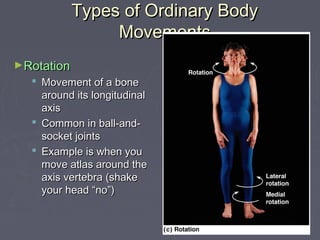
►RotationRotation
 Movement of a boneMovement of a bone
around its longitudinalaround its longitudinal
axisaxis
 Common in ball-and-Common in ball-and-
socket jointssocket joints
 Example is when youExample is when you
move atlas around themove atlas around the
axis vertebra (shakeaxis vertebra (shake
your head “no”)your head “no”)
Types of Ordinary Body MovementsTypes of Ordinary Body Movements
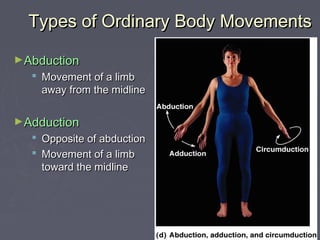
►AbductionAbduction
 Movement of a limbMovement of a limb
away from the midlineaway from the midline
►AdductionAdduction
 Opposite of abductionOpposite of abduction
 Movement of a limbMovement of a limb
toward the midlinetoward the midline
Types of Ordinary BodyTypes of Ordinary Body
MovementsMovements
►CircumductionCircumduction
 Combination of flexion,Combination of flexion,
extension, abduction,extension, abduction,
and adductionand adduction
 Common in ball-and-Common in ball-and-
socket jointssocket joints
Special MovementsSpecial Movements
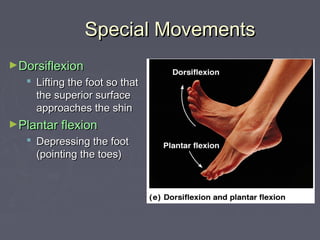
►DorsiflexionDorsiflexion
 Lifting the foot so thatLifting the foot so that
the superior surfacethe superior surface
approaches the shinapproaches the shin
►Plantar flexionPlantar flexion
 Depressing the footDepressing the foot
(pointing the toes)(pointing the toes)
Special MovementsSpecial Movements
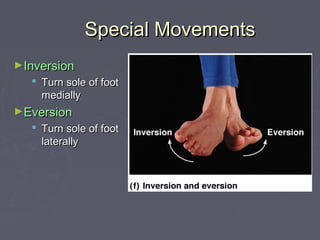
►InversionInversion
 Turn sole of footTurn sole of foot
mediallymedially
►EversionEversion
 Turn sole of footTurn sole of foot
laterallylaterally
Special MovementsSpecial Movements
►SupinationSupination
 Forearm rotates laterally so palm faces up (anterior)Forearm rotates laterally so palm faces up (anterior)
►PronationPronation
 Forearm rotates medially so palm faces down (posterior)Forearm rotates medially so palm faces down (posterior)
Special MovementsSpecial Movements
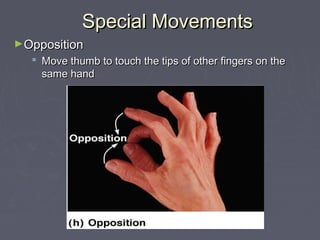
►OppositionOpposition
 Move thumb to touch the tips of other fingers on theMove thumb to touch the tips of other fingers on the
same handsame hand

Body movements ppt

  • 1.
  • 3.
    Muscles and BodyMovementsMuscles and Body Movements ►Movement results when a muscle moves anMovement results when a muscle moves an attached boneattached bone ►Muscles are attached to at least two pointsMuscles are attached to at least two points  OriginOrigin ► Attachment to a immoveable boneAttachment to a immoveable bone  InsertionInsertion ► Attachment to an movable boneAttachment to an movable bone
  • 4.
    Muscles and BodyMovementsMuscles and Body Movements
  • 5.
    Types of OrdinaryBodyTypes of Ordinary Body MovementsMovements ►FlexionFlexion  Decreases the angle of the jointDecreases the angle of the joint  Brings two bones closer togetherBrings two bones closer together  Typical of hinge joints like knee and elbowTypical of hinge joints like knee and elbow ►ExtensionExtension  Opposite of flexionOpposite of flexion  Increases angle between two bonesIncreases angle between two bones
  • 6.
    Types of OrdinaryBodyTypes of Ordinary Body MovementsMovements
  • 7.
    Types of OrdinaryBodyTypes of Ordinary Body MovementsMovements Hyperextension: results when angle is > 180 ̊
  • 8.
    Types of OrdinaryBodyTypes of Ordinary Body MovementsMovements ►RotationRotation  Movement of a boneMovement of a bone around its longitudinalaround its longitudinal axisaxis  Common in ball-and-Common in ball-and- socket jointssocket joints  Example is when youExample is when you move atlas around themove atlas around the axis vertebra (shakeaxis vertebra (shake your head “no”)your head “no”)
  • 9.
    Types of OrdinaryBody MovementsTypes of Ordinary Body Movements ►AbductionAbduction  Movement of a limbMovement of a limb away from the midlineaway from the midline ►AdductionAdduction  Opposite of abductionOpposite of abduction  Movement of a limbMovement of a limb toward the midlinetoward the midline
  • 10.
    Types of OrdinaryBodyTypes of Ordinary Body MovementsMovements ►CircumductionCircumduction  Combination of flexion,Combination of flexion, extension, abduction,extension, abduction, and adductionand adduction  Common in ball-and-Common in ball-and- socket jointssocket joints
  • 11.
    Special MovementsSpecial Movements ►DorsiflexionDorsiflexion Lifting the foot so thatLifting the foot so that the superior surfacethe superior surface approaches the shinapproaches the shin ►Plantar flexionPlantar flexion  Depressing the footDepressing the foot (pointing the toes)(pointing the toes)
  • 12.
    Special MovementsSpecial Movements ►InversionInversion Turn sole of footTurn sole of foot mediallymedially ►EversionEversion  Turn sole of footTurn sole of foot laterallylaterally
  • 13.
    Special MovementsSpecial Movements ►SupinationSupination Forearm rotates laterally so palm faces up (anterior)Forearm rotates laterally so palm faces up (anterior) ►PronationPronation  Forearm rotates medially so palm faces down (posterior)Forearm rotates medially so palm faces down (posterior)
  • 14.
    Special MovementsSpecial Movements ►OppositionOpposition Move thumb to touch the tips of other fingers on theMove thumb to touch the tips of other fingers on the same handsame hand