Submitted by-
Ambika bagora
(RN)
DEFINITION-
The skeletal system is the structural
framework that supports a body. It also
provides protection for a soft tissues and
internal organs and serves as an attachment
for the body's muscles that push against it
and apply force, resulting in movement.
 Support and protects of soft tissues and vital
organs.
 To give attachment to muscles.
 Formation of red blood corpuscles in the
bone marrow.
 Storage of mineral salts like phosphorus and
calcium.
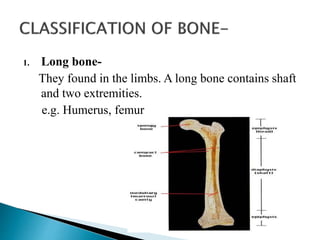
1. Long bone-
They found in the limbs. A long bone contains shaft
and two extremities.
e.g. Humerus, femur
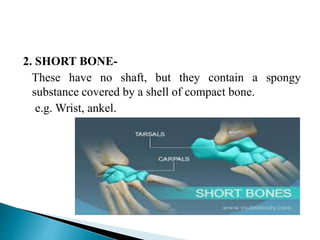
2. SHORT BONE-
These have no shaft, but they contain a spongy
substance covered by a shell of compact bone.
e.g. Wrist, ankel.
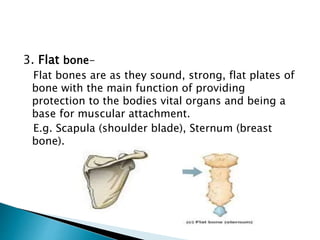
3. Flat bone-
Flat bones are as they sound, strong, flat plates of
bone with the main function of providing
protection to the bodies vital organs and being a
base for muscular attachment.
E.g. Scapula (shoulder blade), Sternum (breast
bone).
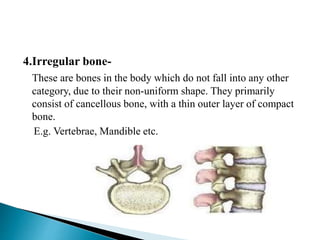
4.Irregular bone-
These are bones in the body which do not fall into any other
category, due to their non-uniform shape. They primarily
consist of cancellous bone, with a thin outer layer of compact
bone.
E.g. Vertebrae, Mandible etc.
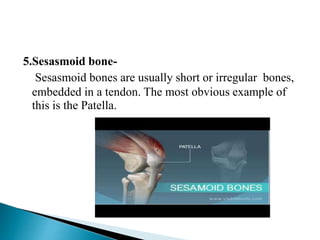
5.Sesasmoid bone-
Sesasmoid bones are usually short or irregular bones,
embedded in a tendon. The most obvious example of
this is the Patella.
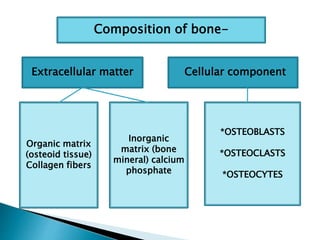
Composition of bone-
Extracellular matter  Cellular component
Organic matrix
(osteoid tissue)
Collagen fibers
Inorganic
matrix (bone
mineral) calcium
phosphate
*OSTEOBLASTS
*OSTEOCLASTS
*OSTEOCYTES
 Ossification, or osteogenesis, is the process of bone
formation by osteoblasts.
 Ossification is distinct from the process of
calcification; whereas calcification takes place during
the ossification of bones, it can also occur in other
tissues.
 .
 Ossification begins approximately six weeks after fertilization
in an embryo. Bone growth continues until approximately age
25.
 Bones can grow in thickness throughout life, but after age 25,
ossification functions primarily in bone remodeling and repair
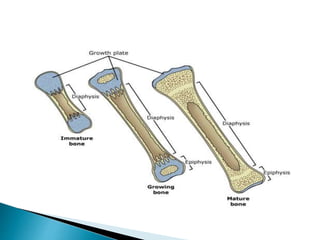
 Long bones continue to lengthen (potentially throughout
adolescence) through the addition of bone tissue at the
epiphyseal plate.
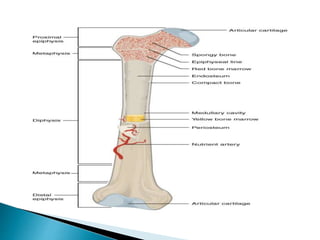
 Each long bone has an elongated shaft or
diaphysis and two expanded ends (epiphyses)
which are smooth and articular.
 The shaft typically has 3 surfaces separated
by 3 borders, a central medullary cavity, a
nutrient foramen and periostium directed
away from the growing end.
 Limb bones are typical long bones.
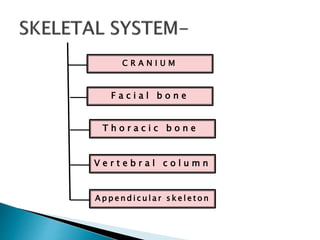
C R A N I U M
T h o r a c i c b o n e
F a c i a l b o n e
V e r t e b r a l c o l u m n
A p p e n d i c u l a r s k e l e t o n
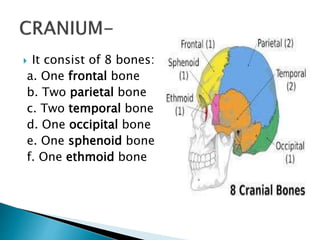
 It consist of 8 bones:
a. One frontal bone
b. Two parietal bone
c. Two temporal bone
d. One occipital bone
e. One sphenoid bone
f. One ethmoid bone
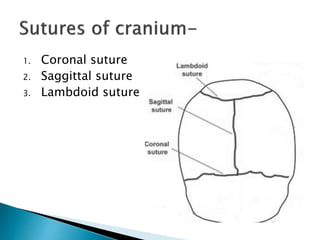
1. Coronal suture
2. Saggittal suture
3. Lambdoid suture
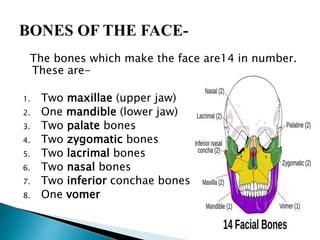
The bones which make the face are14 in number.
These are-
1. Two maxillae (upper jaw)
2. One mandible (lower jaw)
3. Two palate bones
4. Two zygomatic bones
5. Two lacrimal bones
6. Two nasal bones
7. Two inferior conchae bones
8. One vomer
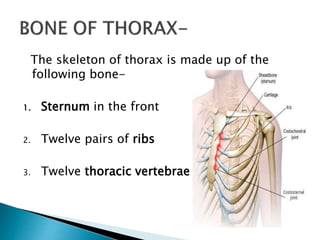
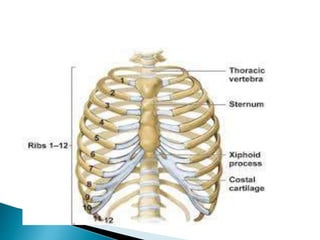
The skeleton of thorax is made up of the
following bone-
1. Sternum in the front
2. Twelve pairs of ribs
3. Twelve thoracic vertebrae
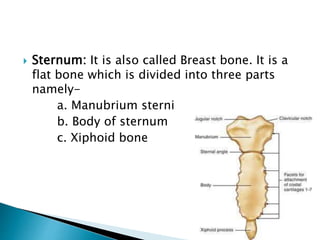
 Sternum: It is also called Breast bone. It is a
flat bone which is divided into three parts
namely-
a. Manubrium sterni
b. Body of sternum
c. Xiphoid bone
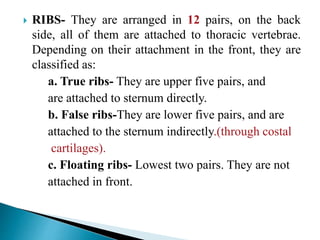
 RIBS- They are arranged in 12 pairs, on the back
side, all of them are attached to thoracic vertebrae.
Depending on their attachment in the front, they are
classified as:
a. True ribs- They are upper five pairs, and
are attached to sternum directly.
b. False ribs-They are lower five pairs, and are
attached to the sternum indirectly.(through costal
cartilages).
c. Floating ribs- Lowest two pairs. They are not
attached in front.
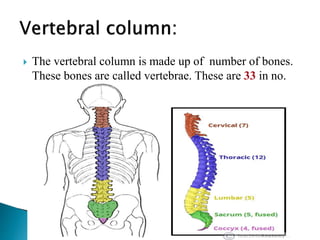
 The vertebral column is made up of number of bones.
These bones are called vertebrae. These are 33 in no.
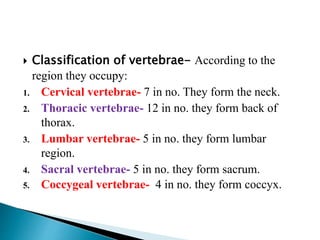
 Classification of vertebrae- According to the
region they occupy:
1. Cervical vertebrae- 7 in no. They form the neck.
2. Thoracic vertebrae- 12 in no. they form back of
thorax.
3. Lumbar vertebrae- 5 in no. they form lumbar
region.
4. Sacral vertebrae- 5 in no. they form sacrum.
5. Coccygeal vertebrae- 4 in no. they form coccyx.
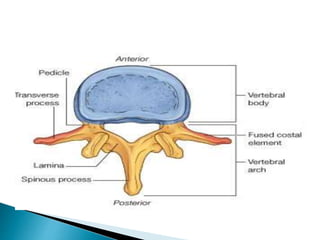
 A body which is a box shaped anterior part. It is slightly
concave in the upper and lower surface.
 Neural arch which is the posterior part.
 Two transverse processes, one on each side. They lie in the
junction between pedicle and lamina.
 One spinous process which is a backward projection.
 Neural canal which is a circular opening. The spinal cord is
passing through this.
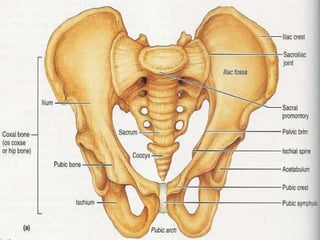
 The pelvic girdle is the connection between
the trunk and lower extremities. It is formed
by 4 bones-
a. Two inominate bones, one on each side
b. Sacrum
c. Coccyx
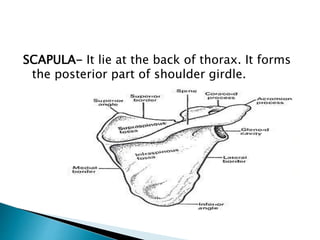
SCAPULA- It lie at the back of thorax. It forms
the posterior part of shoulder girdle.
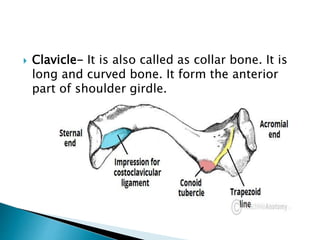
 Clavicle- It is also called as collar bone. It is
long and curved bone. It form the anterior
part of shoulder girdle.
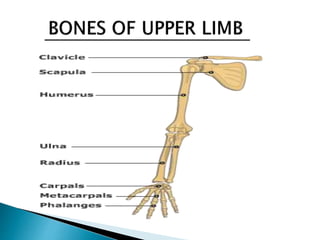
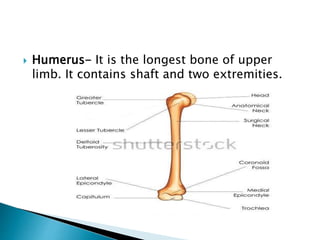
 Humerus- It is the longest bone of upper
limb. It contains shaft and two extremities.
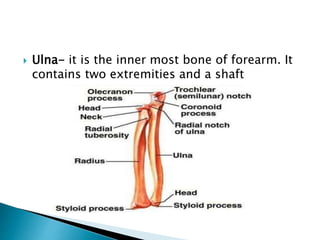
 Ulna- it is the inner most bone of forearm. It
contains two extremities and a shaft
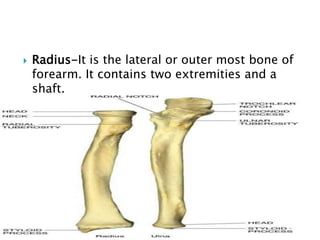
 Radius-It is the lateral or outer most bone of
forearm. It contains two extremities and a
shaft.
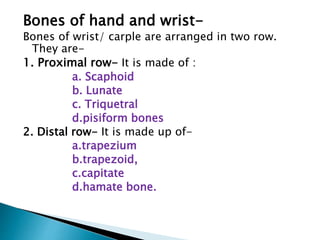
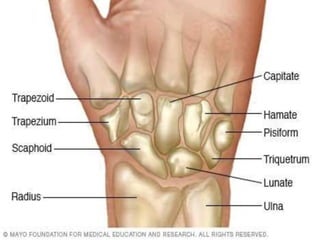
Bones of hand and wrist-
Bones of wrist/ carple are arranged in two row.
They are-
1. Proximal row- It is made of :
a. Scaphoid
b. Lunate
c. Triquetral
d.pisiform bones
2. Distal row- It is made up of-
a.trapezium
b.trapezoid,
c.capitate
d.hamate bone.
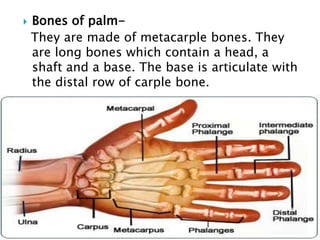
 Bones of palm-
They are made of metacarple bones. They
are long bones which contain a head, a
shaft and a base. The base is articulate with
the distal row of carple bone.
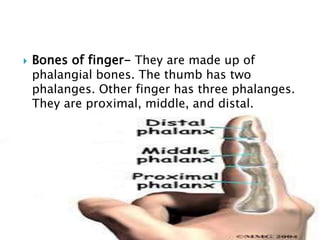
 Bones of finger- They are made up of
phalangial bones. The thumb has two
phalanges. Other finger has three phalanges.
They are proximal, middle, and distal.
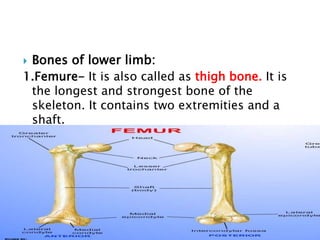
 Bones of lower limb:
1.Femure- It is also called as thigh bone. It is
the longest and strongest bone of the
skeleton. It contains two extremities and a
shaft.
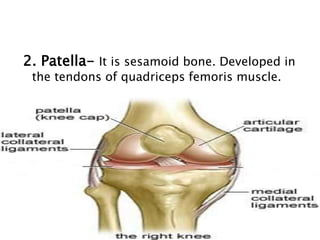
2. Patella- It is sesamoid bone. Developed in
the tendons of quadriceps femoris muscle.
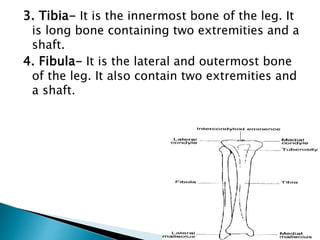
3. Tibia- It is the innermost bone of the leg. It
is long bone containing two extremities and a
shaft.
4. Fibula- It is the lateral and outermost bone
of the leg. It also contain two extremities and
a shaft.
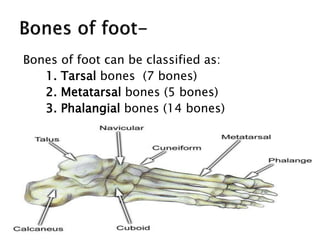
Bones of foot can be classified as:
1. Tarsal bones (7 bones)
2. Metatarsal bones (5 bones)
3. Phalangial bones (14 bones)
Skeletal system

Skeletal system

  • 1.
  • 2.
    DEFINITION- The skeletal systemis the structural framework that supports a body. It also provides protection for a soft tissues and internal organs and serves as an attachment for the body's muscles that push against it and apply force, resulting in movement.
  • 3.
     Support andprotects of soft tissues and vital organs.  To give attachment to muscles.  Formation of red blood corpuscles in the bone marrow.  Storage of mineral salts like phosphorus and calcium.
  • 4.
    1. Long bone- Theyfound in the limbs. A long bone contains shaft and two extremities. e.g. Humerus, femur
  • 5.
    2. SHORT BONE- Thesehave no shaft, but they contain a spongy substance covered by a shell of compact bone. e.g. Wrist, ankel.
  • 6.
    3. Flat bone- Flatbones are as they sound, strong, flat plates of bone with the main function of providing protection to the bodies vital organs and being a base for muscular attachment. E.g. Scapula (shoulder blade), Sternum (breast bone).
  • 7.
    4.Irregular bone- These arebones in the body which do not fall into any other category, due to their non-uniform shape. They primarily consist of cancellous bone, with a thin outer layer of compact bone. E.g. Vertebrae, Mandible etc.
  • 8.
    5.Sesasmoid bone- Sesasmoid bonesare usually short or irregular bones, embedded in a tendon. The most obvious example of this is the Patella.
  • 9.
    Composition of bone- Extracellularmatter  Cellular component Organic matrix (osteoid tissue) Collagen fibers Inorganic matrix (bone mineral) calcium phosphate *OSTEOBLASTS *OSTEOCLASTS *OSTEOCYTES
  • 10.
     Ossification, orosteogenesis, is the process of bone formation by osteoblasts.  Ossification is distinct from the process of calcification; whereas calcification takes place during the ossification of bones, it can also occur in other tissues.  .
  • 11.
     Ossification beginsapproximately six weeks after fertilization in an embryo. Bone growth continues until approximately age 25.  Bones can grow in thickness throughout life, but after age 25, ossification functions primarily in bone remodeling and repair  Long bones continue to lengthen (potentially throughout adolescence) through the addition of bone tissue at the epiphyseal plate.
  • 13.
     Each longbone has an elongated shaft or diaphysis and two expanded ends (epiphyses) which are smooth and articular.  The shaft typically has 3 surfaces separated by 3 borders, a central medullary cavity, a nutrient foramen and periostium directed away from the growing end.  Limb bones are typical long bones.
  • 15.
    C R AN I U M T h o r a c i c b o n e F a c i a l b o n e V e r t e b r a l c o l u m n A p p e n d i c u l a r s k e l e t o n
  • 16.
     It consistof 8 bones: a. One frontal bone b. Two parietal bone c. Two temporal bone d. One occipital bone e. One sphenoid bone f. One ethmoid bone
  • 17.
    1. Coronal suture 2.Saggittal suture 3. Lambdoid suture
  • 18.
    The bones whichmake the face are14 in number. These are- 1. Two maxillae (upper jaw) 2. One mandible (lower jaw) 3. Two palate bones 4. Two zygomatic bones 5. Two lacrimal bones 6. Two nasal bones 7. Two inferior conchae bones 8. One vomer
  • 19.
    The skeleton ofthorax is made up of the following bone- 1. Sternum in the front 2. Twelve pairs of ribs 3. Twelve thoracic vertebrae
  • 20.
     Sternum: Itis also called Breast bone. It is a flat bone which is divided into three parts namely- a. Manubrium sterni b. Body of sternum c. Xiphoid bone
  • 21.
     RIBS- Theyare arranged in 12 pairs, on the back side, all of them are attached to thoracic vertebrae. Depending on their attachment in the front, they are classified as: a. True ribs- They are upper five pairs, and are attached to sternum directly. b. False ribs-They are lower five pairs, and are attached to the sternum indirectly.(through costal cartilages). c. Floating ribs- Lowest two pairs. They are not attached in front.
  • 23.
     The vertebralcolumn is made up of number of bones. These bones are called vertebrae. These are 33 in no.
  • 24.
     Classification ofvertebrae- According to the region they occupy: 1. Cervical vertebrae- 7 in no. They form the neck. 2. Thoracic vertebrae- 12 in no. they form back of thorax. 3. Lumbar vertebrae- 5 in no. they form lumbar region. 4. Sacral vertebrae- 5 in no. they form sacrum. 5. Coccygeal vertebrae- 4 in no. they form coccyx.
  • 25.
     A bodywhich is a box shaped anterior part. It is slightly concave in the upper and lower surface.  Neural arch which is the posterior part.  Two transverse processes, one on each side. They lie in the junction between pedicle and lamina.  One spinous process which is a backward projection.  Neural canal which is a circular opening. The spinal cord is passing through this.
  • 27.
     The pelvicgirdle is the connection between the trunk and lower extremities. It is formed by 4 bones- a. Two inominate bones, one on each side b. Sacrum c. Coccyx
  • 30.
    SCAPULA- It lieat the back of thorax. It forms the posterior part of shoulder girdle.
  • 31.
     Clavicle- Itis also called as collar bone. It is long and curved bone. It form the anterior part of shoulder girdle.
  • 32.
     Humerus- Itis the longest bone of upper limb. It contains shaft and two extremities.
  • 33.
     Ulna- itis the inner most bone of forearm. It contains two extremities and a shaft
  • 34.
     Radius-It isthe lateral or outer most bone of forearm. It contains two extremities and a shaft.
  • 35.
    Bones of handand wrist- Bones of wrist/ carple are arranged in two row. They are- 1. Proximal row- It is made of : a. Scaphoid b. Lunate c. Triquetral d.pisiform bones 2. Distal row- It is made up of- a.trapezium b.trapezoid, c.capitate d.hamate bone.
  • 37.
     Bones ofpalm- They are made of metacarple bones. They are long bones which contain a head, a shaft and a base. The base is articulate with the distal row of carple bone.
  • 38.
     Bones offinger- They are made up of phalangial bones. The thumb has two phalanges. Other finger has three phalanges. They are proximal, middle, and distal.
  • 39.
     Bones oflower limb: 1.Femure- It is also called as thigh bone. It is the longest and strongest bone of the skeleton. It contains two extremities and a shaft.
  • 40.
    2. Patella- Itis sesamoid bone. Developed in the tendons of quadriceps femoris muscle.
  • 41.
    3. Tibia- Itis the innermost bone of the leg. It is long bone containing two extremities and a shaft. 4. Fibula- It is the lateral and outermost bone of the leg. It also contain two extremities and a shaft.
  • 42.
    Bones of footcan be classified as: 1. Tarsal bones (7 bones) 2. Metatarsal bones (5 bones) 3. Phalangial bones (14 bones)