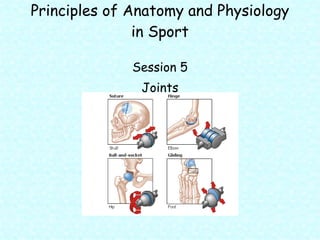
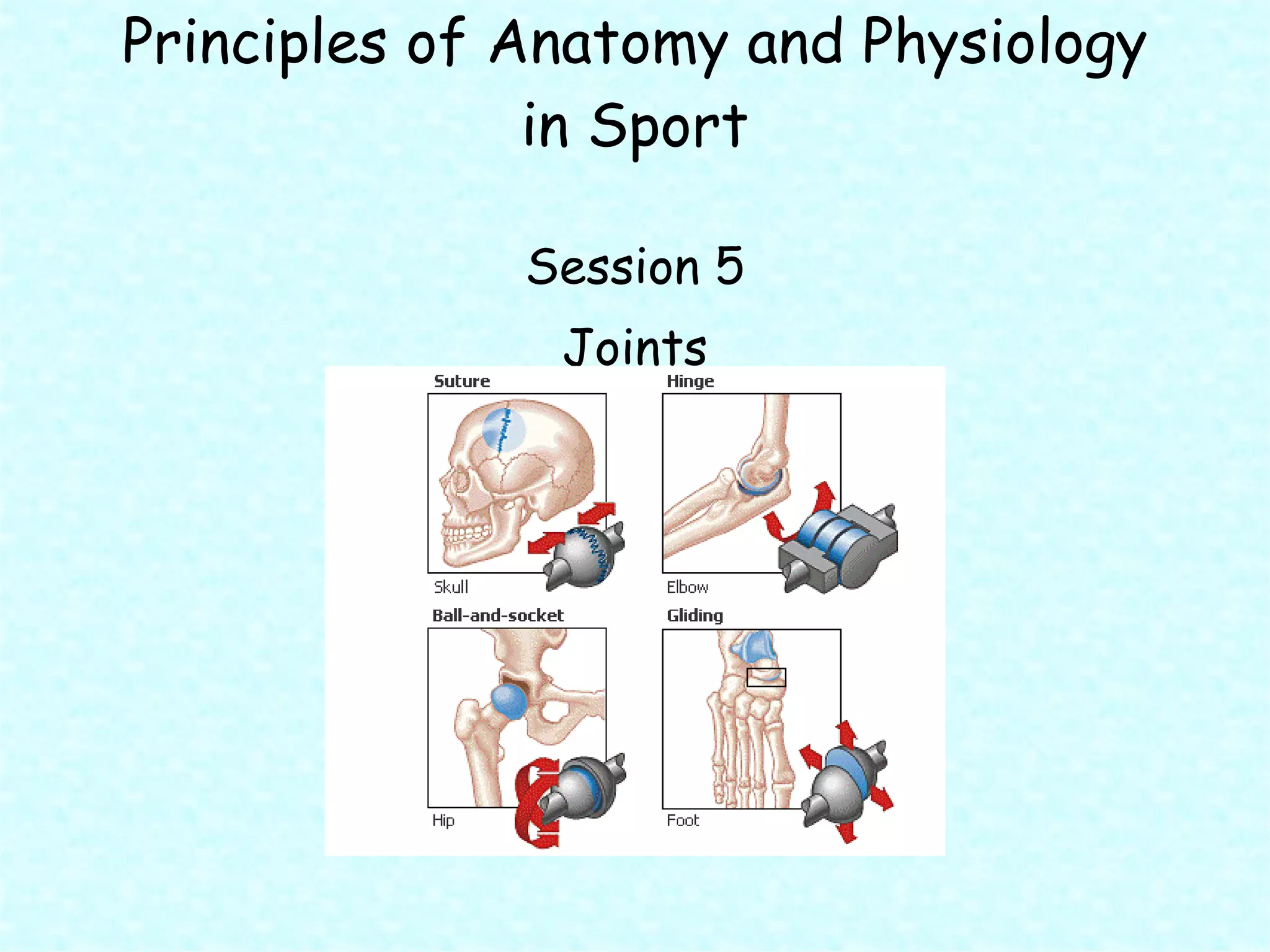
Principles of Anatomy and Physiology in Sport Session 5 Joints
Re-Cap – Last Session Assignment 1 Questions??
Aim To complete assignment 1 Objectives To be able to describe the main classifications of joints in the body To be able to describe a synovial joint structure To be able to provide examples of each classification of joint
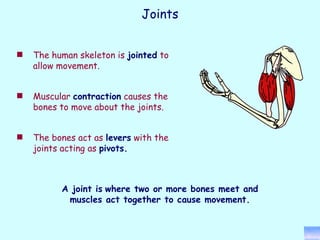
Joints A joint is   where two or more bones meet and muscles act together to cause movement. The human skeleton is  jointed  to allow movement. Muscular  contraction  causes the bones to move about the joints. The bones act as  levers  with the joints acting as  pivots.
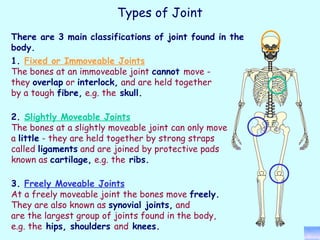
1.   Fixed or Immoveable Joints The bones at an immoveable joint  cannot   move - they  overlap  or  interlock,  and are held together by a tough  fibre,  e.g. the   skull. 2.   Slightly Moveable Joints The bones at a slightly moveable joint can only move  a  little  - they are held together by strong straps  called  ligaments  and are joined by protective pads  known as  cartilage,  e.g. the   ribs. 3.   Freely Moveable Joints At a freely moveable joint the bones move  freely. They are also known as  synovial   joints,  and are the largest group of joints found in the body,  e.g. the   hips,   shoulders   and   knees. Types of Joint There are 3 main classifications of joint found in the body.
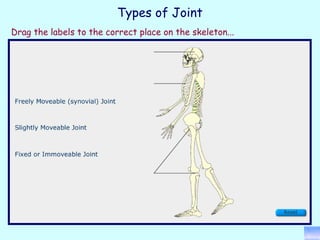
Drag the labels to the correct place on the skeleton... Types of Joint
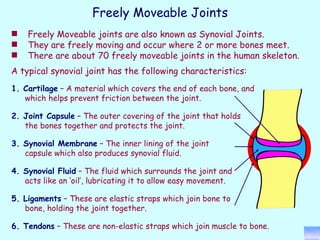
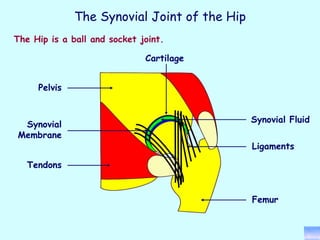
Freely Moveable joints are also known as Synovial Joints. They are freely moving and occur where 2 or more bones meet. There are about 70 freely moveable joints in the human skeleton.  A typical synovial joint has the following characteristics: 2.   Joint   Capsule  – The outer covering of the joint that holds the bones together and protects the joint. 3.   Synovial   Membrane  – The inner lining of the joint capsule which also produces synovial fluid. 4.   Synovial   Fluid  – The fluid which surrounds the joint and acts like an ‘oil’, lubricating it to allow easy movement. 5.   Ligaments  – These are elastic straps which join bone to bone, holding the joint together. 6.   Tendons  – These are non-elastic straps which join muscle to bone.   1.   Cartilage  – A material which covers the end of each bone, and which helps prevent friction between the joint. Freely Moveable Joints
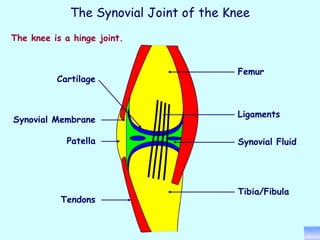
The knee is a hinge joint. Ligaments Tendons Tibia/Fibula Femur Cartilage Synovial Fluid Synovial Membrane Patella The Synovial Joint of the Knee
The Hip is a ball and socket joint. Ligaments Synovial Fluid Tendons Synovial Membrane Pelvis Cartilage Femur The Synovial Joint of the Hip
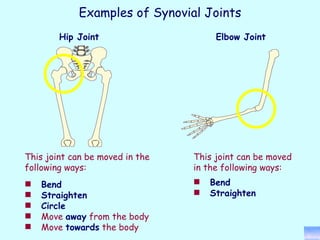
Elbow Joint This joint can be moved in the following ways: Bend Straighten Circle Move  away  from the body Move  towards  the body This joint can be moved in the following ways: Bend Straighten Hip Joint Examples of Synovial Joints
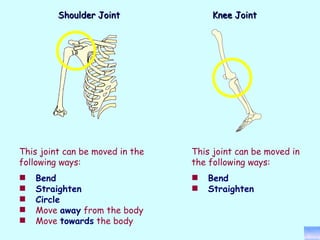
This joint can be moved in the following ways: Bend Straighten Circle Move  away  from the body Move  towards  the body This joint can be moved in the following ways: Bend Straighten Shoulder Joint Knee Joint
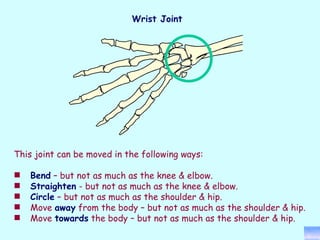
This joint can be moved in the following ways: Bend  – but not as much as the knee & elbow. Straighten  - but not as much as the knee & elbow. Circle  – but not as much as the shoulder & hip. Move  away  from the body – but not as much as the shoulder & hip. Move  towards  the body – but not as much as the shoulder & hip. Wrist Joint
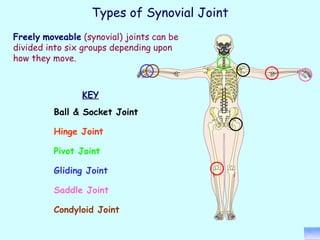
KEY Ball & Socket Joint Hinge Joint Pivot Joint Gliding Joint Saddle Joint Condyloid Joint Freely   moveable  (synovial) joints can be divided into six groups depending upon how they move. Types of Synovial Joint
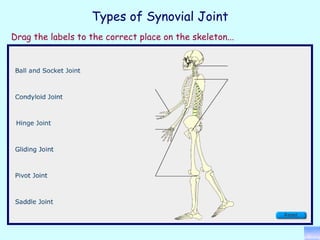
Types of Synovial Joint Drag the labels to the correct place on the skeleton...
Summary Classification of joints Structure of synovial joint Examples of each classification of joint
Objectives To be able to describe the main classifications of joints in the body To be able to describe a synovial joint structure To be able to provide examples of each classification of joint
Next Session Types of joints Movement

Principles of a+p 1112 session 5 - joints (structure)

  • 1.
    Principles of Anatomyand Physiology in Sport Session 5 Joints
  • 2.
    Re-Cap – LastSession Assignment 1 Questions??
  • 3.
    Aim To completeassignment 1 Objectives To be able to describe the main classifications of joints in the body To be able to describe a synovial joint structure To be able to provide examples of each classification of joint
  • 4.
    Joints A jointis where two or more bones meet and muscles act together to cause movement. The human skeleton is jointed to allow movement. Muscular contraction causes the bones to move about the joints. The bones act as levers with the joints acting as pivots.
  • 5.
    1. Fixed or Immoveable Joints The bones at an immoveable joint cannot move - they overlap or interlock, and are held together by a tough fibre, e.g. the skull. 2. Slightly Moveable Joints The bones at a slightly moveable joint can only move a little - they are held together by strong straps called ligaments and are joined by protective pads known as cartilage, e.g. the ribs. 3. Freely Moveable Joints At a freely moveable joint the bones move freely. They are also known as synovial joints, and are the largest group of joints found in the body, e.g. the hips, shoulders and knees. Types of Joint There are 3 main classifications of joint found in the body.
  • 6.
    Drag the labelsto the correct place on the skeleton... Types of Joint
  • 7.
    Freely Moveable jointsare also known as Synovial Joints. They are freely moving and occur where 2 or more bones meet. There are about 70 freely moveable joints in the human skeleton. A typical synovial joint has the following characteristics: 2. Joint Capsule – The outer covering of the joint that holds the bones together and protects the joint. 3. Synovial Membrane – The inner lining of the joint capsule which also produces synovial fluid. 4. Synovial Fluid – The fluid which surrounds the joint and acts like an ‘oil’, lubricating it to allow easy movement. 5. Ligaments – These are elastic straps which join bone to bone, holding the joint together. 6. Tendons – These are non-elastic straps which join muscle to bone. 1. Cartilage – A material which covers the end of each bone, and which helps prevent friction between the joint. Freely Moveable Joints
  • 8.
    The knee isa hinge joint. Ligaments Tendons Tibia/Fibula Femur Cartilage Synovial Fluid Synovial Membrane Patella The Synovial Joint of the Knee
  • 9.
    The Hip isa ball and socket joint. Ligaments Synovial Fluid Tendons Synovial Membrane Pelvis Cartilage Femur The Synovial Joint of the Hip
  • 10.
    Elbow Joint Thisjoint can be moved in the following ways: Bend Straighten Circle Move away from the body Move towards the body This joint can be moved in the following ways: Bend Straighten Hip Joint Examples of Synovial Joints
  • 11.
    This joint canbe moved in the following ways: Bend Straighten Circle Move away from the body Move towards the body This joint can be moved in the following ways: Bend Straighten Shoulder Joint Knee Joint
  • 12.
    This joint canbe moved in the following ways: Bend – but not as much as the knee & elbow. Straighten - but not as much as the knee & elbow. Circle – but not as much as the shoulder & hip. Move away from the body – but not as much as the shoulder & hip. Move towards the body – but not as much as the shoulder & hip. Wrist Joint
  • 13.
    KEY Ball &Socket Joint Hinge Joint Pivot Joint Gliding Joint Saddle Joint Condyloid Joint Freely moveable (synovial) joints can be divided into six groups depending upon how they move. Types of Synovial Joint
  • 14.
    Types of SynovialJoint Drag the labels to the correct place on the skeleton...
  • 15.
    Summary Classification ofjoints Structure of synovial joint Examples of each classification of joint
  • 16.
    Objectives To beable to describe the main classifications of joints in the body To be able to describe a synovial joint structure To be able to provide examples of each classification of joint
  • 17.
    Next Session Typesof joints Movement