

1

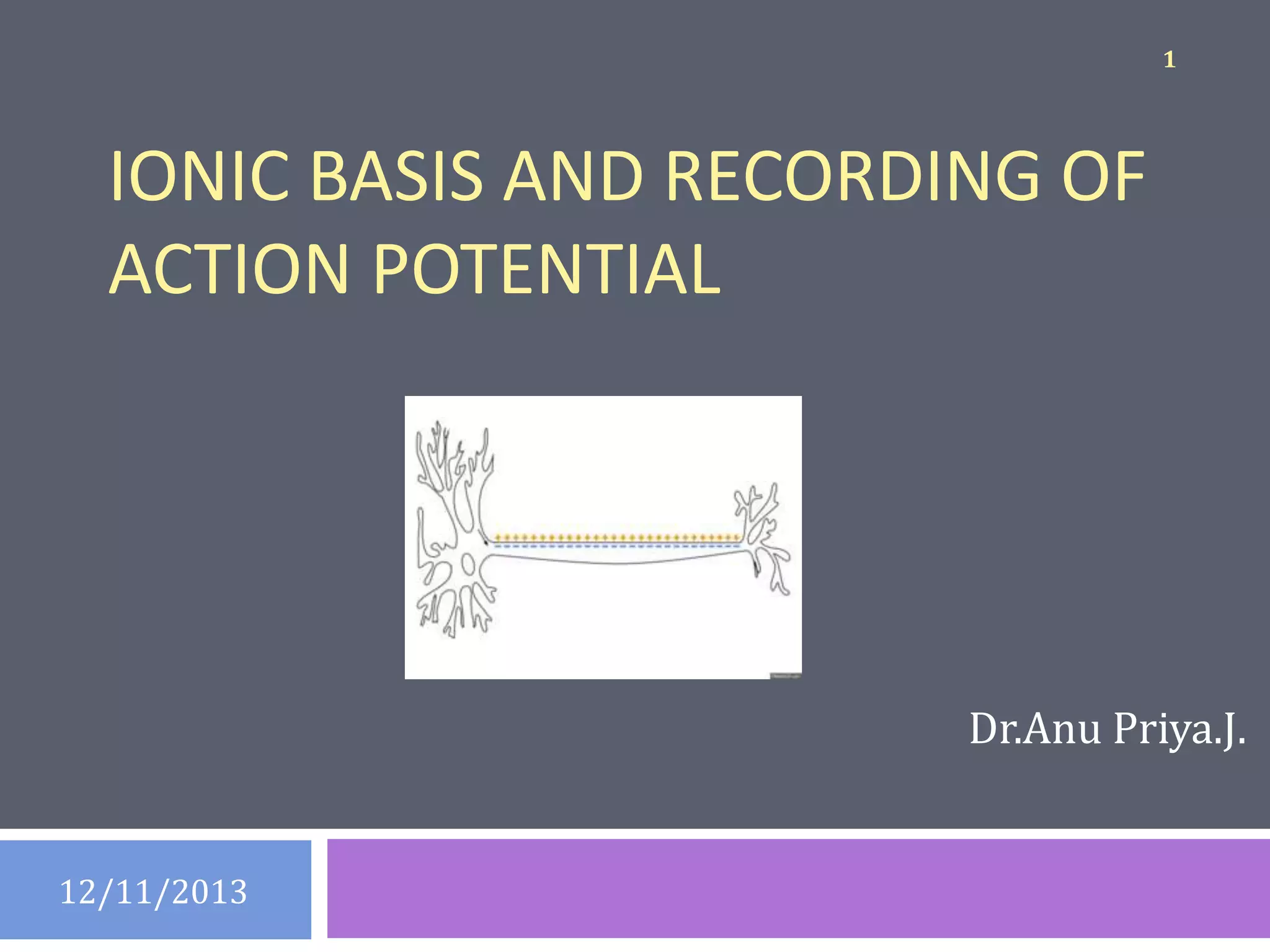
IONIC BASIS AND RECORDING OF
ACTION POTENTIAL

Dr.Anu Priya.J.

12/11/2013
2












Introduction
History
Resting membrane potential
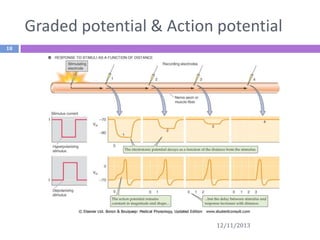
Graded potential
Action potential
Ionic basis
Types
Recording
Applied aspects
12/11/2013
Introduction
3

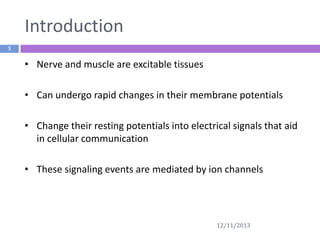
• Nerve and muscle are excitable tissues
• Can undergo rapid changes in their membrane potentials
• Change their resting potentials into electrical signals that aid
in cellular communication
• These signaling events are mediated by ion channels

12/11/2013
History
4



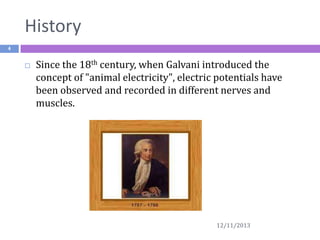
Since the 18th century, when Galvani introduced the
concept of "animal electricity", electric potentials have
been observed and recorded in different nerves and
muscles.

12/11/2013
5



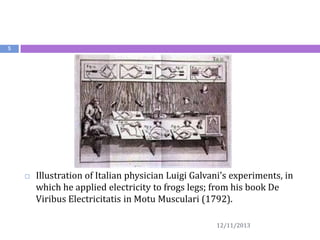
Illustration of Italian physician Luigi Galvani's experiments, in
which he applied electricity to frogs legs; from his book De
Viribus Electricitatis in Motu Musculari (1792).
12/11/2013
History
6





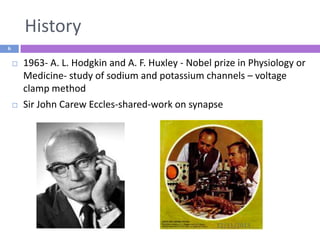
1963- A. L. Hodgkin and A. F. Huxley - Nobel prize in Physiology or
Medicine- study of sodium and potassium channels – voltage
clamp method
Sir John Carew Eccles-shared-work on synapse

12/11/2013
History
7





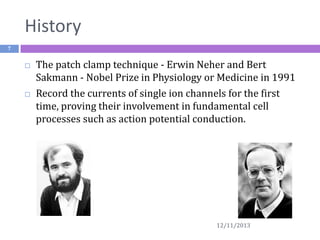
The patch clamp technique - Erwin Neher and Bert
Sakmann - Nobel Prize in Physiology or Medicine in 1991
Record the currents of single ion channels for the first
time, proving their involvement in fundamental cell
processes such as action potential conduction.

12/11/2013
History
8



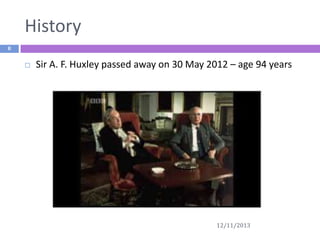
Sir A. F. Huxley passed away on 30 May 2012 – age 94 years

12/11/2013
Resting Membrane Potential
9







It is the potential difference existing across the cell
membrane at rest
Interior of the cell is negatively charged in relation to the
exterior
State of polarisation

12/11/2013
Resting Membrane Potential
10

RMP is maintained by:
1.
Natural concentration gradient
2.
Selective permeability of cell membrane
3.
Impermeable anions
4.
Sodium-potassium ATPase pump

12/11/2013
Resting Membrane Potential
11












Neurons have a selectively permeable membrane
During resting conditions membrane is:
 permeable to potassium (K+) (channels are open)
 impermeable to sodium (Na+) (channels are closed)
Diffusion force pushes K+ out (concentration gradient)
This creates a positively charged extra-cellular space.
Electrostatic force pushes K+ in
Thus, there is a ‘dynamic equilibrium’ with zero net
movement of ions.
The resting membrane potential is negative
12/11/2013
Graded potential
12

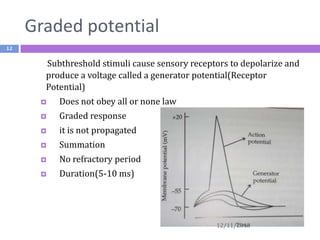
Subthreshold stimuli cause sensory receptors to depolarize and
produce a voltage called a generator potential(Receptor
Potential)


Does not obey all or none law



Graded response



it is not propagated



Summation



No refractory period



Duration(5-10 ms)

12/11/2013
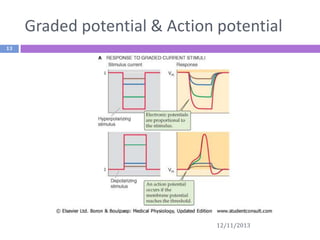
Graded potential & Action potential
13

12/11/2013
Action potential
14











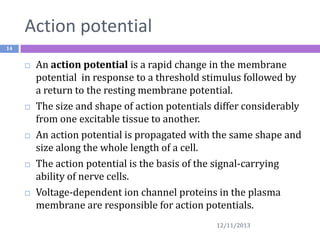
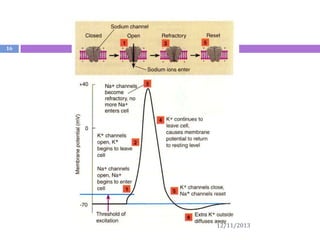
An action potential is a rapid change in the membrane
potential in response to a threshold stimulus followed by
a return to the resting membrane potential.
The size and shape of action potentials differ considerably
from one excitable tissue to another.
An action potential is propagated with the same shape and
size along the whole length of a cell.
The action potential is the basis of the signal-carrying
ability of nerve cells.
Voltage-dependent ion channel proteins in the plasma
membrane are responsible for action potentials.
12/11/2013
15

12/11/2013
16

12/11/2013
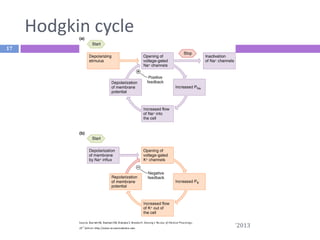
Hodgkin cycle
17

12/11/2013
Graded potential & Action potential
18

12/11/2013
19

12/11/2013
20

12/11/2013
21

12/11/2013
22

Role of other ions
 Impermeable Anions
 Calcium ions

12/11/2013
Properties
23



Voltage inactivation



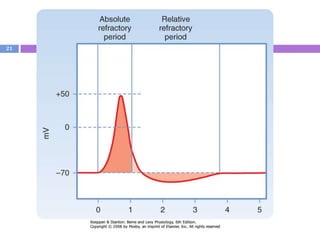
Refractory period



All or none law



Propagative



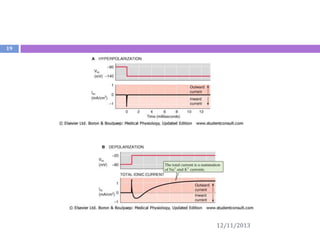
depolarization and repolarization



No summation
12/11/2013
Recording of action potential
24





Mammalian axons less than 20 μm diameter
Squid-giant cells-largest axon in neck regionabout 1 mm diameter

12/11/2013
Recording of action potential
25



a)

b)

Requirements of instrument used :
It should be capable of responding extremely rapidly
The potential changes which are in millivolts has to be
amplified before being recorded

12/11/2013
Recording of action potential
26



1.
2.
3.

The instruments used are:
Microelectrodes
Electronic amplifiers
Cathode ray oscilloscope (CRO)

12/11/2013
Microelectrodes
27



Micropipette – tip size less than 1 mm diameter



Filled with strong electrolyte solution- KCl



Resistance – 1 billion Ω



The tip of the micropipette is passed through the cell membrane of
the nerve fibre



Indifferent electrode – in extracellular fluid



Connected to cathode ray oscilloscope through amplifier
12/11/2013
Electronic amplifier
28



magnify the potential changes of the tissue to be
recorded on the oscilloscope screen

12/11/2013
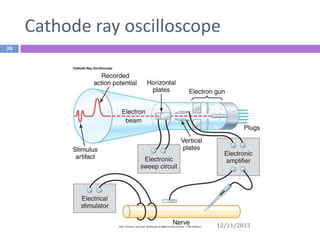
Cathode ray oscilloscope
29

Rapid and instantaneous recording of electrical
events of living tissues
 Parts
i.
Glass tube
ii.
Cathode
iii.
Fluorescent screen
iv.
Two sets ( horizontal and vertical ) electrically
charged plates


12/11/2013
Cathode ray oscilloscope
30

12/11/2013
Recording of action potential
31




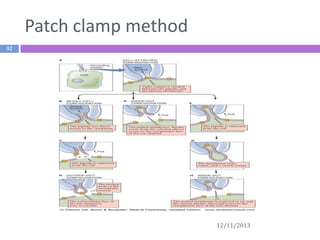
Patch clamp method
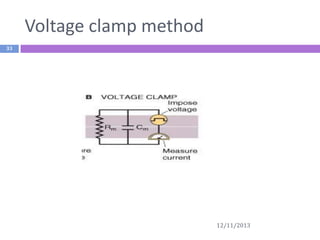
Voltage clamp method

12/11/2013
Patch clamp method
32

12/11/2013
Voltage clamp method
33

12/11/2013
Types
34





Monophasic
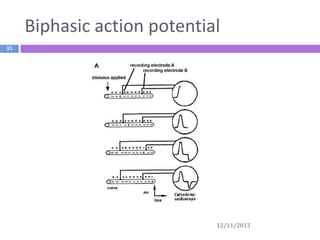
Biphasic
Compound

12/11/2013
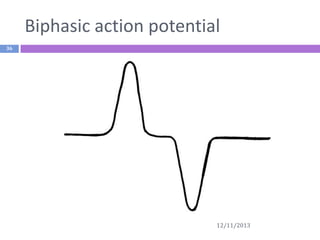
Biphasic action potential
35

12/11/2013
Biphasic action potential
36

12/11/2013
Compound action potential
37









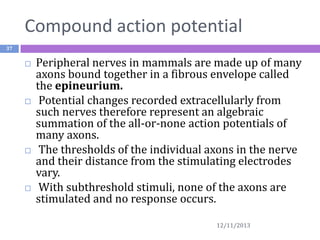
Peripheral nerves in mammals are made up of many
axons bound together in a fibrous envelope called
the epineurium.
Potential changes recorded extracellularly from
such nerves therefore represent an algebraic
summation of the all-or-none action potentials of
many axons.
The thresholds of the individual axons in the nerve
and their distance from the stimulating electrodes
vary.
With subthreshold stimuli, none of the axons are
stimulated and no response occurs.
12/11/2013
38









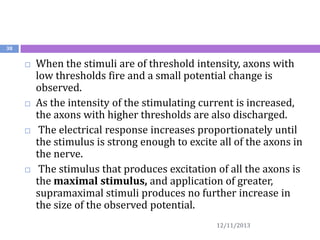
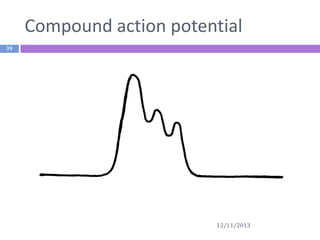
When the stimuli are of threshold intensity, axons with
low thresholds fire and a small potential change is
observed.
As the intensity of the stimulating current is increased,
the axons with higher thresholds are also discharged.
The electrical response increases proportionately until
the stimulus is strong enough to excite all of the axons in
the nerve.
The stimulus that produces excitation of all the axons is
the maximal stimulus, and application of greater,
supramaximal stimuli produces no further increase in
the size of the observed potential.
12/11/2013
Compound action potential
39

12/11/2013
Applied aspects
40

Hereditary spherocytosis (HS)
 Plasma membrane of red cells three times more
permeable to Na+
 The level of Na+,K+-ATPase elevated.
 When HS red blood cells have sufficient glucose to
maintain normal ATP levels, they extrude Na+ as
rapidly as it diffuses into the cell cytosol. Hence
the red blood cell volume is maintained.
12/11/2013
Applied aspects
41









When HS erythrocytes are delayed in the venous
sinuses of the spleen, where glucose and ATP are
present at low levels, the intracellular ATP
concentration falls.
Therefore, Na+ cannot be pumped out by the
Na+,K+-ATPase as rapidly as it enters.
The red blood cells swell - osmotic effect of
elevated intracellular Na+ concentration.
Spleen targets these swollen erythrocytes for
destruction - anemia.
12/11/2013
Applied aspects
42





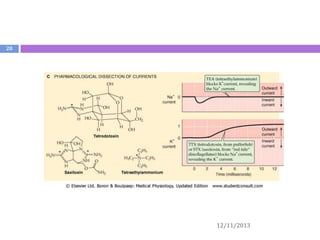
Tetrodotoxin (TTX)- a potent poison - specifically blocks
the Na+ channel- binds to the extracellular side of the
sodium channel.
Tetraethylammonium (TEA+), another poison, blocks the
K+ channel when it is applied to the interior of the nerve
fiber.



12/11/2013
Applied aspects
43



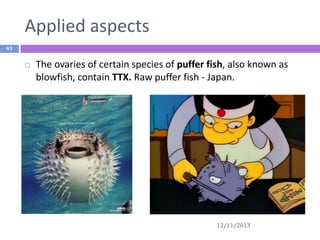
The ovaries of certain species of puffer fish, also known as
blowfish, contain TTX. Raw puffer fish - Japan.

12/11/2013
Applied aspects
44



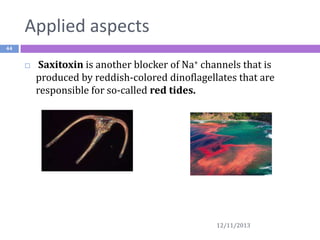
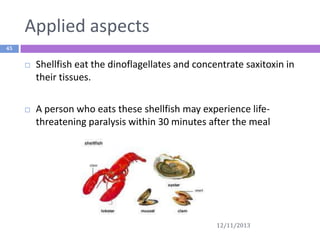
Saxitoxin is another blocker of Na+ channels that is
produced by reddish-colored dinoflagellates that are
responsible for so-called red tides.

12/11/2013
Applied aspects
45



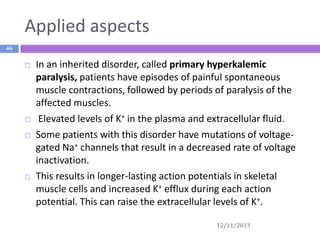
Shellfish eat the dinoflagellates and concentrate saxitoxin in
their tissues.



A person who eats these shellfish may experience lifethreatening paralysis within 30 minutes after the meal

12/11/2013
Applied aspects
46








In an inherited disorder, called primary hyperkalemic
paralysis, patients have episodes of painful spontaneous
muscle contractions, followed by periods of paralysis of the
affected muscles.
Elevated levels of K+ in the plasma and extracellular fluid.
Some patients with this disorder have mutations of voltagegated Na+ channels that result in a decreased rate of voltage
inactivation.
This results in longer-lasting action potentials in skeletal
muscle cells and increased K+ efflux during each action
potential. This can raise the extracellular levels of K+.
12/11/2013
Applied aspects
47









The elevation of extracellular K+ causes depolarization of
skeletal muscle cells.
Initially, the depolarization brings muscle cells closer to
threshold, so that spontaneous action potentials and
contractions are more likely.
As depolarization of the cells becomes more marked, the cells
accommodate because of the voltage-inactivated Na+
channels.
Consequently, the cells become unable to fire action
potentials and are unable to contract in response to action
potentials in their motor axons.
12/11/2013
Applied aspects
48





Low potentials recorded in neuropathy and spinal cord
compression
INJURY POTENTIAL
The difference in electrical potential between the
injured and uninjured parts of a nerve or muscle – also
called demarcation potential

12/11/2013
Applied aspects
49

TETANY
 Hypocalcemia – sodium channels activated by
very little increase of membrane potential from
resting state

12/11/2013
50

12/11/2013
References
51


Guyton and Hall Textbook of Medical Physiology 12th edition



Ganong's Review of Medical Physiology 23rd edition



Berne & Levy Physiology 6th edition



Boron and Boulpaep Medical physiology 2nd edition



Basics of Medical physiology by Dr.Venkatesh.D 3rd edition



Textbook Of Medical Physiology by Indu Khurana 1st edition



Internet references

12/11/2013

IONIC BASIS AND RECORDING OF ACTON POTENTIAL

  • 1.
    1 IONIC BASIS ANDRECORDING OF ACTION POTENTIAL Dr.Anu Priya.J. 12/11/2013
  • 2.
    2          Introduction History Resting membrane potential Gradedpotential Action potential Ionic basis Types Recording Applied aspects 12/11/2013
  • 3.
    Introduction 3 • Nerve andmuscle are excitable tissues • Can undergo rapid changes in their membrane potentials • Change their resting potentials into electrical signals that aid in cellular communication • These signaling events are mediated by ion channels 12/11/2013
  • 4.
    History 4  Since the 18thcentury, when Galvani introduced the concept of "animal electricity", electric potentials have been observed and recorded in different nerves and muscles. 12/11/2013
  • 5.
    5  Illustration of Italianphysician Luigi Galvani's experiments, in which he applied electricity to frogs legs; from his book De Viribus Electricitatis in Motu Musculari (1792). 12/11/2013
  • 6.
    History 6   1963- A. L.Hodgkin and A. F. Huxley - Nobel prize in Physiology or Medicine- study of sodium and potassium channels – voltage clamp method Sir John Carew Eccles-shared-work on synapse 12/11/2013
  • 7.
    History 7   The patch clamptechnique - Erwin Neher and Bert Sakmann - Nobel Prize in Physiology or Medicine in 1991 Record the currents of single ion channels for the first time, proving their involvement in fundamental cell processes such as action potential conduction. 12/11/2013
  • 8.
    History 8  Sir A. F.Huxley passed away on 30 May 2012 – age 94 years 12/11/2013
  • 9.
    Resting Membrane Potential 9    Itis the potential difference existing across the cell membrane at rest Interior of the cell is negatively charged in relation to the exterior State of polarisation 12/11/2013
  • 10.
    Resting Membrane Potential 10 RMPis maintained by: 1. Natural concentration gradient 2. Selective permeability of cell membrane 3. Impermeable anions 4. Sodium-potassium ATPase pump 12/11/2013
  • 11.
    Resting Membrane Potential 11        Neuronshave a selectively permeable membrane During resting conditions membrane is:  permeable to potassium (K+) (channels are open)  impermeable to sodium (Na+) (channels are closed) Diffusion force pushes K+ out (concentration gradient) This creates a positively charged extra-cellular space. Electrostatic force pushes K+ in Thus, there is a ‘dynamic equilibrium’ with zero net movement of ions. The resting membrane potential is negative 12/11/2013
  • 12.
    Graded potential 12 Subthreshold stimulicause sensory receptors to depolarize and produce a voltage called a generator potential(Receptor Potential)  Does not obey all or none law  Graded response  it is not propagated  Summation  No refractory period  Duration(5-10 ms) 12/11/2013
  • 13.
    Graded potential &Action potential 13 12/11/2013
  • 14.
    Action potential 14      An actionpotential is a rapid change in the membrane potential in response to a threshold stimulus followed by a return to the resting membrane potential. The size and shape of action potentials differ considerably from one excitable tissue to another. An action potential is propagated with the same shape and size along the whole length of a cell. The action potential is the basis of the signal-carrying ability of nerve cells. Voltage-dependent ion channel proteins in the plasma membrane are responsible for action potentials. 12/11/2013
  • 15.
  • 16.
  • 17.
  • 18.
    Graded potential &Action potential 18 12/11/2013
  • 19.
  • 20.
  • 21.
  • 22.
    22 Role of otherions  Impermeable Anions  Calcium ions 12/11/2013
  • 23.
    Properties 23  Voltage inactivation  Refractory period  Allor none law  Propagative  depolarization and repolarization  No summation 12/11/2013
  • 24.
    Recording of actionpotential 24   Mammalian axons less than 20 μm diameter Squid-giant cells-largest axon in neck regionabout 1 mm diameter 12/11/2013
  • 25.
    Recording of actionpotential 25  a) b) Requirements of instrument used : It should be capable of responding extremely rapidly The potential changes which are in millivolts has to be amplified before being recorded 12/11/2013
  • 26.
    Recording of actionpotential 26  1. 2. 3. The instruments used are: Microelectrodes Electronic amplifiers Cathode ray oscilloscope (CRO) 12/11/2013
  • 27.
    Microelectrodes 27  Micropipette – tipsize less than 1 mm diameter  Filled with strong electrolyte solution- KCl  Resistance – 1 billion Ω  The tip of the micropipette is passed through the cell membrane of the nerve fibre  Indifferent electrode – in extracellular fluid  Connected to cathode ray oscilloscope through amplifier 12/11/2013
  • 28.
    Electronic amplifier 28  magnify thepotential changes of the tissue to be recorded on the oscilloscope screen 12/11/2013
  • 29.
    Cathode ray oscilloscope 29 Rapidand instantaneous recording of electrical events of living tissues  Parts i. Glass tube ii. Cathode iii. Fluorescent screen iv. Two sets ( horizontal and vertical ) electrically charged plates  12/11/2013
  • 30.
  • 31.
    Recording of actionpotential 31   Patch clamp method Voltage clamp method 12/11/2013
  • 32.
  • 33.
  • 34.
  • 35.
  • 36.
  • 37.
    Compound action potential 37     Peripheralnerves in mammals are made up of many axons bound together in a fibrous envelope called the epineurium. Potential changes recorded extracellularly from such nerves therefore represent an algebraic summation of the all-or-none action potentials of many axons. The thresholds of the individual axons in the nerve and their distance from the stimulating electrodes vary. With subthreshold stimuli, none of the axons are stimulated and no response occurs. 12/11/2013
  • 38.
    38     When the stimuliare of threshold intensity, axons with low thresholds fire and a small potential change is observed. As the intensity of the stimulating current is increased, the axons with higher thresholds are also discharged. The electrical response increases proportionately until the stimulus is strong enough to excite all of the axons in the nerve. The stimulus that produces excitation of all the axons is the maximal stimulus, and application of greater, supramaximal stimuli produces no further increase in the size of the observed potential. 12/11/2013
  • 39.
  • 40.
    Applied aspects 40 Hereditary spherocytosis(HS)  Plasma membrane of red cells three times more permeable to Na+  The level of Na+,K+-ATPase elevated.  When HS red blood cells have sufficient glucose to maintain normal ATP levels, they extrude Na+ as rapidly as it diffuses into the cell cytosol. Hence the red blood cell volume is maintained. 12/11/2013
  • 41.
    Applied aspects 41     When HSerythrocytes are delayed in the venous sinuses of the spleen, where glucose and ATP are present at low levels, the intracellular ATP concentration falls. Therefore, Na+ cannot be pumped out by the Na+,K+-ATPase as rapidly as it enters. The red blood cells swell - osmotic effect of elevated intracellular Na+ concentration. Spleen targets these swollen erythrocytes for destruction - anemia. 12/11/2013
  • 42.
    Applied aspects 42   Tetrodotoxin (TTX)-a potent poison - specifically blocks the Na+ channel- binds to the extracellular side of the sodium channel. Tetraethylammonium (TEA+), another poison, blocks the K+ channel when it is applied to the interior of the nerve fiber.  12/11/2013
  • 43.
    Applied aspects 43  The ovariesof certain species of puffer fish, also known as blowfish, contain TTX. Raw puffer fish - Japan. 12/11/2013
  • 44.
    Applied aspects 44  Saxitoxin isanother blocker of Na+ channels that is produced by reddish-colored dinoflagellates that are responsible for so-called red tides. 12/11/2013
  • 45.
    Applied aspects 45  Shellfish eatthe dinoflagellates and concentrate saxitoxin in their tissues.  A person who eats these shellfish may experience lifethreatening paralysis within 30 minutes after the meal 12/11/2013
  • 46.
    Applied aspects 46     In aninherited disorder, called primary hyperkalemic paralysis, patients have episodes of painful spontaneous muscle contractions, followed by periods of paralysis of the affected muscles. Elevated levels of K+ in the plasma and extracellular fluid. Some patients with this disorder have mutations of voltagegated Na+ channels that result in a decreased rate of voltage inactivation. This results in longer-lasting action potentials in skeletal muscle cells and increased K+ efflux during each action potential. This can raise the extracellular levels of K+. 12/11/2013
  • 47.
    Applied aspects 47     The elevationof extracellular K+ causes depolarization of skeletal muscle cells. Initially, the depolarization brings muscle cells closer to threshold, so that spontaneous action potentials and contractions are more likely. As depolarization of the cells becomes more marked, the cells accommodate because of the voltage-inactivated Na+ channels. Consequently, the cells become unable to fire action potentials and are unable to contract in response to action potentials in their motor axons. 12/11/2013
  • 48.
    Applied aspects 48   Low potentialsrecorded in neuropathy and spinal cord compression INJURY POTENTIAL The difference in electrical potential between the injured and uninjured parts of a nerve or muscle – also called demarcation potential 12/11/2013
  • 49.
    Applied aspects 49 TETANY  Hypocalcemia– sodium channels activated by very little increase of membrane potential from resting state 12/11/2013
  • 50.
  • 51.
    References 51  Guyton and HallTextbook of Medical Physiology 12th edition  Ganong's Review of Medical Physiology 23rd edition  Berne & Levy Physiology 6th edition  Boron and Boulpaep Medical physiology 2nd edition  Basics of Medical physiology by Dr.Venkatesh.D 3rd edition  Textbook Of Medical Physiology by Indu Khurana 1st edition  Internet references 12/11/2013

Editor's Notes

  • #9 Andrew Huxley (right)
  • #24 Absolute Refractory period – infatiguabilityAccommodation
  • #43 Sushi chefs who are trained to remove the ovaries safely are licensed by the government to prepare puffer fish. Despite these precautions, each year several people die from eating improperly prepared puffer fish.