ARTERIAL AND VENOUS
PULSE
Dr. ANU PRIYA J
Definition: Arterial Pulse
 Rhythmic expansion of the arterial wall due to
transmission of pressure waves that travels along
the arteries due to forceful ejection of blood during
systole into the arterial system
OR
 During each cardiac systole, the aorta experiences a
pressure wave which travels down the arterial tree
that can be felt / palpated
Principle
 During each ventricular systole, a
pressure wave is transmitted along the
arterial tree.
 Pressure waves expand the arterial wall
which is palpated as pulse.
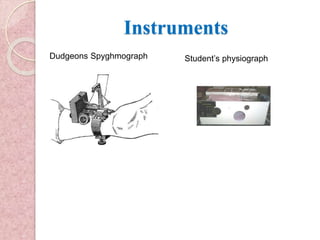
Instruments
Dudgeons Spyghmograph Student’s physiograph
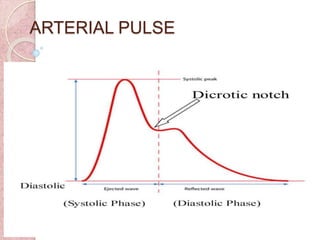
ARTERIAL PULSE
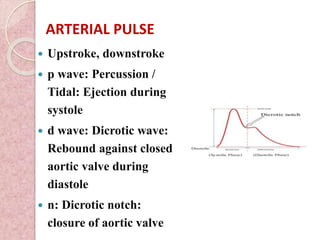
 Upstroke, downstroke
 p wave: Percussion /
Tidal: Ejection during
systole
 d wave: Dicrotic wave:
Rebound against closed
aortic valve during
diastole
 n: Dicrotic notch:
closure of aortic valve
ARTERIAL PULSE
Procedure
 Forearm is semi-pronated and wrist is
slightly flexed & Gently compress
radial artery against the radius
 Parameters
 Rate
 Rhythm
 Volume (Amplitude)
 Character
 Condition of the vessel wall
 Equality
 Radio-femoral/ Radio-radial delay
 Other peripheral pulses
Parameters of the pulse
 Rate: Count 1 complete minute (3 min and avg
for 1 min)
Normal at rest :60-100 beats /min
Rate > 100 : Tachycardia
Rate < 60 : Bradycardia
Tachycardia
 Exercise
 Infants, children
 Excitement
 Anxious
 Physiological
 Pathological
 Fever
 Thyrotoxicosis
 Tachyarrythmias
 Hemorrhagic shock
BRADYCARDIA
 Athletes
 Old age
 Meditation
 Physiological
 Pathological
 Increased ICT
 Heart blocks
Parameters of the pulse
 Rhythm: Spacing order at which
successive pulse waves are felt
 Regular
 Irregular
 Regularly irregular (Atrial fibrillation)
 Irregularly irregular (Premature beats)
Parameters of the pulse
 Volume: Degree of expansion of the
vessel wall during each pulse wave.
 Indicates stroke volume,
 High (Magnus) / Low (Parvus)
Pulse pressure is also a measure of the pulse volume
VOLUME OF THE PULSE
 Aortic stenosis
 Mitral stenosis
 Pulmonary stenosis
 Shock
 Low volume
 High volume
 Fever
 Thyrotoxicosis
 Exercise
Parameters of the pulse
 Character of pulse: Normal: Catacrotic
 Dicrotic: Twice beating, Typhoid
 Pulsus alternans: Alternate strong and weak, LVF
 Pulsus Paradoxus: misnomer, accentuation of normal –
constrictive pericarditis, pericardial effusion
Pulsus Bisferiens
In combined aortic stenosis and
regurgitation
Pulse has 2 peaks:
 Upstroke is sharp and rises high to the
first peak
 Falls and rises again to a second peak
A double pulse is felt and seen in the carotid
Pulsus alternans
 Alternate high and low volume pulse
 Left ventricular failure
Condition of the vessel wall:
 Not palpable /Just
palpable
 Old age
( Locomotor brachii)
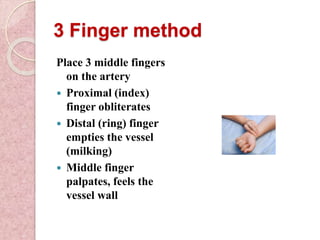
3 Finger method
Place 3 middle fingers
on the artery
 Proximal (index)
finger obliterates
 Distal (ring) finger
empties the vessel
(milking)
 Middle finger
palpates, feels the
vessel wall
Parameters of the pulse
 Delay in pulse: Normally there is no delay.
 Radio-Radial delay
 Radio-Femoral Delay
Parameters of the pulse
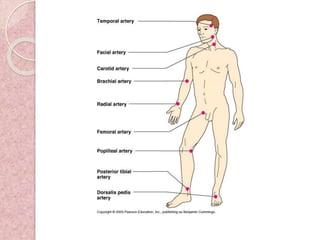
Other peripheral pulses:
 Brachial
 Radial
 Femoral
 Popliteal
 Posterior tibial
 Dorsalis pedies
 Carotid
 Temporal
How to feel the Carotid Pulse
 Place the left thumb on the right carotid A.
in the lower third of the neck at the level
of the cricoid cartilage, just inside the
medial border of the sternomastoid and
press posteriorly.
 Never press both carotids at same time.
Importance
 Working of the heart
 Circulatory state & hemodynamics
 Condition of the vessel wall
 Mental state
 Body temperature and metabolism
REPORT:
 The pulse rate is 80 beats/min ,
regular rhythm, normal volume &
character , vessel wall not palpable,
no Radio-Radial /Radio-femoral delay,
and all the other peripheral pulses are
felt.
VENOUS PULSE
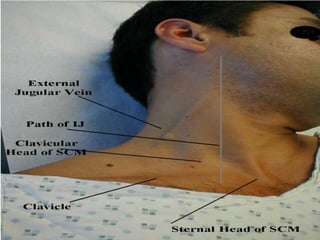
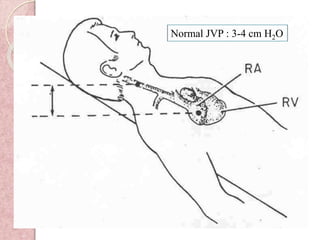
 VENOUS PULSE - study the level of
pressure in the internal jugular vein
(jugular venous pressure JVP)
• Significance – internal jugular vein
reflects the pressure changes in the
right atrium.
• External jugular vein is not reliable –
* venous valves, prevents smooth
conduction of venous pressure;
* passes through fascial planes ,
affected by external compression.
Normal JVP : 3-4 cm H2O
JUGULAR VENOUS PULSE
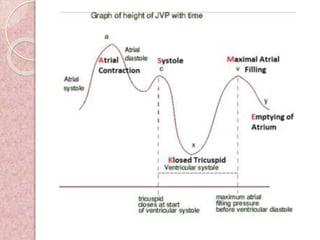
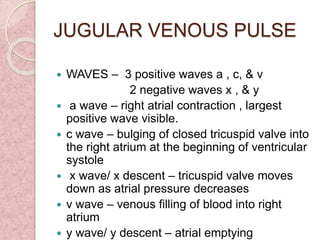
 WAVES – 3 positive waves a , c, & v
2 negative waves x , & y
 a wave – right atrial contraction , largest
positive wave visible.
 c wave – bulging of closed tricuspid valve into
the right atrium at the beginning of ventricular
systole
 x wave/ x descent – tricuspid valve moves
down as atrial pressure decreases
 v wave – venous filling of blood into right
atrium
 y wave/ y descent – atrial emptying
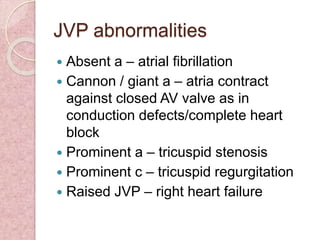
JVP abnormalities
 Absent a – atrial fibrillation
 Cannon / giant a – atria contract
against closed AV valve as in
conduction defects/complete heart
block
 Prominent a – tricuspid stenosis
 Prominent c – tricuspid regurgitation
 Raised JVP – right heart failure
Central venous pressure
 Normally, the center of right atrium is 5
cm below the sternal angle. Hence, Add
+5 cm to the above measurement to obtain
the right atrial pressure.
 Central venous pressure/ Right atrial
pressure = JVP+5 cm H20
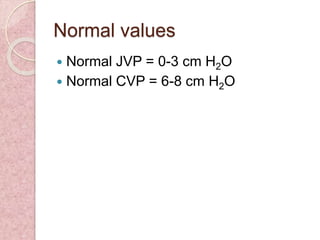
Normal values
 Normal JVP = 0-3 cm H2O
 Normal CVP = 6-8 cm H2O
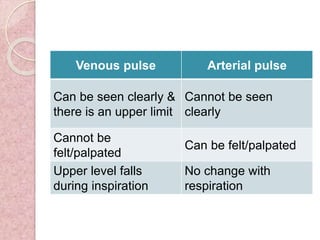
Venous pulse Arterial pulse
Can be seen clearly &
there is an upper limit
Cannot be seen
clearly
Cannot be
felt/palpated
Can be felt/palpated
Upper level falls
during inspiration
No change with
respiration
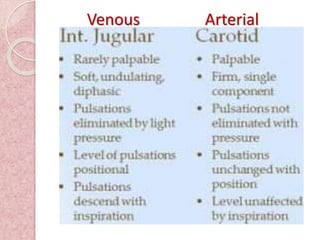
ArterialVenous
THANK
YOU
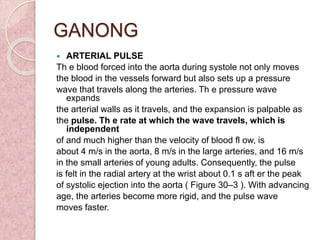
GANONG
 ARTERIAL PULSE
Th e blood forced into the aorta during systole not only moves
the blood in the vessels forward but also sets up a pressure
wave that travels along the arteries. Th e pressure wave
expands
the arterial walls as it travels, and the expansion is palpable as
the pulse. Th e rate at which the wave travels, which is
independent
of and much higher than the velocity of blood fl ow, is
about 4 m/s in the aorta, 8 m/s in the large arteries, and 16 m/s
in the small arteries of young adults. Consequently, the pulse
is felt in the radial artery at the wrist about 0.1 s aft er the peak
of systolic ejection into the aorta ( Figure 30–3 ). With advancing
age, the arteries become more rigid, and the pulse wave
moves faster.
Th e strength of the pulse is determined by the pulse
pressure and bears little relation to the mean pressure.
Th e pulse is weak (“thready”) in shock. It is strong when
stroke volume is large; for example, during exercise or aft er
the administration of histamine. When the pulse pressure is
high, the pulse waves may be large enough to be felt or even
heard by the individual (palpitation, “pounding heart”). When
the aortic valve is incompetent (aortic insuffi ciency), the pulse
is particularly strong, and the force of systolic ejection may
be suffi cient to make the head nod with each heartbeat. Th e
pulse in aortic insuffi ciency is called a collapsing, Corrigan,
or water-hammer pulse.
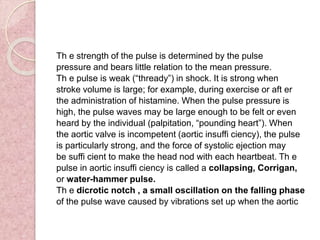
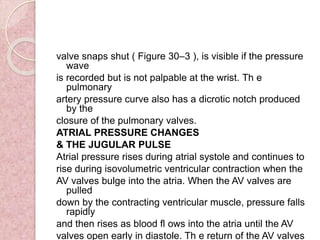
Th e dicrotic notch , a small oscillation on the falling phase
of the pulse wave caused by vibrations set up when the aortic
valve snaps shut ( Figure 30–3 ), is visible if the pressure
wave
is recorded but is not palpable at the wrist. Th e
pulmonary
artery pressure curve also has a dicrotic notch produced
by the
closure of the pulmonary valves.
ATRIAL PRESSURE CHANGES
& THE JUGULAR PULSE
Atrial pressure rises during atrial systole and continues to
rise during isovolumetric ventricular contraction when the
AV valves bulge into the atria. When the AV valves are
pulled
down by the contracting ventricular muscle, pressure falls
rapidly
and then rises as blood fl ows into the atria until the AV
valves open early in diastole. Th e return of the AV valves
reducing atrial capacity. Th e atrial pressure changes are transmitted
to the great veins, producing three characteristic waves
in the record of jugular pressure ( Figure 30–3 ). Th e a wave
is due to atrial systole. As noted above, some blood regurgitates
into the great veins when the atria contract. In addition,
venous infl ow stops, and the resultant rise in venous pressure
contributes to the a wave. Th e c wave is the transmitted
manifestation
of the rise in atrial pressure produced by the bulging
of the tricuspid valve into the atria during isovolumetric
ventricular contraction. Th e v wave mirrors the rise in atrial
pressure before the tricuspid valve opens during diastole.
Th e jugular pulse waves are superimposed on the respiratory
fl uctuations in venous pressure. Venous pressure falls during
inspiration as a result of the increased negative intrathoracic
pressure and rises again during expiration.
Guyton
 Arterial Pressure Pulsations
 With each beat of the heart a new surge of blood
fills the arteries. Were it not for distensibility of
the
 arterial system, all of this new blood would have
to flow through the peripheral blood vessels
almost
 instantaneously, only during cardiac systole, and
no flow would occur during diastole. However,
the
 compliance of the arterial tree normally reduces
the pressure pulsations to almost no pulsations
by the
 time the blood reaches the capillaries; therefore,
tissue blood flow is mainly continuous with very
little

Arterial and venous pulse

  • 1.
  • 2.
    Definition: Arterial Pulse Rhythmic expansion of the arterial wall due to transmission of pressure waves that travels along the arteries due to forceful ejection of blood during systole into the arterial system OR  During each cardiac systole, the aorta experiences a pressure wave which travels down the arterial tree that can be felt / palpated
  • 3.
    Principle  During eachventricular systole, a pressure wave is transmitted along the arterial tree.  Pressure waves expand the arterial wall which is palpated as pulse.
  • 4.
  • 5.
  • 6.
     Upstroke, downstroke p wave: Percussion / Tidal: Ejection during systole  d wave: Dicrotic wave: Rebound against closed aortic valve during diastole  n: Dicrotic notch: closure of aortic valve ARTERIAL PULSE
  • 7.
    Procedure  Forearm issemi-pronated and wrist is slightly flexed & Gently compress radial artery against the radius  Parameters  Rate  Rhythm  Volume (Amplitude)  Character  Condition of the vessel wall  Equality  Radio-femoral/ Radio-radial delay  Other peripheral pulses
  • 8.
    Parameters of thepulse  Rate: Count 1 complete minute (3 min and avg for 1 min) Normal at rest :60-100 beats /min Rate > 100 : Tachycardia Rate < 60 : Bradycardia
  • 9.
    Tachycardia  Exercise  Infants,children  Excitement  Anxious  Physiological  Pathological  Fever  Thyrotoxicosis  Tachyarrythmias  Hemorrhagic shock
  • 10.
    BRADYCARDIA  Athletes  Oldage  Meditation  Physiological  Pathological  Increased ICT  Heart blocks
  • 11.
    Parameters of thepulse  Rhythm: Spacing order at which successive pulse waves are felt  Regular  Irregular  Regularly irregular (Atrial fibrillation)  Irregularly irregular (Premature beats)
  • 12.
    Parameters of thepulse  Volume: Degree of expansion of the vessel wall during each pulse wave.  Indicates stroke volume,  High (Magnus) / Low (Parvus) Pulse pressure is also a measure of the pulse volume
  • 13.
    VOLUME OF THEPULSE  Aortic stenosis  Mitral stenosis  Pulmonary stenosis  Shock  Low volume  High volume  Fever  Thyrotoxicosis  Exercise
  • 14.
    Parameters of thepulse  Character of pulse: Normal: Catacrotic  Dicrotic: Twice beating, Typhoid  Pulsus alternans: Alternate strong and weak, LVF  Pulsus Paradoxus: misnomer, accentuation of normal – constrictive pericarditis, pericardial effusion
  • 15.
    Pulsus Bisferiens In combinedaortic stenosis and regurgitation Pulse has 2 peaks:  Upstroke is sharp and rises high to the first peak  Falls and rises again to a second peak A double pulse is felt and seen in the carotid
  • 16.
    Pulsus alternans  Alternatehigh and low volume pulse  Left ventricular failure
  • 17.
    Condition of thevessel wall:  Not palpable /Just palpable  Old age ( Locomotor brachii)
  • 18.
    3 Finger method Place3 middle fingers on the artery  Proximal (index) finger obliterates  Distal (ring) finger empties the vessel (milking)  Middle finger palpates, feels the vessel wall
  • 19.
    Parameters of thepulse  Delay in pulse: Normally there is no delay.  Radio-Radial delay  Radio-Femoral Delay
  • 20.
    Parameters of thepulse Other peripheral pulses:  Brachial  Radial  Femoral  Popliteal  Posterior tibial  Dorsalis pedies  Carotid  Temporal
  • 22.
    How to feelthe Carotid Pulse  Place the left thumb on the right carotid A. in the lower third of the neck at the level of the cricoid cartilage, just inside the medial border of the sternomastoid and press posteriorly.  Never press both carotids at same time.
  • 23.
    Importance  Working ofthe heart  Circulatory state & hemodynamics  Condition of the vessel wall  Mental state  Body temperature and metabolism
  • 24.
    REPORT:  The pulserate is 80 beats/min , regular rhythm, normal volume & character , vessel wall not palpable, no Radio-Radial /Radio-femoral delay, and all the other peripheral pulses are felt.
  • 25.
    VENOUS PULSE  VENOUSPULSE - study the level of pressure in the internal jugular vein (jugular venous pressure JVP) • Significance – internal jugular vein reflects the pressure changes in the right atrium. • External jugular vein is not reliable – * venous valves, prevents smooth conduction of venous pressure; * passes through fascial planes , affected by external compression.
  • 27.
    Normal JVP :3-4 cm H2O
  • 29.
    JUGULAR VENOUS PULSE WAVES – 3 positive waves a , c, & v 2 negative waves x , & y  a wave – right atrial contraction , largest positive wave visible.  c wave – bulging of closed tricuspid valve into the right atrium at the beginning of ventricular systole  x wave/ x descent – tricuspid valve moves down as atrial pressure decreases  v wave – venous filling of blood into right atrium  y wave/ y descent – atrial emptying
  • 30.
    JVP abnormalities  Absenta – atrial fibrillation  Cannon / giant a – atria contract against closed AV valve as in conduction defects/complete heart block  Prominent a – tricuspid stenosis  Prominent c – tricuspid regurgitation  Raised JVP – right heart failure
  • 31.
    Central venous pressure Normally, the center of right atrium is 5 cm below the sternal angle. Hence, Add +5 cm to the above measurement to obtain the right atrial pressure.  Central venous pressure/ Right atrial pressure = JVP+5 cm H20
  • 32.
    Normal values  NormalJVP = 0-3 cm H2O  Normal CVP = 6-8 cm H2O
  • 33.
    Venous pulse Arterialpulse Can be seen clearly & there is an upper limit Cannot be seen clearly Cannot be felt/palpated Can be felt/palpated Upper level falls during inspiration No change with respiration
  • 34.
  • 35.
  • 36.
    GANONG  ARTERIAL PULSE The blood forced into the aorta during systole not only moves the blood in the vessels forward but also sets up a pressure wave that travels along the arteries. Th e pressure wave expands the arterial walls as it travels, and the expansion is palpable as the pulse. Th e rate at which the wave travels, which is independent of and much higher than the velocity of blood fl ow, is about 4 m/s in the aorta, 8 m/s in the large arteries, and 16 m/s in the small arteries of young adults. Consequently, the pulse is felt in the radial artery at the wrist about 0.1 s aft er the peak of systolic ejection into the aorta ( Figure 30–3 ). With advancing age, the arteries become more rigid, and the pulse wave moves faster.
  • 37.
    Th e strengthof the pulse is determined by the pulse pressure and bears little relation to the mean pressure. Th e pulse is weak (“thready”) in shock. It is strong when stroke volume is large; for example, during exercise or aft er the administration of histamine. When the pulse pressure is high, the pulse waves may be large enough to be felt or even heard by the individual (palpitation, “pounding heart”). When the aortic valve is incompetent (aortic insuffi ciency), the pulse is particularly strong, and the force of systolic ejection may be suffi cient to make the head nod with each heartbeat. Th e pulse in aortic insuffi ciency is called a collapsing, Corrigan, or water-hammer pulse. Th e dicrotic notch , a small oscillation on the falling phase of the pulse wave caused by vibrations set up when the aortic
  • 38.
    valve snaps shut( Figure 30–3 ), is visible if the pressure wave is recorded but is not palpable at the wrist. Th e pulmonary artery pressure curve also has a dicrotic notch produced by the closure of the pulmonary valves. ATRIAL PRESSURE CHANGES & THE JUGULAR PULSE Atrial pressure rises during atrial systole and continues to rise during isovolumetric ventricular contraction when the AV valves bulge into the atria. When the AV valves are pulled down by the contracting ventricular muscle, pressure falls rapidly and then rises as blood fl ows into the atria until the AV valves open early in diastole. Th e return of the AV valves
  • 39.
    reducing atrial capacity.Th e atrial pressure changes are transmitted to the great veins, producing three characteristic waves in the record of jugular pressure ( Figure 30–3 ). Th e a wave is due to atrial systole. As noted above, some blood regurgitates into the great veins when the atria contract. In addition, venous infl ow stops, and the resultant rise in venous pressure contributes to the a wave. Th e c wave is the transmitted manifestation of the rise in atrial pressure produced by the bulging of the tricuspid valve into the atria during isovolumetric ventricular contraction. Th e v wave mirrors the rise in atrial pressure before the tricuspid valve opens during diastole. Th e jugular pulse waves are superimposed on the respiratory fl uctuations in venous pressure. Venous pressure falls during inspiration as a result of the increased negative intrathoracic pressure and rises again during expiration.
  • 40.
    Guyton  Arterial PressurePulsations  With each beat of the heart a new surge of blood fills the arteries. Were it not for distensibility of the  arterial system, all of this new blood would have to flow through the peripheral blood vessels almost  instantaneously, only during cardiac systole, and no flow would occur during diastole. However, the  compliance of the arterial tree normally reduces the pressure pulsations to almost no pulsations by the  time the blood reaches the capillaries; therefore, tissue blood flow is mainly continuous with very little

Editor's Notes

  • #7 a wave: anacrotic wave: change in velocity
  • #15 Pulsus Paradoxus: misnomer, accentuation of normal constrictive pericarditis, pericardial effusion
  • #22 Femoral A. - Cover genitalia. Abduct thigh. Press deeply below inguinal ligt, midway bt symphysis pubis & ant sup iliac spine. Use 2 hands, one on top of the other, to feel the femoral pulse. Dorsalis pedis – lat to extensor hallucis longus tendon-nice pic is there in google search
  • #35 Definition of undulation. 1 a : a rising and falling in waves b : a wavelike motion to and fro in a fluid or elastic medium propagated continuously among its particles but with little or no permanent translation of the particles in the direction of the propagation : vibration.