Cerebral cortex
Dr Anu Priya J
• The adult human brain weighs
on average about 1.5 kg with a
volume of around 1200cm3
• The cerebral hemispheres form
the largest part of the human
brain
• The hemispheres are covered
with a cortical layer with a
convoluted topography, sulci and
gyri
• Separated from each
other in the upper part
by a median longitudinal
fissure
• In the lower part, the
hemispheres are
connected by the corpus
callosum
• Neocortex (Association cortex)
• Cerebral dominance (Cerebral asymmetry)
• Lobes of cerebral cortex
Neocortex (Association cortex)
• Phylogenetically newest part of the cortex
• The seat of all higher functions (not only
sensori-motor association but also intellect,
language, speech, personality, learning &
memory)
Functional organization
• Frontal or Prefrontal association cortex
• Parietal-occipital-temporal association cortex
• Temporal association cortex
• Limbic association cortex
Functions of neocortex
• Language function – dominant hemisphere
(categorical hemisphere)
• Fn of the association cortex located in the temporal
region & language areas (mostly left side –
Wernicke’s area, Angular gyrus, Frontal motor
speech areas)
– Understand the spoken and written words
– Express ideas in speech and writing
• Recognition of faces – non-dominant hemisphere
(representational hemisphere)
• Right inferior temporal lobe – integrate & store
information regarding recognition of faces – receive
visual input from objects, particularly the visual
impression of faces
Lesion
• Prosopagnosia – inability to recognize faces (recognize
known people by their voice, but not by seeing their
faces)
Functions of neocortex
• Calculation
– Inferior part of left frontal lobe – actual
calculation
– Areas around the intraparietal sulci – memorizing
numbers & finger counting
• Lesion
– Acalculia – impairment of mathematical ability
Functions of neocortex
Navigation
• Sense of direction-findings
– Right side hippocampus
– Right side caudate nucleus
Functions of neocortex
Histology of neocortex
• The neocortex is composed
of 6 layers I to VI from
outside to inside
Three types of cells can be
identified
• Pyramidal cells
• Stellate or granule cells
• Fusiform cells
Cerebral asymmetry
(Cerebral dominance)
Cerebral asymmetry
• Dominant – categorical – language, calculation
• Nondominant – representational – recognise
faces, navigation
• Mostly left hemisphere dominant
• Not associated with handedness
• Explain the functions : Refer Neocortex
Lobes of the cerebral cortex
Lobes
• Each hemisphere is
divided into 4 lobes
Frontal lobe
Subdivided into
• Precentral cortex
• Prefrontal cortex
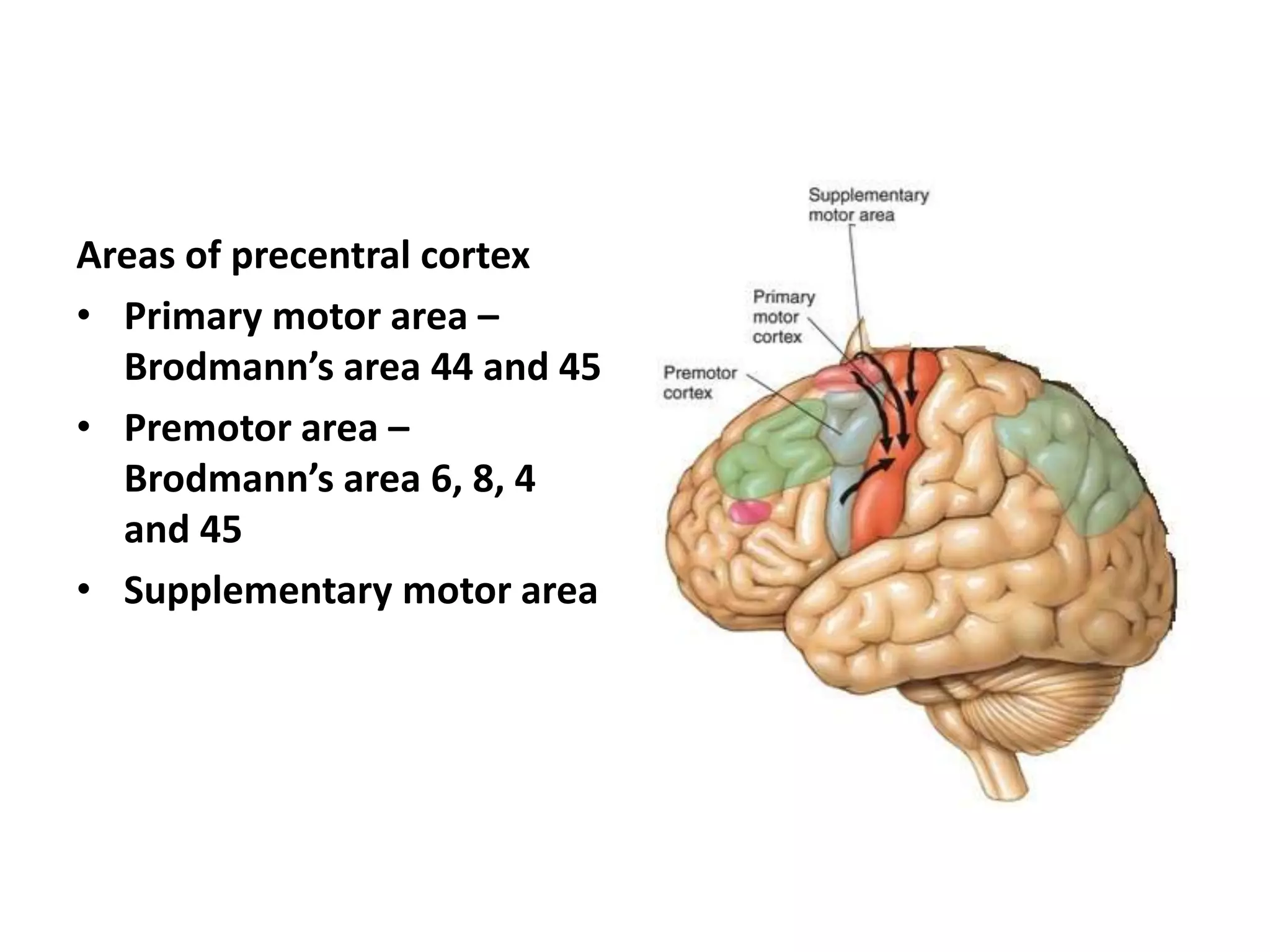
Areas of precentral cortex
• Primary motor area –
Brodmann’s area 44 and 45
• Premotor area –
Brodmann’s area 6, 8, 4
and 45
• Supplementary motor area
Prefrontal cortex
• Also known as
orbitofrontal cortex
• Lies anterior to area 8
and 44
Functions
• Centre for planned actions –
plans complex patterns and
sequence of motor movements
• Centre for higher functions –
centre for learning, emotions,
memory, social behaviour
• Seat of intelligence - short term
memories are stored and
recalled.
• “Organ of mind”
Control of intellectual activities
• To prognosticate
• To plan for the future
• To concentrate on a theme of thought, elaboration of thought
• Delays actions in response to incoming signal to obtain best
response
• Consideration of consequences of motor action
• Solution of complicated mathematical and philosophical problems
Frontal lobe syndrome
• Bilateral prefrontal lobectomy
• Phineas case – rod pierced brain
• Flight of ideas – difficulty in planning
• Emotional instability – lack of restraint –
hostile,aggressive,restless
• Impairment of recent memory alone; remote memories intact
• Loss of moral and social sense
• Lack of attention & concentration power
• Lack of initiative – reducing mental drive
• Functional abnormalities – hyperphagia, loss of control over
urinary or rectal sphincters, orientation disturbance, slight
tremors
Parietal lobe
• Primary sensory area –
Brodmann’s areas 3, 1
and 2  S1
• Secondary sensory area
 S2
• Sensory association
area – Brodmann’s area
5 and 7
Lesion in primary sensory area S1
• When lesion is confined
to sensory cortex,
sensations are perceived
but discriminating
functions are lost
• When thalamus is also
involved, there is loss of
sensations
Secondary sensory area
• Lesion causes deficits in
discrimination power
• Sensory processing in
S1 is preserved
Sensory association area
• Lesion in area 40
produces tactile
agnosia- astereognosis
and tactile aphasia
Temporal lobe
• Primary auditory cortex (41,42)
• Auditory association area (20,21,22)
Unilateral removal of temporal lobe
• Does not cause deafness as each ear is bilaterally
represented
• Removal of one auditory cortex has only a slight
effect on auditory acuity i.e. sharpness of hearing
Temporal lobe syndrome
• Also known as Kluver-Bucy syndrome
• Produced experimentally in animals after removal
of bilateral temporal lobe along with amygdala and
uncus
• Hyperphagia, omniphagia, increased oral activity,
hypersexuality
Features of temporal lobe syndrome
• Aphasia – disturbance in speech
• Auditory disturbances – tinnitus, auditory
hallucinations with sounds like buzzing,
ringing or humming
Wernicke’s aphasia
• Comprehension for spoken and
written language is impaired
• Language output is fluent but
highly paraphasic and
circumlocutious
• Jargon aphasia – string of
neologism
• Language contains few
substantive nouns  speech is
voluminous but uninformative
22
Occipital lobe
• Primary visual cortex - area 17 –
perception of visual impulses
• Visual association area – Area 18
and 19 – recognition and
identification of objects with
past experience
• Occipital eyefield – Area 19 –
movements of eyeball
Modified nomenclature of visual
areas
• V1 – first visual area – Area 17
• V2 – second visual area – greater
part of Area 18
• V3 – third visual area – narrow
strip of Area 18
• V4 – fourth visual area – Area 19
• V5 – fifth visual area – posterior
end of temporal gyrus
Lesion in visual cortex
• Loss of perception of visual
impulses
• Loss of recognition and
identification of known
objects
Thank you

Cerebral cortex

  • 1.
  • 2.
    • The adulthuman brain weighs on average about 1.5 kg with a volume of around 1200cm3 • The cerebral hemispheres form the largest part of the human brain • The hemispheres are covered with a cortical layer with a convoluted topography, sulci and gyri
  • 3.
    • Separated fromeach other in the upper part by a median longitudinal fissure • In the lower part, the hemispheres are connected by the corpus callosum
  • 4.
    • Neocortex (Associationcortex) • Cerebral dominance (Cerebral asymmetry) • Lobes of cerebral cortex
  • 5.
  • 6.
    Neocortex (Association cortex) •Phylogenetically newest part of the cortex • The seat of all higher functions (not only sensori-motor association but also intellect, language, speech, personality, learning & memory)
  • 7.
    Functional organization • Frontalor Prefrontal association cortex • Parietal-occipital-temporal association cortex • Temporal association cortex • Limbic association cortex
  • 8.
    Functions of neocortex •Language function – dominant hemisphere (categorical hemisphere) • Fn of the association cortex located in the temporal region & language areas (mostly left side – Wernicke’s area, Angular gyrus, Frontal motor speech areas) – Understand the spoken and written words – Express ideas in speech and writing
  • 9.
    • Recognition offaces – non-dominant hemisphere (representational hemisphere) • Right inferior temporal lobe – integrate & store information regarding recognition of faces – receive visual input from objects, particularly the visual impression of faces Lesion • Prosopagnosia – inability to recognize faces (recognize known people by their voice, but not by seeing their faces) Functions of neocortex
  • 10.
    • Calculation – Inferiorpart of left frontal lobe – actual calculation – Areas around the intraparietal sulci – memorizing numbers & finger counting • Lesion – Acalculia – impairment of mathematical ability Functions of neocortex
  • 11.
    Navigation • Sense ofdirection-findings – Right side hippocampus – Right side caudate nucleus Functions of neocortex
  • 12.
    Histology of neocortex •The neocortex is composed of 6 layers I to VI from outside to inside Three types of cells can be identified • Pyramidal cells • Stellate or granule cells • Fusiform cells
  • 13.
  • 14.
    Cerebral asymmetry • Dominant– categorical – language, calculation • Nondominant – representational – recognise faces, navigation • Mostly left hemisphere dominant • Not associated with handedness • Explain the functions : Refer Neocortex
  • 15.
    Lobes of thecerebral cortex
  • 16.
    Lobes • Each hemisphereis divided into 4 lobes
  • 18.
    Frontal lobe Subdivided into •Precentral cortex • Prefrontal cortex
  • 19.
    Areas of precentralcortex • Primary motor area – Brodmann’s area 44 and 45 • Premotor area – Brodmann’s area 6, 8, 4 and 45 • Supplementary motor area
  • 20.
    Prefrontal cortex • Alsoknown as orbitofrontal cortex • Lies anterior to area 8 and 44
  • 21.
    Functions • Centre forplanned actions – plans complex patterns and sequence of motor movements • Centre for higher functions – centre for learning, emotions, memory, social behaviour • Seat of intelligence - short term memories are stored and recalled. • “Organ of mind”
  • 22.
    Control of intellectualactivities • To prognosticate • To plan for the future • To concentrate on a theme of thought, elaboration of thought • Delays actions in response to incoming signal to obtain best response • Consideration of consequences of motor action • Solution of complicated mathematical and philosophical problems
  • 23.
    Frontal lobe syndrome •Bilateral prefrontal lobectomy • Phineas case – rod pierced brain • Flight of ideas – difficulty in planning • Emotional instability – lack of restraint – hostile,aggressive,restless • Impairment of recent memory alone; remote memories intact • Loss of moral and social sense • Lack of attention & concentration power • Lack of initiative – reducing mental drive • Functional abnormalities – hyperphagia, loss of control over urinary or rectal sphincters, orientation disturbance, slight tremors
  • 24.
    Parietal lobe • Primarysensory area – Brodmann’s areas 3, 1 and 2  S1 • Secondary sensory area  S2 • Sensory association area – Brodmann’s area 5 and 7
  • 25.
    Lesion in primarysensory area S1 • When lesion is confined to sensory cortex, sensations are perceived but discriminating functions are lost • When thalamus is also involved, there is loss of sensations
  • 26.
    Secondary sensory area •Lesion causes deficits in discrimination power • Sensory processing in S1 is preserved
  • 27.
    Sensory association area •Lesion in area 40 produces tactile agnosia- astereognosis and tactile aphasia
  • 28.
    Temporal lobe • Primaryauditory cortex (41,42) • Auditory association area (20,21,22)
  • 29.
    Unilateral removal oftemporal lobe • Does not cause deafness as each ear is bilaterally represented • Removal of one auditory cortex has only a slight effect on auditory acuity i.e. sharpness of hearing
  • 30.
    Temporal lobe syndrome •Also known as Kluver-Bucy syndrome • Produced experimentally in animals after removal of bilateral temporal lobe along with amygdala and uncus • Hyperphagia, omniphagia, increased oral activity, hypersexuality
  • 31.
    Features of temporallobe syndrome • Aphasia – disturbance in speech • Auditory disturbances – tinnitus, auditory hallucinations with sounds like buzzing, ringing or humming
  • 32.
    Wernicke’s aphasia • Comprehensionfor spoken and written language is impaired • Language output is fluent but highly paraphasic and circumlocutious • Jargon aphasia – string of neologism • Language contains few substantive nouns  speech is voluminous but uninformative 22
  • 33.
    Occipital lobe • Primaryvisual cortex - area 17 – perception of visual impulses • Visual association area – Area 18 and 19 – recognition and identification of objects with past experience • Occipital eyefield – Area 19 – movements of eyeball
  • 34.
    Modified nomenclature ofvisual areas • V1 – first visual area – Area 17 • V2 – second visual area – greater part of Area 18 • V3 – third visual area – narrow strip of Area 18 • V4 – fourth visual area – Area 19 • V5 – fifth visual area – posterior end of temporal gyrus
  • 35.
    Lesion in visualcortex • Loss of perception of visual impulses • Loss of recognition and identification of known objects
  • 36.

Editor's Notes

  • #7 NO sensory evoked potentials or movements when electrically stimulated ; but they yield electrical responses to a variety of sensory stimuli.