Classroom Observation
The more you know,
the more you notice.
Noticing
• Noticing is a key element of observation.
• Sherlock Holes noticed small details and
then put them all together.
• Describe without giving an opinion.
• Previous knowledge about key
methodology concepts are crucial for being
able to notice.
Ethnographic Observation
•
•
•
•

Noticing
Being descriptive
Non-judgemental
Focus observation to look rather than watch
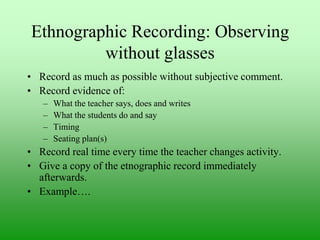
Ethnographic Recording: Observing
without glasses
• Record as much as possible without subjective comment.
• Record evidence of:
–
–
–
–

What the teacher says, does and writes
What the students do and say
Timing
Seating plan(s)

• Record real time every time the teacher changes activity.
• Give a copy of the etnographic record immediately
afterwards.
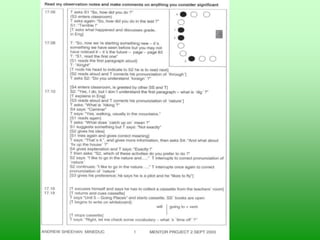
• Example….
THE BEST TOOL FOR OBSERVATION
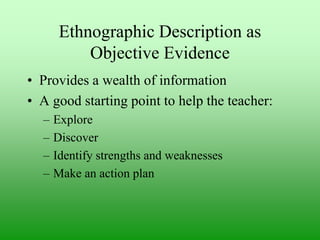
Ethnographic Description as
Objective Evidence
• Provides a wealth of information
• A good starting point to help the teacher:
–
–
–
–

Explore
Discover
Identify strengths and weaknesses
Make an action plan
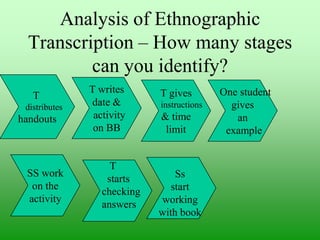
Analysis of Ethnographic
Transcription – How many stages
can you identify?
T
distributes

handouts

SS work
on the
activity

T writes
date &
activity
on BB

T
starts
checking
answers

T gives
instructions

& time
limit

Ss
start
working
with book

One student
gives
an
example
Alternative sequence
• After writing their ethnographic
observations, teachers can create their
alternative sequences.
• What could you do to improve the observed
teaching sequence?
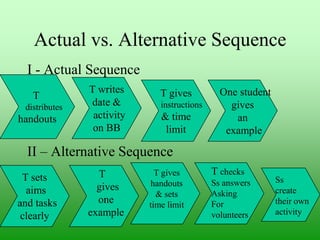
Actual vs. Alternative Sequence
I - Actual Sequence
T
distributes

handouts

T writes
date &
activity
on BB

T gives
instructions

& time
limit

One student
gives
an
example

II – Alternative Sequence
T sets
aims
and tasks
clearly

T
gives
one
example

T gives
handouts
& sets
time limit

T checks
Ss answers
Asking
For
volunteers

Ss
create
their own
activity
DIFFERENT TOOLS
WHEN IT COMES
TO OBSERVE
A LESSON
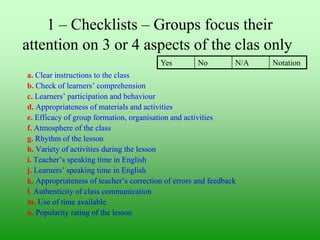
1 – Checklists – Groups focus their
attention on 3 or 4 aspects of the clas only
Yes

No

N/A

a. Clear instructions to the class
b. Check of learners‟ comprehension
c. Learners‟ participation and behaviour
d. Appropriateness of materials and activities
e. Efficacy of group formation, organisation and activities
f. Atmosphere of the class
g. Rhythm of the lesson
h. Variety of activities during the lesson
i. Teacher‟s speaking time in English
j. Learners‟ speaking time in English
k. Appropriateness of teacher‟s correction of errors and feedback
l. Authenticity of class communication
m. Use of time available
n. Popularity rating of the lesson

Notation
TEACHERS CAN CREATE
THEIR OWN
CHECKLISTS
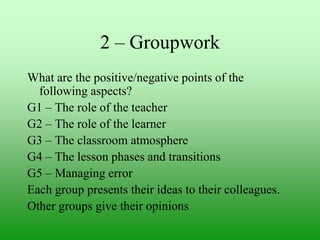
2 – Groupwork
What are the positive/negative points of the
following aspects?
G1 – The role of the teacher
G2 – The role of the learner
G3 – The classroom atmosphere
G4 – The lesson phases and transitions
G5 – Managing error
Each group presents their ideas to their colleagues.
Other groups give their opinions
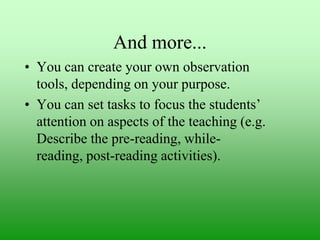
And more...
• You can create your own observation
tools, depending on your purpose.
• You can set tasks to focus the students‟
attention on aspects of the teaching (e.g.
Describe the pre-reading, whilereading, post-reading activities).
And more...
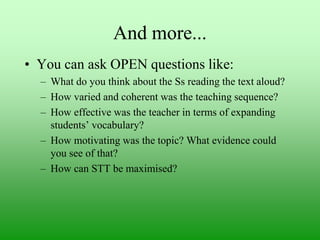
• You can ask OPEN questions like:
– What do you think about the Ss reading the text aloud?
– How varied and coherent was the teaching sequence?
– How effective was the teacher in terms of expanding
students‟ vocabulary?
– How motivating was the topic? What evidence could
you see of that?
– How can STT be maximised?
And more...
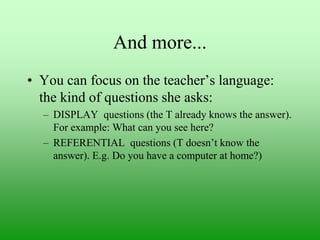
• You can focus on the teacher‟s language:
the kind of questions she asks:
– DISPLAY questions (the T already knows the answer).
For example: What can you see here?
– REFERENTIAL questions (T doesn‟t know the
answer). E.g. Do you have a computer at home?)
ANY VIDEO SEQUENCE
CAN BE
USEFUL
HOW CAN WE GIVE USEFUL
FEEDBACK
DESCRIBE
DO NOT PRESCRIBE
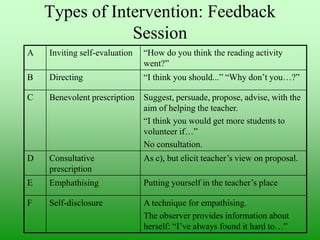
Types of Intervention: Feedback
Session
A

Inviting self-evaluation

“How do you think the reading activity
went?”

B

Directing

“I think you should...” “Why don‟t you…?”

C

Benevolent prescription

Suggest, persuade, propose, advise, with the
aim of helping the teacher.
“I think you would get more students to
volunteer if…”
No consultation.

D

Consultative
prescription

As c), but elicit teacher‟s view on proposal.

E

Emphathising

Putting yourself in the teacher‟s place

F

Self-disclosure

A technique for empathising.
The observer provides information about
herself: “I‟ve always found it hard to…”
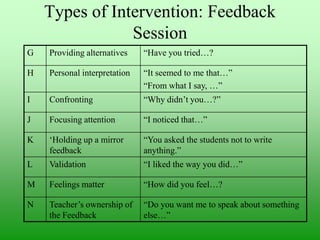
Types of Intervention: Feedback
Session
G

Providing alternatives

“Have you tried…?

H

Personal interpretation

“It seemed to me that…”
“From what I say, …”

I

Confronting

“Why didn‟t you…?”

J

Focusing attention

“I noticed that…”

K

„Holding up a mirror
feedback

“You asked the students not to write
anything.”

L

Validation

“I liked the way you did…”

M

Feelings matter

“How did you feel…?

N

Teacher‟s ownership of
the Feedback

“Do you want me to speak about something
else…”
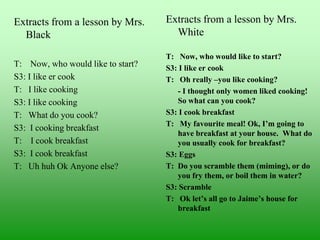
Extracts from a lesson by Mrs.
Black
T: Now, who would like to start?
S3: I like er cook
T: I like cooking
S3: I like cooking
T: What do you cook?
S3: I cooking breakfast
T: I cook breakfast
S3: I cook breakfast
T: Uh huh Ok Anyone else?

Extracts from a lesson by Mrs.
White
T: Now, who would like to start?
S3: I like er cook
T: Oh really –you like cooking?
- I thought only women liked cooking!
So what can you cook?
S3: I cook breakfast
T: My favourite meal! Ok, I’m going to
have breakfast at your house. What do
you usually cook for breakfast?
S3: Eggs
T: Do you scramble them (miming), or do
you fry them, or boil them in water?
S3: Scramble
T: Ok let’s all go to Jaime’s house for
breakfast
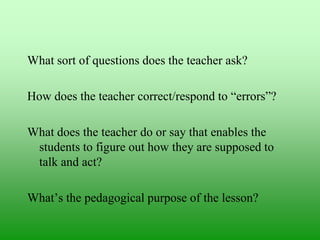
What sort of questions does the teacher ask?
How does the teacher correct/respond to “errors”?
What does the teacher do or say that enables the
students to figure out how they are supposed to
talk and act?

What‟s the pedagogical purpose of the lesson?
Classroom Observation
Ana Maria Hurtado
2007

Classroom observation

  • 1.
    Classroom Observation The moreyou know, the more you notice.
  • 2.
    Noticing • Noticing isa key element of observation. • Sherlock Holes noticed small details and then put them all together. • Describe without giving an opinion. • Previous knowledge about key methodology concepts are crucial for being able to notice.
  • 3.
  • 4.
    Ethnographic Recording: Observing withoutglasses • Record as much as possible without subjective comment. • Record evidence of: – – – – What the teacher says, does and writes What the students do and say Timing Seating plan(s) • Record real time every time the teacher changes activity. • Give a copy of the etnographic record immediately afterwards. • Example….
  • 6.
    THE BEST TOOLFOR OBSERVATION
  • 8.
    Ethnographic Description as ObjectiveEvidence • Provides a wealth of information • A good starting point to help the teacher: – – – – Explore Discover Identify strengths and weaknesses Make an action plan
  • 9.
    Analysis of Ethnographic Transcription– How many stages can you identify? T distributes handouts SS work on the activity T writes date & activity on BB T starts checking answers T gives instructions & time limit Ss start working with book One student gives an example
  • 10.
    Alternative sequence • Afterwriting their ethnographic observations, teachers can create their alternative sequences. • What could you do to improve the observed teaching sequence?
  • 11.
    Actual vs. AlternativeSequence I - Actual Sequence T distributes handouts T writes date & activity on BB T gives instructions & time limit One student gives an example II – Alternative Sequence T sets aims and tasks clearly T gives one example T gives handouts & sets time limit T checks Ss answers Asking For volunteers Ss create their own activity
  • 12.
    DIFFERENT TOOLS WHEN ITCOMES TO OBSERVE A LESSON
  • 13.
    1 – Checklists– Groups focus their attention on 3 or 4 aspects of the clas only Yes No N/A a. Clear instructions to the class b. Check of learners‟ comprehension c. Learners‟ participation and behaviour d. Appropriateness of materials and activities e. Efficacy of group formation, organisation and activities f. Atmosphere of the class g. Rhythm of the lesson h. Variety of activities during the lesson i. Teacher‟s speaking time in English j. Learners‟ speaking time in English k. Appropriateness of teacher‟s correction of errors and feedback l. Authenticity of class communication m. Use of time available n. Popularity rating of the lesson Notation
  • 14.
  • 15.
    2 – Groupwork Whatare the positive/negative points of the following aspects? G1 – The role of the teacher G2 – The role of the learner G3 – The classroom atmosphere G4 – The lesson phases and transitions G5 – Managing error Each group presents their ideas to their colleagues. Other groups give their opinions
  • 16.
    And more... • Youcan create your own observation tools, depending on your purpose. • You can set tasks to focus the students‟ attention on aspects of the teaching (e.g. Describe the pre-reading, whilereading, post-reading activities).
  • 17.
    And more... • Youcan ask OPEN questions like: – What do you think about the Ss reading the text aloud? – How varied and coherent was the teaching sequence? – How effective was the teacher in terms of expanding students‟ vocabulary? – How motivating was the topic? What evidence could you see of that? – How can STT be maximised?
  • 18.
    And more... • Youcan focus on the teacher‟s language: the kind of questions she asks: – DISPLAY questions (the T already knows the answer). For example: What can you see here? – REFERENTIAL questions (T doesn‟t know the answer). E.g. Do you have a computer at home?)
  • 19.
  • 20.
    HOW CAN WEGIVE USEFUL FEEDBACK DESCRIBE DO NOT PRESCRIBE
  • 21.
    Types of Intervention:Feedback Session A Inviting self-evaluation “How do you think the reading activity went?” B Directing “I think you should...” “Why don‟t you…?” C Benevolent prescription Suggest, persuade, propose, advise, with the aim of helping the teacher. “I think you would get more students to volunteer if…” No consultation. D Consultative prescription As c), but elicit teacher‟s view on proposal. E Emphathising Putting yourself in the teacher‟s place F Self-disclosure A technique for empathising. The observer provides information about herself: “I‟ve always found it hard to…”
  • 22.
    Types of Intervention:Feedback Session G Providing alternatives “Have you tried…? H Personal interpretation “It seemed to me that…” “From what I say, …” I Confronting “Why didn‟t you…?” J Focusing attention “I noticed that…” K „Holding up a mirror feedback “You asked the students not to write anything.” L Validation “I liked the way you did…” M Feelings matter “How did you feel…? N Teacher‟s ownership of the Feedback “Do you want me to speak about something else…”
  • 23.
    Extracts from alesson by Mrs. Black T: Now, who would like to start? S3: I like er cook T: I like cooking S3: I like cooking T: What do you cook? S3: I cooking breakfast T: I cook breakfast S3: I cook breakfast T: Uh huh Ok Anyone else? Extracts from a lesson by Mrs. White T: Now, who would like to start? S3: I like er cook T: Oh really –you like cooking? - I thought only women liked cooking! So what can you cook? S3: I cook breakfast T: My favourite meal! Ok, I’m going to have breakfast at your house. What do you usually cook for breakfast? S3: Eggs T: Do you scramble them (miming), or do you fry them, or boil them in water? S3: Scramble T: Ok let’s all go to Jaime’s house for breakfast
  • 24.
    What sort ofquestions does the teacher ask? How does the teacher correct/respond to “errors”? What does the teacher do or say that enables the students to figure out how they are supposed to talk and act? What‟s the pedagogical purpose of the lesson?
  • 25.